We investigate a generalized stochastic fractional neuronal model combining fractional dynamics with correlated stochastic inputs. The proposed framework is described by a fractional differential equation driven by a latent stochastic process with stationary increments and mean-reverting structure. This formulation allows the inclusion of both short-range and long-range dependence structures and naturally produces non-exponential relaxation phenomena. The main goal is the development of a feasible parameter estimation procedure based on discrete observations of the neuronal state process. We propose a two-step methodology. First, the parameters governing the fractional dynamics are estimated by exploiting the asymptotic behavior of Mittag–Leffler functions near the origin. Subsequently, the latent stochastic input is reconstructed through fractional differentiation techniques, allowing the estimation of the parameters governing the hidden noise dynamics. We derive quantitative error bounds for the estimators and analyze the reconstruction error of the latent process under suitable regularity assumptions on the driving noise. In particular, the interplay between the order of the fractional derivative and the Hölder regularity of the noise process naturally emerges in the stability analysis of the reconstruction procedure. Finally, simulation studies illustrate the applicability of the proposed methodology and highlight the influence of memory effects and noise regularity on the quality of statistical inference. The results support the relevance of fractional stochastic analysis for the modeling and inference of neuronal systems with memory and correlated inputs.
Citation: Pauliina Ilmonen, Milla Laurikkala, Enrica Pirozzi, Luigia Caputo, Lauri Viitasaari. Parameter estimation in generalized fractional neuronal models[J]. Mathematical Biosciences and Engineering, 2026, 23(11): 3415-3435. doi: 10.3934/mbe.2026117
We investigate a generalized stochastic fractional neuronal model combining fractional dynamics with correlated stochastic inputs. The proposed framework is described by a fractional differential equation driven by a latent stochastic process with stationary increments and mean-reverting structure. This formulation allows the inclusion of both short-range and long-range dependence structures and naturally produces non-exponential relaxation phenomena. The main goal is the development of a feasible parameter estimation procedure based on discrete observations of the neuronal state process. We propose a two-step methodology. First, the parameters governing the fractional dynamics are estimated by exploiting the asymptotic behavior of Mittag–Leffler functions near the origin. Subsequently, the latent stochastic input is reconstructed through fractional differentiation techniques, allowing the estimation of the parameters governing the hidden noise dynamics. We derive quantitative error bounds for the estimators and analyze the reconstruction error of the latent process under suitable regularity assumptions on the driving noise. In particular, the interplay between the order of the fractional derivative and the Hölder regularity of the noise process naturally emerges in the stability analysis of the reconstruction procedure. Finally, simulation studies illustrate the applicability of the proposed methodology and highlight the influence of memory effects and noise regularity on the quality of statistical inference. The results support the relevance of fractional stochastic analysis for the modeling and inference of neuronal systems with memory and correlated inputs.

| [1] |
H. C. Tuckwell, Introduction to Theoretical Neurobiology, Cambridge University Press, Cambridge, 1988. https://doi.org/10.1017/cbo9780511623202 |
| [2] |
L. Sacerdote, M. T. Giraudo, Stochastic integrate and fire models: A review on mathematical methods and their applications, In Stochastic Biomathematical Models, Lecture Notes in Mathematics, Springer, Heidelberg, (2013), 99–148. https://doi.org/10.1007/978-3-642-32157-3_5 |
| [3] |
C. Siettos, J. Starke, Multiscale modeling of brain dynamics: From single neurons and networks to mathematical tools, WIRES Syst. Biol. Med., 8 (2016), 438–458. https://doi.org/10.1002/wsbm.1348 doi: 10.1002/wsbm.1348
|
| [4] |
R. L. Magin, Fractional Calculus in Bioengineering, Begell House Publishers, Connecticut, 2006. |
| [5] |
F. Mainardi, Fractional Calculus and Waves in Linear Viscoelasticity, Imperial College Press, London, 2010. https://doi.org/10.1142/p614 |
| [6] |
M. M. Meerschaert, A. S. Sikorskii, Stochastic Models for Fractional Calculus, De Gruyter, Berlin, 2012. https://doi.org/10.1515/9783110258165 |
| [7] |
R. Metzler, J. Klafter, The random walk's guide to anomalous diffusion: a fractional dynamics approach, Phys. Rep., 339 (2000), 1–77. https://doi.org/10.1016/S0370-1573(00)00070-3 doi: 10.1016/S0370-1573(00)00070-3
|
| [8] |
E. Pirozzi, Some Fractional Stochastic Models for Neuronal Activity with Different Time-Scales and Correlated Inputs, Fract. Fract., 8 (2024), 57. https://doi.org/10.3390/fractalfract8010057 doi: 10.3390/fractalfract8010057
|
| [9] |
W. Teka, T. M. Marinov, F. Santamaria, Neuronal spike timing adaptation described with a fractional leaky integrate-and-fire model, PLoS Comput. Biol., 10 (2014), e1003526. https://doi.org/10.1371/journal.pcbi.1003526 doi: 10.1371/journal.pcbi.1003526
|
| [10] |
E. Pirozzi, Colored noise and a stochastic fractional model for correlated inputs and adaptation in neuronal firing, Biological Cybernetics, 112 (2018), 25–39. https://doi.org/10.1007/s00422-017-0731-0 doi: 10.1007/s00422-017-0731-0
|
| [11] |
M. Abundo, E. Pirozzi, Fractionally integrated Gauss–Markov processes and applications, Commun. Nonlinear Sci Numer. Simul., 101 (2021), 105862. https://doi.org/10.1016/j.cnsns.2021.105862 doi: 10.1016/j.cnsns.2021.105862
|
| [12] |
E. Pirozzi, Mittag–Leffler fractional stochastic integrals and processes with applications, Mathematics, 12 (2024), 3094. https://doi.org/10.3390/math12193094 doi: 10.3390/math12193094
|
| [13] |
M. M. Meerschaert, P. Straka, Inverse stable subordinators, Math. Model. Nat. Phenom., 8 (2013), 1–16. https://doi.org/10.1051/mmnp/20138201 |
| [14] |
N. Leonenko, E. Pirozzi, The time-changed stochastic approach and fractionally integrated processes to model the actin–myosin interaction and dwell times, Math. Biosci. Eng., 22 (2025), 1019–1054. https://doi.org/10.3934/mbe.2025037 doi: 10.3934/mbe.2025037
|
| [15] |
M. Voutilainen, L. Viitasaari, P. Ilmonen, S. Torres, C. Tudor, Vector-valued generalised Ornstein–Uhlenbeck processes: properties and parameter estimation, Scand. J. Stat., 49 (2022), 992–1022. https://doi.org/10.1111/sjos.12552 doi: 10.1111/sjos.12552
|
| [16] |
P. Ilmonen, M. Laurikkala, K. Ralchenko, T. Sottinen, L. Viitasaari, Data driven modeling of multiple interest rates with generalized Vasicek-type models, arXiv preprint arXiv: 2509.03208, 2025. https://arXiv.org/abs/2509.03208 |
| [17] |
A. N. Burkitt, A review of the integrate-and-fire neuron model: Ⅰ. homogeneous synaptic input, Biol. Cybern., 95 (2006), 1–19. https://doi.org/10.1007/s00422-006-0068-6 doi: 10.1007/s00422-006-0068-6
|
| [18] |
R. Gorenflo, A. A. Kilbas, F. Mainardi, S. Rogosin, Mittag-Leffler Functions, Related Topics and Applications, Springer, Berlin, 2020. https://doi.org/10.1007/978-3-662-61550-8 |
| [19] |
S. G. Samko, A. A. Kilbas, O. I. Marichev, Fractional Integrals and Derivatives: Theory and Applications, Gordon and Breach Science Publishers, Amsterdam, 1993. |
Figures(7) / Tables(3)

Pauliina Ilmonen, Milla Laurikkala, Enrica Pirozzi, Luigia Caputo, Lauri Viitasaari. Parameter estimation in generalized fractional neuronal models[J]. Mathematical Biosciences and Engineering, 2026, 23(11): 3415-3435. doi: 10.3934/mbe.2026117

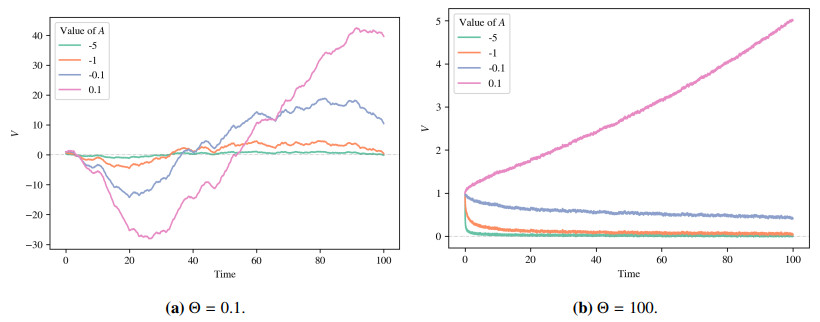
Simulated paths of $ V $ for different values of $ A $ and $ \Theta $
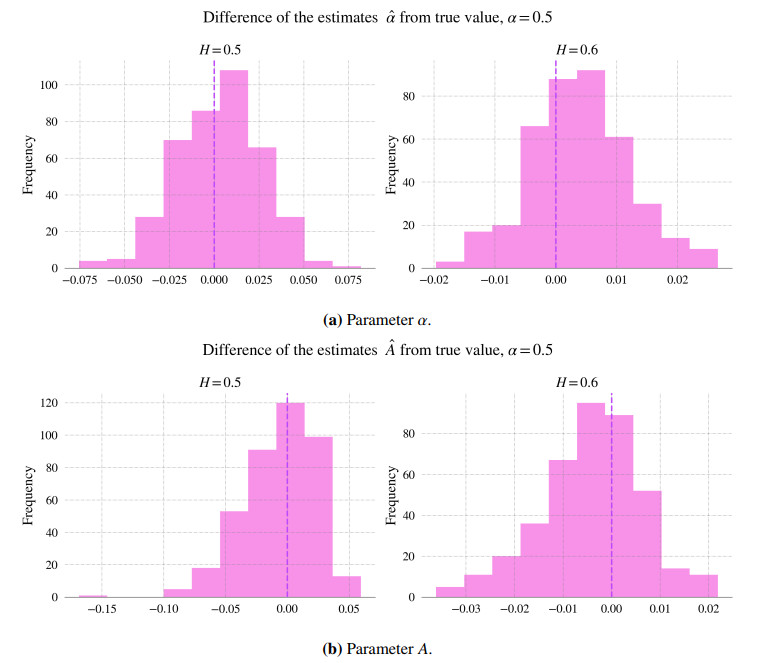
Differences between parameter estimates and true values of the parameters $ \alpha $ and $ A $ for different values of $ H $ when $ \alpha = 0.5 $
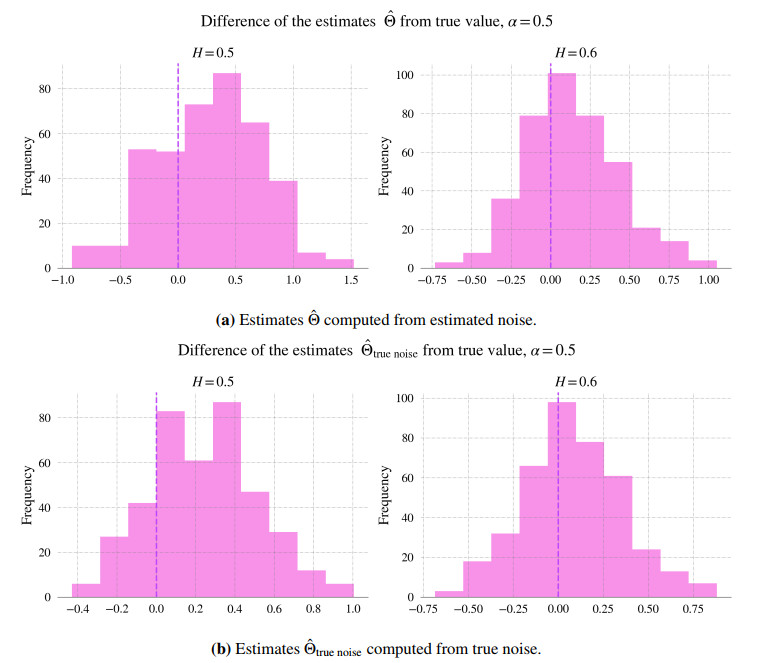
Differences between parameter estimates and true values of the parameter $ \Theta $ for different values of $ H $ when $ \alpha = 0.5 $
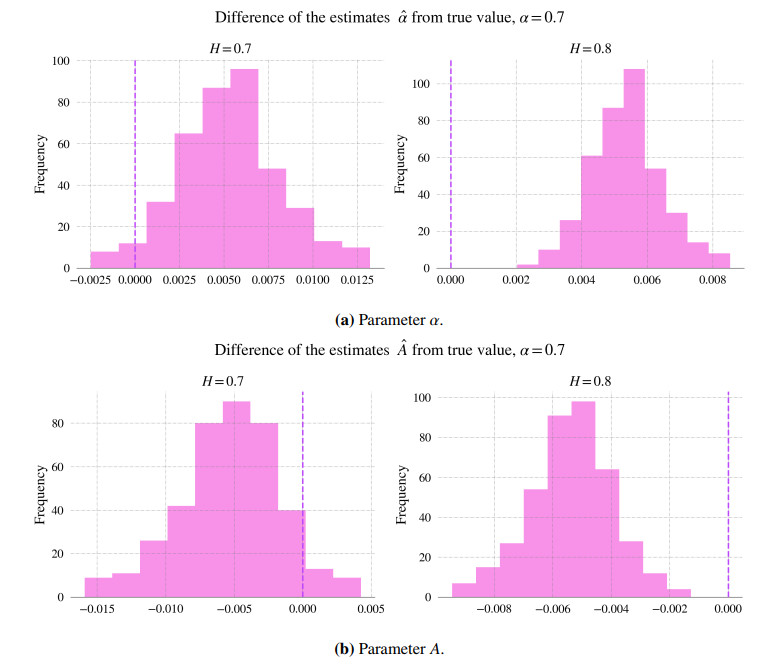
Differences between parameter estimates and true values of the parameters $ \alpha $ and $ A $ for different values of $ H $ when $ \alpha = 0.7 $
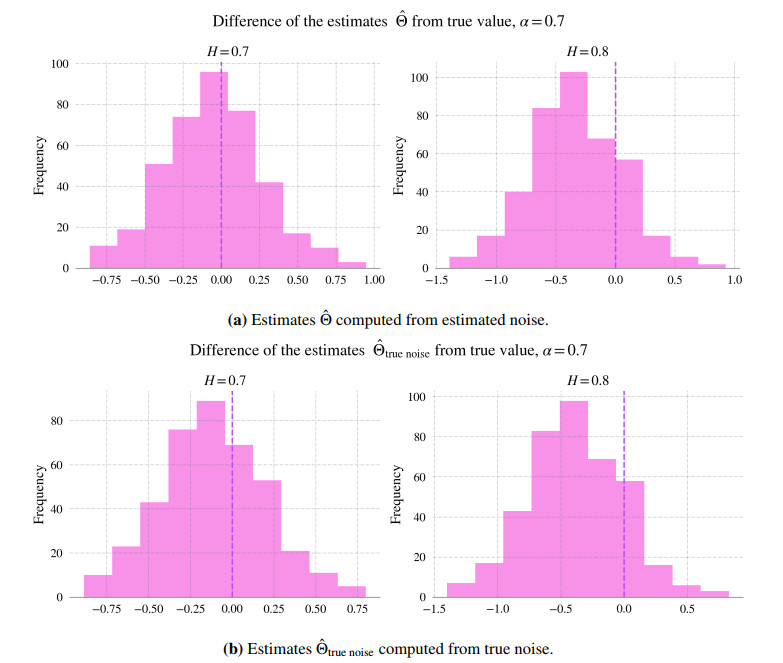
Differences between parameter estimates and true values of the parameter $ \Theta $ for different values of $ H $ when $ \alpha = 0.7 $
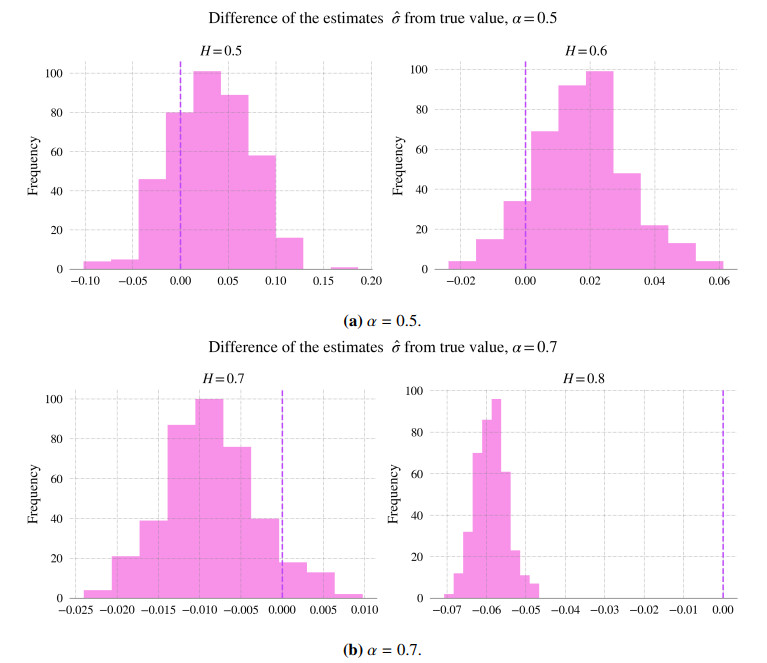
Differences between the estimates of $ \sigma $ from the true value for different values of $ \alpha $ and $ H $
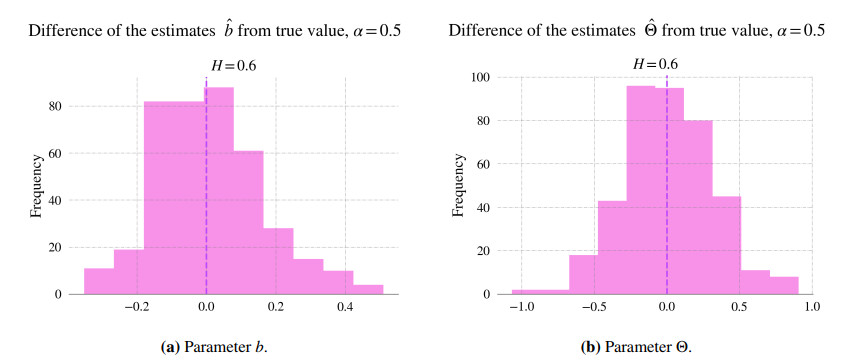
Differences between parameter estimates and true values of the parameters $ b $ and $ \Theta $ when $ \alpha = 0.5 $ and $ H = 0.6 $ in the case $ b = 3 $




 DownLoad: