In this work, a nonlinear delay differential equation model was proposed to investigate the interaction between healthy coconut leaves, infested leaves, rugose spiraling whiteflies, and the predator Pseudomallada astur. A discrete time delay was incorporated into the predator dynamics to account for the developmental period between prey consumption and predator recruitment. The positivity and boundedness of solutions were established, and the basic reproduction number was derived using the next-generation matrix approach. The existence of the pest-free and coexistence equilibria was investigated, and sufficient conditions for their local asymptotic stability were obtained. The influence of the developmental delay on system stability was analyzed, and conditions for the occurrence of delay-induced Hopf bifurcation were derived. In addition, normalized sensitivity analysis identified the parameters that most strongly influence pest invasion, while numerical simulations illustrated the effects of the maximum infestation rate, whitefly reproduction rate, predation rate, and predator developmental delay on the system dynamics. The results demonstrated that enhancing predator efficiency and reducing infestation and reproduction rates effectively suppress whitefly outbreaks. The proposed model provides useful mathematical insights for designing effective biological pest-management strategies for coconut plantations.
Citation: E. Jenitta, R. Senthamarai. Mathematical analysis of a time delay predator-prey model for coconut pest management[J]. Mathematical Biosciences and Engineering, 2026, 23(11): 3377-3414. doi: 10.3934/mbe.2026116
In this work, a nonlinear delay differential equation model was proposed to investigate the interaction between healthy coconut leaves, infested leaves, rugose spiraling whiteflies, and the predator Pseudomallada astur. A discrete time delay was incorporated into the predator dynamics to account for the developmental period between prey consumption and predator recruitment. The positivity and boundedness of solutions were established, and the basic reproduction number was derived using the next-generation matrix approach. The existence of the pest-free and coexistence equilibria was investigated, and sufficient conditions for their local asymptotic stability were obtained. The influence of the developmental delay on system stability was analyzed, and conditions for the occurrence of delay-induced Hopf bifurcation were derived. In addition, normalized sensitivity analysis identified the parameters that most strongly influence pest invasion, while numerical simulations illustrated the effects of the maximum infestation rate, whitefly reproduction rate, predation rate, and predator developmental delay on the system dynamics. The results demonstrated that enhancing predator efficiency and reducing infestation and reproduction rates effectively suppress whitefly outbreaks. The proposed model provides useful mathematical insights for designing effective biological pest-management strategies for coconut plantations.

| [1] |
K. Elango, S. J. Nelson, A. Aravind, Rugose spiraling whitefly, Aleurodicus rugioperculatus Martin (Hemiptera: Aleyrodidae): An invasive foe of coconut, J. Entomol. Res., 44 (2020), 261–266. https://doi.org/10.5958/0974-4576.2020.00046.8 doi: 10.5958/0974-4576.2020.00046.8
|
| [2] |
M. Alagar, K. Rajamanikam, S. Chinnadurai, A. Yasmin, Surveillance, assessment of infestation, biology, host range of an invasive rugose spiraling whitefly, Aleurodicus rugioperculatus Martin and status of its natural enemies in Tamil Nadu, J. Entomol. Zool. Stud., 8 (2020), 2041–2047. |
| [3] |
K. Elango, S. J. Nelson, Effect of host plants on the behaviour of rugose spiraling whitefly (Aleurodicus rugioperculatus) and their natural enemies, Res. J. Agric. Sci., 11 (2020), 120–123. |
| [4] |
K. Selvaraj, R. Sundararaj, T. Venkatesan, C. R. Ballal, S. K. Jalali, A. Gupta, et al., Potential natural enemies of the invasive rugose spiraling whitefly, Aleurodicus rugioperculatus, in India, J. Biol. Control, 30 (2016), 236–239. https://doi.org/10.18311/jbc/2016/15598 doi: 10.18311/jbc/2016/15598
|
| [5] |
P. Panja, Dynamics of a crop, pest and predator model in an agricultural system, RICO, 12 (2023), 100274. https://doi.org/10.1016/j.rico.2023.100274 doi: 10.1016/j.rico.2023.100274
|
| [6] |
T. Abraha, F. Al Basir, L. L. Obsu, D. F. M. Torres, Farming awareness based optimum interventions for crop pest control, Math. Biosci. Eng., 18 (2021), 5364–5391. https://doi.org/10.3934/mbe.2021272 doi: 10.3934/mbe.2021272
|
| [7] |
F. Al Basir, P. K. Roy, Dynamics of mosaic disease with roguing and delay in Jatropha curcas plantations, J. Appl. Math. Comput., 58 (2018), 1–31. https://doi.org/10.1007/s12190-017-1131-2 doi: 10.1007/s12190-017-1131-2
|
| [8] |
T. Abraha, F. Al Basir, L. L. Obsu, D. F. M. Torres, Pest control using farming awareness: Impact of time delays and optimal use of biopesticides, Chaos Soliton Fract, 146 (2021), 110869. https://doi.org/10.1016/j.chaos.2021.110869 doi: 10.1016/j.chaos.2021.110869
|
| [9] |
F. Al Basir, Y. N. Kyrychko, K. B. Blyuss, S. Ray, Effects of vector developmental time on the dynamics of cassava mosaic disease, Bull. Math. Biol., 83 (2021), 87. https://doi.org/10.1007/s11538-021-00921-4 doi: 10.1007/s11538-021-00921-4
|
| [10] |
S. Ray, F. Al Basir, Impact of incubation delay in plant–vector interaction, Math. Comput. Simul., 170 (2020), 16–31. https://doi.org/10.1016/j.matcom.2019.09.001 doi: 10.1016/j.matcom.2019.09.001
|
| [11] |
K. Jankaew, C. Rattanakul, W. Sarika, A delay differential equation model of mealybugs and green lacewings, Adv. Differ. Equ., 283 (2019), 2019. https://doi.org/10.1186/s13662-019-2226-x doi: 10.1186/s13662-019-2226-x
|
| [12] |
S. Pathak, A. Maiti, Pest control using virus as control agent: A mathematical model, Nonlinear Anal.: Model. Control, 17 (2012), 67–90. https://doi.org/10.15388/NA.17.1.14079 doi: 10.15388/NA.17.1.14079
|
| [13] |
N. B. Chalapathi Rao, B. S. Ramani, D. R. Roshan, B. V. Bhagavan, Diet standardization for Pseudomallada astur Banks and assessment of its predatory potential against rugose spiraling whitefly Aleurodicus rugioperculatus Martin (Hemiptera: Aleyrodidae), Int. J. Trop. Insect Sci., 42 (2022), 783–791. https://doi.org/10.1007/s42690-021-00601-9 doi: 10.1007/s42690-021-00601-9
|
| [14] |
N. C. Rao, B. S. Ramani, B. V. K. Bhagavan, Functional response and density dependent feeding interaction of Pseudomallada Astur banks (neuroptera: Chrysopidae) against rugose spiraling whitefly, Aleurodicus Rugioperculatus martin (hemiptera: Aleyrodidae), PMHE, 26 (2020), 229–234. |
| [15] |
N. C. Rao, D. R. Roshan, G. K. Rao, G. Ramanandam, A review on rugose spiraling whitefly, Aleurodicus rugioperculatus, in India, J. Pharmacogn. Phytochem., 7 (2018), 948–953. |
| [16] |
S. Govindaraj, S. Rathinam, Mathematical modeling and analysis of the effect of the rugose spiraling whitefly on coconut trees, AIMS Math., 7 (2022), 13053–13073. https://doi.org/10.3934/math.2022722 doi: 10.3934/math.2022722
|
| [17] |
G. Suganya, R. Senthamarai, Impact of awareness on the dynamics of pest control in coconut trees: A mathematical model, Eng. Lett., 30 (2022). |
| [18] |
G. Suganya, E. Jenitta, R. Senthamarai, A study on the dynamics of pest population with biocontrol using predator, parasite in presence of awareness, Ki & M, 16 (2024), 713–729. https://doi.org/10.20537/2076-7633-2024-16-3-713-729 doi: 10.20537/2076-7633-2024-16-3-713-729
|
| [19] |
G. Suganya, R. Senthamarai, Analytical approximation of a nonlinear model for pest control in coconut trees by the homotopy analysis method, Ki & M, 14 (2022), 1093–1106. https://doi.org/10.20537/2076-7633-2022-14-5-1093-1106 doi: 10.20537/2076-7633-2022-14-5-1093-1106
|
| [20] |
B. Dhivyadharshini, R. Senthamarai, Modeling rugose spiraling whitefly infestation on coconut trees using delay differential equations: Analysis via HPM, Eur. J. Pure Appl. Math., 17 (2024), 1908–1936. https://doi.org/10.29020/nybg.ejpam.v17i3.5249 doi: 10.29020/nybg.ejpam.v17i3.5249
|
| [21] |
J. K. Hale, Theory of Functional Differential Equations, 2$^{nd}$ edition, Springer-Verlag, New York, 1977. https://doi.org/10.1007/978-1-4612-9892-2 |
| [22] |
M. Bodnar, The nonnegativity of solutions of delay differential equations, Appl. Math. Lett., 13 (2000), 91–95. https://doi.org/10.1016/S0893-9659(00)00061-6 doi: 10.1016/S0893-9659(00)00061-6
|
| [23] |
X. Yang, L. Chen, J. Chen, Permanence and positive periodic solution for the single-species nonautonomous delay diffusive models, Comput. Math. Appl., 32 (1996), 109–116. https://doi.org/10.1016/0898-1221(96)00129-0 doi: 10.1016/0898-1221(96)00129-0
|
| [24] |
B. West, J. M. Cushing, Book reviews, Bltn Mathcal Biology, 57 (1995), 169–173. https://doi.org/10.1007/BF02458322 doi: 10.1007/BF02458322
|
| [25] |
S. Ruan, Delay differential equations in single species dynamics, in Delay Differential Equations and Applications (eds. O. Arino, M. L. Hbid and E. Ait Dads), Springer, Dordrecht, (2006), 477–517. https://doi.org/10.1007/1-4020-3647-7_11 |
Figures(7) / Tables(1)

E. Jenitta, R. Senthamarai. Mathematical analysis of a time delay predator-prey model for coconut pest management[J]. Mathematical Biosciences and Engineering, 2026, 23(11): 3377-3414. doi: 10.3934/mbe.2026116

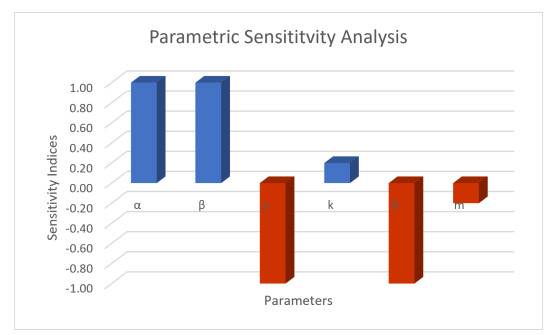
Graphical representation of sensitivity indices corresponding to parameters influencing $ \mathscr{R}_{0} $
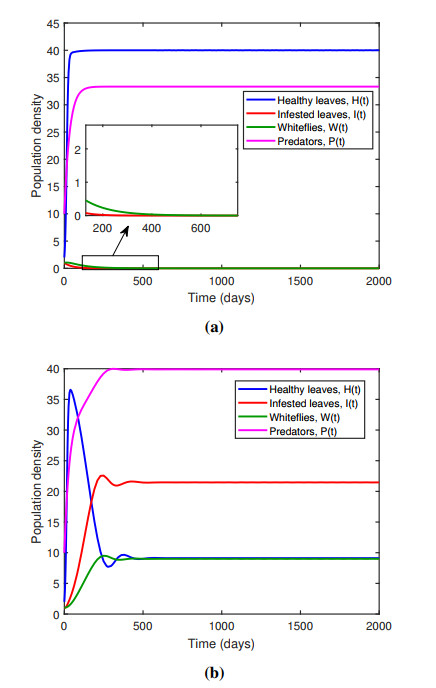
(a) Time evolution of the system dynamics corresponding to the pest-free equilibrium ($ \mathscr R_0 < 1 $) for $ \alpha = 0.0001 $. (b) Time evolution of the system dynamics corresponding to the endemic equilibrium ($ \mathscr R_0 > 1 $) for $ \alpha = 0.1 $. Other parameter values are as in Table 1
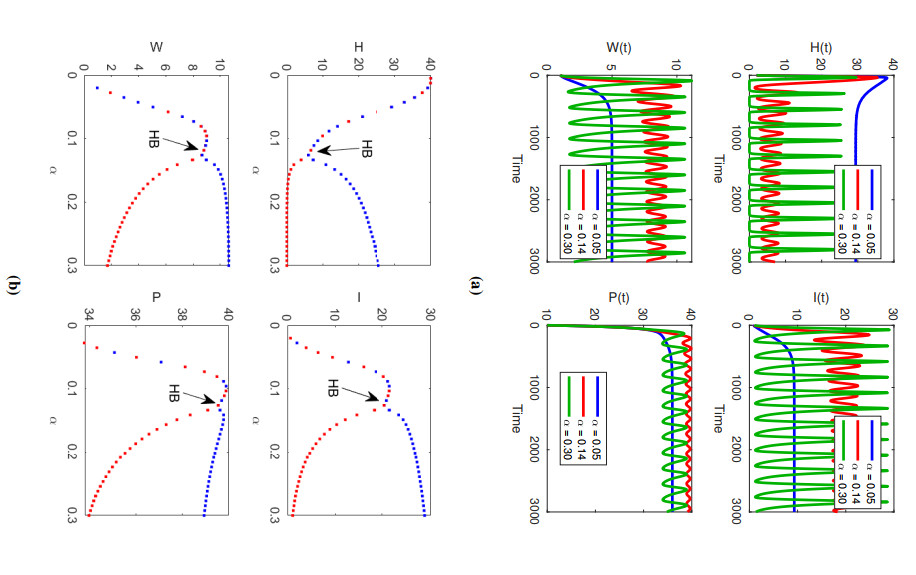
Effect of the maximum infestation rate $ \alpha $ on the system dynamics. (a) Time evolution of the healthy coconut leaves $ H(t) $, infested leaves $ I(t) $, whitefly population $ W(t) $, and predator population $ P(t) $ for different values of $ \alpha $. (b) Bifurcation diagrams of $ H $, $ I $, $ W $, and $ P $ with respect to $ \alpha $, where HB denotes the Hopf bifurcation point. We plot the maximum (blue dotted line) and minimum (red dotted line) values of the periodic solutions. Other parameter values are as given in Table 1
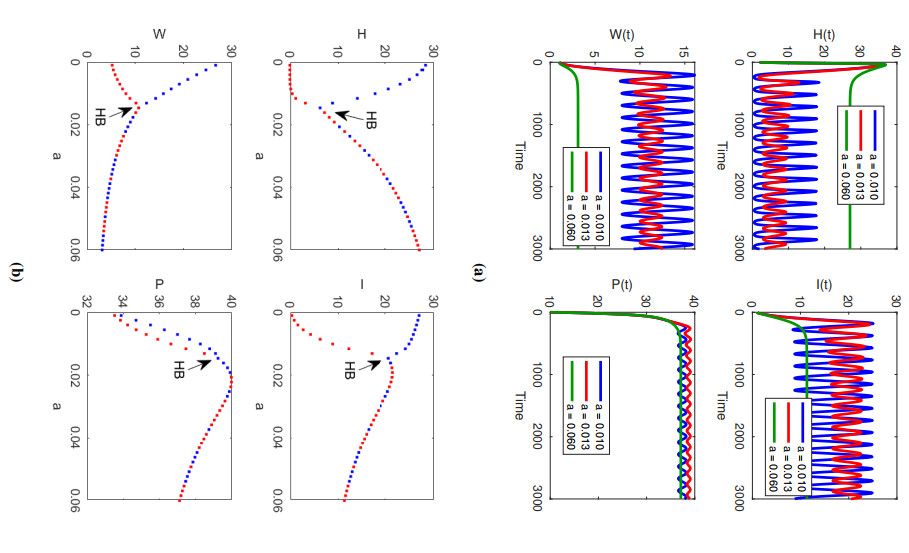
Effect of the predation rate $ a $ on the system dynamics. (a) Time evolution of the healthy coconut leaves $ H(t) $, infested leaves $ I(t) $, whitefly population $ W(t) $, and predator population $ P(t) $ for different values of $ a $. (b) Bifurcation diagrams of $ H $, $ I $, $ W $, and $ P $ with respect to the predation rate $ a $, where HB denotes the Hopf bifurcation point. We plot the maximum (blue dotted line) and minimum (red dotted line) values of the periodic solutions. Other parameter values are as given in Table 1
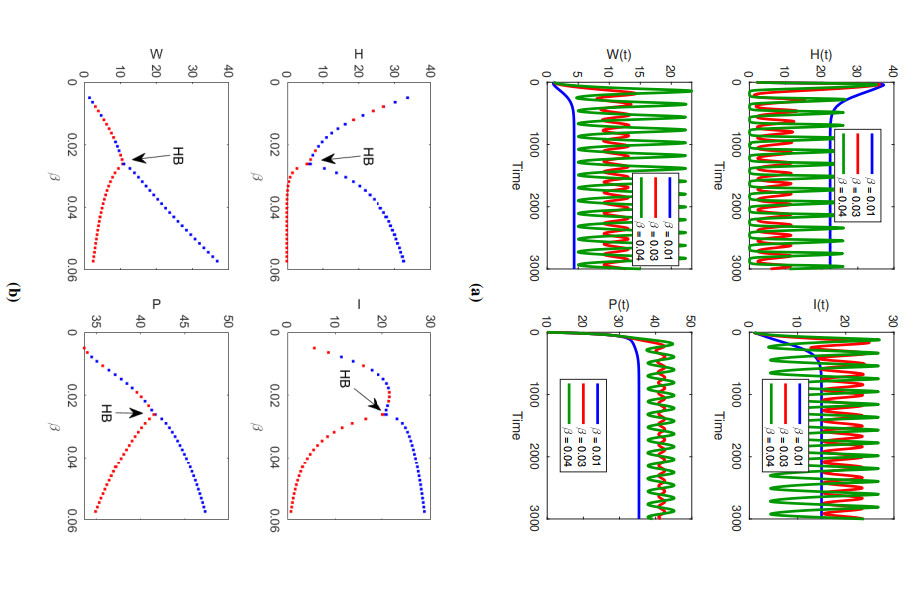
Effect of the whitefly reproduction rate $ \beta $ on the system dynamics. (a) Time evolution of the healthy coconut leaves $ H(t) $, infested leaves $ I(t) $, whitefly population $ W(t) $, and predator population $ P(t) $ for different values of $ \beta $. (b) Bifurcation diagrams of $ H $, $ I $, $ W $, and $ P $ with respect to the whitefly reproduction rate $ \beta $, where HB denotes the Hopf bifurcation point. We plot the maximum (blue dotted line) and minimum (red dotted line) values of the periodic solutions. Other parameter values are as given in Table 1
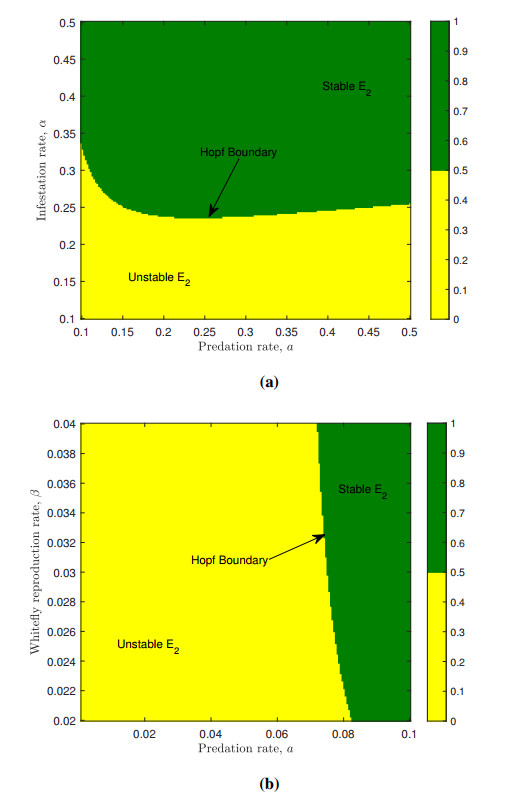
Stability region of the coexistence equilibrium $ E_2 $ in the $ \beta $–$ a $ parameter plane. The color code represents the maximum real part of the eigenvalues $ \lambda $ of the Jacobian matrix at $ E_2 $. The green region indicates that $ E_2 $ is locally asymptotically stable, whereas the yellow region indicates that $ E_2 $ is unstable. The boundary separating the stable and unstable regions corresponds to the Hopf bifurcation boundary. Other parameter values are as given in Table 1
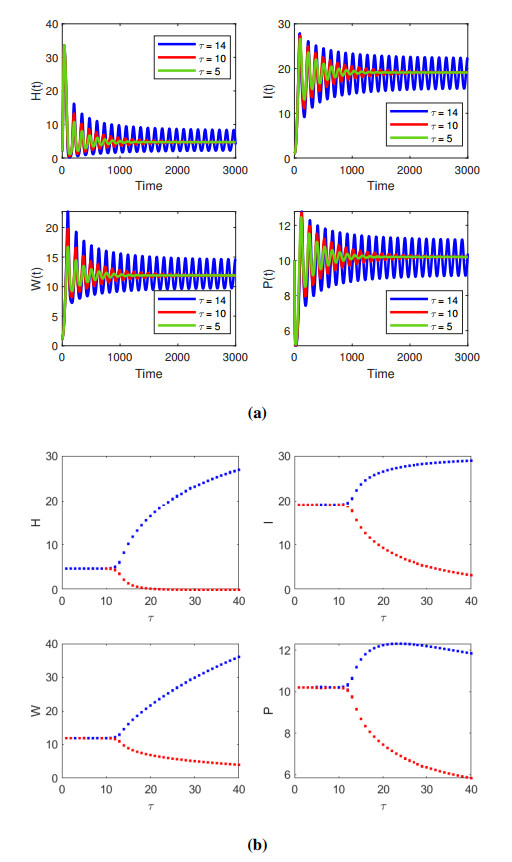
Effect of the developmental delay $ \tau $ on the system dynamics. (a) Time evolution of the healthy coconut leaves $ H(t) $, infested leaves $ I(t) $, whitefly population $ W(t) $, and predator population $ P(t) $ for $ \tau = 5, \, 10, $ and $ 14 $. The coexistence equilibrium is stable for $ \tau < \tau^{*} $, whereas sustained oscillations appear for $ \tau > \tau^{*} $. (b) Bifurcation diagrams of $ H $, $ I $, $ W $, and $ P $ with respect to $ \tau $, where HB denotes the Hopf bifurcation point at $ \tau^{*}\approx 13.15 $. The maximum (blue dotted line) and minimum (red dotted line) values of the periodic solutions are plotted after the transient. The parameter values are $ a = 0.30 $, $ \beta = 0.10 $, and $ \sigma = 0.20 $, with the remaining parameters as given in Table 1




 DownLoad: