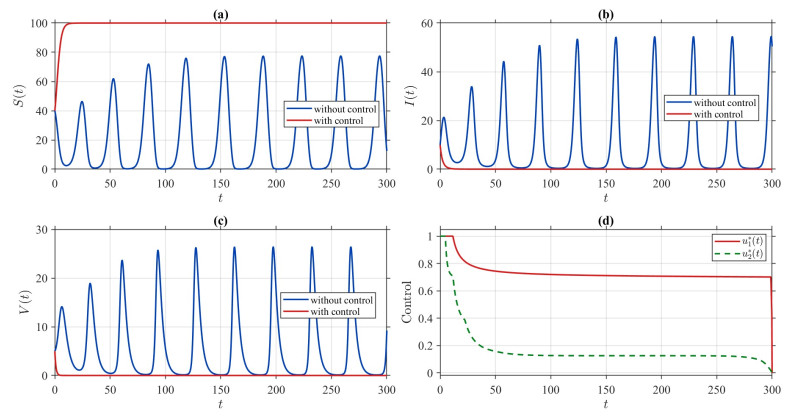
We develop an eco-epidemiological model consisting of susceptible plant biomass, infected plant biomass, and pest density. The pest density plays a dual role by feeding on plant biomass and contributing to effective vector-mediated disease transmission. Allomone effects are included to reduce the net contribution of susceptible and infected plant consumption to pests' growth. The model accounts for direct plant-to-plant transmission, vector-mediated transmission, herbivory, and chemical plant defense. We analyze the existence and uniqueness, non-negativity, boundedness, equilibrium points, invasion thresholds, and local stability. The Li–Muldowney geometric approach is used to study the global stability of the coexistence equilibrium. A transcritical bifurcation characterizes the threshold transition in the direct transmission dynamics on the pest-free invariant subspace, while a codimension-two threshold interaction occurs when the direct transmission and pest density invasion thresholds are simultaneously satisfied. A Hopf bifurcation indicates the onset of oscillatory coexistence, and numerical simulations further show how vector-mediated transmission can amplify long-term fluctuations. The Latin hypercube sampling (LHS) and partial rank correlation coefficients (PRCCs) sensitivity results identify direct transmission, infected-plant removal, carrying capacity, and pest mortality as important parameters associated with the long-term mean state variables, with pest mortality showing the strongest association with mean pest density. The simulations also show that allomone-mediated pest suppression can reduce pest density and stabilize coexistence. An optimal control problem with treatment and insecticide interventions is then formulated and characterized through Pontryagin's minimum principle. For the selected objective function weights and control bounds, the combined treatment–insecticide strategy provides the strongest reduction in infected plant biomass and pest density among the scenarios considered, while maintaining susceptible plant biomass near the carrying capacity.
Citation: Taufan Talib, Agus Suryanto, Isnani Darti, Wuryansari Muharini Kusumawinahyu. Dynamic analysis and optimal control of a plant–pest model with dual transmission and allomone effects[J]. Mathematical Biosciences and Engineering, 2026, 23(11): 3273-3319. doi: 10.3934/mbe.2026113
We develop an eco-epidemiological model consisting of susceptible plant biomass, infected plant biomass, and pest density. The pest density plays a dual role by feeding on plant biomass and contributing to effective vector-mediated disease transmission. Allomone effects are included to reduce the net contribution of susceptible and infected plant consumption to pests' growth. The model accounts for direct plant-to-plant transmission, vector-mediated transmission, herbivory, and chemical plant defense. We analyze the existence and uniqueness, non-negativity, boundedness, equilibrium points, invasion thresholds, and local stability. The Li–Muldowney geometric approach is used to study the global stability of the coexistence equilibrium. A transcritical bifurcation characterizes the threshold transition in the direct transmission dynamics on the pest-free invariant subspace, while a codimension-two threshold interaction occurs when the direct transmission and pest density invasion thresholds are simultaneously satisfied. A Hopf bifurcation indicates the onset of oscillatory coexistence, and numerical simulations further show how vector-mediated transmission can amplify long-term fluctuations. The Latin hypercube sampling (LHS) and partial rank correlation coefficients (PRCCs) sensitivity results identify direct transmission, infected-plant removal, carrying capacity, and pest mortality as important parameters associated with the long-term mean state variables, with pest mortality showing the strongest association with mean pest density. The simulations also show that allomone-mediated pest suppression can reduce pest density and stabilize coexistence. An optimal control problem with treatment and insecticide interventions is then formulated and characterized through Pontryagin's minimum principle. For the selected objective function weights and control bounds, the combined treatment–insecticide strategy provides the strongest reduction in infected plant biomass and pest density among the scenarios considered, while maintaining susceptible plant biomass near the carrying capacity.

| [1] |
J. Pretty, Z. P. Bharucha, Integrated pest management for sustainable intensification of agriculture in Asia and Africa, Insects, 6 (2015), 152–182. https://doi.org/10.3390/insects6010152 doi: 10.3390/insects6010152
|
| [2] |
S. Engindeniz, G. O. Cosar, An economic comparison of pesticide applications for processing and table tomatoes: A case study for Turkey, J. Plant Prot. Res., 53 (2013), 230–237. https://doi.org/10.2478/jppr-2013-0035 doi: 10.2478/jppr-2013-0035
|
| [3] |
M. Love, R. D. Magarey, B. L. Holderman, D. S. Carley, F. Maggi, N. Singer, Tracking sustainability in crop pest management in the United States using an eco-efficiency index, Front. Insect Sci., 5 (2025), 1582496. https://doi.org/10.3389/finsc.2025.1582496 doi: 10.3389/finsc.2025.1582496
|
| [4] |
I. Tlak Gajger, S. A. Dar, Plant allelochemicals as sources of insecticides, Insects, 12 (2021), 189. https://doi.org/10.3390/insects12030189 doi: 10.3390/insects12030189
|
| [5] |
R. A. Schmidt-Jeffris, Nontarget pesticide impacts on pest natural enemies: Progress and gaps in current knowledge, Curr. Opin. Insect Sci., 58 (2023), 101056. https://doi.org/10.1016/j.cois.2023.101056 doi: 10.1016/j.cois.2023.101056
|
| [6] |
R. Kaur, D. Choudhary, S. Bali, S. S. Bandral, V. Singh, M. A. Ahmad, et al., Pesticides: An alarming detrimental to health and environment, Sci. Total Environ., 915 (2024), 170113. https://doi.org/10.1016/j.scitotenv.2024.170113 doi: 10.1016/j.scitotenv.2024.170113
|
| [7] |
M. Jeger, The epidemiology of plant virus disease: Towards a new synthesis, Plants, 9 (2020), 1768. https://doi.org/10.3390/plants9121768 doi: 10.3390/plants9121768
|
| [8] |
M. P. Daugherty, J. R. S. Lopes, R. P. P. Almeida, Vector within-host feeding preference mediates transmission of a heterogeneously distributed pathogen, Ecol. Entomol., 35 (2010), 360–366. https://doi.org/10.1111/j.1365-2311.2010.01189.x doi: 10.1111/j.1365-2311.2010.01189.x
|
| [9] |
R. Donnelly, C. A. Gilligan, The role of pathogen-mediated insect superabundance in the East African emergence of a plant virus, J. Ecol., 110 (2022), 1113–1124. https://doi.org/10.1111/1365-2745.13854 doi: 10.1111/1365-2745.13854
|
| [10] |
M. Jeger, F. Hamelin, N. J. Cunniffe, Emerging themes and approaches in plant virus epidemiology, Phytopathology, 113 (2023), 1630–1646. https://doi.org/10.1094/PHYTO-10-22-0378-V doi: 10.1094/PHYTO-10-22-0378-V
|
| [11] |
A. E. Whitfield, B. W. Falk, D. Rotenberg, Insect vector-mediated transmission of plant viruses, Virology, 479–480 (2015), 278–289. https://doi.org/10.1016/j.virol.2015.03.026 doi: 10.1016/j.virol.2015.03.026
|
| [12] |
P. A. Divekar, N. Srinivasa, B. A. Divekar, R. Kumar, G. B. Gowda, A. Ray, et al., Plant secondary metabolites as defense tools against herbivores for sustainable crop protection, Int. J. Mol. Sci., 23 (2022), 2690. https://doi.org/10.3390/ijms23052690 doi: 10.3390/ijms23052690
|
| [13] |
W. D. J. Kirk, W. J. de Kogel, E. H. Koschier, D. A. J. Teulon, Semiochemicals for thrips and their use in pest management, Annu. Rev. Entomol., 66 (2021), 101–119. https://doi.org/10.1146/annurev-ento-022020-081531 doi: 10.1146/annurev-ento-022020-081531
|
| [14] |
M. Parashar, M. Rathinam, N. Dokka, R. Sreevathsa, Chemical camouflage in plants: Defensive science of stealth against insect herbivory, ACS Agric. Sci. & Technol., 5 (2025), 1251–1262. https://doi.org/10.1021/acsagscitech.5c00223 doi: 10.1021/acsagscitech.5c00223
|
| [15] |
N. M. A. El-Ghany, Pheromones and chemical communication in insects, in Pests, Weeds and Diseases in Agricultural Crop and Animal Husbandry Production (eds. D. Kontogiannatos, A. Kourti and K.F. Mendes), IntechOpen, London, (2020). https://doi.org/10.5772/intechopen.92384 |
| [16] |
J. Poldy, Volatile cues influence host-choice in arthropod pests, Animals, 10 (2020), 1984. https://doi.org/10.3390/ani10111984 doi: 10.3390/ani10111984
|
| [17] |
H. A. F. El-Shafie, J. R. Faleiro, Semiochemicals and their potential use in pest management, in Biological Control of Pest and Vector Insects (ed. V.D.C. Shields), IntechOpen, London, (2017). https://doi.org/10.5772/66463 |
| [18] |
J. Boevé, R. Giot, Chemical composition: Hearing insect defensive volatiles, Patterns, 2 (2021), 100352. https://doi.org/10.1016/j.patter.2021.100352 doi: 10.1016/j.patter.2021.100352
|
| [19] |
S. J. Seybold, C. J. Fettig, Managing bark and ambrosia beetles (Coleoptera: Curculionidae: Scolytinae) with semiochemicals, Can. Entomol., 153 (2020), 4–12. https://doi.org/10.4039/tce.2020.24 doi: 10.4039/tce.2020.24
|
| [20] |
J. N. Haro-González, G. A. Castillo-Herrera, M. Martínez-Velázquez, H. Espinosa-Andrews, Clove essential oil (Syzygium aromaticum L. Myrtaceae): Extraction, chemical composition, food applications, and essential bioactivity for human health, Molecules, 26 (2021), 6387. https://doi.org/10.3390/molecules26216387 doi: 10.3390/molecules26216387
|
| [21] |
T. A. W. Asnan, S. Widayanti, I. S. Harahap, H. Widhisatuti, The effectiveness of clove oil, its fractions, and clove oil-based fumigant tablet formulations, against Tribolium castaneum (Herbst), J. Entomol. Indones., 18 (2021), 191. https://doi.org/10.5994/jei.18.3.191 doi: 10.5994/jei.18.3.191
|
| [22] |
M. A. Ullah, A. Hassan, A. Hamza, Role of clove in human medical history, SAR J. Anat. Physiol., 4 (2023), 10–19. https://doi.org/10.36346/sarjap.2023.v04i02.001 doi: 10.36346/sarjap.2023.v04i02.001
|
| [23] |
B. C. D. Jorge, H. E. Hummel, J. Groß, Repellent activity of clove essential oil volatiles and development of nanofiber-based dispensers against pear psyllids (Hemiptera: Psyllidae), Insects, 13 (2022), 743. https://doi.org/10.3390/insects13080743 doi: 10.3390/insects13080743
|
| [24] |
S. Chaudhary, R. K. Kanwar, A. Sehgal, D. M. Cahill, C. J. Barrow, R. Sehgal, et al., Progress on Azadirachta indica based biopesticides in replacing synthetic toxic pesticides, Front. Plant Sci., 8 (2017), 610. https://doi.org/10.3389/fpls.2017.00610 doi: 10.3389/fpls.2017.00610
|
| [25] |
S. Chaudhary, S. K. Yadav, P. Verma, S. Sagar, M. Lal, Botanical insecticides for crop protection: Major classes and possible mechanisms of action, in Insecticides in Pest Control - Impact, Challenges and Strategies (ed. S. Kumar), IntechOpen, (2024). https://doi.org/10.5772/intechopen.1006743 |
| [26] |
F. Acheuk, S. Basiouni, A. A. Shehata, K. Dick, H. Hajri, S. Lasram, et al., Status and prospects of botanical biopesticides in Europe and Mediterranean countries, Biomolecules, 12 (2022), 311. https://doi.org/10.3390/biom12020311 doi: 10.3390/biom12020311
|
| [27] |
J. M. Grunseich, M. N. Thompson, N. M. Aguirre, A. M. Helms, The role of plant-associated microbes in mediating host-plant selection by insect herbivores, Plants, 9 (2019), 6. https://doi.org/10.3390/plants9010006 doi: 10.3390/plants9010006
|
| [28] |
K. E. Mauck, C. M. de Moraes, M. C. Mescher, Deceptive chemical signals induced by a plant virus attract insect vectors to inferior hosts, Proc. Natl. Acad. Sci. U.S.A., 107 (2010), 3600–3605. https://doi.org/10.1073/pnas.0907191107 doi: 10.1073/pnas.0907191107
|
| [29] |
S. M. Nebapure, K. Shankarganesh, S. Rajna, K. C. Naga, D. Pandey, S. Gambhir, et al., Dynamic changes in virus-induced volatiles in cotton modulate the orientation and oviposition behavior of the whitefly Bemisia tabaci, Front. Physiol., 13 (2022), 1017948. https://doi.org/10.3389/fphys.2022.1017948 doi: 10.3389/fphys.2022.1017948
|
| [30] |
X. Martini, M. R. Coy, E. H. Kuhns, L. L. Stelinski, Temporal decline in pathogen-mediated release of methyl salicylate associated with decreasing vector preference for infected over uninfected plants, Front. Ecol. Evol., 6 (2018), 185. https://doi.org/10.3389/fevo.2018.00185 doi: 10.3389/fevo.2018.00185
|
| [31] |
X. Chang, Y. Guo, Y. Ren, Y. Li, F. Wang, G. Ye, et al., Virus-induced plant volatiles promote virus acquisition and transmission by insect vectors, Int. J. Mol. Sci., 24 (2023), 1777. https://doi.org/10.3390/ijms24021777 doi: 10.3390/ijms24021777
|
| [32] |
M. S. Ullah, E. Hernández-López, J. Wang, Nonlinear dynamics and memory effects of an eco-epidemiological model: a bifurcation study with Allee thresholds and behavioral feedback, Model. Earth Syst. Environ., 12 (2025). https://doi.org/10.1007/s40808-025-02628-0 doi: 10.1007/s40808-025-02628-0
|
| [33] |
N. Sk, B. Mondal, M. Ch-Chaoui, R. K. Upadhyay, S. Mandal, P. K. Tiwari, Influence of Allee effect and cooperative hunting on the dynamics of a modified Hastings–Powell model in deterministic, discrete, and stochastic environments, Eur. Phys. J. Plus, 140 (2025), 1178. https://doi.org/10.1140/epjp/s13360-025-07123-0 doi: 10.1140/epjp/s13360-025-07123-0
|
| [34] |
M. J. Jeger, J. Holt, F. van den Bosch, L. V. Madden, Epidemiology of insect-transmitted plant viruses: Modelling disease dynamics and control interventions, Physiol. Entomol., 29 (2004), 291–304. https://doi.org/10.1111/j.0307-6962.2004.00394.x doi: 10.1111/j.0307-6962.2004.00394.x
|
| [35] |
R. Shi, H. Zhao, S. Tang, Global dynamic analysis of a vector-borne plant disease model, Adv. Differ. Equ., 2014 (2014), 59. https://doi.org/10.1186/1687-1847-2014-59 doi: 10.1186/1687-1847-2014-59
|
| [36] |
V. A. Bokil, L. J. S. Allen, M. J. Jeger, S. Lenhart, Optimal control of a vectored plant disease model for a crop with continuous replanting, J. Biol. Dyn., 13 (2019), 325–353. https://doi.org/10.1080/17513758.2019.1622808 doi: 10.1080/17513758.2019.1622808
|
| [37] |
R. Mondal, D. Kesh, D. Mukherjee, Influence of induced plant volatile and refuge in tritrophic model, Energy Ecol. Environ., 3 (2018), 171–184. https://doi.org/10.1007/s40974-018-0092-0 doi: 10.1007/s40974-018-0092-0
|
| [38] |
C. Sun, M. Loreau, Dynamics of a three-species food chain model with adaptive traits, Chaos Solitons & Fractals, 41 (2009), 2812–2819. https://doi.org/10.1016/j.chaos.2008.10.015 doi: 10.1016/j.chaos.2008.10.015
|
| [39] |
R. Mondal, Y. Takeuchi, D. Kesh, D. Mukherjee, Dynamical study on volatiles signaling in plant disease and pest-natural enemy interaction, Model. Earth Syst. Environ., 11 (2025), 57. https://doi.org/10.1007/s40808-024-02248-0 doi: 10.1007/s40808-024-02248-0
|
| [40] |
G. Thomas, Q. Rusman, W. R. Morrison Ⅲ, D. M. Magalhães, J. A. Dowell, E. Ngumbi, et al., Deciphering plant-insect-microorganism signals for sustainable crop production, Biomolecules, 13 (2023), 997. https://doi.org/10.3390/biom13060997 doi: 10.3390/biom13060997
|
| [41] |
N. M. Abd El-Ghany, Semiochemicals for controlling insect pests, J. Plant Prot. Res., 59 (2019), 1–11. https://doi.org/10.24425/jppr.2019.126036 doi: 10.24425/jppr.2019.126036
|
| [42] |
A. Sharma, R. K. Sandhi, G. V. P. Reddy, A review of interactions between insect biological control agents and semiochemicals, Insects, 10 (2019), 439. https://doi.org/10.3390/insects10120439 doi: 10.3390/insects10120439
|
| [43] |
K. Yazaki, G. Arimura, T. Ohnishi, 'Hidden' terpenoids in plants: Their biosynthesis, localization and ecological roles, Plant Cell Physiol., 58 (2017), 1615–1621. https://doi.org/10.1093/pcp/pcx123 doi: 10.1093/pcp/pcx123
|
| [44] |
G. M. Gurr, J. Liu, J. A. Pickett, P. C. Stevenson, Review of the chemical ecology of homoterpenes in arthropod–plant interactions, Austral Entomol., 62 (2023), 3–14. https://doi.org/10.1111/aen.12629 doi: 10.1111/aen.12629
|
| [45] |
L. Perko, Differential Equations and Dynamical Systems, 3$^{rd}$ edition, Springer Science & Business Media, New York, 2013. |
| [46] |
J. A. Oguntuase, On an inequality of Gronwall, J. Inequal. Pure Appl. Math., 2 (2001), 6. |
| [47] |
F. van den Bosch, M. J. Jeger, The basic reproduction number of vector-borne plant virus epidemics, Virus Res., 241 (2017), 196–202. https://doi.org/10.1016/j.virusres.2017.06.014 doi: 10.1016/j.virusres.2017.06.014
|
| [48] |
R. Amelia, N. Anggriani, A. K. Supriatna, N. Istifadah, Mathematical model for analyzing the dynamics of tungro virus disease in rice: A systematic literature review, Mathematics, 10 (2022), 2944. https://doi.org/10.3390/math10162944 doi: 10.3390/math10162944
|
| [49] |
A.-F. O. Ayembillah, B. Seidu, C. S. Bornaa, Mathematical modeling of the dynamics of maize streak virus disease (MSVD), Math. Model. Control, 2 (2022), 153–164. https://doi.org/10.3934/mmc.2022016 doi: 10.3934/mmc.2022016
|
| [50] |
R. Amelia, N. Anggriani, A. K. Supriatna, N. Istifadah, Analysis and optimal control of the tungro virus disease spread model in rice plants by considering the characteristics of the virus, roguing, and pesticides, Mathematics, 11 (2023), 1151. https://doi.org/10.3390/math11051151 doi: 10.3390/math11051151
|
| [51] |
S. T. Tresna, N. Anggriani, A. K. Supriatna, Study of mathematical modeling for plant disease transmission: A systematic literature review during 2012–2022, Jambura J. Biomath., 4 (2023), 1–14. https://doi.org/10.34312/jjbm.v4i1.18443 doi: 10.34312/jjbm.v4i1.18443
|
| [52] |
J. D. Murray, Mathematical Biology I: An Introduction, 3$^{rd}$ edition, Springer-Verlag, New York, 2002. |
| [53] |
H. I. Freedman, P. Waltman, Persistence in models of three interacting predator-prey populations, Math. Biosci., 68 (1984), 213–231. https://doi.org/10.1016/0025-5564(84)90032-4 doi: 10.1016/0025-5564(84)90032-4
|
| [54] |
M. Y. Li, J. S. Muldowney, On Bendixson's criterion, J. Differ. Equ., 106 (1993), 27–39. https://doi.org/10.1006/jdeq.1993.1097 doi: 10.1006/jdeq.1993.1097
|
| [55] |
M. Y. Li, J. S. Muldowney, A geometric approach to global-stability problems, SIAM J. Math. Anal., 27 (1996), 1070–1083. https://doi.org/10.1137/S0036141094266449 doi: 10.1137/S0036141094266449
|
| [56] |
C. Robinson, An Introduction to Dynamical Systems: Continuous and Discrete, 2$^{nd}$ edition, American Mathematical Society, Providence, RI, 2012. |
| [57] |
S. Marino, I. B. Hogue, C. J. Ray, D. E. Kirschner, A methodology for performing global uncertainty and sensitivity analysis in systems biology, J. Theor. Biol., 254 (2008), 178–196. https://doi.org/10.1016/j.jtbi.2008.04.011 doi: 10.1016/j.jtbi.2008.04.011
|
| [58] |
C. Dai, Z. Wang, W. Wang, Y. Li, K. Wang, Epidemics and underlying factors of multiple-peak pattern on hand, foot and mouth disease in Wenzhou, China, Math. Biosci. Eng., 16 (2019), 2168–2188. https://doi.org/10.3934/mbe.2019106 doi: 10.3934/mbe.2019106
|
| [59] |
F. B. Agusto, E. Numfor, K. Srinivasan, E. A. Iboi, A. Fulk, J. M. Saint Onge, et al., Impact of public sentiments on the transmission of COVID-19 across a geographical gradient, PeerJ, 11 (2023), e14736. https://doi.org/10.7717/peerj.14736 doi: 10.7717/peerj.14736
|
| [60] |
M. A. Khan, Z. U. A. Zafar, I. Ahmad, N. M. Isa, E. Alzahrani, Numerical modeling and simulation of stochastic fractional order model for COVID-19 infection in Mittag–Leffler kernel, Sci. Rep., 15 (2025), 33031. https://doi.org/10.1038/s41598-025-18513-w doi: 10.1038/s41598-025-18513-w
|
| [61] |
M. S. Ullah, X. Wang, J. Wang, A cost-sensitive behavioral modeling analysis of the early identification and control of infectious diseases, Bull. Math. Biol., 88 (2026), 129. https://doi.org/10.1007/s11538-026-01696-2 doi: 10.1007/s11538-026-01696-2
|
| [62] |
S. Lenhart, J.T. Workman, Optimal Control Applied to Biological Models, Chapman & Hall/CRC, Boca Raton, 2007. https://doi.org/10.1201/9781420011418 |
Figures(15) / Tables(5)

Taufan Talib, Agus Suryanto, Isnani Darti, Wuryansari Muharini Kusumawinahyu. Dynamic analysis and optimal control of a plant–pest model with dual transmission and allomone effects[J]. Mathematical Biosciences and Engineering, 2026, 23(11): 3273-3319. doi: 10.3934/mbe.2026113

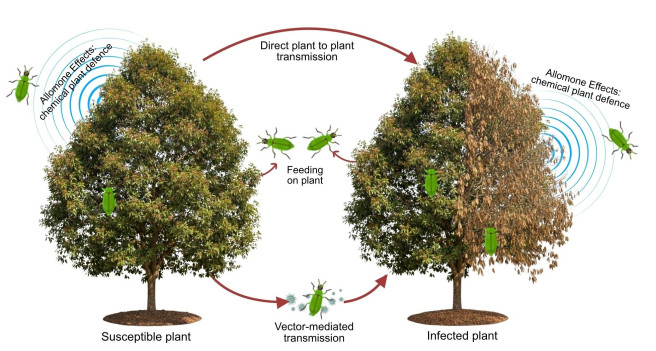
Schematic diagram of the plant–pest model with direct transmission, effective vector-mediated transmission, herbivory, and allomone-mediated suppression. The pest population contributes to plant damage through herbivory and to disease transmission through an effective infectious vector pressure. Allomone effects reduce the net demographic gain obtained by pests from plant consumption
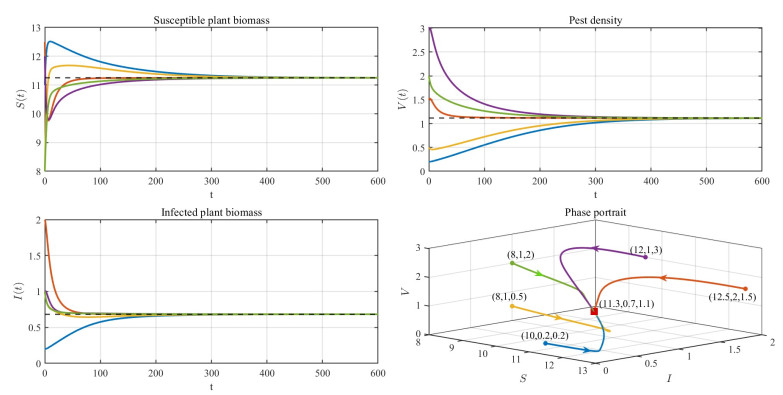
Time series of System (2.1) for several positive initial conditions, illustrating numerical convergence toward the coexistence equilibrium $ E_3 $
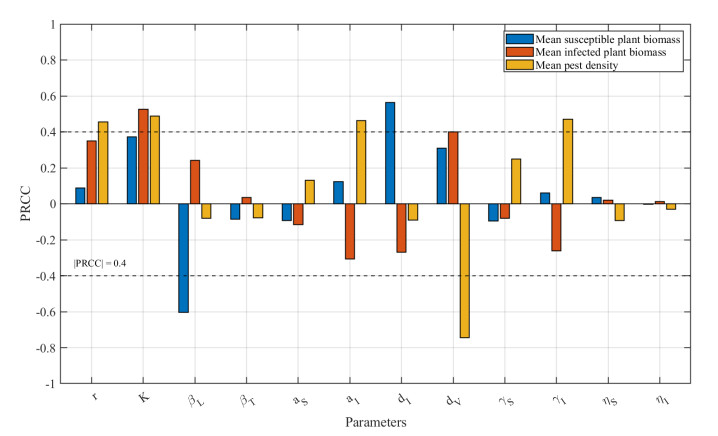
PRCC values of the model parameters for the time-averaged susceptible plant biomass, infected plant biomass, and pest density over the interval $ 600\leq t\leq1200 $. The dashed lines at $ |\mathrm{PRCC}| = 0.4 $ indicate relatively strong associations and do not represent a statistical significance threshold
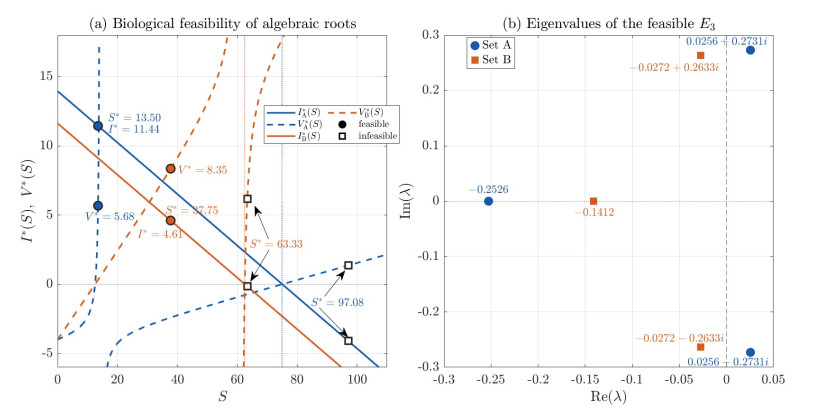
Biological feasibility and local stability of coexistence equilibria under two parameter sets. (a) Feasibility profiles $ I^*(S) $ and $ V^*(S) $, together with the infected plant positivity thresholds $ S = d_V/c_S $. Filled circles indicate biologically feasible roots, whereas open squares indicate infeasible roots. (b) Eigenvalues of the Jacobian at the feasible coexistence equilibria, showing local instability for Set A and local asymptotic stability for Set B
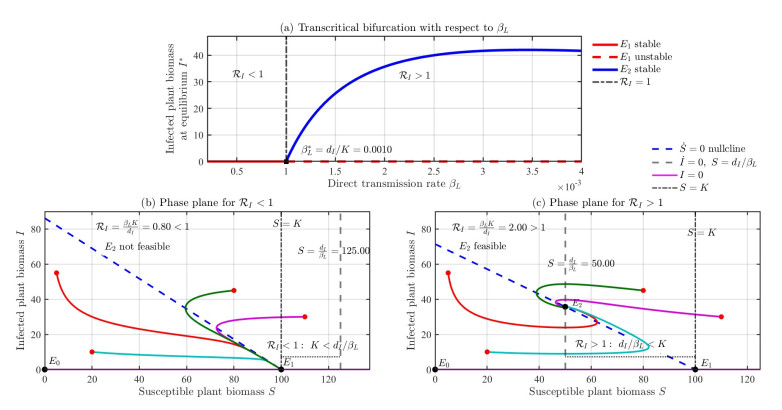
Bifurcation governed by the direct transmission threshold $ \mathcal{R}_I $. Panel (a) shows the bifurcation diagram with respect to $ \beta_L $, where $ \beta_L^* = d_I/K $ corresponds to $ \mathcal{R}_I = 1 $. Panels (b) and (c) show the pest-free phase plane dynamics for $ \mathcal{R}_I < 1 $ and $ \mathcal{R}_I > 1 $, respectively
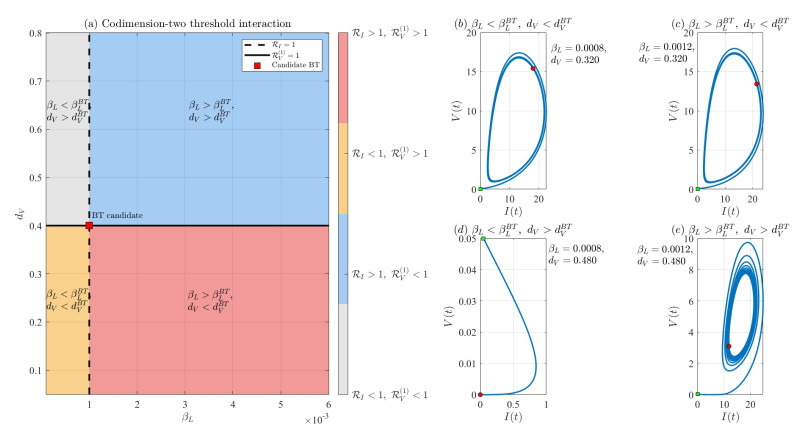
Codimension-two threshold interaction and local dynamics near the candidate Bogdanov–Takens point. (a) The $ (\beta_L, d_V) $-plane divided by the threshold curves $ \mathcal{R}_I = 1 $ and $ \mathcal{R}_V^{(1)} = 1 $, whose intersection gives the codimension-two threshold point. (b)–(e) Local phase portraits near $ E_1 = (K, 0, 0) $ for parameter values below and above the two critical thresholds
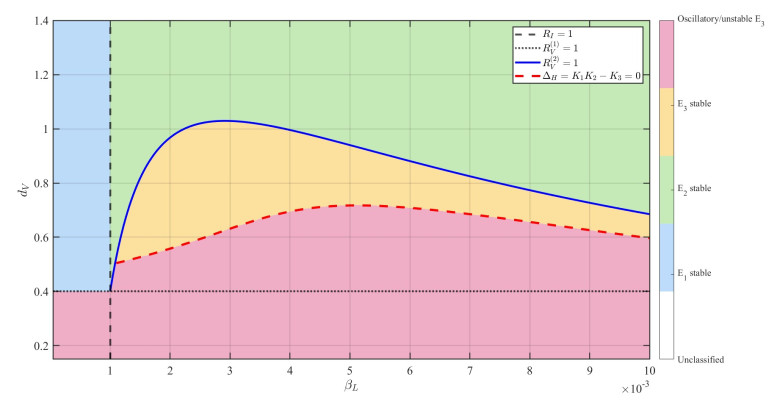
Two-parameter region diagram in the $ (\beta_L, d_V) $-plane showing different dynamic regimes of System (2.1)
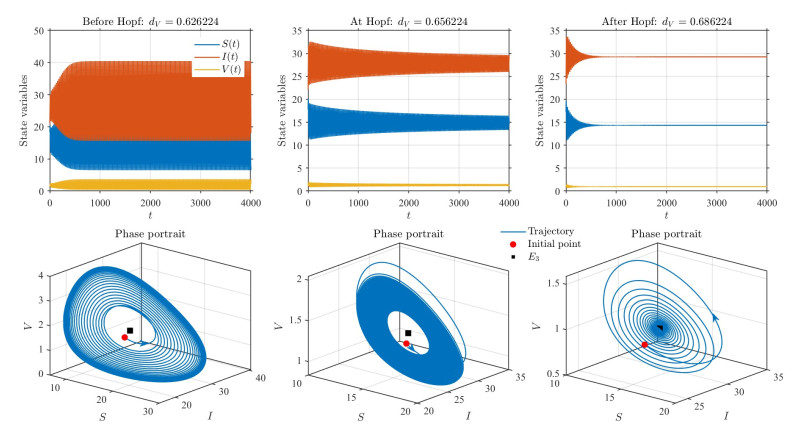
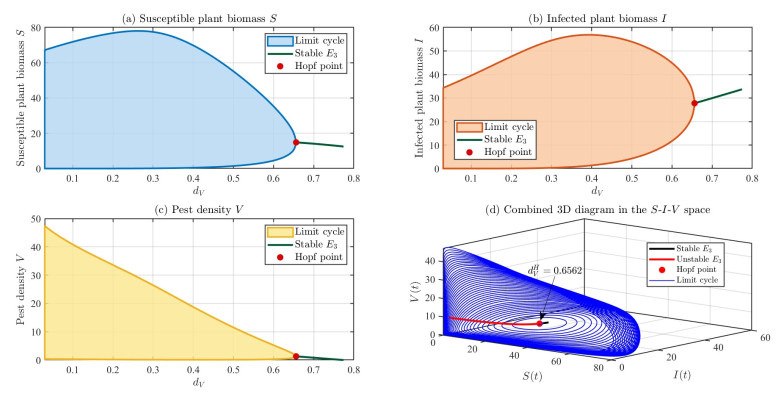
Time series and phase portraits before, near, and after the Hopf bifurcation point $ d_V^H $
Hopf bifurcation diagram with respect to the pest mortality rate $ d_V $. The critical value $ d_V^H $ separates oscillatory coexistence from stable coexistence
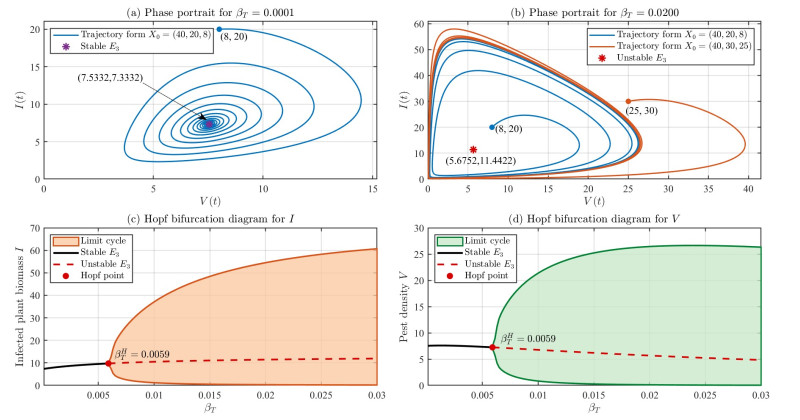
Effects of vector-mediated transmission on phase dynamics and Hopf bifurcation. (a)–(b) show the $ (V, I) $ phase portraits for $ \beta_T = 0.0001 $ and $ \beta_T = 0.0200 $, respectively. (c)–(d) present the Hopf bifurcation diagrams for infected plant biomass $ I $ and pest density $ V $ with respect to $ \beta_T $, with a critical Hopf point at $ \beta_T^H\approx0.005897 $
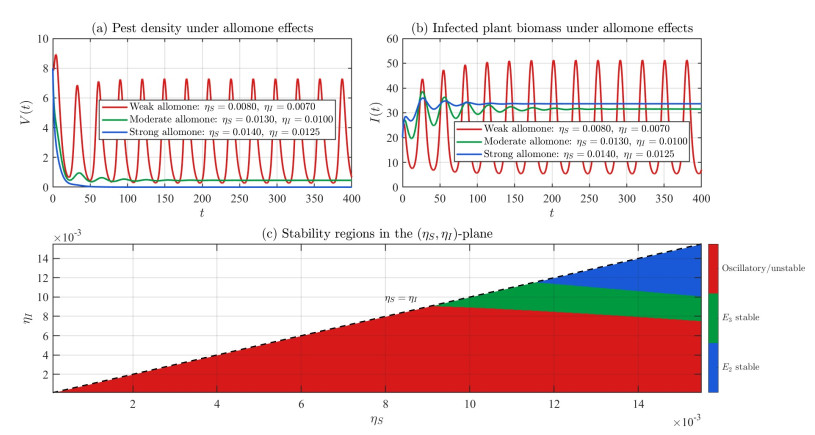
Effects of allomone-mediated pest suppression under $ \eta_S > \eta_I $. (a)–(b) The responses of $ V(t) $ and $ I(t) $ under weak, moderate, and strong allomone effects; (c) the corresponding stability regions in the $ (\eta_S, \eta_I) $-plane
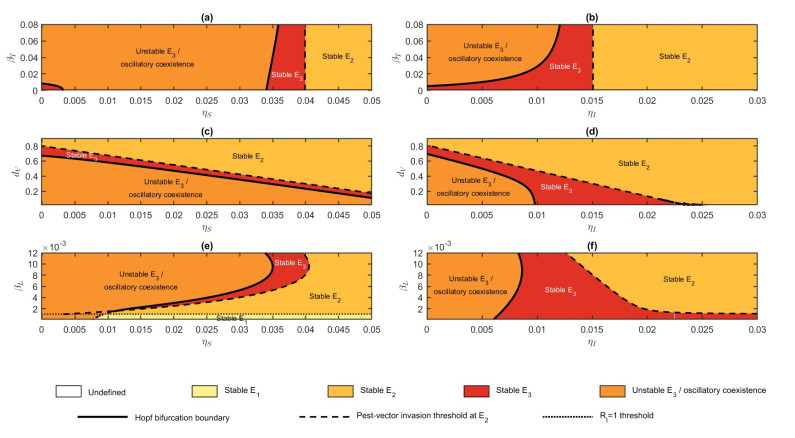
Two-parameter dynamic regions of Model (2.1). Panels (a)–(f) illustrate the combined effects of the allomone parameters $ \eta_S $ and $ \eta_I $ with $ \beta_T $, $ d_V $, and $ \beta_L $. The colored regions indicate the numerically identified dynamic regimes, while the black curves indicate the corresponding threshold and numerically determined Hopf boundaries
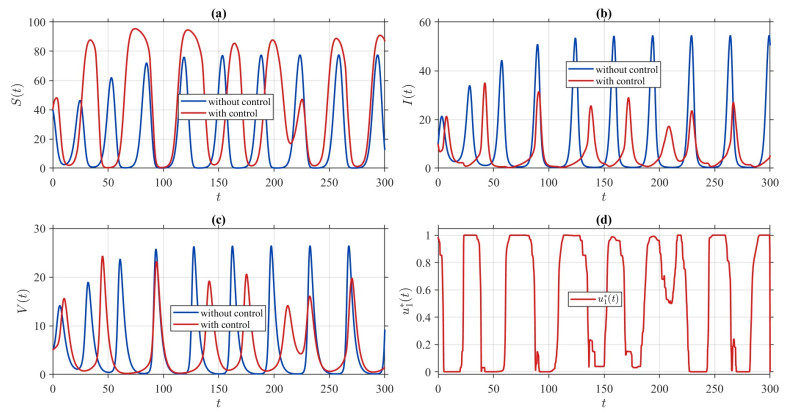
State variables and optimal control profile for the treatment-only strategy: (a) Susceptible plant biomass, (b) infected plant biomass, (c) pest density, and (d) optimal treatment control
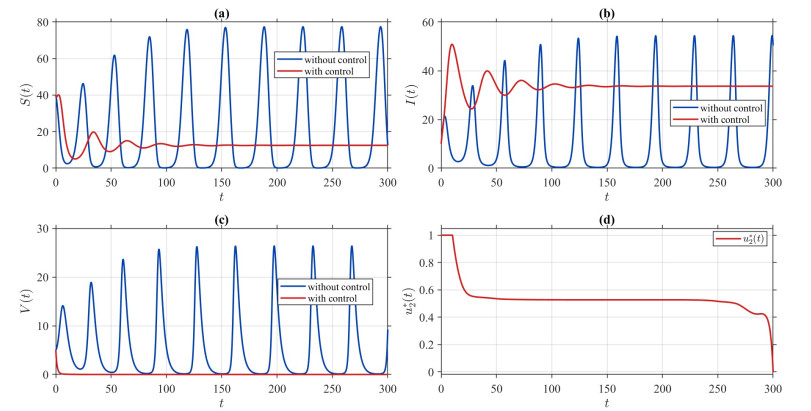
State variables and optimal control profile for the insecticide-only strategy: (a) Susceptible plant biomass, (b) infected plant biomass, (c) pest density, and (d) optimal insecticide control
State variables and optimal control profiles for the combined control strategy: (a) Susceptible plant biomass, (b) infected plant biomass, (c) pest density, and (d) optimal treatment and insecticide controls




 DownLoad: