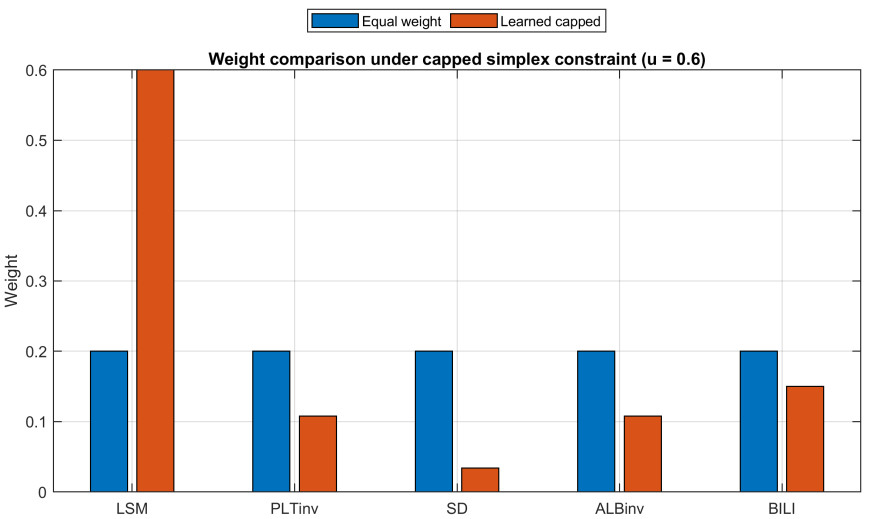
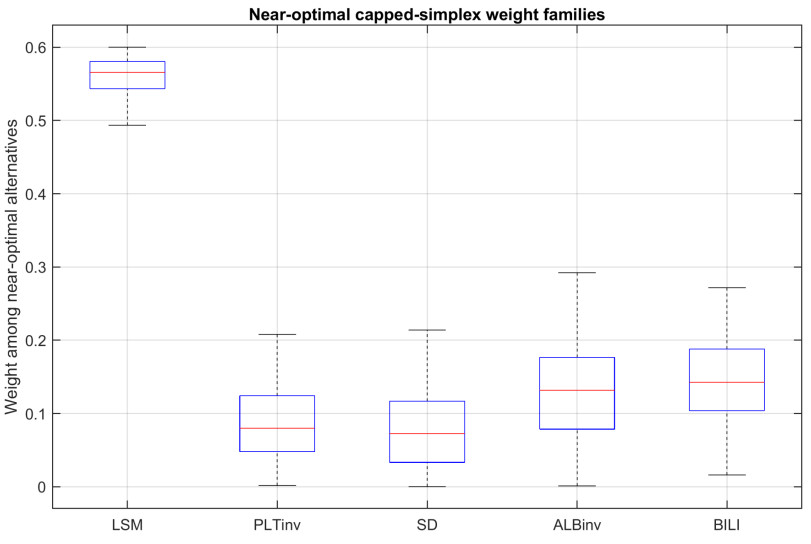
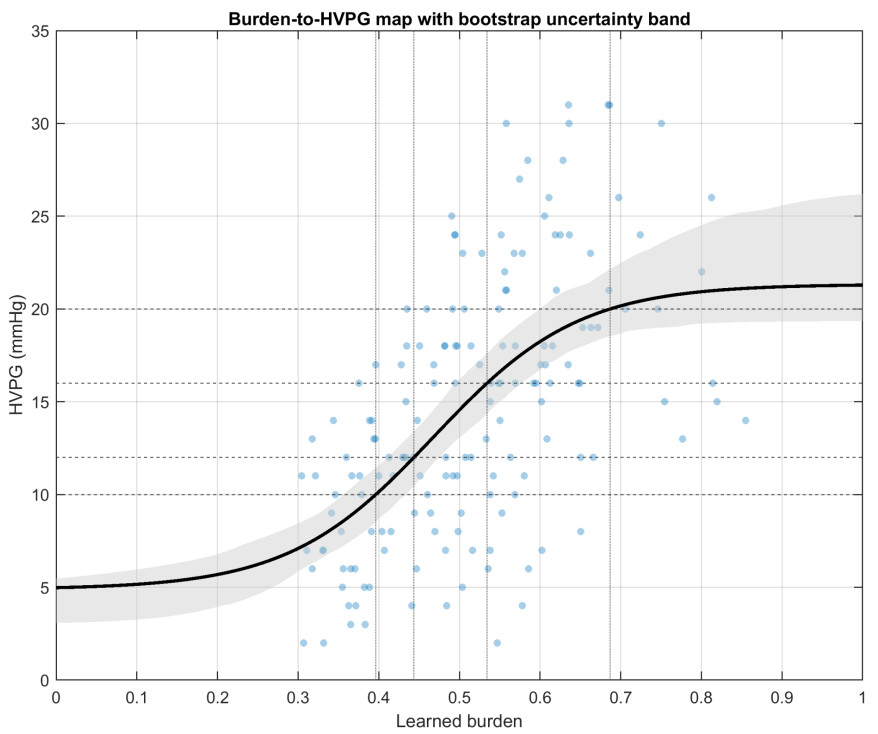
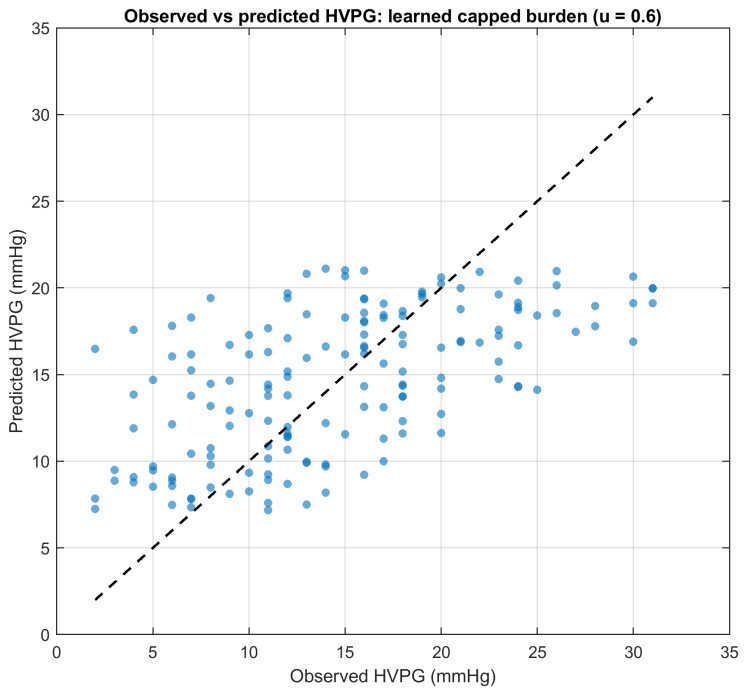
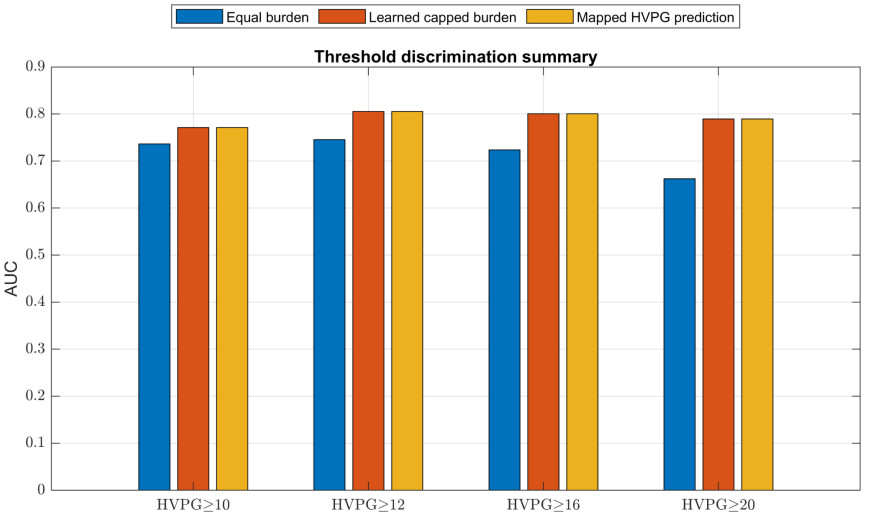
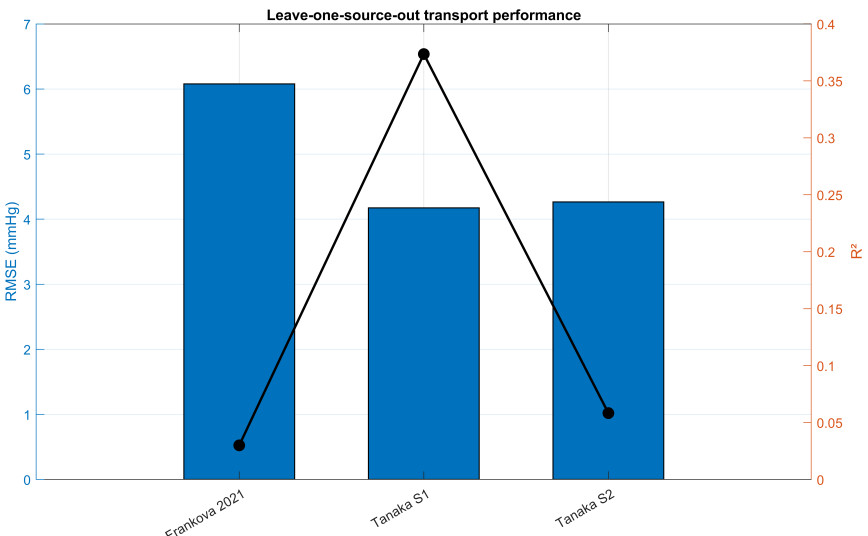
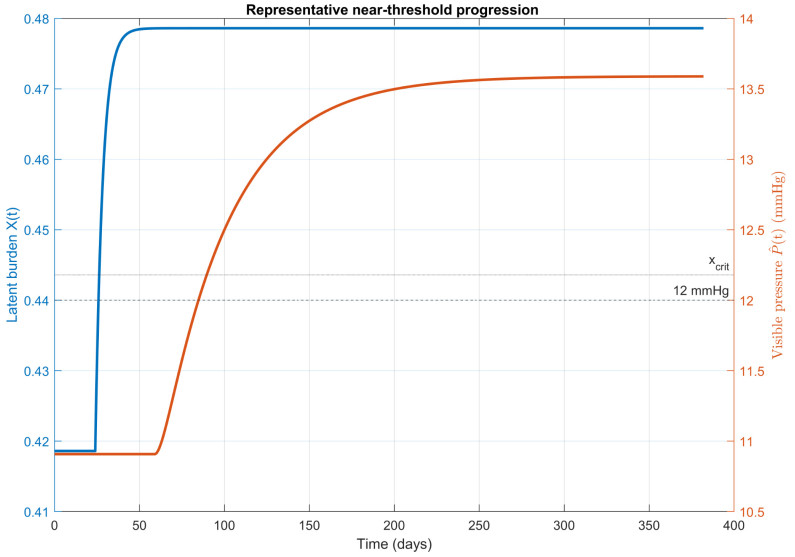
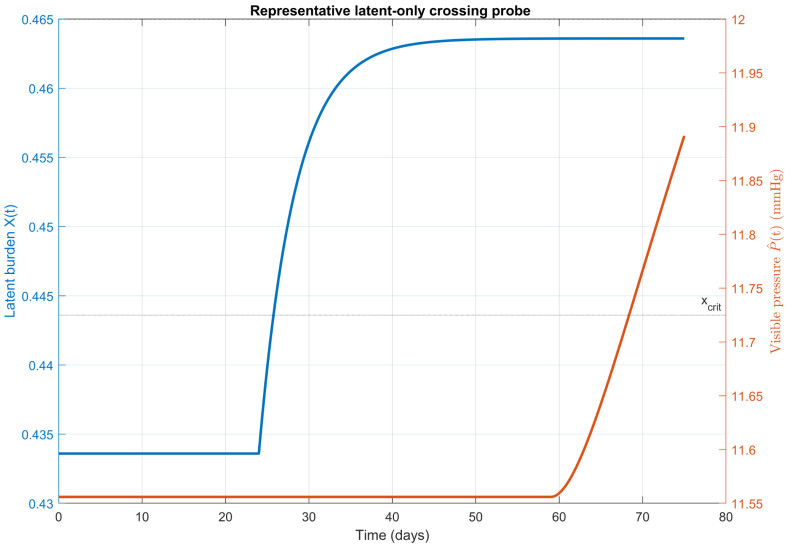
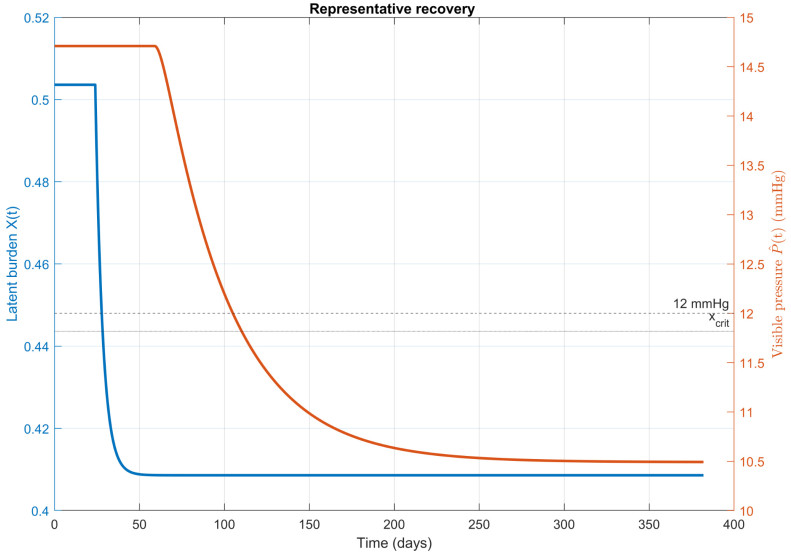
Portal hypertension is clinically defined by invasive hepatic venous pressure gradient (HVPG) thresholds, whereas routine assessment relies on non-invasive markers that are biologically heterogeneous and only indirectly related to portal pressure. We have developed a computational framework designed as a threshold-translation and scenario-exploration tool rather than a predictive or mechanistic model with three explicitly separated components: a data-driven empirical core, a literature-informed delayed dynamic layer, and a synthetic scenario module. Using HVPG-linked datasets, the empirical core has constructed a constrained latent burden score from liver stiffness, inverse platelet count, spleen diameter, inverse albumin, and bilirubin and has compared it with an equal-weight score. The constrained score has improved threshold discrimination more than continuous prediction at clinically relevant HVPG levels. A monotone burden-to-HVPG mapping has translated the latent burden axis into the clinically interpretable HVPG scale and has yielded cohort-specific burden thresholds. Leave-one-source-out (LOSO) technique shows that pooled burden learning is informative but not source-invariant, indicating limited transportability across cohorts. To examine delayed separation between latent burden evolution and visible pressure manifestation, we have introduced a delay differential equation model with literature-informed parameters. The resulting temporal gaps are illustrative scenario outputs and not patient-specific predictions. Overall, the framework provides a transparent, threshold-oriented computational approach for translating heterogeneous biomarkers into interpretable HVPG thresholds while linking data-based burden learning with scenario-based dynamic simulation.
Citation: M. Fakharany, Thoraya N. Alharthi, M. A. Elfouly. A latent burden–HVPG mathematical framework for threshold mapping and delay-differential scenario analysis in portal hypertension[J]. Mathematical Biosciences and Engineering, 2026, 23(8): 2462-2486. doi: 10.3934/mbe.2026089
Portal hypertension is clinically defined by invasive hepatic venous pressure gradient (HVPG) thresholds, whereas routine assessment relies on non-invasive markers that are biologically heterogeneous and only indirectly related to portal pressure. We have developed a computational framework designed as a threshold-translation and scenario-exploration tool rather than a predictive or mechanistic model with three explicitly separated components: a data-driven empirical core, a literature-informed delayed dynamic layer, and a synthetic scenario module. Using HVPG-linked datasets, the empirical core has constructed a constrained latent burden score from liver stiffness, inverse platelet count, spleen diameter, inverse albumin, and bilirubin and has compared it with an equal-weight score. The constrained score has improved threshold discrimination more than continuous prediction at clinically relevant HVPG levels. A monotone burden-to-HVPG mapping has translated the latent burden axis into the clinically interpretable HVPG scale and has yielded cohort-specific burden thresholds. Leave-one-source-out (LOSO) technique shows that pooled burden learning is informative but not source-invariant, indicating limited transportability across cohorts. To examine delayed separation between latent burden evolution and visible pressure manifestation, we have introduced a delay differential equation model with literature-informed parameters. The resulting temporal gaps are illustrative scenario outputs and not patient-specific predictions. Overall, the framework provides a transparent, threshold-oriented computational approach for translating heterogeneous biomarkers into interpretable HVPG thresholds while linking data-based burden learning with scenario-based dynamic simulation.

| [1] |
Y. Iwakiri, J. Trebicka, Portal hypertension in cirrhosis: Pathophysiological mechanisms and therapy, JHEP Rep., 3 (2021), 100316. https://doi.org/10.1016/j.jhepr.2021.100316 doi: 10.1016/j.jhepr.2021.100316

|
| [2] |
R. de Franchis, J. Bosch, G. Garcia-Tsao, T. Reiberger, C. Ripoll, J. G. Abraldes, et al., Baveno Ⅶ - renewing consensus in portal hypertension, J. Hepatol., 76 (2022), 959–974. https://doi.org/10.1016/j.jhep.2021.12.022 doi: 10.1016/j.jhep.2021.12.022
|
| [3] |
R. Paternostro, W. J. Kwanten, B. S. Hofer, G. Semmler, A. Bagdadi, I. Luzko, et al., Hepatic venous pressure gradient predicts risk of hepatic decompensation and liver-related mortality in patients with MASLD, J. Hepatol., 81 (2024), 827–836. https://doi.org/10.1016/j.jhep.2024.05.033 doi: 10.1016/j.jhep.2024.05.033
|
| [4] |
D. E. Kaplan, C. Ripoll, M. Thiele, B. E. Fortune, D. A. Simonetto, G. Garcia-Tsao, et al., AASLD practice guidance on risk stratification and management of portal hypertension and varices in cirrhosis, Hepatology, 79 (2024), 1180–1211. https://doi.org/10.1097/HEP.0000000000000647 doi: 10.1097/HEP.0000000000000647
|
| [5] |
C. Ripoll, R. Groszmann, G. Garcia-Tsao, N. Grace, A. Burroughs, R. Planas, et al., Hepatic venous pressure gradient predicts clinical decompensation in patients with compensated cirrhosis, Gastroenterology, 133 (2007), 481–488. https://doi.org/10.1053/j.gastro.2007.05.024 doi: 10.1053/j.gastro.2007.05.024
|
| [6] |
A. Berzigotti, S. Seijo, U. Arena, J. G. Abraldes, F. Vizzutti, J. C. García–Pagán, et al., Elastography, spleen size, and platelet count identify portal hypertension in patients with compensated cirrhosis, Gastroenterology, 144 (2013), 102–111.e1. https://doi.org/10.1053/j.gastro.2012.10.001 doi: 10.1053/j.gastro.2012.10.001
|
| [7] |
J. G. Abraldes, C. Bureau, H. Stefanescu, S. Augustin, M. Ney, H. Blasco, et al., Noninvasive tools and risk of clinically significant portal hypertension and varices in compensated cirrhosis: The ANTICIPATE study, Hepatology, 64 (2016), 2173–2184. https://doi.org/10.1002/hep.28824 doi: 10.1002/hep.28824
|
| [8] |
M. Pons, S. Augustin, B. Scheiner, M. Guillaume, M. Rosselli, S. G. Rodrigues, et al., Noninvasive diagnosis of portal hypertension in patients with compensated advanced chronic liver disease, Am. J. Gastroenterol., 116 (2021), 723–732. https://doi.org/10.14309/ajg.0000000000000994 doi: 10.14309/ajg.0000000000000994
|
| [9] |
S. Frankova, M. Lunova, H. Gottfriedova, R. Senkerikova, M. Neroldova, J. Kovac, et al., Liver stiffness measured by two-dimensional shear-wave elastography predicts hepatic vein pressure gradient at high values in liver transplant candidates with advanced liver cirrhosis, PLoS One, 16 (2021), e0244934. https://doi.org/10.1371/journal.pone.0244934 doi: 10.1371/journal.pone.0244934
|
| [10] |
T. Tanaka, M. Hirooka, Y. Koizumi, T. Watanabe, O. Yoshida, Y. Tokumoto, et al., Development of a method for measuring spleen stiffness by transient elastography using a new device and ultrasound-fusion method, PLoS One, 16 (2021), e0246315. https://doi.org/10.1371/journal.pone.0246315 doi: 10.1371/journal.pone.0246315
|
| [11] |
T. Reiberger, The value of liver and spleen stiffness for evaluation of portal hypertension in compensated cirrhosis, Hepatol. Commun., 6 (2022), 950–964. https://doi.org/10.1002/hep4.1855 doi: 10.1002/hep4.1855
|
| [12] |
E. Dajti, F. Ravaioli, R. Zykus, P. E. Rautou, L. Elkrief, I. Grgurevic, et al., Accuracy of spleen stiffness measurement for the diagnosis of clinically significant portal hypertension in patients with compensated advanced chronic liver disease: A systematic review and individual patient data meta-analysis, Lancet Gastroenterol. Hepatol., 8 (2023), 816–828. https://doi.org/10.1016/S2468-1253(23)00150-4 doi: 10.1016/S2468-1253(23)00150-4
|
| [13] |
A. Binzberger, M. Hänle, M. Pfahler, W. Kratzer, T. Seufferlein, E. Zizer, Spleen and liver stiffness evaluation by ARFI imaging: A reliable tool for a short-term monitoring of portal hypertension, Int. J. Hepatol., 2022 (2022), 7384144. https://doi.org/10.1155/2022/7384144 doi: 10.1155/2022/7384144
|
| [14] |
D. E. Bozal, J. Hannemann, M. Bürger, G. Allo, E. Dittmann, A. Martin, et al., Spleen stiffness measurements during recompensation in patients with acutely decompensated liver cirrhosis: Preliminary findings of a pilot study, Front. Med., 11 (2024), 1475997. https://doi.org/10.3389/fmed.2024.1475997 doi: 10.3389/fmed.2024.1475997
|
| [15] |
X. Xu, J. Liu, Y. Zhu, F. Rui, C. Wu, J. Li, Spleen stiffness measurement as a non-invasive assessment in patients with portal hypertension, Egastroenterology, 2 (2024), e100031. https://doi.org/10.1136/egastro-2023-100031 doi: 10.1136/egastro-2023-100031
|
| [16] |
W. Nasomsong, P. Laukongtam, S. Chirapongsathorn, Clinically significant portal hypertension assessed by spleen stiffness measurement and its associated outcomes among people living with HIV/AIDS, Sci. Rep., 15 (2025), 39952. https://doi.org/10.1038/s41598-025-23635-2 doi: 10.1038/s41598-025-23635-2
|
| [17] |
W. A. Hassan, R. M. Kemaly, M. A. Sayed, H. M. Nafeh, Liver stiffness measurement, doppler ultrasound, and serum non-invasive markers as predictors of varices and variceal bleeding in cirrhotic patients, Egypt. Liver J., 15 (2025), 78. https://doi.org/10.1186/s43066-025-00483-3 doi: 10.1186/s43066-025-00483-3
|
| [18] |
W. Lv, L. Yu, L. Wang, S. Tang, J. Yuan, Z. Wu, et al., Development and evaluation of a predictive model based on multi-frequency magnetic resonance elastography for high-risk esophagogastric varices in patients with cirrhotic portal hypertension, Insights Imaging, 17 (2026), 69. https://doi.org/10.1186/s13244-026-02246-z doi: 10.1186/s13244-026-02246-z
|
| [19] |
M. Mandorfer, J. G. Abraldes, A. Berzigotti, Non-invasive assessment of portal hypertension: Liver stiffness and beyond, JHEP Rep., 7 (2025), 101300. https://doi.org/10.1016/j.jhepr.2024.101300 doi: 10.1016/j.jhepr.2024.101300
|
| [20] |
O. S. Rudra, A. Jindal, S. K. Sarin, Use of noninvasive tests to assess clinically significant portal hypertension and response to beta-blockers, Gastro Hep Adv., 4 (2025), 100761. https://doi.org/10.1016/j.gastha.2025.100761 doi: 10.1016/j.gastha.2025.100761
|
| [21] |
C. Liu, J. Li, R. He, I. Grgurevic, Y. Guo, S. Liu, et al., A combined model of spleen stiffness and baveno vii criteria for clinically significant portal hypertension in compensated advanced chronic liver disease: An international multicenter study, Portal Hypertens. Cirrhosis, 4 (2025), 4–12. https://doi.org/10.1002/poh2.70004 doi: 10.1002/poh2.70004
|
| [22] |
J. Bañares, M. Pons, T. Reiberger, M. Mandorfer, M. Jachs, G. Semmler, et al., Refining the baveno vii criteria for clinically significant portal hypertension: An individual-patient data meta-analysis, J. Hepatol., 84 (2026), 543–553. https://doi.org/10.1016/j.jhep.2025.10.014 doi: 10.1016/j.jhep.2025.10.014
|
| [23] |
X. Chen, J. Zhou, Y. Lin, K. Jia, J. Tian, F. Li, et al., CT-derived spleen volume accurately diagnoses severe portal hypertension at HVPG thresholds of 16 mmHg, Sci. Rep., 15 (2025), 16850. https://doi.org/10.1038/s41598-025-02143-3 doi: 10.1038/s41598-025-02143-3
|
| [24] |
Y. Nakamura, M. Hirooka, R. Yano, N. Kamiyama, T. Oguri, T. Shimamoto, et al., Predictive value of subharmonic-aided pressure estimation for diagnosing clinically significant portal hypertension, Sci. Rep., 15 (2025), 42181. https://doi.org/10.1038/s41598-025-26100-2 doi: 10.1038/s41598-025-26100-2
|
| [25] |
C. de Margerie-Mellon, F. Joly, A. Tenenhaus, R. Sartoris, V. Paradis, M. Ronot, et al., Preliminary quantitative assessment of liver and spleen MR imaging and elastography in clinically significant portal hypertension, Sci. Rep., 16 (2026), 5430. https://doi.org/10.1038/s41598-025-34761-2 doi: 10.1038/s41598-025-34761-2
|
| [26] |
L. B. Yang, X. Gao, M. Xu, Y. Li, L. Dong, X. D. Huang, et al., Noninvasive model based on liver and spleen stiffness for predicting clinical decompensation in patients with cirrhosis, World J. Gastroenterol., 31 (2025), 107408. https://doi.org/10.3748/wjg.v31.i33.107408 doi: 10.3748/wjg.v31.i33.107408
|
Figures(9) / Tables(13)

M. Fakharany, Thoraya N. Alharthi, M. A. Elfouly. A latent burden–HVPG mathematical framework for threshold mapping and delay-differential scenario analysis in portal hypertension[J]. Mathematical Biosciences and Engineering, 2026, 23(8): 2462-2486. doi: 10.3934/mbe.2026089





 DownLoad: