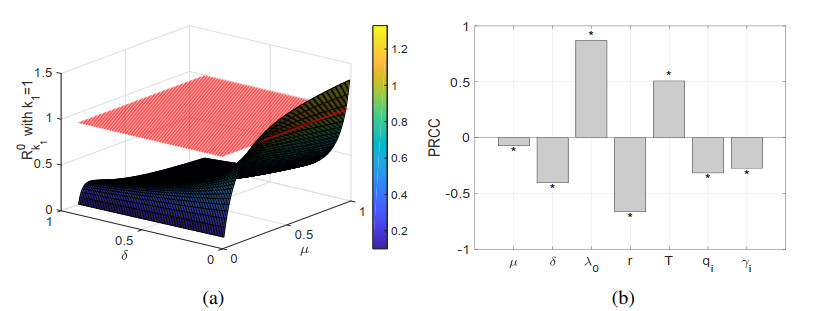
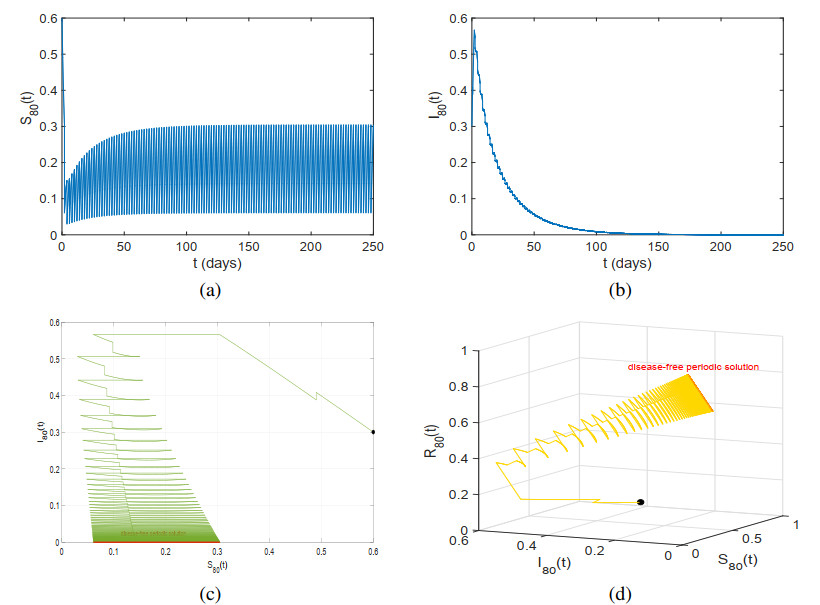
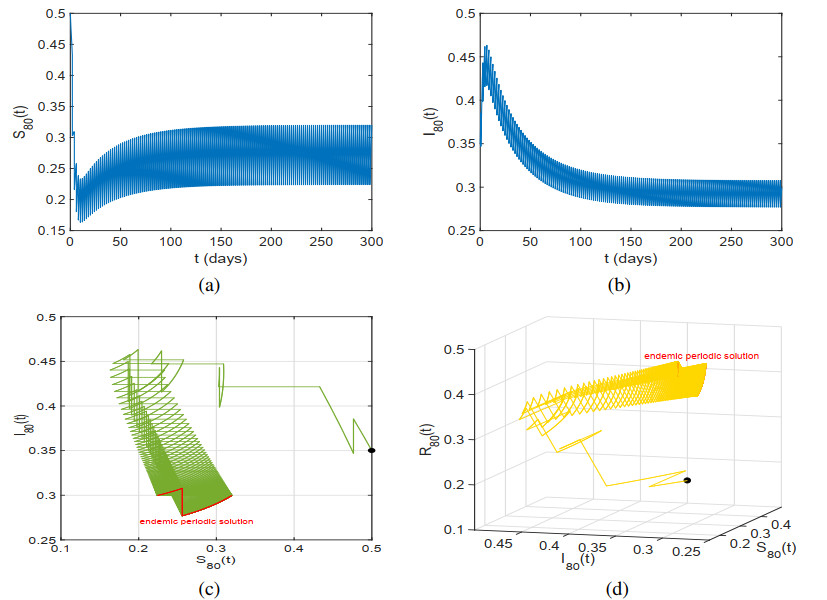
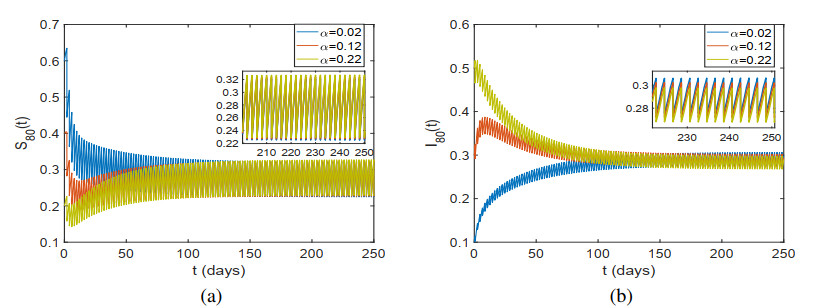
A network-based susceptible-infected-recovered (SIR) epidemic model is proposed to study the spread of infectious diseases, thereby incorporating vertical transmission and a saturated incidence rate. Additionally, it introduces double impulsive control strategies, including pulse vaccination and screening with treatment at distinct fixed intervals. Dynamical behaviors of the formulated model are analyzed using two types of transmission thresholds, namely $ R^0_{k_i} $ and $ \widehat{R^0_{k_i}} $. By applying the Floquet theorem and comparison principle, the system admits a disease-free periodic solution that is globally asymptotically stable if $ \max\limits_{i = 1, 2, \ldots, n}\widehat{R^0_{k_i}} < 1 $. The persistence of disease is confirmed from the uniform persistence of the Poincaré map when $ \frac{1}{1+\alpha}\max\limits_{i = 1, 2, \ldots, n}R^0_{k_i} > 1 $, where $ \alpha $ is the saturated coefficient in the saturation infection. Scenario studies are performed to numerically evaluate the impact of various parameters on the disease dynamics, and the effectiveness of double impulsive controls. It can be concluded that synthetical double impulsive controls are more efficient at eradicating the disease compared with only either of them.
Citation: Gui Guan, Zhenyuan Guo, Yanyu Xiao, Yuming Chen. Dynamics of a network-based SIR epidemic model with double impulsive controls[J]. Mathematical Biosciences and Engineering, 2026, 23(8): 2367-2392. doi: 10.3934/mbe.2026086
A network-based susceptible-infected-recovered (SIR) epidemic model is proposed to study the spread of infectious diseases, thereby incorporating vertical transmission and a saturated incidence rate. Additionally, it introduces double impulsive control strategies, including pulse vaccination and screening with treatment at distinct fixed intervals. Dynamical behaviors of the formulated model are analyzed using two types of transmission thresholds, namely $ R^0_{k_i} $ and $ \widehat{R^0_{k_i}} $. By applying the Floquet theorem and comparison principle, the system admits a disease-free periodic solution that is globally asymptotically stable if $ \max\limits_{i = 1, 2, \ldots, n}\widehat{R^0_{k_i}} < 1 $. The persistence of disease is confirmed from the uniform persistence of the Poincaré map when $ \frac{1}{1+\alpha}\max\limits_{i = 1, 2, \ldots, n}R^0_{k_i} > 1 $, where $ \alpha $ is the saturated coefficient in the saturation infection. Scenario studies are performed to numerically evaluate the impact of various parameters on the disease dynamics, and the effectiveness of double impulsive controls. It can be concluded that synthetical double impulsive controls are more efficient at eradicating the disease compared with only either of them.

| [1] |
J. Yang, L. K. Guan, Z. Chen, Y. S. Tan, Z. J. Liu, R. A. Cheke, Bifurcation analysis of a nonlinear pulse SIR model with media coverage, Nonlinear Dyn., 111 (2023), 19543–19562. https://doi.org/10.1007/s11071-023-08869-x doi: 10.1007/s11071-023-08869-x

|
| [2] |
S. Nayagam, M. Thursz, E. Sicuri, L. Conteh, S. Wiktor, D. L. Low-Beer, et al., Requirements for global elimination of hepatitis B: a modelling study, Lancet Infect. Dis., 16 (2016), 1399–1408. https://doi.org/10.1016/S1473-3099(16)30204-3 doi: 10.1016/S1473-3099(16)30204-3
|
| [3] |
Y. Y. Zhang, Z. T. Xu, Dynamics of a diffusive HBV model with delayed Beddington-DeAngelis response, Chaos, 15 (2014), 118–139. https://doi.org/10.1016/j.nonrwa.2013.06.005 doi: 10.1016/j.nonrwa.2013.06.005
|
| [4] |
T. Khan, S. Ahmad, G. Zaman, Modeling and qualitative analysis of a hepatitis B epidemic model, Chaos, 29 (2019), 103139. https://doi.org/10.1063/1.5111699 doi: 10.1063/1.5111699
|
| [5] |
P. T. Karaji, N. Nyamoradi, Analysis of a fractional SIR model with General incidence function, Appl. Math. Lett., 108 (2020), 106499. https://doi.org/10.1016/j.aml.2020.106499 doi: 10.1016/j.aml.2020.106499
|
| [6] |
G. Hussain, T. Khan, A. Zahri, G. Zaman, Ergodic stationary distribution of stochastic epidemic model for HBV with double saturated incidence rates and vaccination, Chaos, Solitons Fractals, 160 (2022), 112195. https://doi.org/10.1016/j.chaos.2022.112195 doi: 10.1016/j.chaos.2022.112195
|
| [7] |
A. A. Raezah, A. Raouf, R. Zarin, A. Khan, Exploring the effectiveness of control measures and long-term behavior in Hepatitis B: An analysis of an endemic model with horizontal and vertical transmission, Results Phys., 53 (2023), 106966. https://doi.org/10.1016/j.rinp.2023.106966 doi: 10.1016/j.rinp.2023.106966
|
| [8] |
Z. Wang, Y. Moreno, S. Boccaletti, M. Perc, Vaccination and epidemics in networked populations-An introduction, Chaos, Solitons Fractals, 103 (2017), 177–183. https://doi.org/10.1016/j.chaos.2017.06.004 doi: 10.1016/j.chaos.2017.06.004
|
| [9] |
C. Nowzari, V. M. Preciado, G. J. Pappas, Analysis and control of epidemics: A survey of spreading process on complex networks, IEEE Control Syst. Mag., 36 (2016), 26–46. https://doi.org/10.1109/MCS.2015.2495000 doi: 10.1109/MCS.2015.2495000
|
| [10] |
J. D. Cao, Y. Wang, A. Alofi, A. Al-Mazrooei, A. Elaiw, Global stability of an epidemic model with carrier state in heterogeneous networks, IMA J. Appl. Math., 80 (2015), 1025–1048. https://doi.org/10.1093/imamat/hxu040 doi: 10.1093/imamat/hxu040
|
| [11] |
Y. C. Wu, Z. P. Zhang, L. M. Song, C. Y. Xia, Global stability analysis of two strains epidemic model with imperfect vaccination and immunity waning in a complex network, Chaos, Solitons Fractals, 179 (2024), 114414. https://doi.org/10.1016/j.chaos.2023.114414 doi: 10.1016/j.chaos.2023.114414
|
| [12] |
S. Jafarizadeh, Convergence speed and robustness analysis of epidemic spreading processes with time-delay, IEEE Trans. Netw. Sci. Eng., 10 (2023), 3818–3833. https://doi.org/10.1109/TNSE.2023.3274298 doi: 10.1109/TNSE.2023.3274298
|
| [13] |
S. Lv, Y. Wang, C. Guo, L. B. Zhang, Effects of experts on the coupling dynamics of complex contagion of awareness and epidemic spreading, Nonlinear Dyn., 112 (2024), 2367–2380. https://doi.org/10.1007/s11071-023-09146-7 doi: 10.1007/s11071-023-09146-7
|
| [14] |
A. L. Oestereich, M. A. Pires, N. Crokidakis, D. O. Cajueiro, Optimal rewiring in adaptive networks in multi-coupled vaccination, epidemic and opinion dynamics, Chaos, Solitons Fractals, 176 (2023), 114125. https://doi.org/10.1016/j.chaos.2023.114125 doi: 10.1016/j.chaos.2023.114125
|
| [15] |
X. J. Fu, J. R. Wang, Dynamic behaviors and non-instantaneous impulsive vaccination of an SAIQR model on complex networks, Appl. Math. Comput., 465 (2024), 128425. https://doi.org/10.1016/j.amc.2023.128425 doi: 10.1016/j.amc.2023.128425
|
| [16] |
Q. Q. Zhang, B. Tang, S. Y. Tang, Vaccination threshold size and backward bifurcation of SIR model with state-dependent pulse control, J. Theor. Biol., 455 (2018), 75–85. https://doi.org/10.1016/j.jtbi.2018.07.010 doi: 10.1016/j.jtbi.2018.07.010
|
| [17] |
G. R. Jiang, S. Y. Liu, L. Ling, Periodic solutions of an SIS epidemic model with fixed-time birth pulses and state feedback pulse treatments, Int. J. Comput. Math., 91 (2014), 844–856. https://doi.org/10.1080/00207160.2013.818667 doi: 10.1080/00207160.2013.818667
|
| [18] |
Q. Li, Y. N. Xiao, Analysis of a hybrid SIR model combining the fixed-moments pulse interventions with susceptibles-triggered threshold policy, Appl. Math. Comput., 453 (2023), 128082. https://doi.org/10.1016/j.amc.2023.128082 doi: 10.1016/j.amc.2023.128082
|
| [19] |
L. Ding, P. Hu, Z. H. Guan, T. Li, An efficient hybrid control strategy for restraining rumor spreading, IEEE Trans. Syst. Man Cybern.: Syst., 51 (2021), 6779–6791. https://doi.org/10.1109/TSMC.2019.2963418 doi: 10.1109/TSMC.2019.2963418
|
| [20] |
Y. Y. Cheng, L. A. Huo, L. J. Zhao, Stability analysis and optimal control of rumor spreading model under media coverage considering time delay and pulse vaccination, Chaos, Solitons Fractals, 157 (2022), 111931. https://doi.org/10.1016/j.chaos.2022.111931 doi: 10.1016/j.chaos.2022.111931
|
| [21] |
X. Wang, Y. D. Tao, X. Y. Song, Analysis of pest-epidemic model by releasing diseased pest with impulsive transmission, Nonlinear Dyn., 65 (2011), 175–185. https://doi.org/10.1007/s11071-010-9882-4 doi: 10.1007/s11071-010-9882-4
|
| [22] |
Y. X. Xie, L. J. Wang, Q. C. Deng, Z. J. Wu, The dynamics of an impulsive predator-prey model with communicable disease in the prey species only, Appl. Math. Comput., 292 (2017), 320–335. https://doi.org/10.1016/j.amc.2016.07.042 doi: 10.1016/j.amc.2016.07.042
|
| [23] |
Y. F. Li, S. Huang, X. Y. Song, Global dynamic analysis of a nonlinear state-dependent feedback control SIR model with saturation incidence, Eur. Phys. J. Plus, 138 (2023), 636. https://doi.org/10.1140/epjp/s13360-023-04277-7 doi: 10.1140/epjp/s13360-023-04277-7
|
| [24] |
X. Z. Liu, P. Stechlinski, Pulse and constant control schemes for epidemic models with seasonality, Nonlinear Anal.: Real World Appl., 12 (2011), 931–946. https://doi.org/10.1016/j.nonrwa.2010.08.017 doi: 10.1016/j.nonrwa.2010.08.017
|
| [25] |
X. Z. Liu, P. Stechlinski, Transmission dynamics of a switched multi-city model with transport-related infections, Nonlinear Anal.: Real World Appl., 14 (2013), 264–279. https://doi.org/10.1016/j.nonrwa.2012.06.003 doi: 10.1016/j.nonrwa.2012.06.003
|
| [26] |
Q. C. Wu, M. Small, H. X. Liu, Superinfection behaviors on scale-free networks with competing strains, J. Nonlinear Sci., 23 (2013), 113–127. https://doi.org/10.1007/s00332-012-9146-1 doi: 10.1007/s00332-012-9146-1
|
| [27] |
J. T. Yang, Z. C. Yang, Y. M. Chen, An SIS epidemic model in a patchy environment with pulse vaccination and quarantine, Commun. Nonlinear Sci. Numer. Simul., 118 (2023), 107053. https://doi.org/10.1016/j.cnsns.2022.107053 doi: 10.1016/j.cnsns.2022.107053
|
| [28] | V. Lakshmikantham, D. D. Bainov, P. S. Simeonov, Theory of impulsive differential equations, World Scientific, Singapore, 1989. https://doi.org/10.1142/0906 |
| [29] | D. D. Bainov, P. S. Simeonov, Impulsive differential equations: periodic solutions and applications, Routledge, New York, 1993. https://doi.org/10.1201/9780203751206 |
| [30] |
S. J. Gao, D. H. Xie, L. S. Chen, Pulse vaccination strategy in a delayed SIR epidemic model with vertical transmission, Discrete Contin. Dyn. Syst. – B, 7 (2007), 77–86. https://doi.org/10.3934/DCDSB.2007.7.77 doi: 10.3934/DCDSB.2007.7.77
|
| [31] | R. S. Varga, Matrix Iterative Analysis, Springer, New York, 2000. https://doi.org/10.1007/978-3-642-05156-2 |
| [32] | X. Q. Zhao, Dynamical Systems in Population Biology, Springer-Verlag, New York, 2003. https://doi.org/10.1007/978-3-319-56433-3 |
| [33] |
R. K. Upadhyay, A. K. Pal, S. Kumari, P. Roy, Dynamics of an SEIR epidemic model with nonlinear incidence and treatment rates, Nonlinear Dyn., 96 (2019), 2351–2368. https://doi.org/10.1007/s11071-019-04926-6 doi: 10.1007/s11071-019-04926-6
|
| [34] |
N. Chitnis, J. M. Hyman, J. M. Cushing, Determining important parameters in the spread of malaria through the sensitivity analysis of a mathematical model, Bull. Math. Biol., 70 (2008), 1272–1296. https://doi.org/10.1007/s11538-008-9299-0 doi: 10.1007/s11538-008-9299-0
|
| [35] |
X. J. Cheng, L. X. Yang, Q. Y. Zhu, C. Q. Gan, G, Li, Impulse strategies for suppressing cyber propaganda with awareness, IEEE Trans. Comput. Soc. Syst., 12 (2025), 2685–2695. https://doi.org/10.1109/TCSS.2024.3522889 doi: 10.1109/TCSS.2024.3522889
|
| [36] |
X. J. Cheng, L. X. Yang, G. Li, Z. N. Ma, T. Q. Zhu, L. D. Wang, et al., Modeling and mitigating social engineering malware: integrating malware-opinion dynamics with optimal impulse control approaches, IEEE Trans. Inf. Forensics Secur., 20 (2025), 12231–12244. https://doi.org/10.1109/TIFS.2025.3630005 doi: 10.1109/TIFS.2025.3630005
|
| [37] |
X. J. Cheng, L. X. Yang, Q. Y. Zhu, C. Q. Gan, X. F. Yang, G. Li, Cost-effective hybrid control strategies for dynamical propaganda war game, IEEE Trans. Inf. Forensics Secur., 19 (2024), 9789–9802. https://doi.org/10.1109/TIFS.2024.3468903 doi: 10.1109/TIFS.2024.3468903
|
| [38] |
S. Chatterjee, A. N. Zehmakan, Effective vaccination strategies in network-based SIR model, Chaos, Solitons Fractals, 175 (2023), 113952. https://doi.org/10.1016/j.chaos.2023.113952 doi: 10.1016/j.chaos.2023.113952
|
| [39] |
S. Chatterjee, A. N. Zehmakan, S. Rastogi, A novel room-based epidemic model: Quarantine, testing, and vaccination strategies, Chaos, Solitons Fractals, 177 (2023), 114297. https://doi.org/10.1016/j.chaos.2023.114297 doi: 10.1016/j.chaos.2023.114297
|
Figures(9)

Gui Guan, Zhenyuan Guo, Yanyu Xiao, Yuming Chen. Dynamics of a network-based SIR epidemic model with double impulsive controls[J]. Mathematical Biosciences and Engineering, 2026, 23(8): 2367-2392. doi: 10.3934/mbe.2026086





 DownLoad: