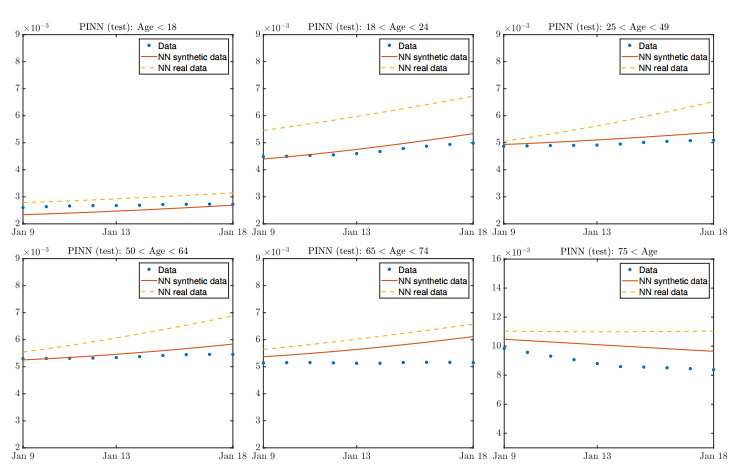
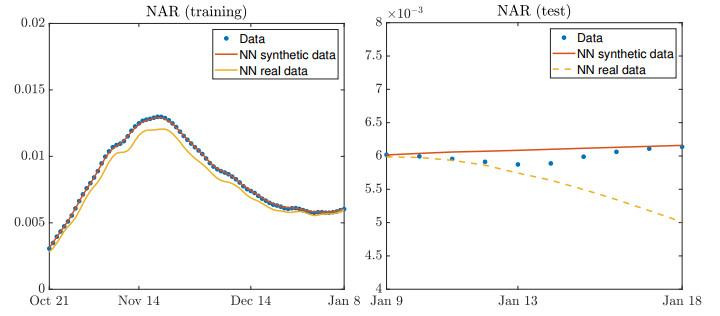
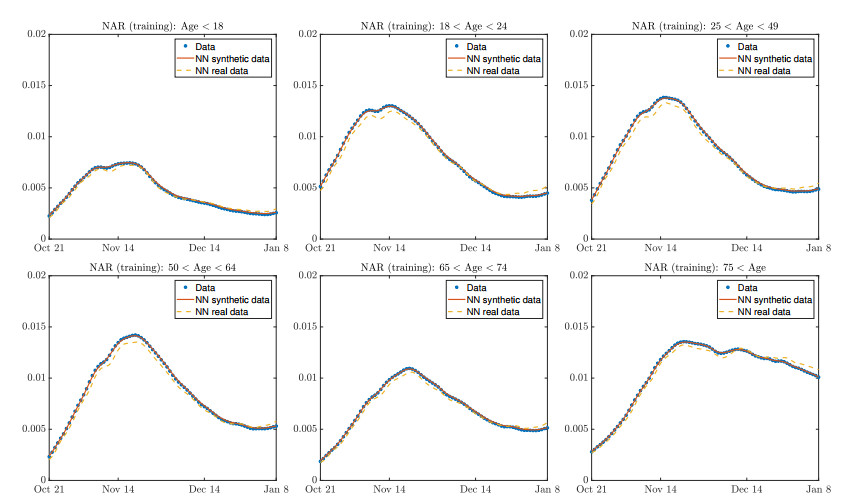
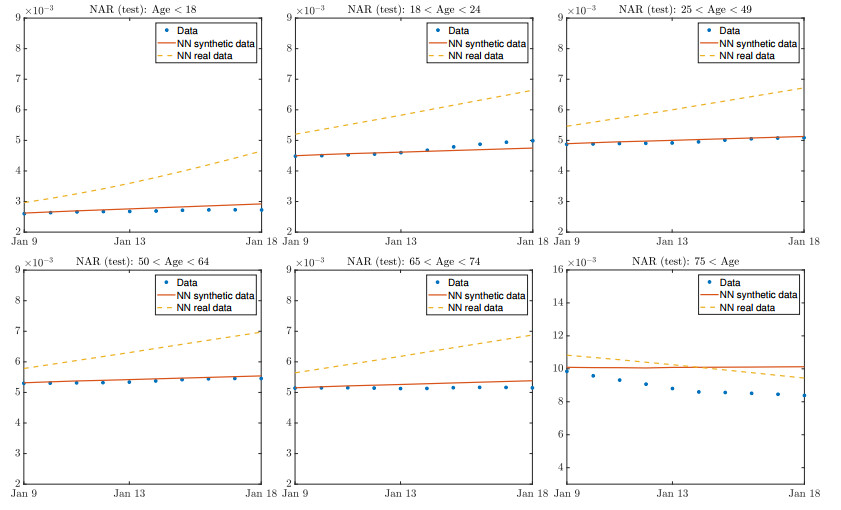
In this work, we propose a data augmentation strategy aimed at improving the training phase of neural networks and, consequently, the accuracy of their predictions. Our approach relies on generating synthetic data through a suitable compartmental model combined with the incorporation of uncertainty. Available data are used to calibrate the model, which is further integrated with deep learning techniques to produce additional synthetic data for training. The results show that neural networks trained on these augmented datasets exhibit significantly improved predictive performances. In particular, we focus on two different neural network architectures: Physics-Informed Neural Networks (PINNs) and Nonlinear Autoregressive (NAR) models. The NAR approach proves especially effective for short-term forecasting, thereby providing accurate quantitative estimates by directly learning the dynamics from data and avoiding the additional computational cost of embedding physical constraints into the training. In contrast, PINNs yield less accurate quantitative predictions but capture the qualitative long-term behavior of the system, thus making them more suitable to explore broader dynamical trends. Numerical simulations of the second phase of the COVID-19 pandemic in the Lombardy region (Italy) validate the effectiveness of the proposed approach.
Citation: Giacomo Dimarco, Federica Ferrarese, Lorenzo Pareschi. Augmented data and neural networks for robust epidemic forecasting: Application to COVID-19 in Italy[J]. Mathematical Biosciences and Engineering, 2026, 23(2): 474-498. doi: 10.3934/mbe.2026019
In this work, we propose a data augmentation strategy aimed at improving the training phase of neural networks and, consequently, the accuracy of their predictions. Our approach relies on generating synthetic data through a suitable compartmental model combined with the incorporation of uncertainty. Available data are used to calibrate the model, which is further integrated with deep learning techniques to produce additional synthetic data for training. The results show that neural networks trained on these augmented datasets exhibit significantly improved predictive performances. In particular, we focus on two different neural network architectures: Physics-Informed Neural Networks (PINNs) and Nonlinear Autoregressive (NAR) models. The NAR approach proves especially effective for short-term forecasting, thereby providing accurate quantitative estimates by directly learning the dynamics from data and avoiding the additional computational cost of embedding physical constraints into the training. In contrast, PINNs yield less accurate quantitative predictions but capture the qualitative long-term behavior of the system, thus making them more suitable to explore broader dynamical trends. Numerical simulations of the second phase of the COVID-19 pandemic in the Lombardy region (Italy) validate the effectiveness of the proposed approach.

| [1] |
G. Chowell, C. Ammon, N. W. Hengartner, J. Hyman, Transmission dynamics of the great influenza pandemic of 1918 in Geneva, Switzerland: Assessing the effects of hypothetical interventions, J. Theor. Biol., 241 (2006), 193–204. https://doi.org/10.1016/j.jtbi.2005.11.026 doi: 10.1016/j.jtbi.2005.11.026

|
| [2] |
G. Dimarco, L. Pareschi, G. Toscani, M. Zanella, Wealth distribution under the spread of infectious diseases, Phys. Rev. E, 102 (2020), 022303. https://doi.org/10.1103/PhysRevE.102.022303 doi: 10.1103/PhysRevE.102.022303
|
| [3] |
A. Lunelli, A. Pugliese, C. Rizzo, Epidemic patch models applied to pandemic influenza: Contact matrix, stochasticity, robustness of predictions, Math. Biosci., 220 (2009), 24–33. https://doi.org/10.1016/j.mbs.2009.03.008 doi: 10.1016/j.mbs.2009.03.008
|
| [4] |
G. Toscani, A multi-agent approach to the impact of epidemic spreading on commercial activities, Math. Models Methods Appl. Sci., 32 (2022), 1931–1948. https://doi.org/10.1142/S0218202522500440 doi: 10.1142/S0218202522500440
|
| [5] |
G. Albi, L. Pareschi, M. Zanella, Control with uncertain data of socially structured compartmental epidemic models, J. Math. Biol., 82 (2021), 63. https://doi.org/10.1007/s00285-021-01617-y doi: 10.1007/s00285-021-01617-y
|
| [6] |
G. Albi, L. Pareschi, M. Zanella, Modelling lockdown measures in epidemic outbreaks using selective socio-economic containment with uncertainty, Math. Biosci. Eng., 18 (2021), 7161–7191. https://doi.org/10.3934/mbe.2021355 doi: 10.3934/mbe.2021355
|
| [7] |
L. Bolzoni, E. Bonacini, R. D. Marca, M. Groppi, Optimal control of epidemic size and duration with limited resources, Math. Biosci., 315 (2019), 108232. https://doi.org/10.1016/j.mbs.2019.108232 doi: 10.1016/j.mbs.2019.108232
|
| [8] |
S. Flaxman, S. Mishra, A. Gandy, H. J. T. Unwin, T. A. Mellan, H. Coupland, et al., Estimating the effects of non-pharmaceutical interventions on COVID-19 in Europe, Nature, 584 (2020), 257–261. https://doi.org/10.1038/s41586-020-2405-7 doi: 10.1038/s41586-020-2405-7
|
| [9] |
S. Lee, G. Chowell, C. Castillo-Chávez, Optimal control for pandemic influenza: The role of limited antiviral treatment and isolation, J. Theor. Biol., 265 (2010), 136–150. https://doi.org/10.1016/j.jtbi.2010.04.003 doi: 10.1016/j.jtbi.2010.04.003
|
| [10] |
V. Capasso, G. Serio, A generalization of the Kermack-McKendrick deterministic epidemic model, Math. Biosci., 42 (1978), 43–61. https://doi.org/10.1016/0025-5564(78)90006-8 doi: 10.1016/0025-5564(78)90006-8
|
| [11] |
H. W. Hethcote, The mathematics of infectious diseases, SIAM Rev., 42 (2000), 599–653. https://doi.org/10.1137/S0036144500371907 doi: 10.1137/S0036144500371907
|
| [12] |
W. O. Kermack, A. G. McKendrick, A contribution to the mathematical theory of epidemics, Proc. R. Soc. London, Ser. A, 115 (1927), 700–721. https://doi.org/10.1098/rspa.1927.0118 doi: 10.1098/rspa.1927.0118
|
| [13] |
R. H. Chisholm, P. T. Campbell, Y. Wu, S. Y. Tong, J. McVernon, N. Geard, Implications of asymptomatic carriers for infectious disease transmission and control, R. Soc. Open Sci., 5 (2018), 172341. https://doi.org/10.1098/rsos.172341 doi: 10.1098/rsos.172341
|
| [14] |
C. Anastassopoulou, L. Russo, A. Tsakris, C. Siettos, Data-based analysis, modelling and forecasting of the COVID-19 outbreak, PloS One, 15 (2020), e0230405. https://doi.org/10.1371/journal.pone.0230405 doi: 10.1371/journal.pone.0230405
|
| [15] |
K. Y. Leung, P. Trapman, T. Britton, Who is the infector? Epidemic models with symptomatic and asymptomatic cases, Math. Biosci., 301 (2018), 190–198. https://doi.org/10.1016/j.mbs.2018.04.002 doi: 10.1016/j.mbs.2018.04.002
|
| [16] |
K. Mizumoto, K. Kagaya, A. Zarebski, G. Chowell, Estimating the asymptomatic proportion of coronavirus disease 2019 (COVID-19) cases on board the Diamond Princess cruise ship, Yokohama, Japan, 2020, Eurosurveillance, 25 (2020), 2000180. https://doi.org/10.2807/1560-7917.ES.2020.25.40.2010082 doi: 10.2807/1560-7917.ES.2020.25.40.2010082
|
| [17] | G. Albi, G. Bertaglia, W. Boscheri, G. Dimarco, L. Pareschi, G. Toscani, et al., Kinetic modelling of epidemic dynamics: Social contacts, control with uncertain data, and multiscale spatial dynamics, in Predicting Pandemics in a Globally Connected World: Toward a Multiscale, Multidisciplinary Framework through Modeling and Simulation, Springer, 18 (2022), 43–108. https://doi.org/10.1007/978-3-030-96562-4_3 |
| [18] |
G. Bertaglia, W. Boscheri, G. Dimarco, L. Pareschi, Spatial spread of COVID-19 outbreak in Italy using multiscale kinetic transport equations with uncertainty, Math. Biosci. Eng., 18 (2021), 7028–7059. https://doi.org/10.3934/mbe.2021350 doi: 10.3934/mbe.2021350
|
| [19] |
A. Capaldi, S. Behrend, B. Berman, J. Smith, J. Wright, A. L. Lloyd, Parameter estimation and uncertainty quantication for an epidemic model, Math. Biosci. Eng., 9 (2012), 553–576. https://doi.org/10.3934/mbe.2012.9.553 doi: 10.3934/mbe.2012.9.553
|
| [20] |
G. Dimarco, B. Perthame, G. Toscani, M. Zanella, Kinetic models for epidemic dynamics with social heterogeneity, J. Math. Biol., 83 (2021), 4. https://doi.org/10.1007/s00285-021-01630-1 doi: 10.1007/s00285-021-01630-1
|
| [21] |
A. Korobeinikov, P. K. Maini, Non-linear incidence and stability of infectious disease models, Math. Med. Biol., 22 (2005), 113–128. https://doi.org/10.1093/imammb/dqi001 doi: 10.1093/imammb/dqi001
|
| [22] |
M. Zanella, C. Bardelli, G. Dimarco, S. Deandrea, P. Perotti, M. Azzi, et al., A data-driven epidemic model with social structure for understanding the COVID-19 infection on a heavily affected Italian province, Math. Models Methods Appl. Sci., 31 (2021), 2533–2570. https://doi.org/10.1142/S021820252150055X doi: 10.1142/S021820252150055X
|
| [23] |
C. Castillo-Chavez, H. W. Hethcote, V. Andreasen, S. A. Levin, W. M. Liu, Epidemiological models with age structure, proportionate mixing, and cross-immunity, J. Math. Biol., 27 (1989), 233–258. https://doi.org/10.1007/BF00275810 doi: 10.1007/BF00275810
|
| [24] |
A. Franceschetti, A. Pugliese, Threshold behaviour of a SIR epidemic model with age structure and immigration, J. Math. Biol., 57 (2008), 1–27. https://doi.org/10.1007/s00285-007-0143-1 doi: 10.1007/s00285-007-0143-1
|
| [25] |
I. Voinsky, G. Baristaite, D. Gurwitz, Effects of age and sex on recovery from COVID-19: Analysis of 5769 Israeli patients, J. Infect., 81 (2020), e102–e103. https://doi.org/10.1016/j.jinf.2020.05.026 doi: 10.1016/j.jinf.2020.05.026
|
| [26] | S. Han, L. Stelz, H. Stoecker, L. Wang, K. Zhou, Approaching epidemiological dynamics of COVID-19 with physics-informed neural networks, J. Franklin Inst., 361 (2024), 106671. |
| [27] |
C. Lu, X. Zhu, Bifidelity data-assisted neural networks in nonintrusive reduced-order modeling, J. Sci. Comput., 87 (2021), 8. https://doi.org/10.1007/s10915-020-01403-w doi: 10.1007/s10915-020-01403-w
|
| [28] |
G. Bertaglia, C. Lu, L. Pareschi, X. Zhu, Asymptotic-preserving neural networks for multiscale hyperbolic models of epidemic spread, Math. Models Methods Appl. Sci., 32 (2022), 1949–1985. https://doi.org/10.1142/S0218202522500452 doi: 10.1142/S0218202522500452
|
| [29] | I. Goodfellow, Y. Bengio, A. Courville, Deep Learning, MIT Press, 2016. |
| [30] |
C. Millevoi, D. Pasetto, M. Ferronato, A Physics-Informed Neural Network approach for compartmental epidemiological models, PLoS Comput. Biol., 20 (2024), e1012387. https://doi.org/10.1371/journal.pcbi.1012387 doi: 10.1371/journal.pcbi.1012387
|
| [31] |
A. McInerney, K. Burke, A statistical modelling approach to feedforward neural network model selection, Stat. Model., 25 (2025), 323–342. https://doi.org/10.1177/1471082X241258261 doi: 10.1177/1471082X241258261
|
| [32] |
E. Pashaei, E. Pashaei, Training feedforward neural network using enhanced black hole algorithm: A case study on COVID-19 related ACE2 gene expression classification, Arabian J. Sci. Eng., 46 (2021), 3807–3828. https://doi.org/10.1007/s13369-020-05217-8 doi: 10.1007/s13369-020-05217-8
|
| [33] |
C. L. Chen, D. B. Kaber, P. G. Dempsey, A new approach to applying feedforward neural networks to the prediction of musculoskeletal disorder risk, Appl. Ergon., 31 (2000), 269–282. https://doi.org/10.1016/S0003-6870(99)00055-1 doi: 10.1016/S0003-6870(99)00055-1
|
| [34] |
T. De Ryck, S. Mishra, Numerical analysis of physics-informed neural networks and related models in physics-informed machine learning, Acta Numer., 33 (2024), 633–713. https://doi.org/10.1017/S0962492923000089 doi: 10.1017/S0962492923000089
|
| [35] |
S. Berkhahn, M. Ehrhardt, A physics-informed neural network to model COVID-19 infection and hospitalization scenarios, Adv. Contin. Discrete Models, 2022 (2022), 61. https://doi.org/10.1186/s13662-022-03733-5 doi: 10.1186/s13662-022-03733-5
|
| [36] |
I. D. Mienye, T. G. Swart, G. Obaido, Recurrent neural networks: A comprehensive review of architectures, variants, and applications, Information, 15 (2024), 517. https://doi.org/10.3390/info15090517 doi: 10.3390/info15090517
|
| [37] | Z. Li, Y. Zheng, J. Xin, G. Zhou, A Recurrent Neural Network and differential equation based spatiotemporal infectious disease model with application to COVID-19, in 12th International Joint Conference on Knowledge Discovery, Knowledge Engineering and Knowledge Management, 23 (2020). |
| [38] |
A. B. Amendolara, D. Sant, H. G. Rotstein, E. Fortune, LSTM-based recurrent neural network provides effective short term flu forecasting, BMC Public Health, 23 (2023), 1788. https://doi.org/10.1186/s12889-023-16720-6 doi: 10.1186/s12889-023-16720-6
|
| [39] |
R. Sarkar, S. Julai, S. Hossain, W. T. Chong, M. Rahman, A comparative study of activation functions of NAR and NARX neural network for long-term wind speed forecasting in Malaysia, Math. Probl. Eng., 2019 (2019), 6403081. https://doi.org/10.1155/2019/9605393 doi: 10.1155/2019/9605393
|
| [40] |
M. Awais, A. S. Ali, G. Dimarco, F. Ferrarese, L. Pareschi, A data augmentation strategy for deep neural networks with application to epidemic modelling, Boll. Unione Mat. Ital., 2025 (2025), 1–17. https://doi.org/10.1007/s40574-025-00486-3 doi: 10.1007/s40574-025-00486-3
|
| [41] |
M. Gatto, E. Bertuzzo, L. Mari, S. Miccoli, L. Carraro, R. Casagrandi, et al., Spread and dynamics of the COVID-19 epidemic in Italy: Effects of emergency containment measures, Proc. Natl. Acad. Sci. U.S.A., 117 (2020), 10484–10491. https://doi.org/10.1073/pnas.2004978117 doi: 10.1073/pnas.2004978117
|
Figures(11) / Tables(3)

Giacomo Dimarco, Federica Ferrarese, Lorenzo Pareschi. Augmented data and neural networks for robust epidemic forecasting: Application to COVID-19 in Italy[J]. Mathematical Biosciences and Engineering, 2026, 23(2): 474-498. doi: 10.3934/mbe.2026019





 DownLoad: