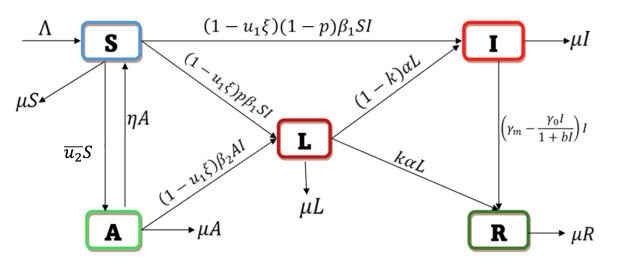
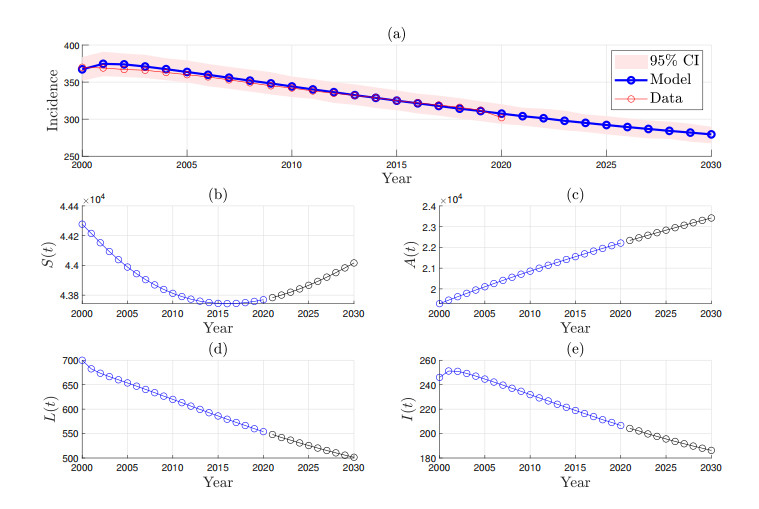
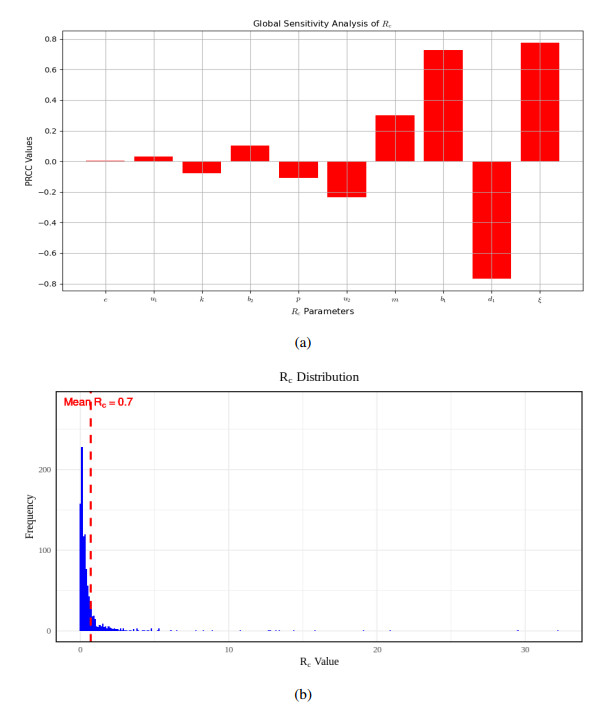
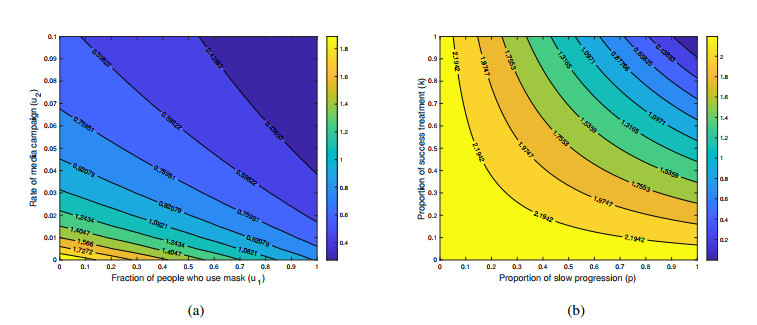
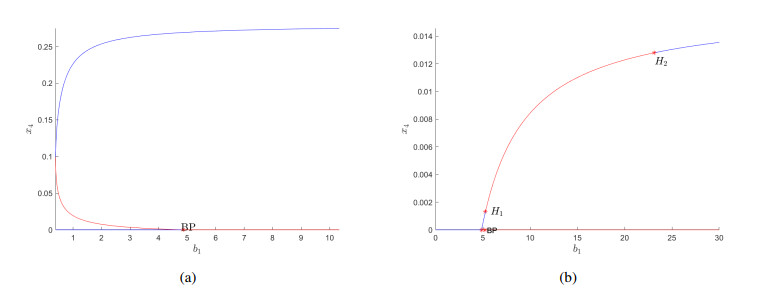
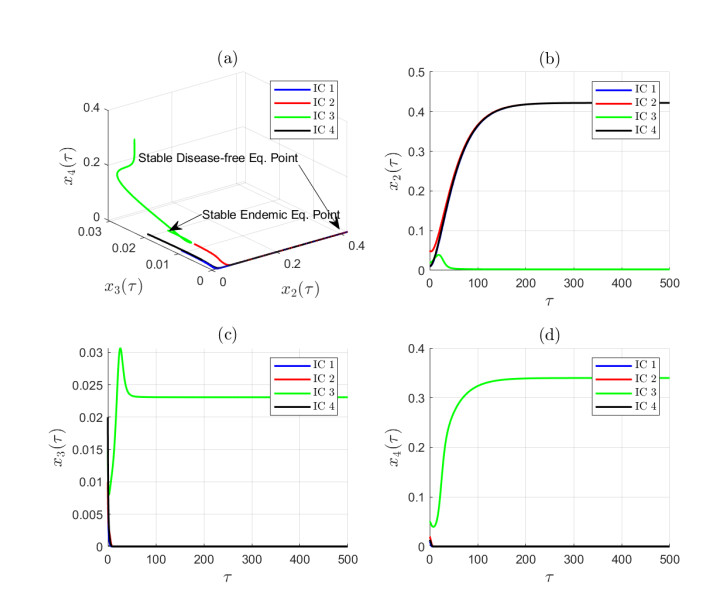
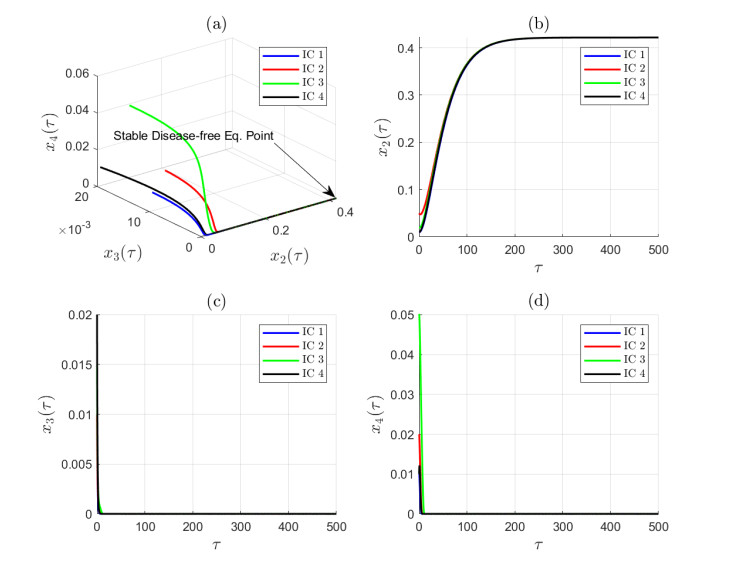
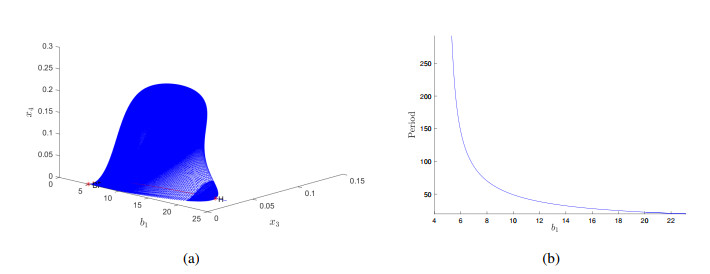
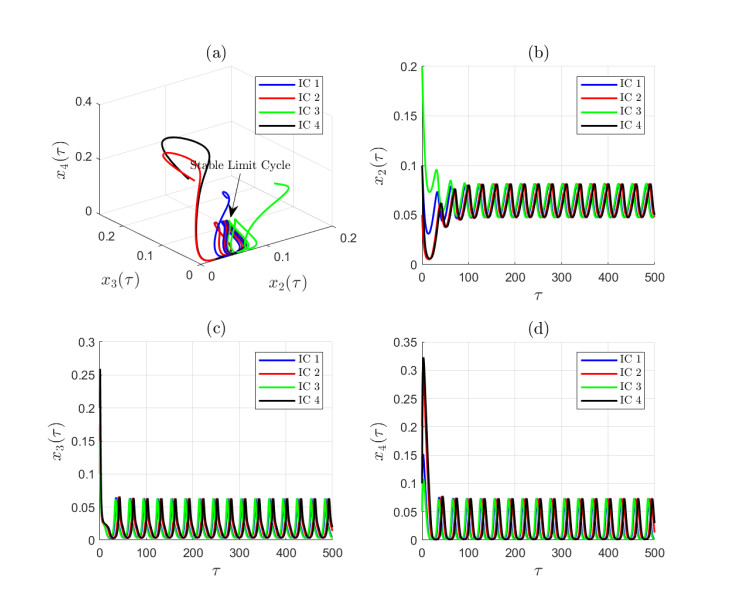
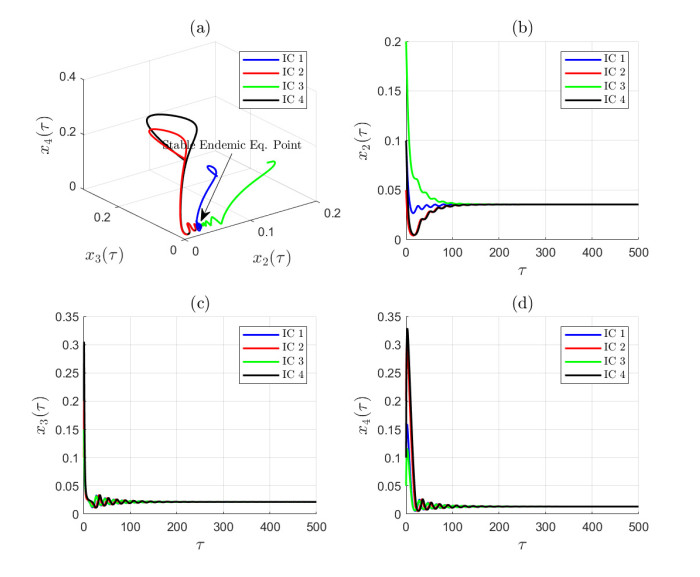
In this study, we present a unified mathematical model for tuberculosis (TB) that integrates key interventions: Mask use and media campaigns to raise community awareness and promote vaccine booster uptake. The model also incorporates slow–fast disease progression and limited treatment capacity. A mathematical analysis was conducted to determine the existence and stability of equilibrium points. From the mathematical analysis on the stability criteria of the TB-free equilibrium point, we show that TB can be eradicated if the basic reproduction number is below one. However, due to insufficient treatment capacity, a backward bifurcation may occur when the reproduction number equals one, enabling the coexistence of endemic and disease-free equilibria even when the reproduction number is below one. The parameter estimation is based on TB incidence data per 100,000 individuals in Indonesia. Sensitivity analysis reveald that although both interventions are effective, media campaigns combined with vaccine boosters are more impactful in reducing TB transmission than the use of masks. Numerical simulations further suggest the possibility of periodic outbreaks, indicating potential seasonal TB patterns. To explore adaptive intervention strategies, we extended the model using an optimal control framework. Our findings suggested that combined implementation of face masks and media campaigns is more effective than using either alone, particularly when the likelihood of rapid disease progression increases.
Citation: Dipo Aldila, Chidozie Williams Chukwu, Eka D. A. Ginting, F. Fatmawati, Faishal Farrel Herdicho, Mohammad Ivan Azis, S. Sutrisno. Backward bifurcation and periodic dynamics in a tuberculosis model with integrated control strategies[J]. Mathematical Biosciences and Engineering, 2025, 22(10): 2720-2760. doi: 10.3934/mbe.2025100
In this study, we present a unified mathematical model for tuberculosis (TB) that integrates key interventions: Mask use and media campaigns to raise community awareness and promote vaccine booster uptake. The model also incorporates slow–fast disease progression and limited treatment capacity. A mathematical analysis was conducted to determine the existence and stability of equilibrium points. From the mathematical analysis on the stability criteria of the TB-free equilibrium point, we show that TB can be eradicated if the basic reproduction number is below one. However, due to insufficient treatment capacity, a backward bifurcation may occur when the reproduction number equals one, enabling the coexistence of endemic and disease-free equilibria even when the reproduction number is below one. The parameter estimation is based on TB incidence data per 100,000 individuals in Indonesia. Sensitivity analysis reveald that although both interventions are effective, media campaigns combined with vaccine boosters are more impactful in reducing TB transmission than the use of masks. Numerical simulations further suggest the possibility of periodic outbreaks, indicating potential seasonal TB patterns. To explore adaptive intervention strategies, we extended the model using an optimal control framework. Our findings suggested that combined implementation of face masks and media campaigns is more effective than using either alone, particularly when the likelihood of rapid disease progression increases.

| [1] |
D. Aldila, B. L. Fardian, C. W. Chukwu, M. H. N. Aziz, P. Z. Kamalia, Improving tuberculosis control: Assessing the value of medical masks and case detection—a multi-country study with cost-effectiveness analysis, R. Soc. Open Sci., 11 (2024), 231715. https://doi.org/10.1098/rsos.231715 doi: 10.1098/rsos.231715

|
| [2] | Centers for Disease Control and Prevention, Signs and Symptoms of Tuberculosis, 2024, [Online; accessed 10-May-2024]. Available from: https://www.cdc.gov/tb/signs-symptoms/?CDC_AAref_Val = https://www.cdc.gov/tb/topic/basics/signsandsymptoms.htm. |
| [3] |
C. W. Chukwu, E. Bonyah, M. L. Juga, F. Fatmawati, On mathematical modeling of fractional-order stochastic for tuberculosis transmission dynamics, Results Control Optim., 11 (2023), 100238. https://doi.org/10.1016/j.rico.2023.100238 doi: 10.1016/j.rico.2023.100238
|
| [4] | WHO, Global Tuberculosis Report 2022, 2022, [Online; accessed 22-May-2024]. Available from: https://cdn.who.int/media/docs/default-source/hq-tuberculosis/global-tuberculosis-report-2022/global-tb-report-2022-factsheet.pdf?sfvrsn = 88f8d76_8 & download = true. |
| [5] | WHO, Global Tuberculosis Report 2023, 2023, [Online; accessed 25-May-2024]. Available from: https://www.who.int/publications/i/item/9789240061729. |
| [6] | WHO, Global Tuberculosis Report 2020, 2020, [Online; accessed 15-May-2024]. Available from: https://www.who.int/publications/i/item/9789240013131. |
| [7] | WHO, Global Tuberculosis Report 2019, 2019, [Online; accessed 2-May-2024]. Available from: https://www.who.int/publications/i/item/9789241565714. |
| [8] | S. D. Lawn, A. I. Zumla, Tuberculosis, Lancet, 378 (2011), 57–72. https://doi.org/10.1016/S0140-6736(10)62173-3 |
| [9] |
B. Song, C. Castillo-Chavez, J. P. Aparicio, Tuberculosis models with fast and slow dynamics: The role of close and casual contacts, Math. Biosci., 180 (2002), 187–205. https://doi.org/10.1016/S0025-5564(02)00112-8 doi: 10.1016/S0025-5564(02)00112-8
|
| [10] |
R. Xu, J. Yang, X. Tian, J. Lin, Global dynamics of a tuberculosis model with fast and slow progression and age-dependent latency and infection, J. Biol. Dyn., 13 (2019), 675–705. https://doi.org/10.1080/17513758.2019.1683628 doi: 10.1080/17513758.2019.1683628
|
| [11] | Stop TB Partnership, Stop TB Partnership: Global Plan to End TB 2023–2030, [Online; accessed 22-May-2024]. Available from: https://www.stoptb.org/news/launched-global-plan-end-tb-2023-2030. |
| [12] | Centers for Disease Control and Prevention. TB Disease Treatment: 6- or 9-Month Ripe tb Treatment Regimen, 2023, [Online; accessed 20-May-2024]. Available from: https://www.cdc.gov/tb/webcourses/tb101/page16413.html. |
| [13] | A. S. Weichel, Antimycobacterial therapy for tuberculosis, Am. Fam. Physician, 61 (2000), 861–862. Available from: https://www.aafp.org/pubs/afp/issues/2000/0201/p861.html. |
| [14] | International Union Against Tuberculosis and Lung Disease, Guide for the Clinical and Operational Management of Drug-Resistant Tuberculosis, 2013, [Online; accessed 23-July-2025]. Available from: https://theunion.org/sites/default/files/2020-08/mdr-tbguide_6-19-13_web.pdf. |
| [15] |
M. Majumder, P. K. Tiwari, S. Pal, Impact of saturated treatments on HIV-TB dual epidemic as a consequence of COVID-19: Optimal control with awareness and treatment, Nonlinear Dyn., 109 (2022), 143–176. https://doi.org/10.1007/s11071-022-07395-6 doi: 10.1007/s11071-022-07395-6
|
| [16] |
S. Athithan, M. Ghosh, Mathematical modelling of TB with the effects of case detection and treatment, Int. J. Dyn. Control, 1 (2013), 223–230. https://doi.org/10.1007/s40435-013-0020-2 doi: 10.1007/s40435-013-0020-2
|
| [17] |
D. Aldila, J. P. Chávez, K. P. Wijaya, N. C. Ganegoda, G. M. Simorangkir, H. Tasman, et al., A tuberculosis epidemic model as a proxy for the assessment of the novel M72/AS01E vaccine, Commun. Nonlinear Sci. Numer. Simul., 120 (2023), 107162. https://doi.org/10.1016/j.cnsns.2023.107162 doi: 10.1016/j.cnsns.2023.107162
|
| [18] |
Y. D. Zhang, H. F. Huo, H. Xiang, Dynamics of tuberculosis with fast and slow progression and media coverage, Math. Biosci. Eng., 16 (2019), 1150–1170. https://doi.org/10.3934/mbe.2019055 doi: 10.3934/mbe.2019055
|
| [19] |
K. K. Avilov, A. A. Romanyukha, E. M. Belilovsky, S. E. Borisov, Mathematical modelling of the progression of active tuberculosis: Insights from fluorography data, Infect. Dis. Modell., 7 (2022), 374–386. https://doi.org/10.1016/j.idm.2022.06.007 doi: 10.1016/j.idm.2022.06.007
|
| [20] |
T. Sumner, R. G. White, The predicted impact of tuberculosis preventive therapy: The importance of disease progression assumptions, BMC Infect. Dis., 20 (2020), 880. https://doi.org/10.1186/s12879-020-05592-5 doi: 10.1186/s12879-020-05592-5
|
| [21] |
K. C. Chong, C. C. Leung, W. W. Yew, B. C. Y. Zee, G. C. H. Tam, M. H. Wang, et al., Mathematical modelling of the impact of treating latent tuberculosis infection in the elderly in a city with intermediate tuberculosis burden, Sci. Rep., 9 (2019), 4869. https://doi.org/10.1038/s41598-019-41256-4 doi: 10.1038/s41598-019-41256-4
|
| [22] |
S. Bowong, J. J. Tewa, Mathematical analysis of a tuberculosis model with differential infectivity, Commun. Nonlinear Sci. Numer. Simul., 14 (2009), 4010–4021. https://doi.org/10.1016/j.cnsns.2009.02.017 doi: 10.1016/j.cnsns.2009.02.017
|
| [23] |
L. Liu, Y. Wang, A mathematical study of a tb model with treatment interruptions and two latent periods, Comput. Math. Methods Med., 2014 (2014), 932186. https://doi.org/10.1155/2014/932186 doi: 10.1155/2014/932186
|
| [24] |
D. Okuonghae, B. O. Ikhimwin, Dynamics of a mathematical model for tuberculosis with variability in susceptibility and disease progressions due to difference in awareness level, Front. Microbiol., 6 (2016), 1530. https://doi.org/10.3389/fmicb.2015.01530 doi: 10.3389/fmicb.2015.01530
|
| [25] |
D. C. Maulana, M. I. Utoyo, U. D. Purwati, C. W. Chukw, Parameter estimation and analysis on sis-seis types model of tuberculosis transmission in east java indonesia, Commun. Math. Biol. Neurosci., 2022 (2022), 114. https://doi.org/10.28919/cmbn/7739 doi: 10.28919/cmbn/7739
|
| [26] | E. P. Hafidh, N. Aulida, B. D. Handari, D. Aldila, Optimal control problem from tuberculosis and multidrug resistant tuberculosis transmission model, in AIP Conference Proceedings 2018, AIP Publishing, 2023 (2018), 020223. https://doi.org/10.1063/1.5064220 |
| [27] |
O. Diekmann, J. A. P. Heesterbeek, M. G. Roberts, The construction of next-generation matrices for compartmental epidemic models, J. R. Soc. Interface, 7 (2010), 873–885. https://doi.org/10.1098/rsif.2009.0386 doi: 10.1098/rsif.2009.0386
|
| [28] |
C. Castillo-Chavez, B. Song, Dynamical models of tuberculosis and their applications, Math. Biosci. Eng., 1 (2004), 361–404. https://doi.org/10.3934/mbe.2004.1.361 doi: 10.3934/mbe.2004.1.361
|
| [29] |
D. Aldila, A. H. Hassan, M. H. N. Aziz, P. Z. Kamalia, An analytical transmission model for evaluating pneumonia vaccination and control strategies, Healthcare Anal., 7 (2025), 100394. https://doi.org/10.1016/j.health.2025.100394 doi: 10.1016/j.health.2025.100394
|
| [30] |
D. Aldila, A. H. Hassan, C. W. Chukwu, S. Y. Tchoumi, M. H. N. Aziz, Evaluating vaccination and quarantine for measles intervention strategy in jakarta, indonesia through mathematical modeling, Partial Differ. Equations Appl. Math., 14 (2025), 101191. https://doi.org/10.1016/j.padiff.2025.101191 doi: 10.1016/j.padiff.2025.101191
|
| [31] |
F. A. Oguntolu, O. J. Peter, D. Aldila, G. B. Balogun, O. P. Ogunmola, B. I. Omede, Mathematical analysis of the transmission dynamics of hepatitis B virus, Braz. J. Phys., 55 (2025), 160. https://doi.org/10.1007/s13538-025-01772-3 doi: 10.1007/s13538-025-01772-3
|
| [32] |
O. J. Peter, D. Aldila, T. A. Ayoola, G. B. Balogun, F. A. Oguntolu, Modeling tuberculosis dynamics with vaccination and treatment strategies, Sci. Afr., 28 (2025), e02647. https://doi.org/10.1016/j.sciaf.2025.e02647 doi: 10.1016/j.sciaf.2025.e02647
|
| [33] |
D. Aldila, Change in stability direction induced by temporal interventions: A case study of a tuberculosis transmission model with relapse and reinfection, Front. Appl. Math. Stat., 11 (2025), 1541981. https://doi.org/10.3389/fams.2025.1541981 doi: 10.3389/fams.2025.1541981
|
| [34] |
H. A. Fatahillah, D. Aldila, Forward and backward bifurcation analysis from an imperfect vaccine efficacy model with saturated treatment and saturated infection, Jambura J. Biomath., 5 (2024), 132–143. https://doi.org/10.37905/jjbm.v5i2.28810 doi: 10.37905/jjbm.v5i2.28810
|
| [35] |
D. Aldila, J. P. Chávez, C. W. Chukwu, A. Y. Fathiyah, J. W. Puspita, K. A. D. Setio, et al., Unraveling dengue dynamics with data calibration from palu and jakarta: Optimizing active surveillance and fogging interventions, Chaos, Solitons Fractals, 189 (2024), 115729. https://doi.org/10.1016/j.chaos.2024.115729 doi: 10.1016/j.chaos.2024.115729
|
| [36] |
W. M. Liu, Criterion of hopf bifurcations without using eigenvalues, J. Math. Anal. Appl., 182 (1994), 250–256. https://doi.org/10.1006/jmaa.1994.1079 doi: 10.1006/jmaa.1994.1079
|
| [37] | World Bank, Incidence of Tuberculosis (per 100,000 people), 2024, [Online; accessed 08-March-2024]. Available from: https://data.worldbank.org/indicator/SH.TBS.INCD. |
| [38] |
S. Marino, I. B. Hogue, C. J. Ray, D. E. Kirschner, A methodology for performing global uncertainty and sensitivity analysis in systems biology, J. Theor. Biol., 254 (2008), 178–196. https://doi.org/10.1016/j.jtbi.2008.04.011 doi: 10.1016/j.jtbi.2008.04.011
|
| [39] |
H. Tasman, D. Aldila, P. A. Dumbela, M. Z. Ndii, F. Fatmawati, F. F. Herdicho, et al., Assessing the impact of relapse, reinfection and recrudescence on malaria eradication policy: A bifurcation and optimal control analysis, Trop. Med. Infect. Dis., 7 (2022), 263. https://doi.org/10.3390/tropicalmed7100263 doi: 10.3390/tropicalmed7100263
|
| [40] |
B. D. Handari, R. A. Ramadhani, C. W. Chukwu, S. H. A. Khoshnaw, D. Aldila, An optimal control model to understand the potential impact of the new vaccine and transmission-blocking drugs for malaria: A case study in papua and west papua, Indonesia, Vaccines, 10 (2022), 1174. https://doi.org/10.3390/vaccines10081174 doi: 10.3390/vaccines10081174
|
| [41] |
F. Fatmawati, C. W. Chukwu, R. T. Alqahtani, C. Alfiniyah, F. F. Herdicho, Tasmi, A Pontryagin's maximum principle and optimal control model with cost-effectiveness analysis of the COVID-19 epidemic, Decis. Anal. J., 8 (2023), 100273. https://doi.org/10.1016/j.dajour.2023.100273 doi: 10.1016/j.dajour.2023.100273
|
| [42] |
F. Fatmawati, F. F. Herdicho, W. Windarto, C. W. Chukwu, H. Tasman, An optimal control of malaria transmission model with mosquito seasonal factor, Results Phys., 25 (2021), 104238. https://doi.org/10.1016/j.rinp.2021.104238 doi: 10.1016/j.rinp.2021.104238
|
| [43] |
D. Aldila, N. Awdinda, F. Fatmawati, F. F. Herdicho, M. Z. Ndii, C. W. Chukwu, Optimal control of pneumonia transmission model with seasonal factor: Learning from jakarta incidence data, Heliyon, 9 (2023), e18096. https://doi.org/10.1016/j.heliyon.2023.e18096 doi: 10.1016/j.heliyon.2023.e18096
|
| [44] |
C. W. Chukwu, Z. Chazuka, S. Safdar, I. H. Febriana, D. Aldila, Assessing Syphilis transmission among msm population incorporating low and high-risk infection: A modeling study, Comput. Appl. Math., 43 (2024), 205. https://doi.org/10.1007/s40314-024-02669-8 doi: 10.1007/s40314-024-02669-8
|
| [45] |
M. McAsey, L. Mou, W. Han, Convergence of the forward-backward sweep method in optimal control, Comput. Optim. Appl., 53 (2012) 207–226. https://doi.org/10.1007/s10589-011-9454-7 doi: 10.1007/s10589-011-9454-7
|
| [46] |
D. Aldila, R. P. Dhanendra, S. H. A. Khoshnaw, J. W. Puspita, P. Z. Kamalia, M. Shahzad, Understanding HIV/AIDS dynamics: Insights from CD4+T cells, antiretroviral treatment, and country-specific analysis, Front. Public Health, 12 (2024), 1324858. https://doi.org/10.3389/fpubh.2024.1324858 doi: 10.3389/fpubh.2024.1324858
|
| [47] |
I. H. Febiriana, A. H. Hassan, D. Aldila, Enhancing Malaria control strategy: Optimal control and cost-effectiveness analysis on the impact of vector bias on the efficacy of mosquito repellent and hospitalization, J. Appl. Math., 2024 (2024), 9943698. https://doi.org/10.1155/2024/9943698 doi: 10.1155/2024/9943698
|
| [48] |
C. K. Mahadhika, D. Aldila, A deterministic transmission model for analytics-driven optimization of COVID-19 post-pandemic vaccination and quarantine strategies, Math. Biosci. Eng., 21 (2024), 4956–4988. https://doi.org/10.3934/mbe.2024219 doi: 10.3934/mbe.2024219
|
| [49] |
A. H. Hassan, D. Aldila, M. H. N. Aziz, Optimal control and stability analysis of monkeypox transmission dynamics with the impact of contaminated surfaces, Front. Appl. Math. Stat., 10 (2024), 1372579. https://doi.org/10.3389/fams.2024.1372579 doi: 10.3389/fams.2024.1372579
|
| [50] |
W. Li, Y. Wang, J. Cao, M. Abdel-Aty, Dynamics and backward bifurcations of sei tuberculosis models in homogeneous and heterogeneous populations, J. Math. Anal. Appl., 543 (2025), 128924. https://doi.org/10.1016/j.jmaa.2024.128924 doi: 10.1016/j.jmaa.2024.128924
|
| [51] |
R. Pastor-Satorras, C. Castellano, P. V. Mieghem, A. Vespignani, Epidemic processes in complex networks, Rev. Mod. Phys., 87 (2015), 925–979. https://doi.org/10.1103/RevModPhys.87.925 doi: 10.1103/RevModPhys.87.925
|
Figures(17) / Tables(3)

Dipo Aldila, Chidozie Williams Chukwu, Eka D. A. Ginting, F. Fatmawati, Faishal Farrel Herdicho, Mohammad Ivan Azis, S. Sutrisno. Backward bifurcation and periodic dynamics in a tuberculosis model with integrated control strategies[J]. Mathematical Biosciences and Engineering, 2025, 22(10): 2720-2760. doi: 10.3934/mbe.2025100





 DownLoad: