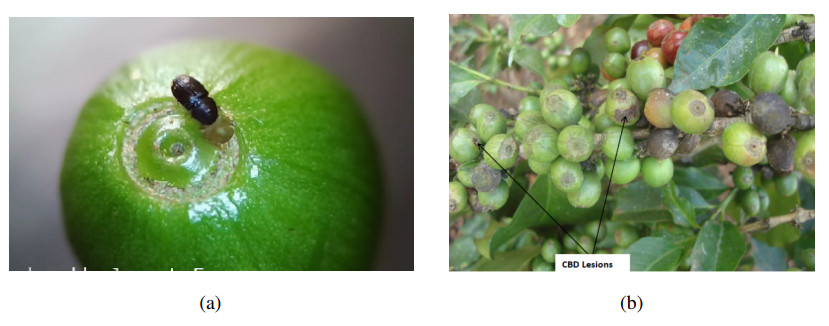
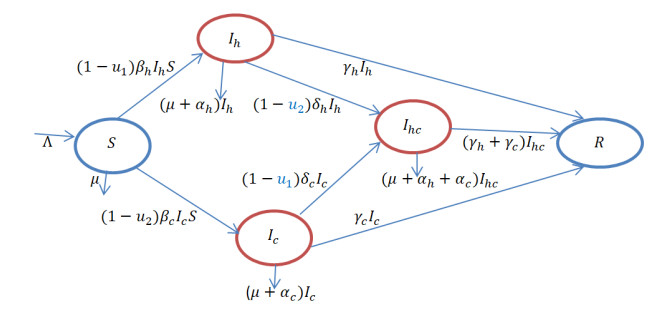
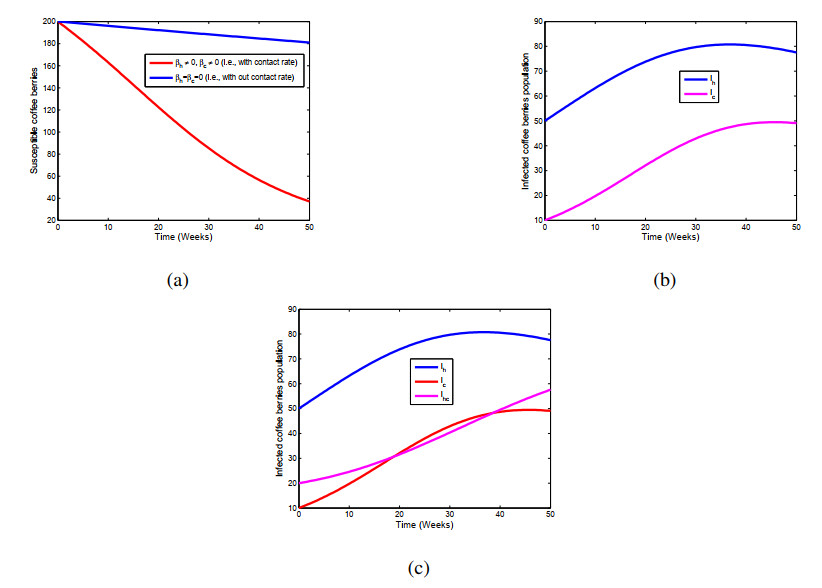
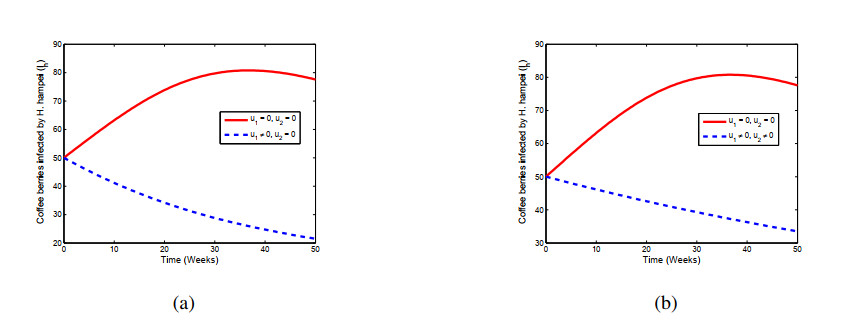
Several pests and diseases are major factors challenging the coffee industry worldwide. Particularly, production of Coffee Arabica in many African countries has been affected by Hypothenemus hampei and Colletotrichum kahawae in a coffee farm. Pest(s) and disease(s) are commonly inter-related and can interact, because pests and pathogens have the same biophysical requirements in ecosystems. Assessment of coffee berries damage due to multiple pests and diseases is a necessary step in designing appropriate control strategies. In this paper, we developed a mathematical model describing the co-dynamics of Hypothenemus hampei (coffee berry borer, CBB) and Colletotrichum kahawae (coffee berry disease, CBD). The model used a system of nonlinear ordinary differential equations to capture the interactions among the CBB pest population, the CBD fungal pathogen, and the healthy and infected coffee berry populations. Optimal control strategies were also incorporated to assess effective management approaches. Optimal control strategies were obtained by minimizing the number of pests and fungal pathogen population by incorporating two control variables such as biological control and cultural practices. The existence of optimal controls was examined using Pontryagin's minimum principle. The Hamiltonian was constructed, and adjoint equations were solved to minimize the cost functional. Lastly, from different scenarios, the numerical simulations were performed to illustrate the model's co-dynamics with and without optimal control strategies.
Citation: Abdisa Shiferaw Melese, Legesse Lemecha Obsu, Feyissa Kebede Bushu. Mathematical modeling for Hypothenemus hampei and Colletotrichum kahawae co-dynamics with optimal control strategies[J]. Mathematical Biosciences and Engineering, 2025, 22(10): 2672-2685. doi: 10.3934/mbe.2025098
Several pests and diseases are major factors challenging the coffee industry worldwide. Particularly, production of Coffee Arabica in many African countries has been affected by Hypothenemus hampei and Colletotrichum kahawae in a coffee farm. Pest(s) and disease(s) are commonly inter-related and can interact, because pests and pathogens have the same biophysical requirements in ecosystems. Assessment of coffee berries damage due to multiple pests and diseases is a necessary step in designing appropriate control strategies. In this paper, we developed a mathematical model describing the co-dynamics of Hypothenemus hampei (coffee berry borer, CBB) and Colletotrichum kahawae (coffee berry disease, CBD). The model used a system of nonlinear ordinary differential equations to capture the interactions among the CBB pest population, the CBD fungal pathogen, and the healthy and infected coffee berry populations. Optimal control strategies were also incorporated to assess effective management approaches. Optimal control strategies were obtained by minimizing the number of pests and fungal pathogen population by incorporating two control variables such as biological control and cultural practices. The existence of optimal controls was examined using Pontryagin's minimum principle. The Hamiltonian was constructed, and adjoint equations were solved to minimize the cost functional. Lastly, from different scenarios, the numerical simulations were performed to illustrate the model's co-dynamics with and without optimal control strategies.

| [1] |
O. Sujaritpong, S. Yoo-Kong, P. Bhadola, Analysis and dynamics of the international coffee trade network, J. Phys. Conf. Ser., 1719 (2021), 012106. https://doi.org/10.1088/1742-6596/1719/1/012106 doi: 10.1088/1742-6596/1719/1/012106

|
| [2] | S. T. Murphy, D. Moore, Biological control of the coffee berry borer, Hypothenemus hampei, (Ferrari) (Coleoptera: Scolytida): Previous programmes and possibilities for the future, Biocontrol News Inf., 11 (1990), 107–117. |
| [3] |
A. Damon, A review of the biology and control of the coffee berry borer, Hypothenemus hampei (coleoptera: Scolytidae), Bull. Entomol. Res., 90 (2000), 453–465. https://doi.org/10.1017/s0007485300000584 doi: 10.1017/s0007485300000584
|
| [4] |
A. Wariyo, S. Kidanu, W. Gebiretsadik, Status and importance of major coffee insect pests in major coffee growing areas of southern Ethiopia, Am. J. Entomol., 6 (2022), 1–6. https://doi.org/10.11648/j.aje.20220601.11 doi: 10.11648/j.aje.20220601.11
|
| [5] |
A. S. Melese, Mathematical model and optimal control analysis of coffee berry borer with temperature and rainfall variability, Int. J. Biomath., 17 (2024), 2350047. https://doi.org/10.1142/S179352452350047X doi: 10.1142/S179352452350047X
|
| [6] | Y. F. Fotso, F. Grognard, B. Tsanou, S. Touzeau, Modelling and control of coffee berry borer infestation, in 11th European Conference on Mathematical and Theoretical Biology (ECMTB), HAL, 2018. |
| [7] |
Y. Y. Marino, V. J. Vega, J. M. Garcia, J. C. Verle Rodrigues, N. M. Garcia, P. Bayman, The coffee berry borer (Coleoptera: Curculionidae) in Puerto Rico: Distribution, infestation, and population per fruit, J. Insect Sci., 17 (2017), 58. https://doi.org/10.1093/jisesa/iew125 doi: 10.1093/jisesa/iew125
|
| [8] |
V. V. Silva, L. Guerra-Guimaraes, H. G. Azinheira, D. Fernandez, A. S. Petitot, B. Bertrand, et al., Coffee resistance to the main diseases: Leaf rust and coffee berry disease, Braz. J. Plant Physiol., 18 (2006), 119–147. https://doi.org/10.1590/S1677-04202006000100010 doi: 10.1590/S1677-04202006000100010
|
| [9] |
J. M. Waller, P. D. Bridge, R. Black, G. Hakiza, Characterization of the coffee berry disease pathogen, Colletotrichum kahawae sp. nov., Mycol. Res., 97 (1993), 989–994. https://doi.org/10.1016/S0953-7562(09)80867-8 doi: 10.1016/S0953-7562(09)80867-8
|
| [10] | F. E. Vega, G. Mercadier, P. F. Dowd, Fungi associated with the coffee berry borer Hypothenemus hampei (ferrari) (coleoptera: Scolytidae), in Proceedings of the 18th International Scientific Colloquium on Coffee, Association Scientifique Internationale du Café (ASIC), (1999), 229–238. |
| [11] |
E. Griffiths, J. N. Gibbs, J. M. Waller, Control of coffee berry disease, Ann. Appl. Biol., 67 (1971), 45–74. https://doi.org/10.1111/j.1744-7348.1971.tb02907.x doi: 10.1111/j.1744-7348.1971.tb02907.x
|
| [12] |
L. M. Serrato-Diaz, Y. A. Marino, P. Bayman, Pathogens causing anthracnose and fruit rots of coffee associated with the coffee berry borer and the entomopathogenic fungus Beauveria bassiana in Puerto Rico, Phytopathology, 110 (2020), 1541–1552. https://doi.org/10.1094/PHYTO-02-20-0057-R doi: 10.1094/PHYTO-02-20-0057-R
|
| [13] | J. M. Waller, M. Bigger, R. J. Hillocks, Coffee Pests, Diseases and Their Management, CABI, 2007. |
| [14] |
M. S. Chan, M. J. Jeger, An analytical model of plant virus disease dynamics with roguing and replanting, J. Appl. Ecol., 31 (1994), 413–427. https://doi.org/10.2307/2404439 doi: 10.2307/2404439
|
| [15] |
Y. F. Fotso, S. Touzeau, B. Tsanou, S. Bowong, F. Grognard, Modelling and optimal strategy to control coffee berry borer, Math. Methods Appl. Sci., 44 (2021), 14569–14592. https://doi.org/ 10.1002/mma.7726 doi: 10.1002/mma.7726
|
| [16] |
A. S. Melese, O. D. Makinde, L. L. Obsu, Mathematical modelling and analysis of coffee berry disease dynamics on a coffee farm, Math. Biosci. Eng., 19 (2022), 7349–7373. http://doi.org/10.3934/mbe.2022347 doi: 10.3934/mbe.2022347
|
| [17] | W. H. Fleming, R. W. Rishel, Deterministic and Stochastic Optimal Control, Springer, 2012. https://doi.org/10.1007/978-1-4612-6380-7 |
| [18] | H. Nyaberi, W. N. Mutuku, D. M. Malonza, G. W. Gachigua, G. Alworah, An optimal control model for coffee berry disease and coffee leaf rust co-infection, J. Math. Anal. Model., 5 (2024), 1–25. |
| [19] | L. F. Lopez-Monsalve, J. Quiroga-Cardona, N. A. Lopez, C. A. Ramirez-Cardona, C. P. Florez-Ramos, Characterization in populations of Coffea arabica L. for resistance to CBD using molecular markers. CS, (2024). https://doi.org/10.25186/.v19i.2230 |
| [20] | W. Workafes, K. Kebede, Coffee production systems in Ethiopia, Ethiopian Agricultural Research Organization, in Proceedings of the Workshop, EARO, (2000), 99–106. Available from: https://agris.fao.org/search/en/providers/122600/records/647235ee53aa8c8963024b4a. |
| [21] |
J. A. Bedimo, D. Bieysse, I. Njiayouom, J. P. Deumeni, C. Cilas, J. L. Notteghem, Effect of cultural practices on the development of arabica coffee berry disease, caused by Colletotrichum kahawae, Eur. J. Plant Pathol., 119 (2007), 391–400. https://doi.org/10.1007/s10658-007-9169-x doi: 10.1007/s10658-007-9169-x
|
| [22] |
L. F. Artistizabal, A. E. Bustillo, S. P. Arthurs, Integration pest management of coffee berry borer: Strategies from latin america that could be useful for coffee farmers in Hawaii, Insects, 7 (2016), 6. https://doi.org/10.3390/insects7010006 doi: 10.3390/insects7010006
|
| [23] |
B. P. Dufour, B. Frerot, Optimization of coffee berry borer, Hypothenemus hampei Ferrari (Col., Scolytidae), mass trappingwith an attractant mixture, J. Appl. Entomol., 132 (2008), 591–600. https://doi.org/10.1111/j.1439-0418.2008.01291.x doi: 10.1111/j.1439-0418.2008.01291.x
|
| [24] |
T. Abraha, F. A. Basir, L. L. Obsu, D. F. M. Delfim, Pest control using farming awareness: Impact of time delays and optimal use of biopesticides, Chaos Soliton Fractals, 146 (2021), 110869. https://doi.org/10.1016/j.chaos.2021.110869 doi: 10.1016/j.chaos.2021.110869
|
| [25] | L. S. Pontryagin, Mathematical Theory of Optimal Processes, Taylor & Francis Group an information business, 2018. https://doi.org/10.1201/9780203749319 |
| [26] |
E. A. Coddington, N. Levinson, T. Teichmann, Theory of ordinary differential equations, Phys. Today, 9 (1956), 18. https://doi.org/10.1063/1.3059875 doi: 10.1063/1.3059875
|
| [27] | S. Lenhart, J. T. Workman, Optimal Control Applied to Biological Models, Chapman and Hall/CRC, 2007. https://doi.org/10.1201/9781420011418 |
Figures(7) / Tables(2)

Abdisa Shiferaw Melese, Legesse Lemecha Obsu, Feyissa Kebede Bushu. Mathematical modeling for Hypothenemus hampei and Colletotrichum kahawae co-dynamics with optimal control strategies[J]. Mathematical Biosciences and Engineering, 2025, 22(10): 2672-2685. doi: 10.3934/mbe.2025098





 DownLoad: