We develop a common two-function framework for best proximity points of non-self mappings in complete non-Archimedean fuzzy metric spaces. In the spirit of Proinov, the contractive condition is written with a pair of auxiliary functions, and this single condition is used for four schemes, namely the fuzzy proximal contraction of the second kind and its interpolative Reich–Rus–Ćirić, Kannan, and Hardy–Rogers forms. For each scheme, two best proximity point theorems are proven under different conditions on the auxiliary functions. The Banach type and the Gregori–Sapena type fuzzy proximal contractions are obtained as special cases, and an example shows that this inclusion is strict. Worked examples illustrate the results. As a stylized illustration, the two branches of the period-two cycle of the logistic map, a caricature of biennial measles outbreaks, are treated as disjoint sets, and the best proximity point gives the parameter value at which the oscillation is mildest.
Citation: Muhammad Amad Sarwar, Jianping Zhao, Caiyun Liu, Amel Ali Alhussan. Second-kind proximal contractions in complete fuzzy metric spaces with a stylized illustration from measles dynamics[J]. AIMS Mathematics, 2026, 11(11): 39316-39352. doi: 10.3934/math.20261513
We develop a common two-function framework for best proximity points of non-self mappings in complete non-Archimedean fuzzy metric spaces. In the spirit of Proinov, the contractive condition is written with a pair of auxiliary functions, and this single condition is used for four schemes, namely the fuzzy proximal contraction of the second kind and its interpolative Reich–Rus–Ćirić, Kannan, and Hardy–Rogers forms. For each scheme, two best proximity point theorems are proven under different conditions on the auxiliary functions. The Banach type and the Gregori–Sapena type fuzzy proximal contractions are obtained as special cases, and an example shows that this inclusion is strict. Worked examples illustrate the results. As a stylized illustration, the two branches of the period-two cycle of the logistic map, a caricature of biennial measles outbreaks, are treated as disjoint sets, and the best proximity point gives the parameter value at which the oscillation is mildest.

| [1] |
B. Schweizer, A. Sklar, Statistical metric spaces, Pacific J. Math., 10 (1960), 313–334. https://doi.org/10.2140/pjm.1960.10.313 |
| [2] |
L. A. Zadeh, Fuzzy sets, Inform. Control, 8 (1965), 338–353. https://doi.org/10.1016/S0019-9958(65)90241-X |
| [3] |
I. Kramosil, J. Michálek, Fuzzy metrics and statistical metric spaces, Kybernetika, 11 (1975), 336–344. |
| [4] |
A. George, P. Veeramani, On some results in fuzzy metric spaces, Fuzzy Sets Syst., 64 (1994), 395–399. https://doi.org/10.1016/0165-0114(94)90162-7 doi: 10.1016/0165-0114(94)90162-7
|
| [5] |
M. Grabiec, Fixed points in fuzzy metric spaces, Fuzzy Sets Syst., 27 (1988), 385–389. https://doi.org/10.1016/0165-0114(88)90064-4 doi: 10.1016/0165-0114(88)90064-4
|
| [6] |
V. Gregori, A. Sapena, On fixed-point theorems in fuzzy metric spaces, Fuzzy Sets Syst., 125 (2002), 245–252. https://doi.org/10.1016/S0165-0114(00)00088-9 doi: 10.1016/S0165-0114(00)00088-9
|
| [7] |
T. Suzuki, M. Kikkawa, C. Vetro, The existence of best proximity points in metric spaces with the property UC, Nonlinear Anal., 71 (2009), 2918–2926. https://doi.org/10.1016/j.na.2009.01.173 doi: 10.1016/j.na.2009.01.173
|
| [8] |
S. Sadiq Basha, Extensions of Banach's contraction principle, Numer. Funct. Anal. Optim., 31 (2010), 569–576. https://doi.org/10.1080/01630563.2010.485713 doi: 10.1080/01630563.2010.485713
|
| [9] |
S. Sadiq Basha, Best proximity points: global optimal approximate solutions, J. Global Optim., 49 (2011), 15–21. https://doi.org/10.1007/s10898-009-9521-0 doi: 10.1007/s10898-009-9521-0
|
| [10] |
R. Espínola, G. S. R. Kosuru, P. Veeramani, Pythagorean property and best-proximity point theorems, J. Optim. Theory Appl., 164 (2015), 534–550. https://doi.org/10.1007/s10957-014-0583-x doi: 10.1007/s10957-014-0583-x
|
| [11] |
E. Karapınar, Revisiting the Kannan type contractions via interpolation, Adv. Theory Nonlinear Anal. Appl., 2 (2018), 85–87. |
| [12] |
E. Karapınar, R. P. Agarwal, Interpolative Rus–Reich–Ćirić type contractions via simulation functions, An. Şt. Univ. Ovidius Constanţa Ser. Mat., 27 (2019), 137–152. https://doi.org/10.2478/auom-2019-0038 |
| [13] |
E. Karapınar, O. Alqahtani, H. Aydi, On interpolative Hardy–Rogers type contractions, Symmetry, 11 (2018), 8. https://doi.org/10.3390/sym11010008 doi: 10.3390/sym11010008
|
| [14] |
E. Karapınar, A. Fulga, S. S. Yesilkaya, New results on Perov-interpolative contractions of Suzuki type mappings, J. Funct. Spaces, 2021 (2021), 9587604. https://doi.org/10.1155/2021/9587604 doi: 10.1155/2021/9587604
|
| [15] |
P. D. Proinov, Fixed point theorems for generalized contractive mappings in metric spaces, J. Fixed Point Theory Appl., 22 (2020), 21. https://doi.org/10.1007/s11784-020-0756-1 doi: 10.1007/s11784-020-0756-1
|
| [16] |
A. F. Roldán López de Hierro, A. Fulga, E. Karapınar, N. Shahzad, Proinov-type fixed-point results in non-Archimedean fuzzy metric spaces, Mathematics, 9 (2021), 1594. https://doi.org/10.3390/math9141594 doi: 10.3390/math9141594
|
| [17] |
M. Zhou, N. Saleem, X. Liu, A. Fulga, A. F. Roldán López de Hierro, A new approach to Proinov-type fixed-point results in non-Archimedean fuzzy metric spaces, Mathematics, 9 (2021), 3001. https://doi.org/10.3390/math9233001 doi: 10.3390/math9233001
|
| [18] |
U. Ishtiaq, F. Jahangeer, D. A. Kattan, I. K. Argyros, S. Regmi, On orthogonal fuzzy interpolative contractions with applications to Volterra type integral equations and fractional differential equations, Axioms, 12 (2023), 725. https://doi.org/10.3390/axioms12080725 doi: 10.3390/axioms12080725
|
| [19] |
H. A. Hammad, H. Aydi, C. Park, Fixed point approach for solving a system of Volterra integral equations and Lebesgue integral concept in FCM-spaces, AIMS Mathematics, 7 (2022), 9003–9022. https://doi.org/10.3934/math.2022501 doi: 10.3934/math.2022501
|
| [20] |
S. Alizadeh, D. Baleanu, S. Rezapour, Analyzing transient response of the parallel RCL circuit by using the Caputo–Fabrizio fractional derivative, Adv. Differ. Equ., 2020 (2020), 55. https://doi.org/10.1186/s13662-020-2527-0 doi: 10.1186/s13662-020-2527-0
|
| [21] |
I. Altun, A. Taşdemir, On best proximity points of interpolative proximal contractions, Quaest. Math., 44 (2021), 1233–1241. https://doi.org/10.2989/16073606.2020.1785576 doi: 10.2989/16073606.2020.1785576
|
| [22] |
K. Javed, M. Nazam, F. Jahangeer, M. Arshad, M. De la Sen, A new approach to generalized interpolative proximal contractions in non-Archimedean fuzzy metric spaces, AIMS Mathematics, 8 (2023), 2891–2909. https://doi.org/10.3934/math.2023151 doi: 10.3934/math.2023151
|
| [23] |
K. Javed, M. M. Lashin, M. Nazam, H. H. Al Sulami, A. Hussain, M. Arshad, Best proximity point theorems for the generalized fuzzy interpolative proximal contractions, Fractal Fract., 6 (2022), 455. https://doi.org/10.3390/fractalfract6080455 doi: 10.3390/fractalfract6080455
|
| [24] |
R. M. May, Simple mathematical models with very complicated dynamics, Nature, 261 (1976), 459–467. https://doi.org/10.1038/261459a0 doi: 10.1038/261459a0
|
| [25] |
D. J. Earn, P. Rohani, B. M. Bolker, B. T. Grenfell, A simple model for complex dynamical transitions in epidemics, Science, 287 (2000), 667–670. https://doi.org/10.1126/science.287.5453.667 doi: 10.1126/science.287.5453.667
|
| [26] |
H. A. Hammad, H. Aydi, M. G. Alshehri, Solving hybrid functional-fractional equations originating in biological population dynamics with an effect on infectious diseases, AIMS Mathematics, 9 (2024), 14574–14593. https://doi.org/10.3934/math.2024709 doi: 10.3934/math.2024709
|
| [27] |
S. Sadiq Basha, Best proximity point theorems, J. Approx. Theory, 163 (2011), 1772–1781. https://doi.org/10.1016/j.jat.2011.06.012 doi: 10.1016/j.jat.2011.06.012
|
| [28] |
C. Vetro, P. Salimi, Best proximity point results in non-Archimedean fuzzy metric spaces, Fuzzy Inf. Eng., 5 (2013), 417–429. https://doi.org/10.1007/s12543-013-0155-z doi: 10.1007/s12543-013-0155-z
|
| [29] |
T. Li, Y. Guo, Optimal control and cost-effectiveness analysis of a new COVID-19 model for Omicron strain, Physica A, 606 (2022), 128134. https://doi.org/10.1016/j.physa.2022.128134 doi: 10.1016/j.physa.2022.128134
|
| [30] |
T. Li, Y. Guo, Modeling and optimal control of mutated COVID-19 (Delta strain) with imperfect vaccination, Chaos Solitons Fract., 156 (2022), 111825. https://doi.org/10.1016/j.chaos.2022.111825 doi: 10.1016/j.chaos.2022.111825
|
| [31] |
Y. Guo, T. Li, Modeling the transmission of second-wave COVID-19 caused by imported cases: a case study, Math. Methods Appl. Sci., 45 (2022), 8096–8114. https://doi.org/10.1002/mma.8041 doi: 10.1002/mma.8041
|
Figures(7) / Tables(4)

Muhammad Amad Sarwar, Jianping Zhao, Caiyun Liu, Amel Ali Alhussan. Second-kind proximal contractions in complete fuzzy metric spaces with a stylized illustration from measles dynamics[J]. AIMS Mathematics, 2026, 11(11): 39316-39352. doi: 10.3934/math.20261513

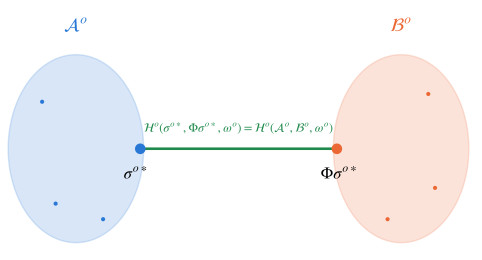
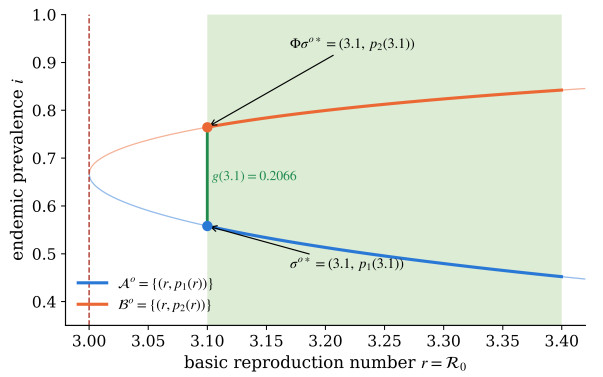
A best proximity point $ \sigma^{o\ast}\in\mathcal{A}^{o} $ and its image $ \Phi\sigma^{o\ast}\in\mathcal{B}^{o} $, which attain the optimal proximity of the two sets
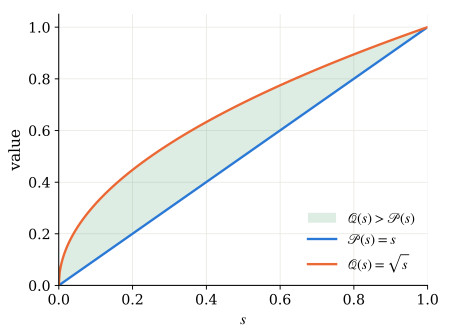
The auxiliary functions $ \mathscr{P}(s) = s $ and $ \mathscr{Q}(s) = \sqrt{s} $ of Example 3.2, with $ \mathscr{Q} > \mathscr{P} $ on $ (0, 1) $
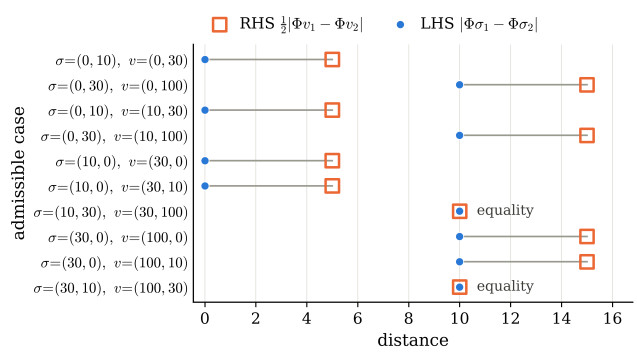
Example 3.8 with $ \mathscr{P}(t) = \ln t $ and $ \mathscr{Q}(t) = \frac12\ln t $. Each row is an admissible case, and the horizontal axis shows LHS $ = |\Phi\sigma^{o}_{1}-\Phi\sigma^{o}_{2}| $ and RHS $ = \frac12|\Phi v_{1}-\Phi v_{2}| $. LHS $ \leq $ RHS in all ten cases
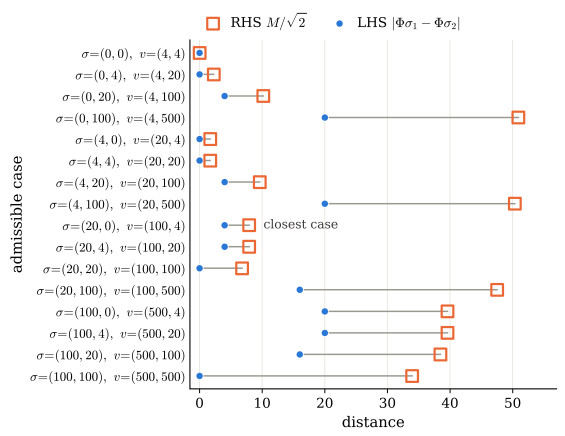
Example 3.12 with $ \alpha = \frac25 $, $ \beta = \frac15 $, $ \mathscr{P}(t) = -(\ln t)^{2} $, and $ \mathscr{Q}(t) = -\frac12(\ln t)^{2} $. Each row is an admissible case, and the horizontal axis shows LHS $ = |\Phi\sigma^{o}_{1}-\Phi\sigma^{o}_{2}| $ and RHS $ = M/\sqrt{2} $. LHS $ \leq $ RHS in all sixteen cases
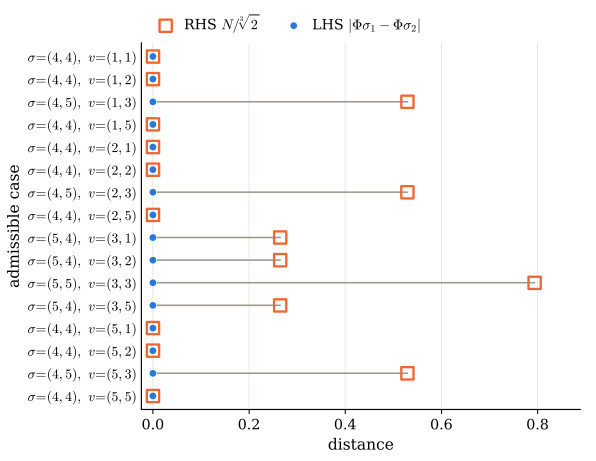
Example 3.16 with $ \alpha = \frac13 $, $ \mathscr{P}(t) = (\ln t)^{3} $, and $ \mathscr{Q}(t) = \frac12(\ln t)^{3} $. Each row is an admissible case, and the horizontal axis shows LHS $ = |\Phi\sigma^{o}_{1}-\Phi\sigma^{o}_{2}| = 0 $ and RHS $ = N/\sqrt[3]{2} $, where $ N = \alpha|\Phi v_{1}-\Phi\sigma^{o}_{1}|+(1-\alpha)|\Phi v_{2}-\Phi\sigma^{o}_{2}| $
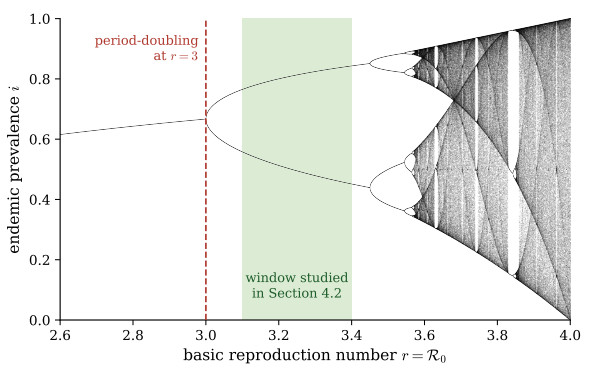
Bifurcation diagram of the logistic map $ i_{l+1} = r\, i_{l}(1-i_{l}) $ for $ r\in[2.6, 4] $. The dashed line marks $ r = 3 $, and the shaded band is the window $ [3.1, 3.4] $ of Section 4.2
The best proximity point $ \sigma^{o\ast} = (3.1, p_{1}(3.1)) $ and its image $ \Phi\sigma^{o\ast} $. The thick curves are $ \mathcal{A}^{o} $ and $ \mathcal{B}^{o} $ over the shaded window $ [3.1, 3.4] $, and the segment between the two points has length $ g(3.1) = 0.2066 $




 DownLoad: