This paper investigated the Riemann problem for the Aw–Rascle (AR) traffic flow model with variable velocity offset. The model describes traffic flow under different road conditions, such as the transition from urban roads to rural ones. A stationary wave was introduced in the traffic flow. The resonance phenomena and wave coalescence were analyzed. Uniqueness of the Riemann solution was also discussed. We further studied the interaction of elementary waves case by case, under the framework of the characteristic analysis method. Numerical simulations were presented to validate the analytical results.
Citation: Shuzhi Liu, Yuanhong Wu. The Riemann problem and interaction of waves for the Aw–Rascle model with variable velocity offset[J]. AIMS Mathematics, 2026, 11(11): 39260-39292. doi: 10.3934/math.20261511
This paper investigated the Riemann problem for the Aw–Rascle (AR) traffic flow model with variable velocity offset. The model describes traffic flow under different road conditions, such as the transition from urban roads to rural ones. A stationary wave was introduced in the traffic flow. The resonance phenomena and wave coalescence were analyzed. Uniqueness of the Riemann solution was also discussed. We further studied the interaction of elementary waves case by case, under the framework of the characteristic analysis method. Numerical simulations were presented to validate the analytical results.

| [1] |
A. Aw, M. Rascle, Resurrection of "second order" models of traffic flow, SIAM J. Appl. Math., 60 (2000), 916–938. https://doi.org/10.1137/S0036139997332099 doi: 10.1137/S0036139997332099
|
| [2] |
C. F. Daganzo, Requiem for second-order fluid approximations of traffic flow, Transp. Res. Part B Methodol., 29 (1995), 277–286. https://doi.org/10.1016/0191-2615(95)00007-Z doi: 10.1016/0191-2615(95)00007-Z
|
| [3] |
H. M. Zhang, A non-equilibrium traffic model devoid of gas-like behavior, Transp. Res. Part B Methodol., 36 (2002), 275–290. https://doi.org/10.1016/S0191-2615(00)00050-3 doi: 10.1016/S0191-2615(00)00050-3
|
| [4] |
W. F. Jiang, Z. Wang, Developing an Aw–Rascle model of traffic flow, J. Eng. Math., 97 (2016), 135–146. https://doi.org/10.1007/s10665-015-9801-2 doi: 10.1007/s10665-015-9801-2
|
| [5] |
Z. Shao, The Riemann problem for a traffic flow model, Phys. Fluids, 35 (2023), 036104. https://doi.org/10.1063/5.0141732 doi: 10.1063/5.0141732
|
| [6] |
C. Shen, M. Sun, Formation of delta shocks and vacuum states in the vanishing pressure limit of Riemann solutions to the perturbed Aw–Rascle model, J. Differ. Equations, 249 (2010), 3024–3051. https://doi.org/10.1016/j.jde.2010.09.004 doi: 10.1016/j.jde.2010.09.004
|
| [7] |
G. Yin, J. Chen, Existence and stability of Riemann solution to the Aw–Rascle model with friction, Indian J. Pure Appl. Math., 49 (2018), 671–688. https://doi.org/10.1007/s13226-018-0294-3 doi: 10.1007/s13226-018-0294-3
|
| [8] |
M. Sun, Interactions of elementary waves for the Aw–Rascle model, SIAM J. Appl. Math., 69 (2009), 1542–1558. https://doi.org/10.1137/080731402 doi: 10.1137/080731402
|
| [9] |
X. Xin, M. Sun, The vanishing pressure limits of Riemann solutions for the Aw–Rascle hydrodynamic traffic flow model with the logarithmic equation of state, Chaos Solitons Fract., 181 (2024), 114671. https://doi.org/10.1016/j.chaos.2024.114671 doi: 10.1016/j.chaos.2024.114671
|
| [10] |
J. M. Greenberg, Extensions and amplifications of a traffic model of Aw and Rascle, SIAM J. Appl. Math., 62 (2002), 729–745. https://doi.org/10.1137/S0036139900378657 doi: 10.1137/S0036139900378657
|
| [11] |
M. Herty, M. Rascle, Coupling conditions for a class of second-order models for traffic flow, SIAM J. Math. Anal., 38 (2006), 595–616. https://doi.org/10.1137/05062617X doi: 10.1137/05062617X
|
| [12] |
Y. Wu, S. Liu, Q. Zhang, A constrained Aw–Rascle-type traffic flow model: formulation and numerical validation, Appl. Math. Comput., 531 (2026), 130171. https://doi.org/10.1016/j.amc.2026.130171 doi: 10.1016/j.amc.2026.130171
|
| [13] |
F. Berthelin, P. Degond, M. Delitala, M. Rascle, A model for the formation and evolution of traffic jams, Arch. Ration. Mech. Anal., 187 (2008), 185–220. https://doi.org/10.1007/s00205-007-0061-9 doi: 10.1007/s00205-007-0061-9
|
| [14] |
F. Berthelin, P. Degond, V. Le Blanc, S. Moutari, M. Rascle, J. Royer, A traffic-flow model with constraints for the modeling of traffic jams, Math. Models Methods Appl. Sci., 18 (2008), 1269–1298. https://doi.org/10.1142/S0218202508003030 doi: 10.1142/S0218202508003030
|
| [15] |
Y. Hu, G. Wang, The resonance behavior for the coupling of two Aw–Rascle traffic models, Adv. Differ. Equ., 2020 (2020), 60. https://doi.org/10.1186/s13662-020-2502-9 doi: 10.1186/s13662-020-2502-9
|
| [16] |
P. G. LeFloch, M. D. Thanh, The Riemann problem for fluid flows in a nozzle with discontinuous cross-section, Commun. Math. Sci., 1 (2003), 763–797. https://doi.org/10.4310/cms.2003.v1.n4.a6 doi: 10.4310/cms.2003.v1.n4.a6
|
| [17] |
N. Andrianov, G. Warnecke, The Riemann problem for the Baer–Nunziato two-phase flow model, J. Comput. Phys., 195 (2004), 434–464. https://doi.org/10.1016/j.jcp.2003.10.006 doi: 10.1016/j.jcp.2003.10.006
|
| [18] |
W. Sheng, Q. Zhang, The Riemann problem for a traffic flow model on a road with variable widths, IMA J. Appl. Math., 87 (2022), 757–785. https://doi.org/10.1093/imamat/hxac020 doi: 10.1093/imamat/hxac020
|
| [19] |
Y. Jia, Z. Si, Z. Ju, H. Feng, J. Zhang, X. Yan, et al., Convolutional-recurrent neural network for the prediction of formation and switching dynamics for multicolor solitons, Sci. China Phys. Mech. Astron., 68 (2025), 284211. https://doi.org/10.1007/s11433-025-2679-8 doi: 10.1007/s11433-025-2679-8
|
| [20] |
J. P. Lebacque, S. Mammar, H. Haj-Salem, The Aw–Rascle and Zhang's model: vacuum problems, existence and regularity of the solutions of the Riemann problem, Transp. Res. Part B Methodol., 41 (2007), 710–721. https://doi.org/10.1016/j.trb.2006.11.005 doi: 10.1016/j.trb.2006.11.005
|
| [21] |
Y. Liu, B. Guo, D. Wang, Patterns of emergent nonlinear waves in an initial discontinuity problem of the bad Jaulent–Miodek equation, Acta Math. Appl. Sin. Engl. Ser., 42 (2026), 582–607. https://doi.org/10.1007/s10255-024-1142-3 doi: 10.1007/s10255-024-1142-3
|
| [22] |
Y. Liu, S. Zeng, Structure and dynamic evolution of Riemann problem solutions for the Kundu equation with step-like initial data, Nonlinear Dyn., 113 (2025), 12075–12097. https://doi.org/10.1007/s11071-024-10819-0 doi: 10.1007/s11071-024-10819-0
|
| [23] |
C. Shen, M. Sun, The Riemann problem for the one-dimensional isentropic Euler system under the body force with varying gamma law, Physica D, 448 (2023), 133731. https://doi.org/10.1016/j.physd.2023.133731 doi: 10.1016/j.physd.2023.133731
|
| [24] |
F. Wu, Y. Liu, Z. Yan, Classification and dynamic analysis of nonlinear wave structures evolving from initial discontinuities in the coupled Zakharov–Ito system, Physica D, 482 (2025), 134896. https://doi.org/10.1016/j.physd.2025.134896 doi: 10.1016/j.physd.2025.134896
|
| [25] |
Y. Jia, D. Wang, B. Shen, Z. Ju, Q. Huang, X. Wang, et al., Predicting ultrafast soliton evolution via a parameter-driven neural network, Laser Photonics Rev., 20 (2026), e03212. https://doi.org/10.1002/lpor.202503212 doi: 10.1002/lpor.202503212
|
| [26] |
R. Zhang, Z. Zhao, Y. Hu, J. Kang, Neural-symbolic exact solutions for Camassa–Holm equation, Neurocomputing, 706 (2026), 135040. https://doi.org/10.1016/j.neucom.2026.135040 doi: 10.1016/j.neucom.2026.135040
|
| [27] |
Z. Zhao, R. Zhang, Artificial intelligence-enhanced mathematical derivation method: exact solutions of the Benjamin–Bona–Mahony equation, Eng. Appl. Artif. Intell., 173 (2026), 114464. https://doi.org/10.1016/j.engappai.2026.114464 doi: 10.1016/j.engappai.2026.114464
|
| [28] |
D. Wang, Z. Liu, H. Zhao, H. Qin, G. Bai, C. Chen, et al., Launching by cavitation, Science, 389 (2025), 935–939. https://doi.org/10.1126/science.adu8943 doi: 10.1126/science.adu8943
|
| [29] |
T. Chang, L. Hsiao, The Riemann problem and interaction of waves in gas dynamics, Harlow, Essex: Longman Scientific & Technical, 1989. |
| [30] |
J. Smoller, Shock waves and reaction–diffusion equations, New York: Springer-Verlag, 1994. https://doi.org/10.1007/978-1-4612-0873-0 |
| [31] |
Q. Zhang, W. Sheng, Interaction of elementary waves for the Aw–Rascle traffic flow model with variable lane width, Z. Angew. Math. Phys., 72 (2021), 175. https://doi.org/10.1007/s00033-021-01606-7 doi: 10.1007/s00033-021-01606-7
|
| [32] |
S. Fan, Y. Zhang, Riemann problem and wave interactions for an inhomogeneous Aw–Rascle traffic flow model with extended Chaplygin gas, Int. J. Non-Linear Mech., 152 (2023), 104384. https://doi.org/10.1016/j.ijnonlinmec.2023.104384 doi: 10.1016/j.ijnonlinmec.2023.104384
|
| [33] |
E. Isaacson, B. Temple, Nonlinear resonance in systems of conservation laws, SIAM J. Appl. Math., 52 (1992), 1260–1278. https://doi.org/10.1137/0152073 doi: 10.1137/0152073
|
Figures(24)

Shuzhi Liu, Yuanhong Wu. The Riemann problem and interaction of waves for the Aw–Rascle model with variable velocity offset[J]. AIMS Mathematics, 2026, 11(11): 39260-39292. doi: 10.3934/math.20261511

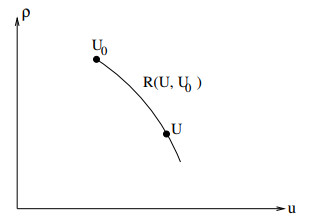
The rarefaction wave for a given $ U_0 $
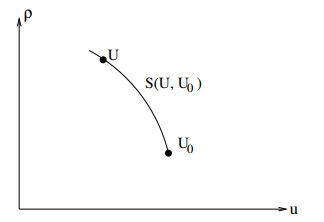
The shock wave for a given $ U_0 $
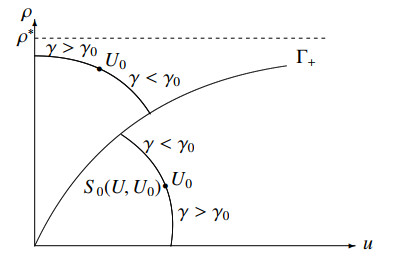
The curve of $ S_0 $
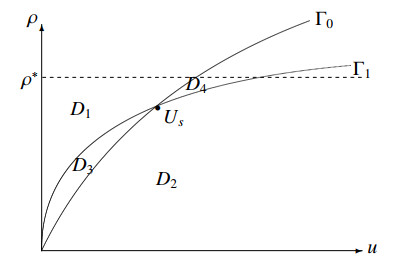
The positions of $ \Gamma_0 $, $ \Gamma_1 $, and the four regions
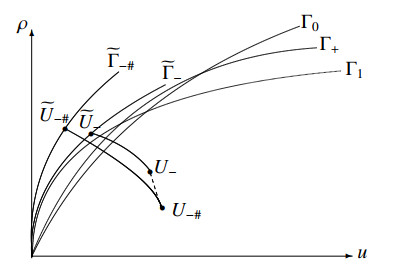
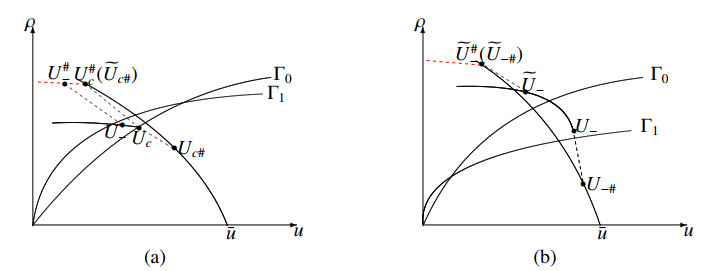
The positions of $ \widetilde{U}_- $ and $ \widetilde{U}_{-\#} $
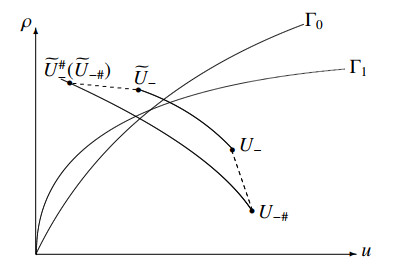
The positions of $ \widetilde{U}_-^{\#} $ and $ \widetilde{U}_{-\#} $
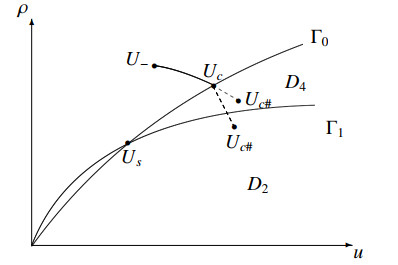
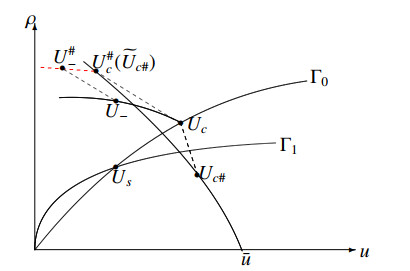
The positions of $ U_{c\#} $ and $ \Gamma_1 $
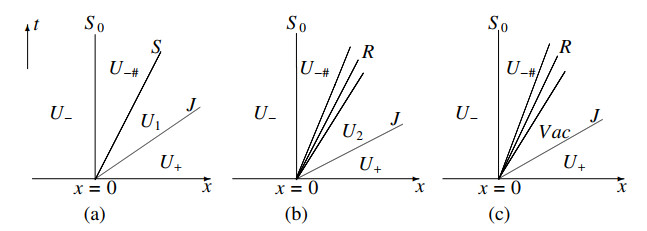
Case 1.1–1.3. $ U_- \in D_2 $
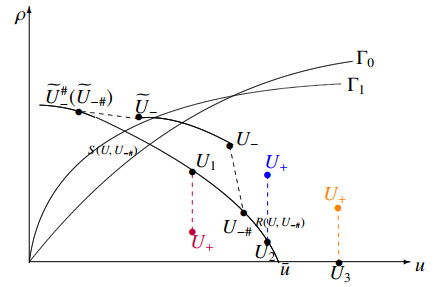
Case 1.1–1.3. (a) $ \widetilde{u}_{-\#} < u_+ < u_{-\#} $; (b) $ u_{-\#} < u_+ < \bar{u} $; (c) $ \bar{u} < u_+ $
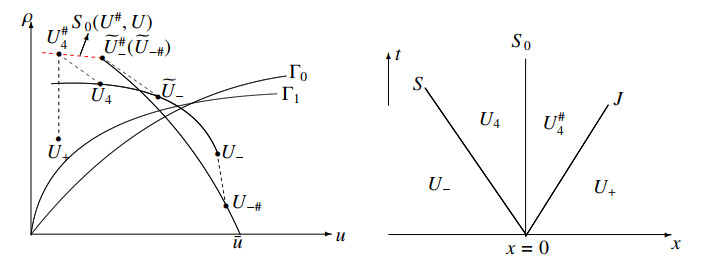
Case 1.4. $ 0 < u_+ < \widetilde{u}_{-\#} $
Case 2.1. $ U_- \in D_1 $, $ u_c < u_s $
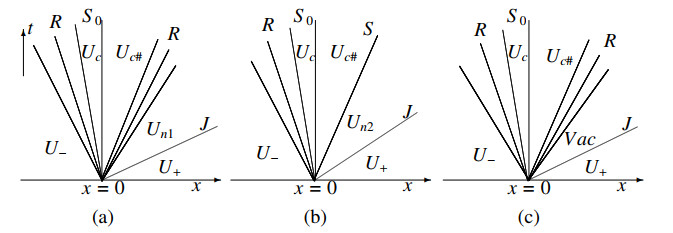
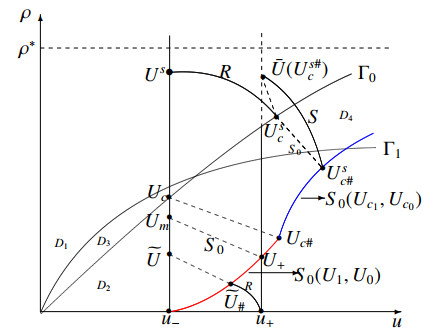
Case 2.1.1–2.1.3. (a) $ u_{c\#} < u_+ < \bar{u} $; (b) $ \widetilde{u}_{c\#} < u_+ < u_{c\#} $; (c) $ u_+ > \bar{u} $
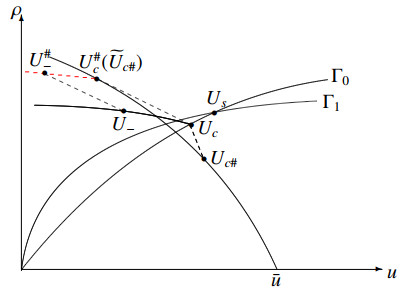
Case 2.1.4. (a) $ 0 < u_+ < u_-^{\#} $; (b) $ u_-^{\#} < u_+ < u_c^{\#} $
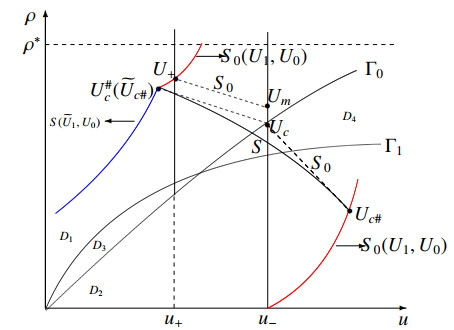
Case 2.2. $ U_- \in D_1 $; $ u_c > u_s $; $ U_{c\#}\in D_2 $
(a) Case 3: $ U_-\in D_3 $; (b) Case 4: $ U_-\in D_4 $
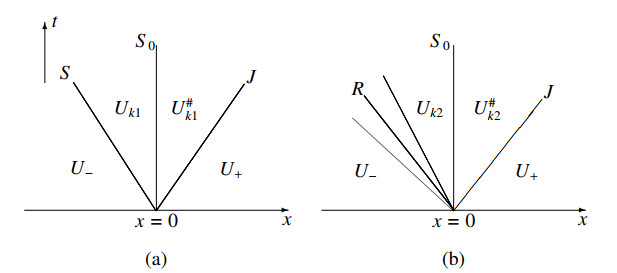
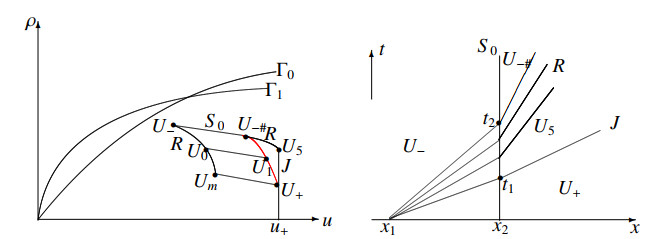
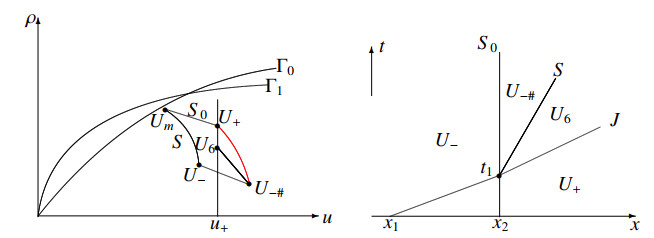
The result of the rarefaction wave interacts with the stationary wave
The result of a shock wave interacting with a stationary wave
Case 1. $ U_+ \in D_2 \cup D_4 $
Case 2. $ U_+ \in D_1\cup D_3 $
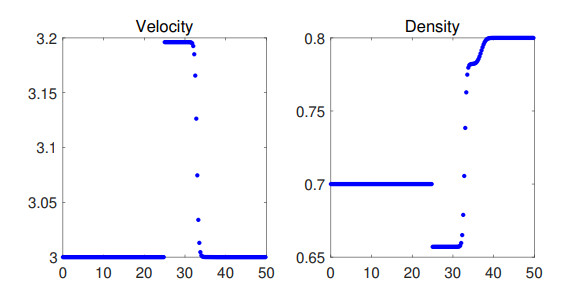
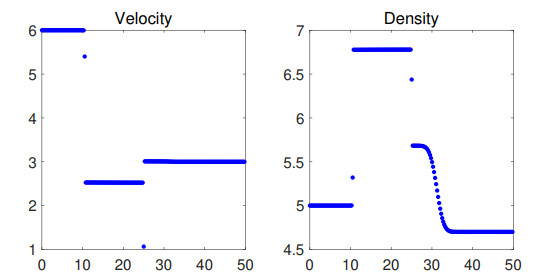
Test 1: The solution for velocity and density at $ t = 2 $
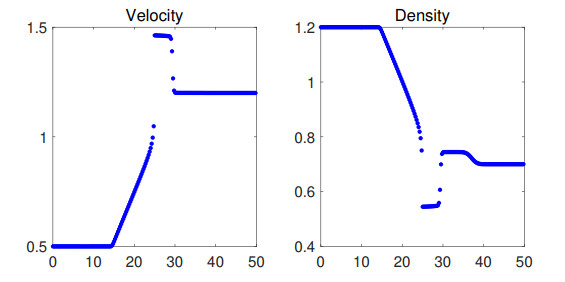
Test 2: The solution for velocity and density at $ t = 1 $
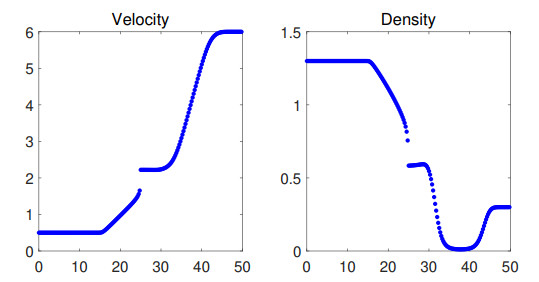
Test 3: The solution for velocity and density at $ t = 5 $
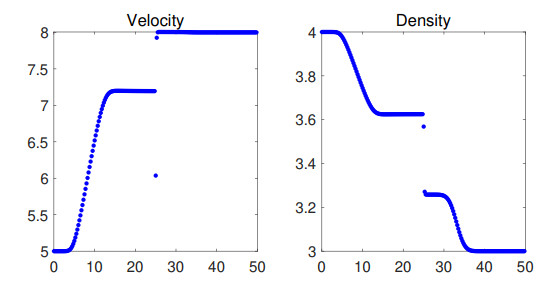
Test 4: The solution for velocity and density at $ t = 1.5 $
Test 5: The solution for velocity and density at $ t = 0.5 $




 DownLoad: