A novel two-predator, $ n $-prey model based on an extended Holling type-Ⅱ functional response that incorporates mutual temporal interference between two different predator species is proposed and analyzed, allowing for both identical and non-identical feeding behaviors. Due to the establishment of positivity and boundedness of all solutions, the model is biologically well-posed. Also, we establish theorems on the global stability of the coexistence state in both symmetric and asymmetric feeding cases, along with their proofs using suitable Lyapunov functions. Moreover, the stability of the axial equilibria is characterized using the reproduction numbers. To quantify predators' specialization (the degree to which predators focus on particular prey over others) on the classes of prey species, a unique preference index is invented via integrating three parameters (attack rate, handling time, and conversion efficiency) into a single metric. Numerical simulations, using a Runge-Kutta method, validate the analytical derivations and demonstrate how predator specialization and prey preference shape long-term competition and survival in multi-species ecosystems. Expectedly, our findings reveal diverse dynamic behaviors including "dichotomous dynamical partitioning", where generalist predatory species show opposing behaviors. In a nutshell, this work uncovers more complex dynamics, such as steady regimes, oscillatory regimes, and various coexistence patterns, in contrast to simpler models already investigated in the existing literature.
Citation: Hanan Saeed, Nouf A. Alrubea, Mehmet Yavuz, Ali Sarrah. Prey preference as a driver of predator coexistence: a novel two-predator $ n $-prey model based on the descriptive statistical index[J]. AIMS Mathematics, 2026, 11(11): 39215-39259. doi: 10.3934/math.20261510
A novel two-predator, $ n $-prey model based on an extended Holling type-Ⅱ functional response that incorporates mutual temporal interference between two different predator species is proposed and analyzed, allowing for both identical and non-identical feeding behaviors. Due to the establishment of positivity and boundedness of all solutions, the model is biologically well-posed. Also, we establish theorems on the global stability of the coexistence state in both symmetric and asymmetric feeding cases, along with their proofs using suitable Lyapunov functions. Moreover, the stability of the axial equilibria is characterized using the reproduction numbers. To quantify predators' specialization (the degree to which predators focus on particular prey over others) on the classes of prey species, a unique preference index is invented via integrating three parameters (attack rate, handling time, and conversion efficiency) into a single metric. Numerical simulations, using a Runge-Kutta method, validate the analytical derivations and demonstrate how predator specialization and prey preference shape long-term competition and survival in multi-species ecosystems. Expectedly, our findings reveal diverse dynamic behaviors including "dichotomous dynamical partitioning", where generalist predatory species show opposing behaviors. In a nutshell, this work uncovers more complex dynamics, such as steady regimes, oscillatory regimes, and various coexistence patterns, in contrast to simpler models already investigated in the existing literature.

| [1] |
A. Sarrah, F. J. Alanazi, M. Yavuz, S. Saber, The effects of fluctuating carrying capacity on the dynamics of a Holling-type Ⅲ predator-prey model, J. Math., 2026 (2026), 5067259. https://doi.org/10.1155/jom/5067259 doi: 10.1155/jom/5067259
|
| [2] |
F. M. K. Almalki, E. Solouma, M. Yavuz, S. Saber, A. Sarrah, Analytical and numerical study of bifurcations and reaction-diffusion patterns in a predator-prey model with Holling Ⅲ response and variable carrying capacity, Ain Shams Eng. J., 17 (2026), 104131. https://doi.org/10.1016/j.asej.2026.104131 doi: 10.1016/j.asej.2026.104131
|
| [3] |
F. M. K. Almalki, G. Alhamzi, M. Bin-Asfour, E. Solouma, N. Almutairi, A. Sarrah, et al., Ecological and epidemiological thresholds in a predator-prey system with cross-infection: stability, bifurcations, and reaction-diffusion dynamics, AIMS Math., 11 (2026), 7695–7739. https://doi.org/10.3934/math.2026317 doi: 10.3934/math.2026317
|
| [4] |
X. Y. Meng, N. N. Qin, H. F. Huo, Dynamics analysis of a predator-prey system with harvesting prey and disease in prey species, J. Biol. Dyn., 12 (2018), 342–374. https://doi.org/10.1080/17513758.2018.1454515 doi: 10.1080/17513758.2018.1454515
|
| [5] |
P. Kumar, S. Raj, Modelling and analysis of prey-predator model involving predation of mature prey using delay differential equations, Numer. Algebra Control Optim., 12 (2022), 783–791. https://doi.org/10.3934/naco.2021035 doi: 10.3934/naco.2021035
|
| [6] |
E. van Leeuwen, Å. Brännström, V. A. A. Jansen, U. Dieckmann, A. G. Rossberg, A generalized functional response for predators that switch between multiple prey species, J. Theor. Biol., 328 (2013), 89–98. https://doi.org/10.1016/j.jtbi.2013.02.003 doi: 10.1016/j.jtbi.2013.02.003
|
| [7] |
T. K. Kar, Stability analysis of a prey-predator model incorporating a prey refuge, Commun. Nonlinear Sci. Numer. Simul., 10 (2005), 681–691. https://doi.org/10.1016/j.cnsns.2003.08.006 doi: 10.1016/j.cnsns.2003.08.006
|
| [8] |
C. S. Holling, Some characteristics of simple types of predation and parasitism. Can. Entomol., 91 (1959), 385–398. https://doi.org/10.4039/Ent91385-7 |
| [9] |
H. Molla, M. S. Rahman, S. Sarwardi, Dynamics of a predator-prey model with Holling type-Ⅱ functional response incorporating a prey refuge depending on both the species, Int. J. Nonlinear Sci. Numer. Simul., 20 (2019), 89–104. https://doi.org/10.1515/ijnsns-2017-0224 doi: 10.1515/ijnsns-2017-0224
|
| [10] |
S. Fatah, A. Mustafa, S. Amin, Predator and n-classes-of-prey model incorporating extended Holling type-Ⅱ functional response for n different prey species, AIMS Math., 8 (2023), 5779–5788. https://doi.org/10.3934/math.2023291 doi: 10.3934/math.2023291
|
| [11] |
M. W. Hayward, G. I. H. Kerley, Prey preferences of the lion (Panthera leo), J. Zoology, 267 (2005), 309–322. https://doi.org/10.1017/S0952836905007508 doi: 10.1017/S0952836905007508
|
| [12] |
J. M. Jeschke, M. Kopp, R. Tollrian, Predator functional responses: discriminating between handling and digesting prey, Ecology, 72 (2002), 95–112. https://doi.org/10.1890/0012-9615(2002)072[0095:PFRDBH]2.0.CO;2 doi: 10.1890/0012-9615(2002)072[0095:PFRDBH]2.0.CO;2
|
| [13] |
M. Kot, Elements of mathematical ecology, Cambridge University Press, 2001. |
| [14] |
G. T. Skalski, J. F. Gilliam, Functional responses with predator interference: viable alternatives to the Holling type-Ⅱ model, Ecology, 82 (2001), 3083–3092. https://doi.org/10.1890/0012-9658(2001)082[3083:FRWPIV]2.0.CO;2 doi: 10.1890/0012-9658(2001)082[3083:FRWPIV]2.0.CO;2
|
| [15] |
C. Packer, D. Scheel, A. E. Pusey, Why lions form groups: Food is not enough, Amer. Nat., 136 (1990), 1–19. https://doi.org/10.1086/285079 doi: 10.1086/285079
|
| [16] |
H. E. Watts, K. E. Holekamp, Ecological determinants of survival and reproduction in the spotted hyena, J. Mammalogy, 90 (2009), 461–471. https://doi.org/10.1644/08-MAMM-A-136.1 doi: 10.1644/08-MAMM-A-136.1
|
Figures(6) / Tables(7)

Hanan Saeed, Nouf A. Alrubea, Mehmet Yavuz, Ali Sarrah. Prey preference as a driver of predator coexistence: a novel two-predator $ n $-prey model based on the descriptive statistical index[J]. AIMS Mathematics, 2026, 11(11): 39215-39259. doi: 10.3934/math.20261510

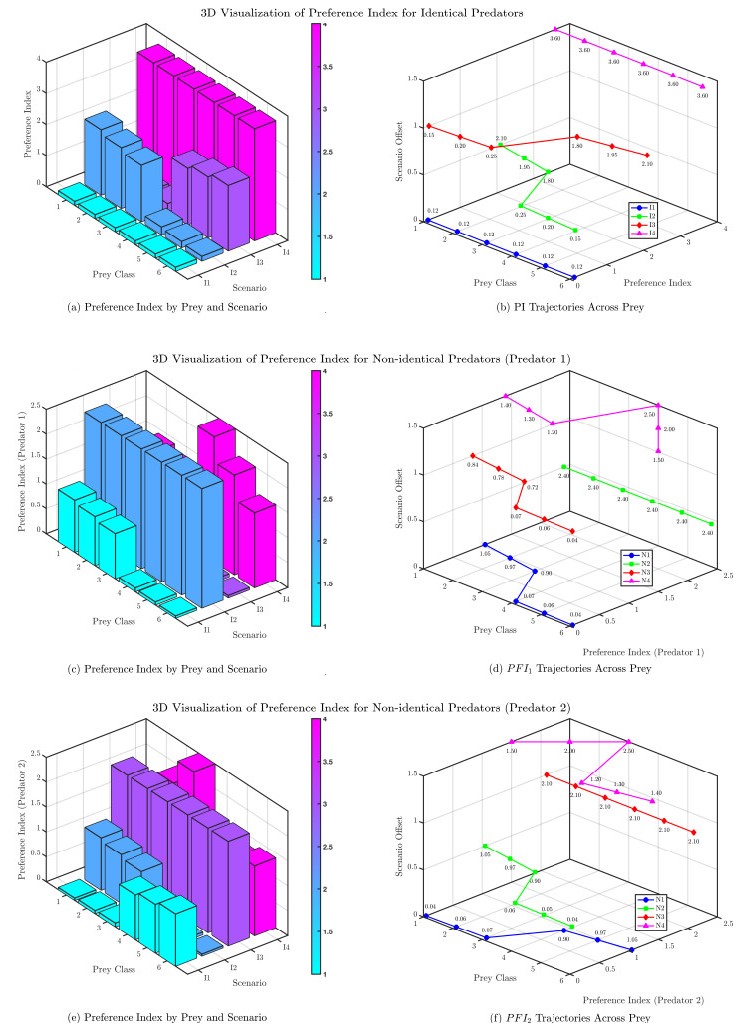
Visualization of the preference indices used in this work to study the nonlinear dynamics of identical and non-identical predator systems
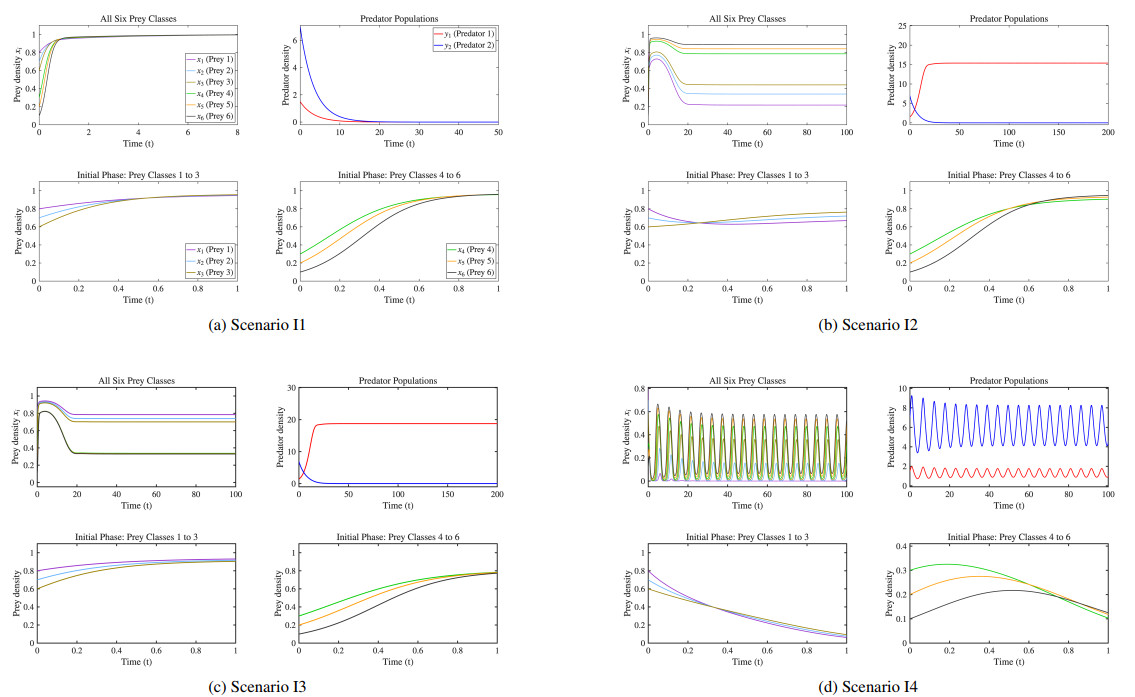
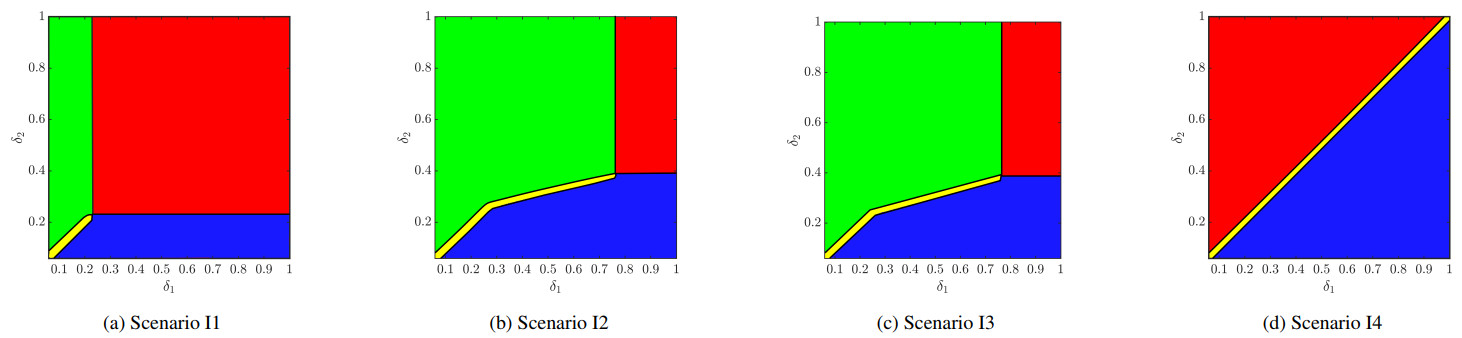
Summary of the four dynamical regimes for the two-predator, six-prey system based on the ecological reproduction numbers $ R_{01} $ and $ R_{02} $. The results are: (a) Scenario I1: both predators become extinct ($ R_{01}, R_{02} < 1 $); (b) Scenario I2: only predator 1 becomes extinct ($ R_{01} < 1, \ R_{02}>1 $); (c) Scenario I3: only predator 2 becomes extinct ($ R_{01}>1, \ R_{02} < 1 $); and (d) Scenario I4: both predators persist ($ R_{01}, R_{02}>1 $)
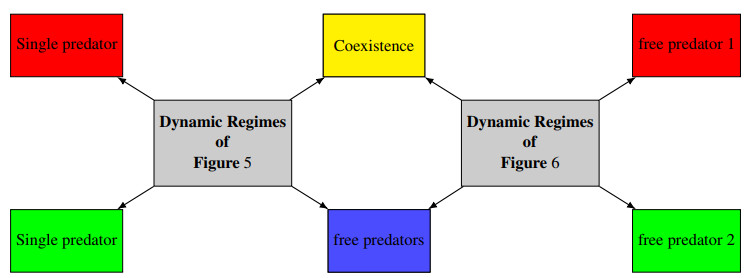
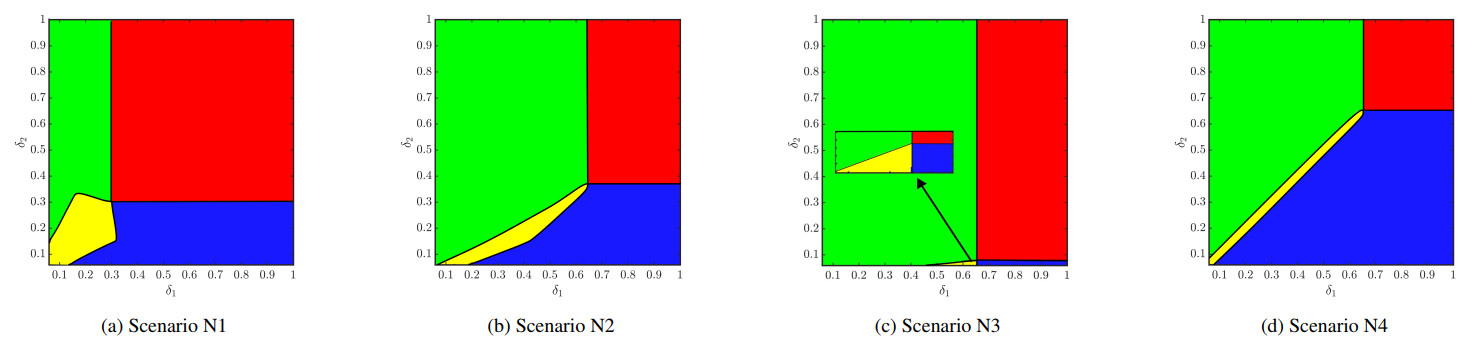
Colored regions in the main regime plots indicate the long-term behavior of the two predators: red corresponds to extinction, green to extinction $ y_{2} $, blue to extinction $ y_{1} $, and yellow to coexistence
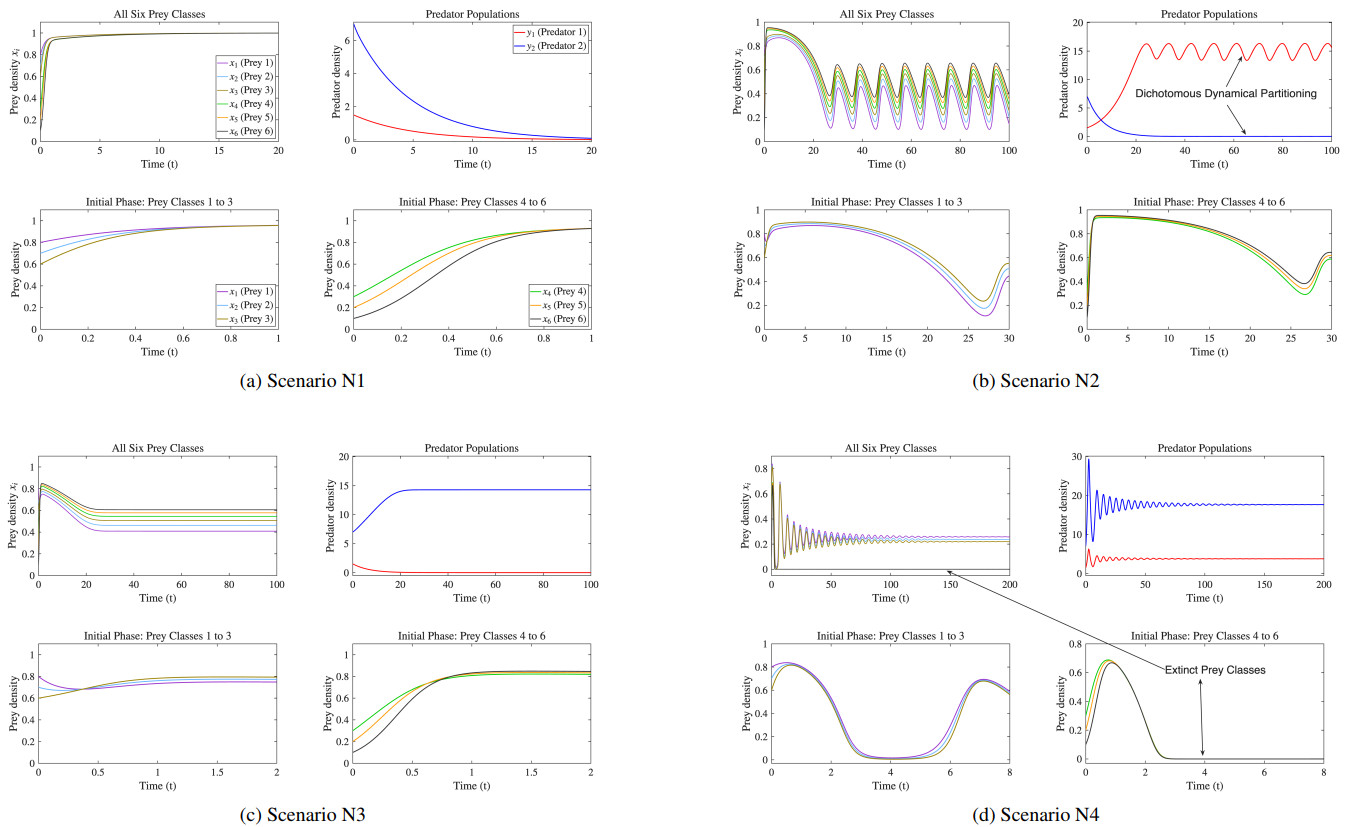
Summary of the four dynamical regimes for the two-predator, six-prey system based on the ecological reproduction numbers $ R_{01} $ and $ R_{02} $: (a) Scenario N1, both predators are extinct $ (R_{01} < 1, \ R_{02} < 1) $; (b) Scenario N2, predator 1 is extinct, whereas predator 2 persists $ (R_{01} < 1, \ R_{02}>1) $; (c) Scenario N3, predator 2 is extinct, whereas predator 1 persists $ (R_{01}>1, \ R_{02} < 1) $; and (d) Scenario N4, both predators persist $ (R_{01}>1, \ R_{02}>1) $
Effect of variations in the death rates of two predators with identical feeding behaviors, using the parameter values listed in Table 4
Effect of variations in the death rates of the two predators with non-identical feeding behaviors, using the same parameter values stated in Table 5




 DownLoad: