The stretched exponential function, a prominent completely monotonic function for characterizing anomalous relaxation and transport phenomena in complex, nonlinear systems across physics and materials science, can be mathematically represented as a continuous linear combination of exponential decay functions with non-negative weights, thereby giving rise to an associated spectral density $ H\left(\tau, \beta \right) $. This article provides a comprehensive, rigorous, and accessible review of the step-by-step derivations of the key formulas and fundamental properties of $ H\left(\tau, \beta \right) $. Specifically, it demonstrates how a continuous linear combination of exponential decay functions with non-negative weights converges to the stretched exponential function, thereby revealing the origin as well as the mathematical and physical significance of $ H\left(\tau, \beta \right) $. It then demonstrates the derivation of the exact analytical solution for $ H\left(\tau, \beta \right) $, widely known as Pollard's integral formula, along with its asymptotic series representation. In addition, the theoretical absolute convergence and the numerical convergence behavior of this asymptotic series are demonstrated. Finally, it demonstrates two fundamental mathematical and physical properties of $ H\left(\tau, \beta \right) $, namely its non-negativity and normalization condition. Mastering these transparent derivations empowers researchers to establish modified Pollard-type representations for other completely monotonic functions, gain profound insights into the underlying mathematical and physical foundations, and select the optimal approach among the integral and series forms to facilitate efficient computations in practical applications.
Citation: Che-Yu Lin. Spectral density of the stretched exponential function: A comprehensive review on the derivations of its integral and series solutions (Pollard's formula) and fundamental properties[J]. AIMS Mathematics, 2026, 11(11): 39165-39182. doi: 10.3934/math.20261508
The stretched exponential function, a prominent completely monotonic function for characterizing anomalous relaxation and transport phenomena in complex, nonlinear systems across physics and materials science, can be mathematically represented as a continuous linear combination of exponential decay functions with non-negative weights, thereby giving rise to an associated spectral density $ H\left(\tau, \beta \right) $. This article provides a comprehensive, rigorous, and accessible review of the step-by-step derivations of the key formulas and fundamental properties of $ H\left(\tau, \beta \right) $. Specifically, it demonstrates how a continuous linear combination of exponential decay functions with non-negative weights converges to the stretched exponential function, thereby revealing the origin as well as the mathematical and physical significance of $ H\left(\tau, \beta \right) $. It then demonstrates the derivation of the exact analytical solution for $ H\left(\tau, \beta \right) $, widely known as Pollard's integral formula, along with its asymptotic series representation. In addition, the theoretical absolute convergence and the numerical convergence behavior of this asymptotic series are demonstrated. Finally, it demonstrates two fundamental mathematical and physical properties of $ H\left(\tau, \beta \right) $, namely its non-negativity and normalization condition. Mastering these transparent derivations empowers researchers to establish modified Pollard-type representations for other completely monotonic functions, gain profound insights into the underlying mathematical and physical foundations, and select the optimal approach among the integral and series forms to facilitate efficient computations in practical applications.

| [1] |
S. Yoshioka, Y. Aso, S. Kojima, Usefulness of the Kohlrausch-Williams-Watts stretched exponential function to describe protein aggregation in lyophilized formulations and the temperature dependence near the glass transition temperature, Pharm. Res., 18 (2001), 256–260. https://doi.org/10.1023/A:1011082309058 doi: 10.1023/A:1011082309058
|
| [2] |
D. Apitz, P. M. Johansen, Limitations of the stretched exponential function for describing dynamics in disordered solid materials, J. Appl. Phys., 97 (2005). https://doi.org/10.1063/1.1852069 |
| [3] |
L. Lévy, H. Che, A. Weller, Using the stretched exponential function for automatic processing of time-domain induced polarization data and further interpretation, Geophys. J. Int., 245 (2026), ggag010. https://doi.org/10.1093/gji/ggag010 doi: 10.1093/gji/ggag010
|
| [4] |
M. Zhong, R. J. Loy, R. S. Anderssen, Approximating the Kohlrausch function by sums of exponentials, ANZIAM J., 54 (2013), 306–323. https://doi.org/10.1017/S1446181113000229 doi: 10.1017/S1446181113000229
|
| [5] |
E. C. de Oliveira, F. Mainardi, J. Vaz Jr, Fractional models of anomalous relaxation based on the Kilbas and Saigo function, Meccanica, 49 (2014), 2049–2060. https://doi.org/10.1007/s11012-014-9930-0 doi: 10.1007/s11012-014-9930-0
|
| [6] |
K. Górska, A. Horzela, A. Lattanzi, T. K. Pogány, On complete monotonicity of three parameter Mittag-Leffler function, Appl. Anal. Discrete Math., 15 (2021), 118–128. https://doi.org/10.2298/AADM190226025G doi: 10.2298/AADM190226025G
|
| [7] |
J. P. Bouchaud, Anomalous relaxation in complex systems: From stretched to compressed exponentials, Anomalous Transport-Found. Appl., 2008,327–345. https://doi.org/10.1002/9783527622979.ch11 |
| [8] |
A. V. Milovanov, J. J. Rasmussen, K. Rypdal, Stretched-exponential decay functions from a self-consistent model of dielectric relaxation, Phys. Lett. A, 372 (2008), 2148–2154. https://doi.org/10.1016/j.physleta.2007.11.025 doi: 10.1016/j.physleta.2007.11.025
|
| [9] |
Z. W. Wu, W. Kob, W. H. Wang, L. Xu, Stretched and compressed exponentials in the relaxation dynamics of a metallic glass-forming melt, Nat. Commun., 9 (2018), 5334. https://doi.org/10.1038/s41467-018-07759-w doi: 10.1038/s41467-018-07759-w
|
| [10] |
M. F. Shlesinger, E. W. Montroll, On the Williams–Watts function of dielectric relaxation, P. Natl. A. Sci., 81 (1984), 1280–1283. https://doi.org/10.1073/pnas.81.4.1280 doi: 10.1073/pnas.81.4.1280
|
| [11] |
R. M. Hill, L. A. Dissado, Debye and non-Debye relaxation, J. Phys. C-Solid State Phys., 18 (1985), 3829–3836. https://doi.org/10.1088/0022-3719/18/19/021 doi: 10.1088/0022-3719/18/19/021
|
| [12] |
A. K. Singh, Non-Debye to Debye spectral shift in solid solutions of orientationally disordered crystals, Phys. Rev. E, 109 (2024), 065003. https://doi.org/10.1103/PhysRevE.109.065003 doi: 10.1103/PhysRevE.109.065003
|
| [13] |
J. C. Phillips, Stretched exponential relaxation in molecular and electronic glasses, Rep. Prog. Phys., 59 (1996), 1133–1207. https://doi.org/10.1088/0034-4885/59/9/003 doi: 10.1088/0034-4885/59/9/003
|
| [14] |
X. Xia, P. G. Wolynes, Microscopic theory of heterogeneity and nonexponential relaxations in supercooled liquids, Phys. Rev. Lett., 86 (2001), 5526. https://doi.org/10.1103/PhysRevLett.86.5526 doi: 10.1103/PhysRevLett.86.5526
|
| [15] |
B. Sturman, E. Podivilov, M. Gorkunov, Origin of stretched exponential relaxation for hopping-transport models, Phys. Rev. Lett., 91 (2003), 176602. https://doi.org/10.1103/PhysRevLett.91.176602 doi: 10.1103/PhysRevLett.91.176602
|
| [16] |
K. S. Cole, R. H. Cole, Dispersion and absorption in dielectrics I. Alternating current characteristics, J. Chem. Phys., 9 (1941), 341–351. https://doi.org/10.1063/1.1750906 doi: 10.1063/1.1750906
|
| [17] |
R. Böhmer, K. L. Ngai, C. A. Angell, D. J. Plazek, Nonexponential relaxations in strong and fragile glass formers, J. Chem. Phys., 99 (1993), 4201–4209. https://doi.org/10.1063/1.466117 doi: 10.1063/1.466117
|
| [18] |
R. Metzler, J. Klafter, The random walk's guide to anomalous diffusion: A fractional dynamics approach, Phys. Rep., 339 (2000), 1–77. https://doi.org/10.1016/S0370-1573(00)00070-3 doi: 10.1016/S0370-1573(00)00070-3
|
| [19] |
C. P. Lindsey, G. D. Patterson, Detailed comparison of the Williams–Watts and Cole–Davidson functions, J. Chem. Phys., 73 (1980), 3348–3357. https://doi.org/10.1063/1.440530 doi: 10.1063/1.440530
|
| [20] |
F. Alvarez, A. Alegra, J. Colmenero, Relationship between the time-domain Kohlrausch–Williams–Watts and frequency-domain Havriliak–Negami relaxation functions, Phys. Rev. B, 44 (1991), 7306. https://doi.org/10.1103/PhysRevB.44.7306 doi: 10.1103/PhysRevB.44.7306
|
| [21] |
M. D. Ediger, Spatially heterogeneous dynamics in supercooled liquids, Ann. Rev. Phys. Chem., 51 (2000), 99–128. https://doi.org/10.1146/annurev.physchem.51.1.99 doi: 10.1146/annurev.physchem.51.1.99
|
| [22] |
F. Brouers, O. Sotolongo-Costa, Generalized fractal kinetics in complex systems (application to biophysics and biotechnology), Physica A, 368 (2006), 165–175. https://doi.org/10.1016/j.physa.2005.12.062 doi: 10.1016/j.physa.2005.12.062
|
| [23] |
W. Chen, X. Hei, H. Sun, D. Hu, Stretched exponential stability of nonlinear Hausdorff dynamical systems, Chaos Soliton. Fract., 109 (2018), 259–264. https://doi.org/10.1016/j.chaos.2018.03.002 doi: 10.1016/j.chaos.2018.03.002
|
| [24] |
A. Lukichev, Physical meaning of the stretched exponential Kohlrausch function, Phys. Lett. A, 383 (2019), 2983–2987. https://doi.org/10.1016/j.physleta.2019.06.029 doi: 10.1016/j.physleta.2019.06.029
|
| [25] |
J. Hristov, Response functions in linear viscoelastic constitutive equations and related fractional operators, Math. Model. Nat. Pheno., 14 (2019), 305. https://doi.org/10.1051/mmnp/2018067 doi: 10.1051/mmnp/2018067
|
| [26] |
J. C. Mauro, Y. Z. Mauro, On the Prony series representation of stretched exponential relaxation, Physica A, 506 (2018), 75–87. https://doi.org/10.1016/j.physa.2018.04.047 doi: 10.1016/j.physa.2018.04.047
|
| [27] |
D. C. Johnston, Stretched exponential relaxation arising from a continuous sum of exponential decays, Phys. Rev., 74 (2006), 184430. https://doi.org/10.1103/PhysRevB.74.184430 doi: 10.1103/PhysRevB.74.184430
|
| [28] |
C. Y. Lin, Interconnection between the stretched exponential function and the Prony series: A concise and rigorous revisit, Mathematics, 14 (2026), 2338. https://doi.org/10.3390/math14132338 doi: 10.3390/math14132338
|
| [29] |
H. Pollard, The representation of e^{-x^{λ}} as a Laplace integral, B. Am. Math. Soc., 52 (1946), 908–910. https://doi.org/10.1090/S0002-9904-1946-08672-3 doi: 10.1090/S0002-9904-1946-08672-3
|
| [30] |
S. Bernstein, Sur les fonctions absolument monotones, Acta Math., 52 (1929), 1–66. https://doi.org/10.1007/BF02592679 doi: 10.1007/BF02592679
|
| [31] |
M. Capiński, P. E. Kopp, The Radon—Nikodym theorem, In: Measure, Integral and Probability, London: Springer London, 2004,187–240. https://doi.org/10.1007/978-1-4471-0645-6_7 |
| [32] |
A. Lion, Thermomechanically consistent formulations of the standard linear solid using fractional derivatives, Arch. Mech., 53 (2001), 253–273. |
| [33] |
E. C. De Oliveira, F. Mainardi, J. Vaz Jr, Models based on Mittag-Leffler functions for anomalous relaxation in dielectrics, Eur. Phys. J.-Spec. Top., 193 (2011), 161–171. https://doi.org/10.1140/epjst/e2011-01388-0 doi: 10.1140/epjst/e2011-01388-0
|
| [34] |
F. Mainardi, R. Garrappa, On complete monotonicity of the Prabhakar function and non-Debye relaxation in dielectrics, J. Comput. Phys., 293 (2015), 70–80. https://doi.org/10.1016/j.jcp.2014.08.006 doi: 10.1016/j.jcp.2014.08.006
|
| [35] |
B. Simon, Basic complex analysis, Am. Math. Soc., 2015. https://doi.org/10.1090/simon/002.1 |
| [36] |
A. Vidras, A. Yger, Multidimensional residue theory and applications, Am. Math. Soc., 275 (2023). https://doi.org/10.1090/surv/275 |
| [37] |
T. Tao, An introduction to measure theory, Am. Math. Soc., 126 (2011). |
| [38] |
A. K. Livesey, J. C. Brochon, Analyzing the distribution of decay constants in pulse-fluorimetry using the maximum entropy method, Biophys. J., 52 (1987), 693–706. https://doi.org/10.1016/S0006-3495(87)83264-2 doi: 10.1016/S0006-3495(87)83264-2
|
| [39] |
A. N. Tikhonov, Regularization of incorrectly posed problems, Sov. Math. Dokl., 4 (1963), 1624–1627. |
| [40] |
A. Arsenault, T. Imai, P. M. Singer, K. M. Suzuki, M. Fujita, Magnetic inhomogeneity in charge-ordered La 1.885 Sr 0.115 CuO 4 studied by NMR, Phys. Rev. B, 101 (2020), 184505. https://doi.org/10.1103/PhysRevB.101.184505 doi: 10.1103/PhysRevB.101.184505
|
| [41] |
V. V. Ginzburg, O. V. Gendelman, A. Zaccone, Unifying physical framework for stretched-exponential, compressed-exponential, and logarithmic relaxation phenomena in glassy polymers, Macromolecules, 57 (2024), 2520–2529. https://doi.org/10.1021/acs.macromol.3c02480 doi: 10.1021/acs.macromol.3c02480
|
| [42] |
A. Zaccone, V. V. Ginzburg, O. V. Gendelman, S. F. Mauro, J. C. Mauro, The Trachenko-Zaccone equation: Nonlinear relaxation from glasses to complex systems, arXiv preprint, 2026. |
| [43] |
K. Trachenko, A. Zaccone, Slow stretched-exponential and fast compressed-exponential relaxation from local event dynamics, J. Phys.-Condens. Mat., 33 (2021), 315101. https://doi.org/10.1088/1361-648X/ac04cd doi: 10.1088/1361-648X/ac04cd
|
| [44] |
A. Zaccone, K. Trachenko, Global population crisis scenarios predicted by a general nonlinear dynamical model, Chaos Soliton. Fract., 209 (2026), 118542. https://doi.org/10.1016/j.chaos.2026.118542 doi: 10.1016/j.chaos.2026.118542
|
Figures(2)

Che-Yu Lin. Spectral density of the stretched exponential function: A comprehensive review on the derivations of its integral and series solutions (Pollard's formula) and fundamental properties[J]. AIMS Mathematics, 2026, 11(11): 39165-39182. doi: 10.3934/math.20261508

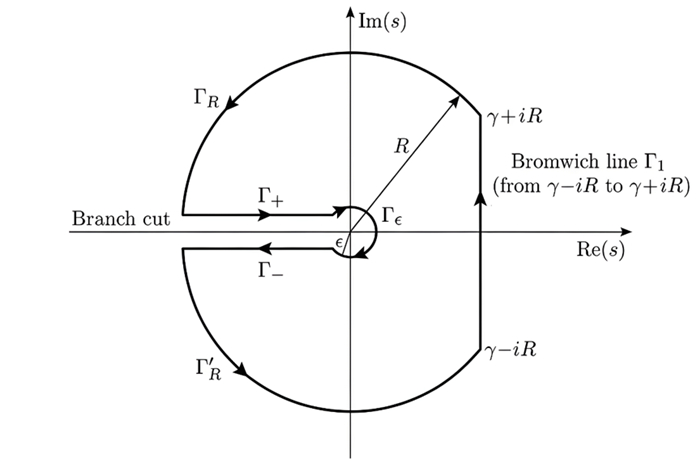
Illustration of the closed keyhole contour $ \mathrm{\Gamma } $ in the complex plane for evaluating Pollard's integral formula, which consists of six distinct segments: the Bromwich line $ {\mathrm{\Gamma }}_{1} $ (from $ \gamma -iR $ to $ \gamma +iR $), two large circular arcs $ {\mathrm{\Gamma }}_{R} $ and $ {\mathrm{\Gamma }}_{R}^{\text{'}} $ of radius $ R $, an infinitesimal circular loop $ {\mathrm{\Gamma }}_{ϵ} $ of radius $ ϵ $ centered at the origin, and two parallel paths running along the upper and lower edges of the branch cut denoted as $ {\mathrm{\Gamma }}_{+} $ and $ {\mathrm{\Gamma }}_{-} $, respectively
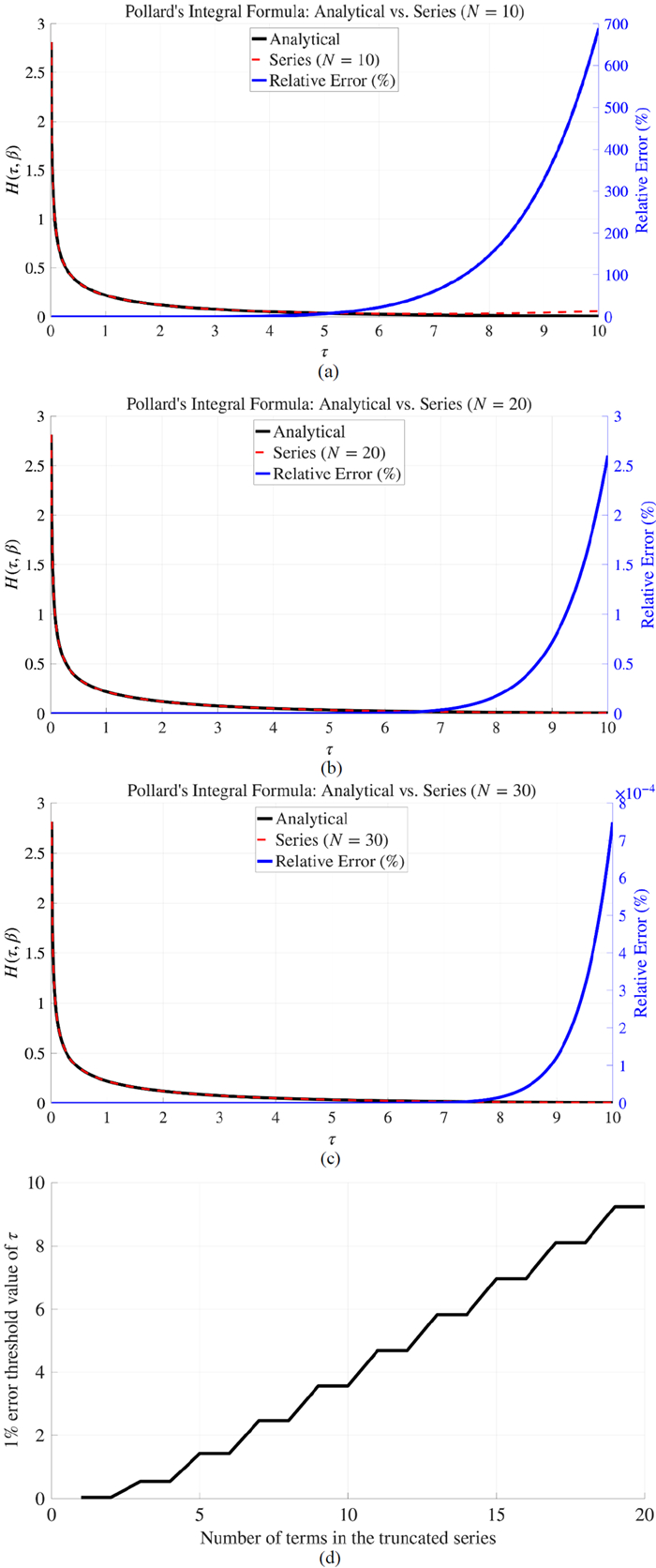
Numerical convergence behavior of the truncated form of the series in Eq (24) with an increasing number of terms. (a–c) Comparison between the analytical solution of Pollard's integral formula at $ \beta = 0.5 $ and the truncated series with (a) 10, (b) 20, and (c) 30 terms. (d) Quantification of the convergence range for each truncation order by illustrating the threshold value of $ \tau $ at which the relative error between the analytical solution and the series exceeds 1% as the number of terms increases from 1 to 20




 DownLoad: