In this study, we investigated the behavior of a hybrid nanofluid comprising of titania (TiO2) and alumina (Al2O3) nanoparticles dispersed in ethylene glycol (EG), considering the effects of nanoparticle aggregation. The flow was studied over a stretching surface wihtin a porous medium, with the effects of an applied magnetic field and viscous dissipation taken into account. Modified extensions of the Krieger-Dougherty model for effective viscosity and the Maxwell and Bruggeman models for thermal conductivity were proposed to describe the hybrid nanofluid in the presence of nanoparticle aggregation. The finite element method (FEM) was employed to obtain numerical solutions of the transformed equations and the results are presented graphically. Response surface methodology (RSM) was then used to examine the effects and interactions of three key input parameters, namely the total nanoparticle volume fraction, porosity parameter, and magnetic parameter, on the local Nusselt numeber for aggregation and non-aggregation cases. In addition, sensitivity analysis was performed to quantify the influence of these parameters on the heat transfer response and to identify the parameters with greater sensitivity. The results showed that increasing the nanoparticle volume fraction and porosity parameter enhances the heat transfer rate in the presence of nanoparticle aggregation, whereas the magnetic parameter exhibits comparatively lower sensitivity within the considered range. The findings provide useful insights for thermal management and solar thermal systems, where enhanced heat transfer and optimized operating conditions are important.
Citation: Jeremy Rymbai, Rajesh Sharma, Anuar Ishak. Heat transfer efficiency of hybrid nanofluid over a stretching surface in porous medium with nanoparticle aggregation: finite element and response surface analyses[J]. AIMS Mathematics, 2026, 11(11): 38492-38523. doi: 10.3934/math.20261486
In this study, we investigated the behavior of a hybrid nanofluid comprising of titania (TiO2) and alumina (Al2O3) nanoparticles dispersed in ethylene glycol (EG), considering the effects of nanoparticle aggregation. The flow was studied over a stretching surface wihtin a porous medium, with the effects of an applied magnetic field and viscous dissipation taken into account. Modified extensions of the Krieger-Dougherty model for effective viscosity and the Maxwell and Bruggeman models for thermal conductivity were proposed to describe the hybrid nanofluid in the presence of nanoparticle aggregation. The finite element method (FEM) was employed to obtain numerical solutions of the transformed equations and the results are presented graphically. Response surface methodology (RSM) was then used to examine the effects and interactions of three key input parameters, namely the total nanoparticle volume fraction, porosity parameter, and magnetic parameter, on the local Nusselt numeber for aggregation and non-aggregation cases. In addition, sensitivity analysis was performed to quantify the influence of these parameters on the heat transfer response and to identify the parameters with greater sensitivity. The results showed that increasing the nanoparticle volume fraction and porosity parameter enhances the heat transfer rate in the presence of nanoparticle aggregation, whereas the magnetic parameter exhibits comparatively lower sensitivity within the considered range. The findings provide useful insights for thermal management and solar thermal systems, where enhanced heat transfer and optimized operating conditions are important.

| [1] |
J. Sarkar, P. Ghosh, A. Adil, A review on hybrid nanofluids: recent research, development and applications, Renew. Sust. Energy Rev., 43 (2015), 164–177. https://doi.org/10.1016/j.rser.2014.11.023 doi: 10.1016/j.rser.2014.11.023
|
| [2] |
S. Khalatbari, P. Jalili, B. Jalili, D. D. Ganji, Investigating the improvement of heat transfer and flow characteristics of hybrid nanofluids: a comprehensive review, In: Proceedings of the Institution of Mechanical Engineers, Part E: Journal of Process Mechanical Engineering, 240 (2026), 5932–5947. https://doi.org/10.1177/09544089251318785 |
| [3] |
N. A. C. Sidik, H. A. Mohammed, O. A. Alawi, S. Samion, A review on preparation methods and challenges of nanofluids, Int. Commun. Heat Mass Transfer, 54 (2014), 115–125. https://doi.org/10.1016/j.icheatmasstransfer.2014.03.002 doi: 10.1016/j.icheatmasstransfer.2014.03.002
|
| [4] |
J. Mackolil, B. Mahanthesh, Sensitivity analysis of Marangoni convection in TiO2-EG nanoliquid with nanoparticle aggregation and temperature-dependent surface tension, J. Thermal Anal. Calorim., 143 (2021), 2085–2098. https://doi.org/10.1007/s10973-020-09642-7 doi: 10.1007/s10973-020-09642-7
|
| [5] |
A. Nikulin, A. S. Moita, A. L. N. Moreira, S. M. S. Murshed, A. Huminic, Y. Grosu, et al., Effect of Al2O3 nanoparticles on laminar, transient and turbulent flow of isopropyl alcohol, Int. J. Heat Mass Transfer, 130 (2019), 1032–1044. https://doi.org/10.1016/j.ijheatmasstransfer.2018.10.114 doi: 10.1016/j.ijheatmasstransfer.2018.10.114
|
| [6] |
W. Ajeeb, R. R. S. T. Silva, S. M. S. Murshed, Experimental investigation of heat transfer performance of Al2O3 nanofluids in a compact plate heat exchanger, Appl. Thermal Eng., 218 (2023), 119321. https://doi.org/10.1016/j.applthermaleng.2022.119321 doi: 10.1016/j.applthermaleng.2022.119321
|
| [7] |
S. Zainodin, A. Jamaludin, R. Nazar, I. Pop, MHD mixed convection flow of hybrid ferrofluid through stagnation-point over the nonlinearly moving surface with convective boundary condition, viscous dissipation, and joule heating effects, Symmetry, 15 (2023), 1–29. https://doi.org/10.3390/sym15040878 doi: 10.3390/sym15040878
|
| [8] |
K. N. V. C. Bhargava, S. M. Ibrahim, R. Kodi, Magneto-hydrodynamic mixed convection chemically rotating and radiating 3D hybrid nanofluid flow through porous media over a stretched surface, Math. Model. Numer. Simul. Appl., 4 (2024), 495–513. https://doi.org/10.53391/mmnsa.1438636 doi: 10.53391/mmnsa.1438636
|
| [9] |
A. B. Vishalakshi, R. Mahesh, U. S. Mahabaleshwar, A. K. Rao, L. M. Pérez, D. Laroze, MHD hybrid nanofluid flow over a stretching/shrinking sheet with skin friction: effects of radiation and mass transpiration, Magnetochemistry, 9 (2023), 1–13. https://doi.org/10.3390/magnetochemistry9050118 doi: 10.3390/magnetochemistry9050118
|
| [10] |
A. Yusuf, M. M. Bhatti, R. Ellahi, M. Marin, Magnetized ternary hybrid nanofluid flow over a curved catalytic surface embedded in a porous medium with Beavers-Joseph slip, volumetric and surface nonthermal heating, Discover Nano, 21 (2026), 206. https://doi.org/10.1186/s11671-026-04625-3 doi: 10.1186/s11671-026-04625-3
|
| [11] |
P. K. Pattnaik, M. Shamshuddin, S. O. Salawu, S. Panda, U. Khan, Modelling the effects of particle shape and slip conditions on a buoyancy-driven rotating flow of hybrid nanofluid in a biaxially stretching sheet, Int. J. Mech. Mater. Design, 22 (2026), 44. https://doi.org/10.1007/s10999-025-09855-4 doi: 10.1007/s10999-025-09855-4
|
| [12] |
S. Pradeep, P. V. Kumar, Study of cross-diffusion effects on unsteady magnetohydrodynamic hybrid nanofluid flow over an inclined vertical plate, Discover Nano, 21 (2026), 199. https://doi.org/10.1186/s11671-026-04611-9 doi: 10.1186/s11671-026-04611-9
|
| [13] |
M. Awais, T. Salahuddin, R. M. Hafez, Z. Jastaneyah, H. Al Garalleh, M. O. Sidi, Mixed convection Carreau-Yasuda nanofluid flow with heat transfer analysis by Cattaneo-Christov heat and mass transfer models, Comput. Biol. Med., 209 (2026), 111705. https://doi.org/10.1016/j.compbiomed.2026.111705 doi: 10.1016/j.compbiomed.2026.111705
|
| [14] |
A. Abderrahmane, N. A. A. Qasem, O. Younis, R. Marzouki, A. Mourad, N. A. Shah, et al., MHD hybrid nanofluid mixed convection heat transfer and entropy generation in a 3-D triangular porous cavity with zigzag wall and rotating cylinder, Mathematics, 10 (2022), 1–18. https://doi.org/10.3390/math10050769 doi: 10.3390/math10050769
|
| [15] |
M. Z. Saghir, M. M. Rahman, Forced convection of Al2O3-Cu, TiO2-SiO2, FWCNT-Fe3O4, and ND-Fe3O4 hybrid nanofluid in porous media, Energies, 13 (2020), 1–19. https://doi.org/10.3390/en13112902 doi: 10.3390/en13112902
|
| [16] |
S. Hazarika, S. Ahmed, A. J. Chamkha, Analysis of platelet shape Al2O3 and TiO2 on heat generative hydromagnetic nanofluids for the base fluid C2H6O2 in a vertical channel of porous medium, Walailak J. Sci. Tech., 18 (2021), 21424. |
| [17] |
J. O. Oladetan, F. M. Fujah, O. S. Omosehin, E. O. Atofarati, U. Nwabuko, O. T. Olakoyejo, et al., Numerical investigation of heat transfer performance of hybrid nanofluid in porous substrate in microchannel heat sink, Int. J. Appl. Comput. Math., 11 (2025), 151. https://doi.org/10.1007/s40819-025-01973-z doi: 10.1007/s40819-025-01973-z
|
| [18] |
S. Taimir, S. Bibi, A. Ehsan, M. Awais, M. Khan, R. M. Hafez, et al., Numerical study of MHD natural convection flow inside a porous cavity with chemical reaction and Soret-Dufour effects, Results Surfaces Interfaces, 25 (2026), 100932. https://doi.org/10.1016/j.rsurfi.2026.100932 doi: 10.1016/j.rsurfi.2026.100932
|
| [19] |
R. M. Hafez, A. Naeem, Z. Abbas, M. Y. Rafiq, Optimization and nonlinear thermal sensitivity analysis of Jeffrey fluid flow between permeable disks with modified Darcy law: implications for energy and cooling systems, Case Stud. Thermal Eng., 81 (2026), 107975. https://doi.org/10.1016/j.csite.2026.107975 doi: 10.1016/j.csite.2026.107975
|
| [20] |
C. M. Mohana, R. M. Hafez, I. Touil, F. L. Rashid, M. Kezzar, R. K. Bangalore, et al., Thermal performance and flow characteristics of methanol based Fe3O4-CoFe2O4-Co3O4 nanofluid systems: numerical and ANN approaches, Arab J. Basic Appl. Sci., 33 (2026), 445–465. https://doi.org/10.1080/25765299.2026.2719976 doi: 10.1080/25765299.2026.2719976
|
| [21] |
A. K. Al-Hadhrami, L. Elliot, D. B. Ingham, A new model for viscous dissipation in porous media across a range of permeability values, Transp. Porous Media, 53 (2003), 117–122. https://doi.org/10.1023/A:1023557332542 doi: 10.1023/A:1023557332542
|
| [22] |
M. Motevasel, A. R. S. Nazar, M. Jamialahmadi, The effect of nanoparticles aggregation on the thermal conductivity of nanofluids at very low concentrations: experimental and theoretical evaluations, Heat Mass Transfer, 54 (2018), 125–133. https://doi.org/10.1007/s00231-017-2116-2 doi: 10.1007/s00231-017-2116-2
|
| [23] |
N. P. Karagiannakis, E. D. Skouras, V. N. Burganos, Modelling thermal conduction in nanoparticle aggregates in the presence of surfactants, Nanomaterials, 10 (2020), 1–21. https://doi.org/10.3390/nano10112288 doi: 10.3390/nano10112288
|
| [24] |
H. Tahmooressi, A. Kasaeian, A. Tarokh, R. Razaei, M. Hoorfar, Numerical simulation of aggregation effect on nanofluids thermal conductivity using the lattice Boltzmann method, Int. Commun. Heat Mass Transfer, 110 (2020), 104408. https://doi.org/10.1016/j.icheatmasstransfer.2019.104408 doi: 10.1016/j.icheatmasstransfer.2019.104408
|
| [25] |
P. Rana, W. Al-Kouz, B. Mahanthesh, J. Mackolil, Heat transfer of TiO2-EG nanoliquid with active and passive control of nanoparticles subject to nonlinear Boussinesq approximation, Int. Commun. Heat Mass Transfer, 126 (2021), 105443. https://doi.org/10.1016/j.icheatmasstransfer.2021.105443 doi: 10.1016/j.icheatmasstransfer.2021.105443
|
| [26] |
H. S. Chen, Y. L. Ding, Y. R. He, C. Q. Tan, Rheological behaviour of ethylene glycol based titania nanofluids, Chem. Phys. Lett., 444 (2007), 333–337. https://doi.org/10.1016/j.cplett.2007.07.046 doi: 10.1016/j.cplett.2007.07.046
|
| [27] |
S. K. Rawat, M. Yaseen, A. Shafiq, M. Kumar, Q. M. Al-Mdallal, Nanoparticle aggregation effect on nonlinear convective nanofluid flow over a stretched surface with linear and exponential heat source/sink, Int. J. Thermofluids, 19 (2023), 100355. https://doi.org/10.1016/j.ijft.2023.100355 doi: 10.1016/j.ijft.2023.100355
|
| [28] |
P. Rana, B. Mahanthesh, J. Mackolil, W. Al-Kouz, Nanofluid flow past a vertical plate with nanoparticle aggregation kinematics, thermal slip and significant buoyancy force effects using modified Buongiorno model, Waves Random Complex Media, 34 (2024), 3425–3449. https://doi.org/10.1080/17455030.2021.1977416 doi: 10.1080/17455030.2021.1977416
|
| [29] |
Z. Mahmood, U. Khan, Mixed convective flow of nanofluid across exponential surface: a numerical assessment of the impact of Darcy-Forchheimer and nanoparticle aggregation, Numer. Heat Transfer Part A Appl., 86 (2025), 2192–2217. https://doi.org/10.1080/10407782.2023.2288265 doi: 10.1080/10407782.2023.2288265
|
| [30] |
I. Wole-Osho, E. C. Okonkwo, S. Abbasoglu, D. Kavaz, Nanofluids in solar thermal collectors: review and limitations, Int. J. Thermophys., 41 (2020), 157. https://doi.org/10.1007/s10765-020-02737-1 doi: 10.1007/s10765-020-02737-1
|
| [31] |
S. P. Tembhare, D. P. Barai, B. A. Bhanvase, Performance evaluation of nanofluids in solar thermal and solar photovoltaic systems: a comprehensive review, Renew. Sust. Energy Rev., 153 (2022), 111738. https://doi.org/10.1016/j.rser.2021.111738 doi: 10.1016/j.rser.2021.111738
|
| [32] |
J. A. Bocanegra, A. Marchitto, M. Misale, Nanofluids in solar collectors: a comprehensive review focused on its sedimentation, Clean Technol. Environ. Policy, 27 (2025), 1753–1784. https://doi.org/10.1007/s10098-024-02964-2 doi: 10.1007/s10098-024-02964-2
|
| [33] |
Q. Xiong, S. Altnji, T. Tayebi, M. Izadi, A. Hajjar, B Sundén, et al., A comprehensive review on the application of hybrid nanofluids in solar energy collectors, Sustain. Energy Technol. Assess., 47 (2021), 101341. https://doi.org/10.1016/j.seta.2021.101341 doi: 10.1016/j.seta.2021.101341
|
| [34] |
A. Yusuf, M. M. Bhatti, R. Ellahi, Thermal and sensitivity analysis on regularized curved solar panels using non-Newtonian quaternary hybrid nanofluids: applications in solar collectors, J. Indian Chem. Soc., 102 (2025), 102256. https://doi.org/10.1016/j.jics.2025.102256 doi: 10.1016/j.jics.2025.102256
|
| [35] |
M. Alktranee, Q. Al-Yasiri, M. A. Al-Furaiji, H. A. H. Al-Hamzawi, P. Bencs, M. Szabó, Performance improvement of flat plate solar collector employing phase change material bags and hybrid nanofluid, Results Eng., 27 (2025), 106972. https://doi.org/10.1016/j.rineng.2025.106972 doi: 10.1016/j.rineng.2025.106972
|
| [36] |
J. N. Reddy, An introduction to the finite element method, 3 Eds., New York: McGraw-Hill, 2006. |
| [37] |
R. Sharma, A. Ishak, I. Pop, Dual solution of unsteady separated stagnation-point flow in a nanofluid with suction: a finite element analysis, Indian J. Pure Appl. Phys., 55 (2017), 275–283. |
| [38] |
S. R. Pop, I. Pop, T. Grosan, Radiation effects on the flow near the stagnation point of a stretching sheet, Tech. Mech. Eur. J. Eng. Mech., 25 (2005), 100–106. |
| [39] |
S. Masood, M. Farooq, A. Anjum, Influence of heat generation/absorption and stagnation point on polystyrene-TiO2/H2O hybrid nanofluid flow, Sci. Rep., 11 (2021), 22381. https://doi.org/10.1038/s41598-021-01747-9 doi: 10.1038/s41598-021-01747-9
|
Figures(18) / Tables(9)

Jeremy Rymbai, Rajesh Sharma, Anuar Ishak. Heat transfer efficiency of hybrid nanofluid over a stretching surface in porous medium with nanoparticle aggregation: finite element and response surface analyses[J]. AIMS Mathematics, 2026, 11(11): 38492-38523. doi: 10.3934/math.20261486

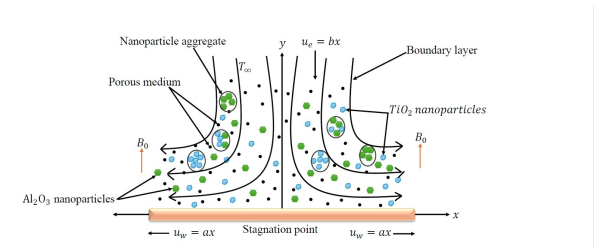
Representation of the physical system
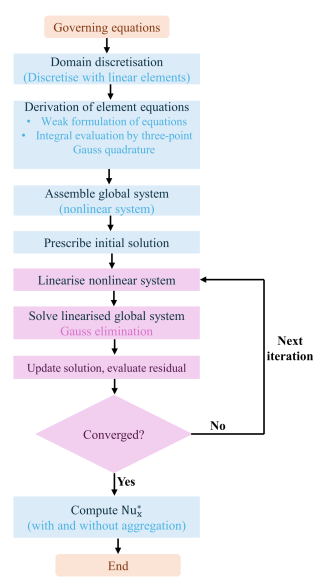
Flowchart of the solution methodology
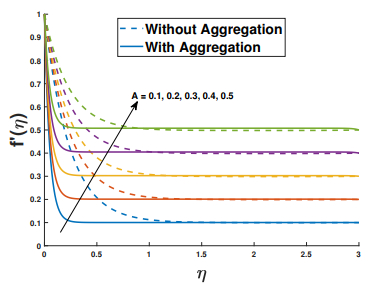
Effect of A on $ f'(\eta) $ for $ \phi_1 = \phi_2 = 0.05 $, $ s = -1 $, $ \Gamma = 0.1 $, $ Ec = 0.1 $, and $ M = 20 $
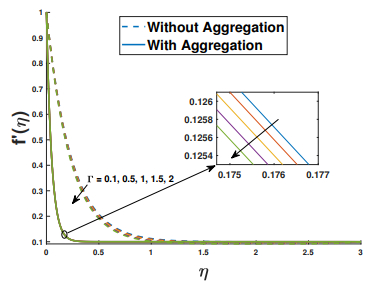
Effect of $ \Gamma $ on $ f'(\eta) $ for $ \phi_1 = \phi_2 = 0.05 $, $ A = 0.1 $, $ s = -1 $, $ Ec = 0.1 $, and $ M = 20 $
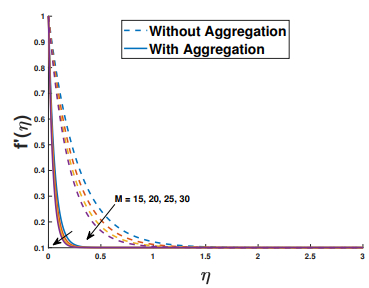
Effect of $ M $ on $ f'(\eta) $ for $ \phi_1 = \phi_2 = 0.05 $, $ A = 0.1 $, $ s = -1 $, $ \Gamma = 0.1 $, and $ Ec = 0.1 $
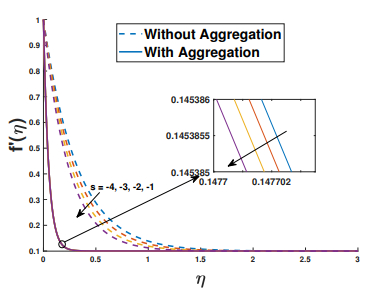
Effect of $ s $ on $ f'(\eta) $ for $ \phi_1 = \phi_2 = 0.05 $, $ A = 0.1 $, $ \Gamma = 0.1 $, $ Ec = 0.1 $, and $ M = 20 $
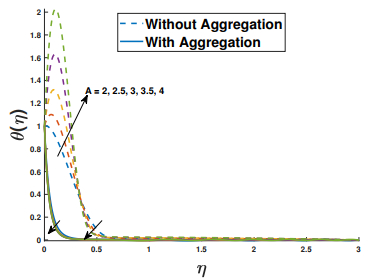
Effect of $ A $ on $ \theta(\eta) $ for $ \phi_1 = \phi_2 = 0.05 $, $ s = -1 $, $ \Gamma = 0.1 $, $ Ec = 0.1 $, and $ M = 20 $
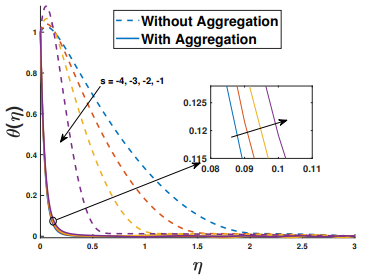
Effect of $ s $ on $ \theta(\eta) $ for $ \phi_1 = \phi_2 = 0.05 $, $ A = 2 $, $ \Gamma = 0.1 $, $ Ec = 0.1 $, and $ M = 20 $
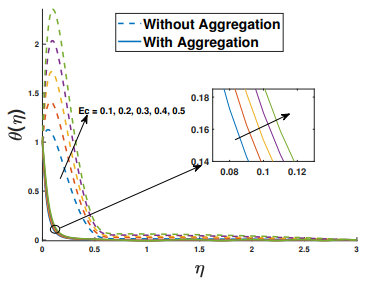
Effect of $ Ec $ on $ \theta(\eta) $ for $ \phi_1 = \phi_2 = 0.05 $, $ A = 2 $, $ s = -1 $, $ \Gamma = 0.1 $, and $ M = 20 $
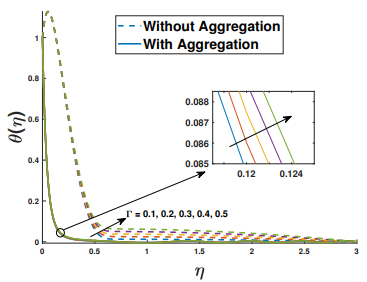
Effect of $ \Gamma $ on $ \theta(\eta) $ for $ \phi_1 = \phi_2 = 0.05 $, $ A = 2 $, $ s = -1 $, $ Ec = 0.1 $, and $ M = 20 $
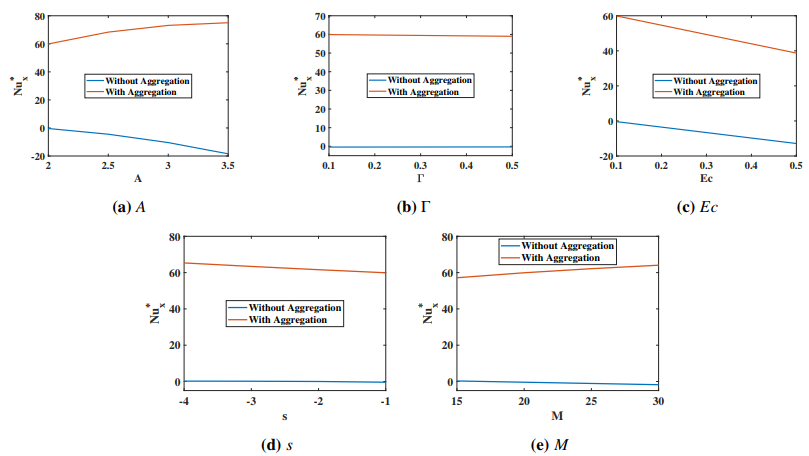
Effect of different parameters on the local Nusselt number
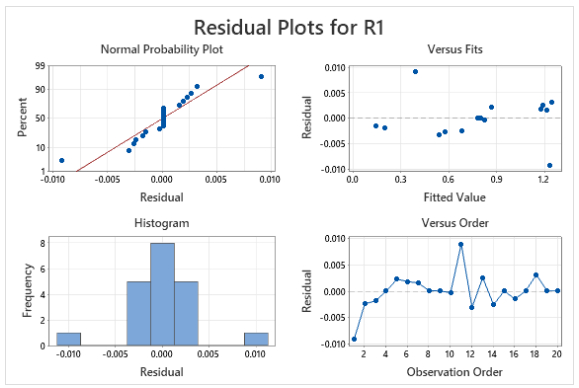
Residual plots for the local nusselt number without aggregation (R1)
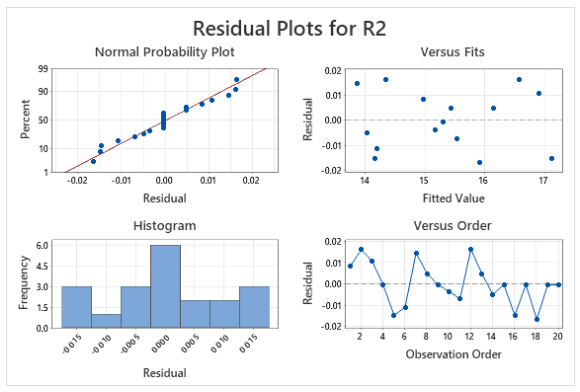
Residual plots for the local nusselt number with aggregation (R2)
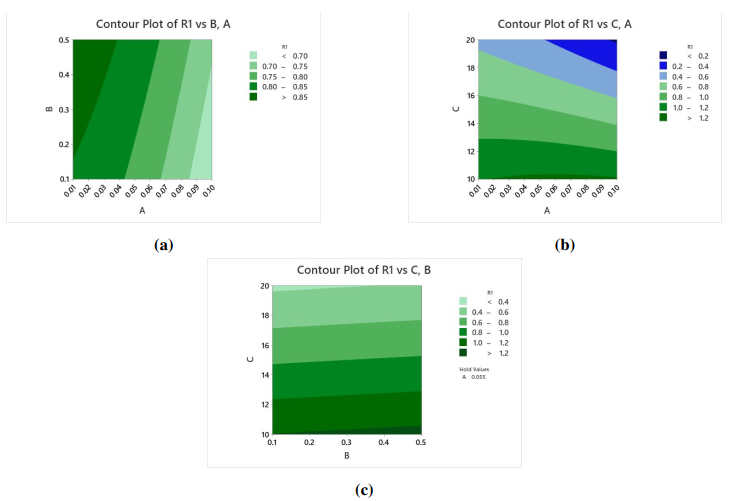
Contour plots for local Nusselt number (without aggregation)
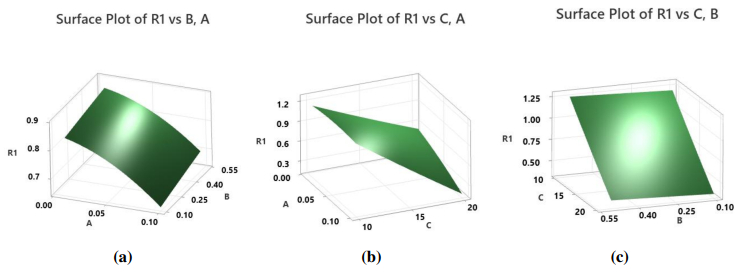
Surface plots for local Nusselt number (without aggregation)
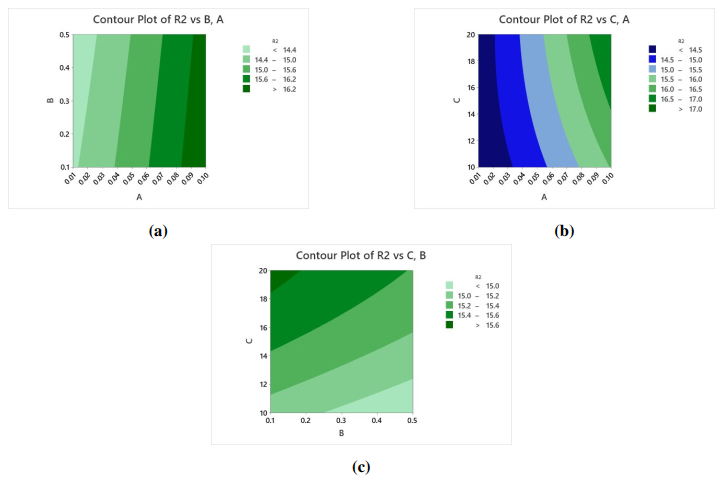
Contour plots for local Nusselt number (with aggregation)
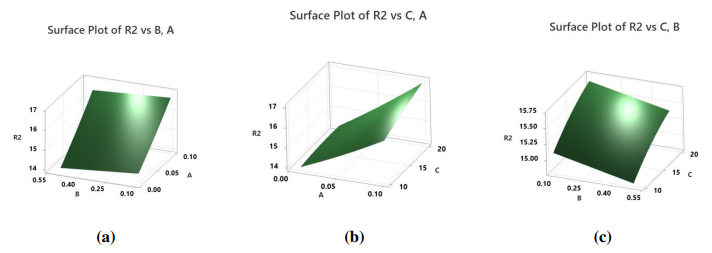
Surface plots for local Nusselt number (with aggregation)
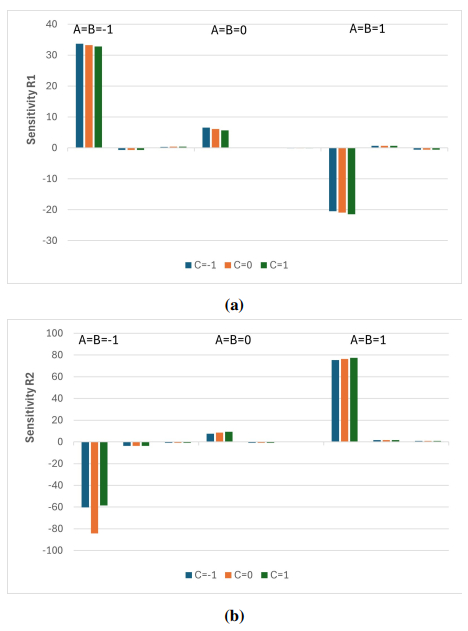
Sensitivity analysis plots of (a) R1 and (b) R2




 DownLoad: