In this study, an enhanced nonlinear time-fractional fuzzy Clannish Random Walker's Parabolic (NLTFFCRWP) model is formulated based on fuzzy Caputo generalized Hukuhara ($ g\mathbb{H} $) differentiability. The suggested formulation efficiently combines the memory-dependent characteristics of fractional dynamics with the uncertainty related to real-world systems using fuzzy modeling. The existence and uniqueness of the fuzzy solution are firmly established through the Banach contraction principle and Schauder's fixed point theorem, under appropriate assumptions. A novel analytical scheme, the Laplace residual power series method (LRPSM), is utilized to obtain an approximate fuzzy solution of the NLTFFCRWP model, which results in a systematic fractional series solution without requiring discretization and linearization. Furthermore, the convergence analysis for the series solution and the Ulam-Hyers stability of the proposed model under the fuzzy Caputo $ g\mathbb{H} $-differentiability are investigated by establishing appropriate adequate conditions. The Ulam-Hyers stability demonstrates that small perturbations in the model produce bounded deviations in the solution, while the convergence analysis verifies that the proposed series solution approaches the exact fuzzy solution. The proposed methodology's accuracy, rapid convergence, and computational efficiency are demonstrated through illustrative examples and a wound-healing application.
Citation: Maria Sarfraz, Ghazala Akram, Khurram Shabbir, Hafiz Abdul Wajid. Mathematical analysis and Ulam-Hyers stability for time-fractional fuzzy clannish random walker's parabolic model[J]. AIMS Mathematics, 2026, 11(11): 38524-38568. doi: 10.3934/math.20261487
In this study, an enhanced nonlinear time-fractional fuzzy Clannish Random Walker's Parabolic (NLTFFCRWP) model is formulated based on fuzzy Caputo generalized Hukuhara ($ g\mathbb{H} $) differentiability. The suggested formulation efficiently combines the memory-dependent characteristics of fractional dynamics with the uncertainty related to real-world systems using fuzzy modeling. The existence and uniqueness of the fuzzy solution are firmly established through the Banach contraction principle and Schauder's fixed point theorem, under appropriate assumptions. A novel analytical scheme, the Laplace residual power series method (LRPSM), is utilized to obtain an approximate fuzzy solution of the NLTFFCRWP model, which results in a systematic fractional series solution without requiring discretization and linearization. Furthermore, the convergence analysis for the series solution and the Ulam-Hyers stability of the proposed model under the fuzzy Caputo $ g\mathbb{H} $-differentiability are investigated by establishing appropriate adequate conditions. The Ulam-Hyers stability demonstrates that small perturbations in the model produce bounded deviations in the solution, while the convergence analysis verifies that the proposed series solution approaches the exact fuzzy solution. The proposed methodology's accuracy, rapid convergence, and computational efficiency are demonstrated through illustrative examples and a wound-healing application.

| [1] |
M. B. Abd-el-Malek, M. M. Kassem, M. L. M. Meky, Group theoretic approach for solving the problem of diffusion of a drug through a thin membrane, J. Comput. Math., 14 (2002), 1–11. https://doi.org/10.1016/S0377-0427(01)00516-7 doi: 10.1016/S0377-0427(01)00516-7
|
| [2] |
S. A. Abdelhafeez, A. A. M. Arafa, Y. H. Zahran, I. S. I. Osman, M. Ramadan, Adapting Laplace residual power series approach to the Caudrey-Dodd-Gibbon equation, Sci. Rep., 14 (2024), 9772. https://doi.org/10.1038/s41598-024-57780-x doi: 10.1038/s41598-024-57780-x
|
| [3] |
R. P. Agarwal, V. Lakshmikantham, J. J. Nieto, On the concept of solution for fractional differential equations with uncertainty, Nonlinear Anal.-Theory, 72 (2010), 2859–2862. https://doi.org/10.1016/j.na.2009.11.029 doi: 10.1016/j.na.2009.11.029
|
| [4] |
R. P. Agarwal, S. Arshad, D. O'Regan, V. Lupulescu, A Schauder fixed point theorem in semilinear spaces and applications, Fixed Point Theory Appl., 2013 (2013), 306. https://doi.org/10.1186/1687-1812-2013-306 doi: 10.1186/1687-1812-2013-306
|
| [5] |
N. Ahmad, A. Ullah, A. Ullah, S. Ahmad, K. Shah, I. Ahmad, On analysis of the fuzzy fractional order Volterra-Fredholm integro-differential equation, Alex. Eng. J., 60 (2021), 1827–1838. https://doi.org/10.1016/j.aej.2020.11.031 doi: 10.1016/j.aej.2020.11.031
|
| [6] |
G. Akram, M. Sarfraz, Multiple optical soliton solutions for CGL equation with Kerr law nonlinearity via extended modified auxiliary equation mapping method, Optik, 242 (2021), 167258. https://doi.org/10.1016/j.ijleo.2021.167258 doi: 10.1016/j.ijleo.2021.167258
|
| [7] |
G. Akram, M. Sadaf, M. Sarfraz, N. Anum, Dynamics investigation of $(1+1)$-dimensional time-fractional potential Korteweg-de Vries equation, Alex. Eng. J., 61 (2022), 501–509. https://doi.org/10.1016/j.aej.2021.06.023 doi: 10.1016/j.aej.2021.06.023
|
| [8] |
M. Alaroud, M. Al-Smadi, R. R. Ahmad, U. K. Salma Din, An analytical numerical method for solving fuzzy fractional Volterra integro-differential equations, Symmetry, 11 (2019), 205. https://doi.org/10.3390/sym11020205 doi: 10.3390/sym11020205
|
| [9] |
R. Alikhani, F. Bahrami, Fuzzy partial differential equations under the cross product of fuzzy numbers, Inform. Sciences, 494 (2019), 80–99. https://doi.org/10.1016/j.ins.2019.04.030 doi: 10.1016/j.ins.2019.04.030
|
| [10] |
T. Allahviranloo, A. Armand, Z. Gouyandeh, Fuzzy fractional differential equations under generalized fuzzy Caputo derivative, J. Intell. Fuzzy Syst., 26 (2014), 1481–1490. https://doi.org/10.3233/IFS-130831 doi: 10.3233/IFS-130831
|
| [11] |
M. Alinezhad, T. Allahviranloo, On the solution of fuzzy fractional optimal control problems with the Caputo derivative, Inform. Sciences, 421 (2017), 218–236. https://doi.org/10.1016/j.ins.2017.08.094 doi: 10.1016/j.ins.2017.08.094
|
| [12] |
T. V. An, N. V. Hoa, The stability of the controlled problem of fuzzy dynamic systems involving the random-order Caputo fractional derivative, Inform. Sciences, 612 (2022), 427–452. https://doi.org/10.1016/j.ins.2022.08.076 doi: 10.1016/j.ins.2022.08.076
|
| [13] |
M. Asif, S. Khan, H. Khan, S. Jebran, A computational strategy based on the residual power series method with the help of the Laplace transforms, Fuzzy Information and Engineering, 18 (2026), 223–250. https://doi.org/10.26599/FIE.2026.9270013 doi: 10.26599/FIE.2026.9270013
|
| [14] |
B. Bede, L. Stefanini, Generalized differentiability of fuzzy-valued functions, Fuzzy Set. Syst., 230 (2013), 119–141. https://doi.org/10.1016/j.fss.2012.10.003 doi: 10.1016/j.fss.2012.10.003
|
| [15] |
B. Bede, S. G. Gal, Generalizations of the differentiability of fuzzy-number-valued functions with applications to fuzzy differential equations, Fuzzy Set. Syst., 151 (2005), 581–599. https://doi.org/10.1016/j.fss.2004.08.001 doi: 10.1016/j.fss.2004.08.001
|
| [16] |
Y. C. Cano, H. R. Flores, On new solutions of fuzzy differential equations, Chaos Soliton. Fract., 38 (2008), 112–119. https://doi.org/10.1016/j.chaos.2006.10.043 doi: 10.1016/j.chaos.2006.10.043
|
| [17] |
J. Chen, J. R. Holt, E. L. Evans, J. S. Lowengrub, M. M. Pathak, PIEZO1 regulates leader cell formation and cellular coordination during collective keratinocyte migration, PLoS Comput. Biol., 20 (2024), e1011855. https://doi.org/10.1371/journal.pcbi.1011855 doi: 10.1371/journal.pcbi.1011855
|
| [18] |
K. Diethelm, N. J. Ford, Analysis of fractional differential equations, J. Math. Anal. Appl., 265 (2002), 229–248. https://doi.org/10.1006/jmaa.2000.7194 doi: 10.1006/jmaa.2000.7194
|
| [19] |
D. Dubois, H. Prade, Towards fuzzy differential calculus part 3: differentiation, Fuzzy Set. Syst., 8 (1982), 225–233. |
| [20] |
A. El Ghazouani, M. Elomari, S. Melliani, Solving higher-order fuzzy differential equations via Laplace residual power series approach, TWMS J. Appl. Eng. Math., 15 (2025), 309–318. |
| [21] |
T. Eriqat, R. Saadeh, A. El-Ajou, A. Qazza, M. N. Oqielat, A. Ghazal, A new analytical algorithm for uncertain fractional differential equations in the fuzzy conformable sense, AIMS Mathematics, 9 (2024), 9641–9681. https://doi.org/10.3934/math.2024472 doi: 10.3934/math.2024472
|
| [22] |
M. Friedman, M. Ming, A. Kandel, Fuzzy derivatives and fuzzy Cauchy problems using LP metric, In: Fuzzy logic foundations and industrial applications, Boston: Springer, 1996, 57–72. https://doi.org/10.1007/978-1-4613-1441-7_3 |
| [23] |
D. Ghosh, J. R. Yaron, M. R. Abedin, S. Godeshala, S. Kumar, J. Kilbourne, et al., Bioactive nanomaterials kickstart early repair processes and potentiate temporally modulated healing of healthy and diabetic wounds, Biomaterials, 306 (2024), 122496. https://doi.org/10.1016/j.biomaterials.2024.122496 doi: 10.1016/j.biomaterials.2024.122496
|
| [24] |
P. Guchhait, M. K. Maiti, M. Maiti, A production inventory model with fuzzy production and demand using fuzzy differential equation: an interval compared genetic algorithm approach, Eng. Appl. Artif. Intel., 26 (2013), 766–778. https://doi.org/10.1016/j.engappai.2012.10.017 doi: 10.1016/j.engappai.2012.10.017
|
| [25] |
E. U. Haq, Q. M. U. Hassan, J. Ahmad, K. Ehsan, Fuzzy solution of system of fuzzy fractional problems using a reliable method, Alex. Eng. J., 61 (2022), 3051–3058. https://doi.org/10.1016/j.aej.2021.08.034 doi: 10.1016/j.aej.2021.08.034
|
| [26] |
O. Kaleva, Fuzzy differential equations, Fuzzy Set. Syst., 24 (1987), 301–317. https://doi.org/10.1016/0165-0114(87)90029-7 doi: 10.1016/0165-0114(87)90029-7
|
| [27] |
E. Khodadadi, E. Çelik, The variational iteration method for fuzzy fractional differential equations with uncertainty, Fixed Point Theory Appl., 2013 (2013), 13. https://doi.org/10.1186/1687-1812-2013-13 doi: 10.1186/1687-1812-2013-13
|
| [28] |
A. Mohammadzadeh, E. Kayacan, A novel fractional-order type-2 fuzzy control method for online frequency regulation in AC microgrid, Eng. Appl. Artif. Intel., 90 (2020), 103483. https://doi.org/10.1016/j.engappai.2020.103483 doi: 10.1016/j.engappai.2020.103483
|
| [29] |
S. Mukherjee, A. Kumar, S. Kumbhakar, Numerical simulation of fuzzy fractional differential equations using a reliable technique, Journal of Fuzzy Extension and Applications, 5 (2024), 159–172. https://doi.org/10.22105/jfea.2024.449034.1418 doi: 10.22105/jfea.2024.449034.1418
|
| [30] |
R. G. Nascimento, K. Fricke, F. A. Viana, A tutorial on solving ordinary differential equations using Python and hybrid physics-informed neural network, Eng. Appl. Artif. Intel., 96 (2020), 103996. https://doi.org/10.1016/j.engappai.2020.103996 doi: 10.1016/j.engappai.2020.103996
|
| [31] |
K. Odagiri, H. Fujisaki, H. Takada, R. Ogawa, Mathematical model for promotion of wound closure with ATP release, Biophysics and Physicobiology, 20 (2023), e200023. https://doi.org/10.2142/biophysico.bppb-v20.0023 doi: 10.2142/biophysico.bppb-v20.0023
|
| [32] |
M. N. Oqielat, T. Eriqat, O. Ogilat, A. El-Ajou, S. E. Alhazmi, S. Al-Omari, Laplace-residual power series method for solving time-fractional reaction-diffusion model, Fractal Fract., 7 (2023), 309. https://doi.org/10.3390/fractalfract7040309 doi: 10.3390/fractalfract7040309
|
| [33] |
F. S. Pedro, M. M. Lopes, V. F. Wasques, E. Esmi, L. C. D. Barros, Fuzzy fractional differential equations with interactive derivative, Fuzzy Set. Syst., 467 (2023), 108488. https://doi.org/10.1016/j.fss.2023.02.009 doi: 10.1016/j.fss.2023.02.009
|
| [34] |
O. A. Peña, P. Martin, Cellular and molecular mechanisms of skin wound healing, Nat. Rev. Mol. Cell Biol., 25 (2024), 599–616. https://doi.org/10.1038/s41580-024-00715-1 doi: 10.1038/s41580-024-00715-1
|
| [35] |
A. Puliyanda, K. Srinivasan, Z. Li, V. Prasad, Benchmarking chemical neural ordinary differential equations to obtain reaction network-constrained kinetic models from spectroscopic data, Eng. Appl. Artif. Intel., 125 (2023), 106690. https://doi.org/10.1016/j.engappai.2023.106690 doi: 10.1016/j.engappai.2023.106690
|
| [36] |
M. L. Puri, D. A. Ralescu, Differentials of fuzzy functions, J. Math. Anal. Appl., 91 (1983), 552–558. https://doi.org/10.1016/0022-247X(83)90169-5 doi: 10.1016/0022-247X(83)90169-5
|
| [37] |
A. Rivaz, O. S. Fard, T. A. Bidgoli, On the existence and uniqueness of solutions for fuzzy fractional differential equations, Tbilisi Math. J., 10 (2017), 197–205. https://doi.org/10.1515/tmj-2017-0013 doi: 10.1515/tmj-2017-0013
|
| [38] |
N. Sajid, G. Akram, Solitary dynamics of longitudinal wave equation arises in magneto-electro-elastic circular rod, Mod. Phys. Lett. B, 35 (2021), 2150086. https://doi.org/10.1142/S021798492150086X doi: 10.1142/S021798492150086X
|
| [39] |
S. Salahshour, T. Allahviranloo, S. Abbasbandy, D. Baleanu, Existence and uniqueness results for fractional differential equations with uncertainty, Adv. Differ. Equ., 2012 (2012), 112. https://doi.org/10.1186/1687-1847-2012-112 doi: 10.1186/1687-1847-2012-112
|
| [40] |
M. Sarfraz, G. Akram, Mathematical analysis and numerical simulation of fuzzy fractional generalized SIR epidemic model via powerful strategies, Math. Comput. Simul., 251 (2027), 741–759. https://doi.org/10.1016/j.matcom.2026.08.019 doi: 10.1016/j.matcom.2026.08.019
|
| [41] |
K. Shah, A. R. Seadawy, M. Arfan, Evaluation of one dimensional fuzzy fractional partial differential equations, Alex. Eng. J., 59 (2020), 3347–3353. https://doi.org/10.1016/j.aej.2020.05.003 doi: 10.1016/j.aej.2020.05.003
|
| [42] |
M. Shahriyar, F. Ismail, S. Aghabeigi, A. Ahmadian, S. Salahshour, An eigenvalue-eigenvector method for solving a system of fractional differential equations with uncertainty, Math. Probl. Eng., 2013 (2013), 579761. https://doi.org/10.1155/2013/579761 doi: 10.1155/2013/579761
|
| [43] |
M. J. Simpson, K. M. Murphy, S. W. McCue, P. R. Buenzli, Discrete and continuous mathematical models of sharp-fronted collective cell migration and invasion, R. Soc. Open Sci., 11 (2024), 240126. https://doi.org/10.1098/rsos.240126 doi: 10.1098/rsos.240126
|
| [44] |
H. N. Van, V. Ho, A survey on the initial value problems of fuzzy implicit fractional differential equations, Fuzzy Set. Syst., 400 (2020), 90–133. https://doi.org/10.1016/j.fss.2019.10.012 doi: 10.1016/j.fss.2019.10.012
|
| [45] |
A. Younus, M. Asif, U. Atta, T. Bashir, T. Abdeljawad, Applications of fuzzy conformable Laplace transforms for solving fuzzy conformable differential equations, Soft Comput., 27 (2023), 8583–8597. https://doi.org/10.1007/s00500-023-08181-1 doi: 10.1007/s00500-023-08181-1
|
| [46] |
L. A. Zadeh, Fuzzy sets, Information and Control, 8 (1965), 338–353. https://doi.org/10.1016/S0019-9958(65)90241-X doi: 10.1016/S0019-9958(65)90241-X
|
Figures(7) / Tables(4)

Maria Sarfraz, Ghazala Akram, Khurram Shabbir, Hafiz Abdul Wajid. Mathematical analysis and Ulam-Hyers stability for time-fractional fuzzy clannish random walker's parabolic model[J]. AIMS Mathematics, 2026, 11(11): 38524-38568. doi: 10.3934/math.20261487

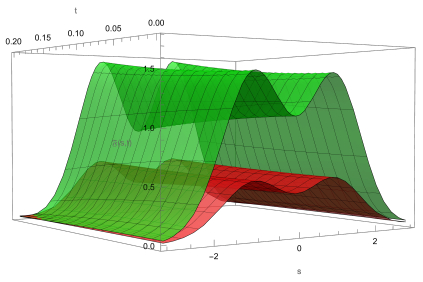
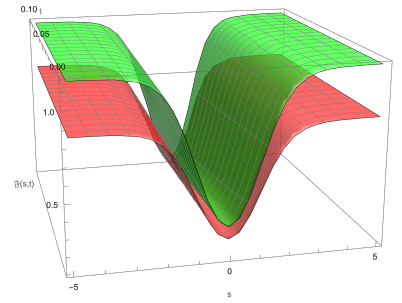
3D plot of lower and upper bounds of $ \mathfrak{F}(\mathfrak{s}, t) $ for $ \curlyvee = 0.5 $ and $ \varpi = 0.75 $
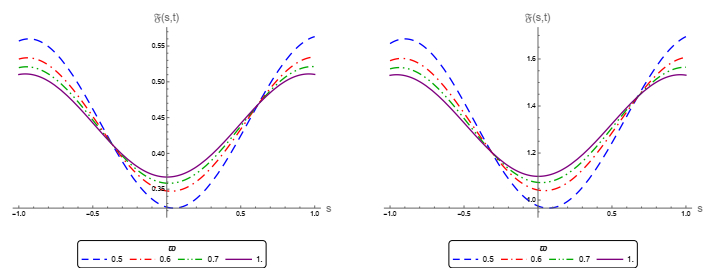
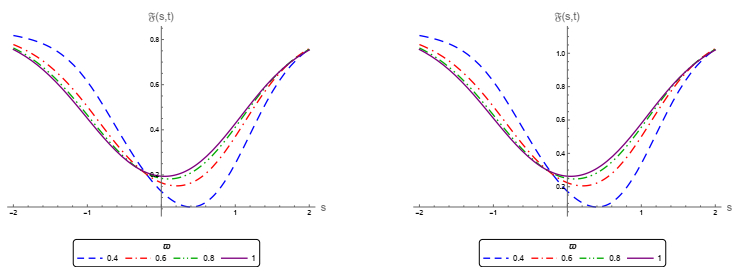
2D plots of $ \underline{\mathfrak{F}}(\mathfrak{s}, t) $ and $ \overline{\mathfrak{F}}(\mathfrak{s}, t) $ for $ \curlyvee = 0.5 $ and $ t = 0.05 $, respectively (from left to right)
3D plot of lower and upper bounds of $ \mathfrak{F}(\mathfrak{s}, t) $ for $ \curlyvee = 0.5 $ and $ \varpi = 0.6 $
2D plots of $ \underline{\mathfrak{F}}(\mathfrak{s}, t) $ and $ \overline{\mathfrak{F}}(\mathfrak{s}, t) $ for $ \curlyvee = 0.5 $ and $ t = 0.1 $, respectively (from left to right)
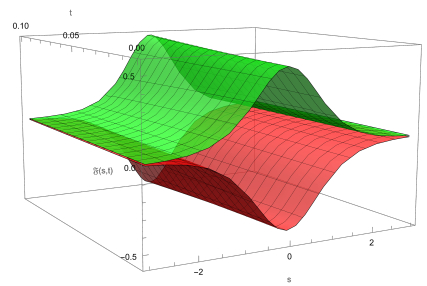
3D plot of lower and upper bounds of the graph of $ \mathfrak{F}(\mathfrak{s}, t) $ for $ \curlyvee = 0.5 $ and $ \varpi = 0.7 $
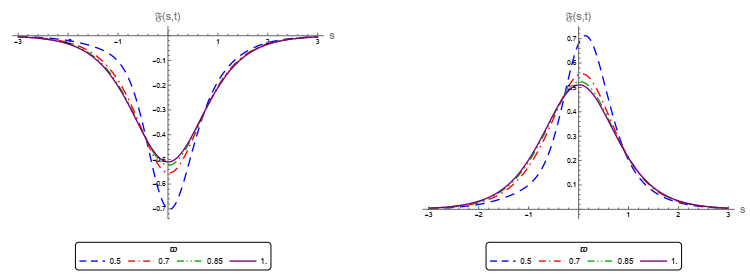
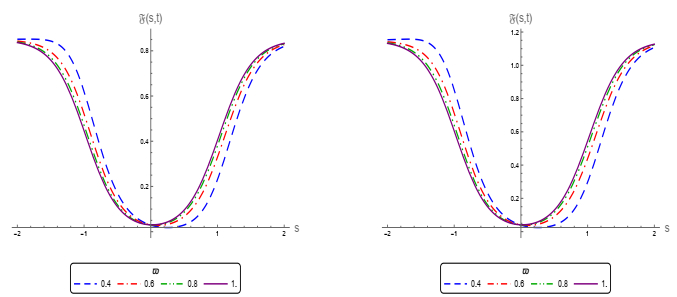
2D plots of $ \underline{\mathfrak{F}}(\mathfrak{s}, t) $ and $ \overline{\mathfrak{F}}(\mathfrak{s}, t) $ for $ \curlyvee = 0.5 $ and $ t = 0.1 $, respectively (from left to right)
2D plots of $ \underline{\mathfrak{F}}(\mathfrak{s}, t) $ and $ \overline{\mathfrak{F}}(\mathfrak{s}, t) $ for $ \curlyvee = 0.5 $ and $ t = 0.1 $, respectively (from left to right)




 DownLoad: