Time delay can select coordinated rhythms in central pattern generator networks, but deterministic existence does not ensure robustness under stochastic perturbations. We investigate a four-oscillator Stuart–Landau ring with delayed unidirectional coupling and multiplicative Itô noise. The original deterministic delay differential equation identifies a critical spatial mode with adjacent phase differences of $ \pi/2 $. A stochastic Galerkin–Koornwinder approximation converts the infinite-dimensional delay system into finite-dimensional systems for spectral, continuation, and stochastic analyses. Periodic continuation and Floquet multipliers reveal a bounded delay interval supporting a stable four-phase rotating wave, namely, a quarter-cycle pattern with adjacent phase differences of $ \pi/2 $. For the full $ N = 8 $ approximation, long-time simulations yield sampled phenomenological (P) transition brackets, identified by the change from an interior amplitude-density peak to boundary dominance, and dynamical (D) transition estimates, determined from the local sample stability of the absorbing zero state, which represents the loss of rhythmic CPG output as oscillation amplitudes decay to zero. Across the sampled delays, the P transition precedes the D transition, producing an intermediate regime in which the most probable nonzero amplitude has disappeared although the zero state is not yet locally sample stable. Representative $ N = 9 $ and $ N = 10 $ calculations provide directional truncation checks, while multi-seed, time-window, and step-size tests quantify numerical sensitivity of the D boundary. Combining the deterministic periodic window, stochastic transition brackets, and phase-performance diagnostics gives candidate finite-order operating intervals and identifies $ \tau = 2.35 $ as the grid point with the largest sampled joint margin. These transition boundaries are numerical results for the finite-order approximation rather than direct boundaries of the original stochastic delay equation.
Citation: Qiyuan He, Chonghe Shi, Zikun Han, Qiubao Wang. Delay-induced four-phase rotating waves and numerical brackets for stochastic P- and D-transitions in a four-oscillator central pattern generator[J]. AIMS Mathematics, 2026, 11(11): 38451-38491. doi: 10.3934/math.20261485
Time delay can select coordinated rhythms in central pattern generator networks, but deterministic existence does not ensure robustness under stochastic perturbations. We investigate a four-oscillator Stuart–Landau ring with delayed unidirectional coupling and multiplicative Itô noise. The original deterministic delay differential equation identifies a critical spatial mode with adjacent phase differences of $ \pi/2 $. A stochastic Galerkin–Koornwinder approximation converts the infinite-dimensional delay system into finite-dimensional systems for spectral, continuation, and stochastic analyses. Periodic continuation and Floquet multipliers reveal a bounded delay interval supporting a stable four-phase rotating wave, namely, a quarter-cycle pattern with adjacent phase differences of $ \pi/2 $. For the full $ N = 8 $ approximation, long-time simulations yield sampled phenomenological (P) transition brackets, identified by the change from an interior amplitude-density peak to boundary dominance, and dynamical (D) transition estimates, determined from the local sample stability of the absorbing zero state, which represents the loss of rhythmic CPG output as oscillation amplitudes decay to zero. Across the sampled delays, the P transition precedes the D transition, producing an intermediate regime in which the most probable nonzero amplitude has disappeared although the zero state is not yet locally sample stable. Representative $ N = 9 $ and $ N = 10 $ calculations provide directional truncation checks, while multi-seed, time-window, and step-size tests quantify numerical sensitivity of the D boundary. Combining the deterministic periodic window, stochastic transition brackets, and phase-performance diagnostics gives candidate finite-order operating intervals and identifies $ \tau = 2.35 $ as the grid point with the largest sampled joint margin. These transition boundaries are numerical results for the finite-order approximation rather than direct boundaries of the original stochastic delay equation.

| [1] |
P. Holmes, R. J. Full, D. E. Koditschek, J. Guckenheimer, The dynamics of legged locomotion: Models, analyses, and challenges, SIAM Rev., 48 (2006), 207–304. https://doi.org/10.1137/S0036144504445133 doi: 10.1137/S0036144504445133
|
| [2] |
A. J. Ijspeert, Central pattern generators for locomotion control in animals and robots: A review, Neural Netw., 21 (2008), 642–653. https://doi.org/10.1016/j.neunet.2008.03.014 doi: 10.1016/j.neunet.2008.03.014
|
| [3] |
J. J. Collins, I. N. Stewart, Coupled nonlinear oscillators and the symmetries of animal gaits, J. Nonlinear Sci., 3 (1993), 349–392. https://doi.org/10.1007/BF02429870 doi: 10.1007/BF02429870
|
| [4] |
C. P. Santos, V. Matos, Gait transition and modulation in a quadruped robot: A brainstem-like modulation approach, Robot. Auton. Syst., 59 (2011), 620–634. https://doi.org/10.1016/j.robot.2011.05.003 doi: 10.1016/j.robot.2011.05.003
|
| [5] |
J. Buchli, A. J. Ijspeert, Self-organized adaptive legged locomotion in a compliant quadruped robot, Auton. Robots, 25 (2008), 331–347. https://doi.org/10.1007/s10514-008-9099-2 doi: 10.1007/s10514-008-9099-2
|
| [6] |
I. Stewart, Spontaneous symmetry-breaking in a network model for quadruped locomotion, Int. J. Bifurcation Chaos, 27 (2017), 1730049. https://doi.org/10.1142/S021812741730049X doi: 10.1142/S021812741730049X
|
| [7] |
Z. Aminzare, V. Srivastava, P. Holmes, Gait transitions in a phase oscillator model of an insect central pattern generator, SIAM J. Appl. Dyn. Syst., 17 (2018), 626–671. https://doi.org/10.1137/17M1125571 doi: 10.1137/17M1125571
|
| [8] |
Z. Song, X. Huang, J. Xu, Spatiotemporal pattern of periodic rhythms in delayed Van der Pol oscillators for the CPG-based locomotion of snake-like robot, Nonlinear Dyn., 110 (2022), 3377–3393. https://doi.org/10.1007/s11071-022-07783-y doi: 10.1007/s11071-022-07783-y
|
| [9] |
Z. Song, J. Zhu, J. Xu, Gaits generation of quadruped locomotion for the CPG controller by the delay-coupled VDP oscillators, Nonlinear Dyn., 111 (2023), 18461–18479. https://doi.org/10.1007/s11071-023-08783-2 doi: 10.1007/s11071-023-08783-2
|
| [10] |
X. Yu, Z. Song, X. Sun, J. Xu, A theoretical approach for gait generation of the CPG controller by using the time-delay coupled oscillators, SIAM J. Appl. Dyn. Syst., 25 (2026), 518–553. https://doi.org/10.1137/25M1739820 doi: 10.1137/25M1739820
|
| [11] |
H. Li, Y. Tian, T. Huang, P. Yang, Hopf bifurcation and hybrid control of a delayed diffusive semi-ratio-dependent predator–prey model, AIMS Math., 9 (2024), 29608–29632. https://doi.org/10.3934/math.20241434 doi: 10.3934/math.20241434
|
| [12] |
P. H. Baxendale, A stochastic Hopf bifurcation, Probab. Theory Relat. Fields, 99 (1994), 581–616. https://doi.org/10.1007/BF01206233 doi: 10.1007/BF01206233
|
| [13] |
S. Hussain, T. N. Alharthi, Bifurcation and persistence in a stochastic seasonal dynamical system, AIMS Math., 11 (2026), 13126–13148. https://doi.org/10.3934/math.2026541 doi: 10.3934/math.2026541
|
| [14] |
M. Gaudreault, F. Lépine, J. Viñals, Pitchfork and Hopf bifurcation thresholds in stochastic equations with delayed feedback, Phys. Rev. E, 80 (2009), 061920. https://doi.org/10.1103/PhysRevE.80.061920 doi: 10.1103/PhysRevE.80.061920
|
| [15] |
Y. Yang, Q. Wang, Capture of stochastic P-bifurcation in a delayed mechanical centrifugal governor, Chaos Soliton. Fract., 174 (2023), 113910. https://doi.org/10.1016/j.chaos.2023.113910 doi: 10.1016/j.chaos.2023.113910
|
| [16] |
M. D. Chekroun, I. Koren, H. Liu, H. Liu, Generic generation of noise-driven chaos in stochastic time delay systems: Bridging the gap with high-end simulations, Sci. Adv., 8 (2022), eabq7137. https://doi.org/10.1126/sciadv.abq7137 doi: 10.1126/sciadv.abq7137
|
| [17] |
Z. Han, Q. Wang, H. Wu, Z. Hu, Stochastic P-bifurcation in a delayed Myc/E2F/miR-17-92 network, Int. J. Bifurcation Chaos, 32 (2022), 2250159. https://doi.org/10.1142/S0218127422501590 doi: 10.1142/S0218127422501590
|
| [18] |
Q. Wang, Z. Han, X. Zhang, Y. Yang, Dynamics of the delay-coupled bubble system combined with the stochastic term, Chaos Soliton. Fract., 148 (2021), 111053. https://doi.org/10.1016/j.chaos.2021.111053 doi: 10.1016/j.chaos.2021.111053
|
| [19] |
Z. Hu, Z. Han, Y. Yang, Q. Wang, Combined impact of multidelay feedback number and interval: A novel mechanism for controlling the stability of stochastic Duffing systems, Int. J. Bifurcation Chaos, 34 (2024), 2450108. https://doi.org/10.1142/S0218127424501086 doi: 10.1142/S0218127424501086
|
| [20] |
N. Zhang, Z. Wang, J. H. Park, W. Li, Semi-global synchronization of stochastic mixed time-delay systems with Lévy Noise under aperiodic intermittent delayed sampled-data control, Automatica, 171 (2025), 111963. https://doi.org/10.1016/j.automatica.2024.111963 doi: 10.1016/j.automatica.2024.111963
|
| [21] |
N. Zhang, Q. Hu, J. H. Park, W. Li, Exponential stability of stochastic highly nonlinear delayed systems with regime-switching diffusion under asynchronous intermittent control, IEEE Trans. Autom. Control, 70 (2025), 8375–8381. https://doi.org/10.1109/TAC.2025.3583609 doi: 10.1109/TAC.2025.3583609
|
| [22] |
N. Zhang, X. Wang, W. Li, Stability for multi-linked stochastic delayed complex networks with stochastic hybrid impulses by Dupire Itô's formula, Nonlinear Anal. Hybrid Syst., 45 (2022), 101200. https://doi.org/10.1016/j.nahs.2022.101200 doi: 10.1016/j.nahs.2022.101200
|
| [23] |
M. D. Chekroun, M. Ghil, H. Liu, S. Wang, Low-dimensional Galerkin approximations of nonlinear delay differential equations, Discrete Contin. Dyn. Syst., 36 (2016), 4133–4177. https://doi.org/10.3934/dcds.2016.36.4133 doi: 10.3934/dcds.2016.36.4133
|
| [24] |
M. D. Chekroun, H. Liu, Effective reduced models from delay differential equations: Bifurcations, tipping solution paths, and ENSO variability, Physica D, 460 (2024), 134058. https://doi.org/10.1016/j.physd.2024.134058 doi: 10.1016/j.physd.2024.134058
|
| [25] |
Z. Liu, Z. Han, J. Xu, Q. Wang, Stochastic Galerkin–Koornwinder method on analyzing stochastic MEMS gyroscope with time delay feedback control, J. Comput. Appl. Math., 483 (2026), 117396. https://doi.org/10.1016/j.cam.2026.117396 doi: 10.1016/j.cam.2026.117396
|
| [26] |
G. Fodor, H. T. Sykora, D. Bachrathy, Collocation method for stochastic delay differential equations, Probab. Eng. Mech., 74 (2023), 103515. https://doi.org/10.1016/j.probengmech.2023.103515 doi: 10.1016/j.probengmech.2023.103515
|
| [27] |
Y. Zhang, Y. Jin, P. Xu, S. Xiao, Stochastic bifurcations in a nonlinear tri-stable energy harvester under colored noise, Nonlinear Dyn., 99 (2020), 879–897. https://doi.org/10.1007/s11071-018-4702-3 doi: 10.1007/s11071-018-4702-3
|
| [28] |
Y. H. Sun, Y. G. Yang, W. Xu, Stochastic P-bifurcations of a noisy nonlinear system with fractional derivative element, Acta Mech. Sin., 37 (2021), 507–515. https://doi.org/10.1007/s10409-020-01020-8 doi: 10.1007/s10409-020-01020-8
|
Figures(11) / Tables(14)

Qiyuan He, Chonghe Shi, Zikun Han, Qiubao Wang. Delay-induced four-phase rotating waves and numerical brackets for stochastic P- and D-transitions in a four-oscillator central pattern generator[J]. AIMS Mathematics, 2026, 11(11): 38451-38491. doi: 10.3934/math.20261485

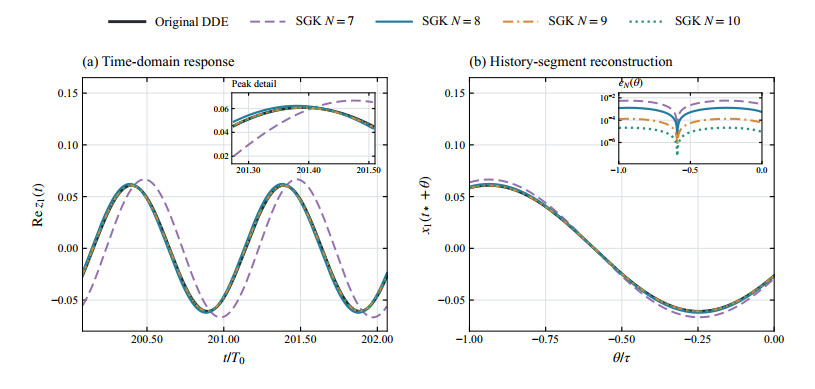
Deterministic DDE and SGK comparison: (a) oscillator output and peak detail; (b) history reconstruction and pointwise error. Orders $ N = 7, 8, 9, 10 $ are compared
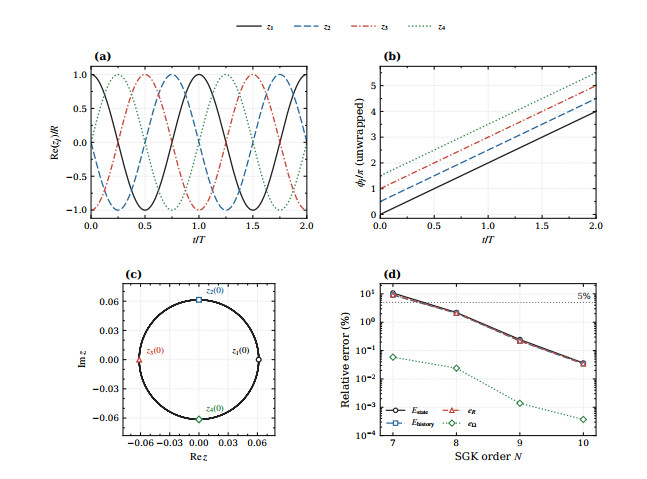
Quarter-cycle reconstruction and SGK accuracy: (a) normalized waveforms; (b) unwrapped phases; (c) common complex-plane orbit; (d) relative state, history, amplitude, and critical-frequency errors
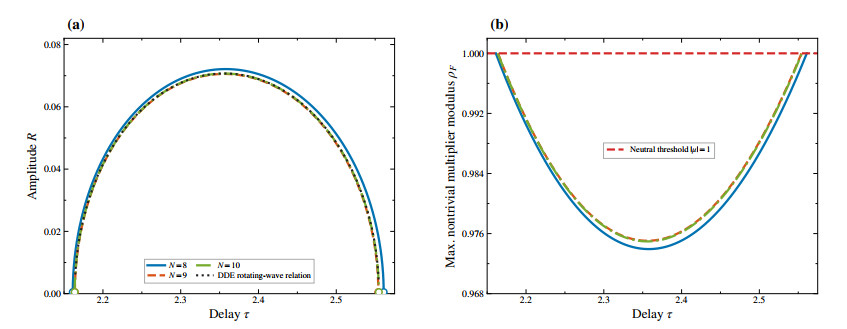
Deterministic SGK branches for $ N = 8, 9, 10 $: (a) amplitude and algebraic DDE reference; (b) largest nontrivial Floquet multiplier modulus, with neutral threshold $ \rho_F = 1 $
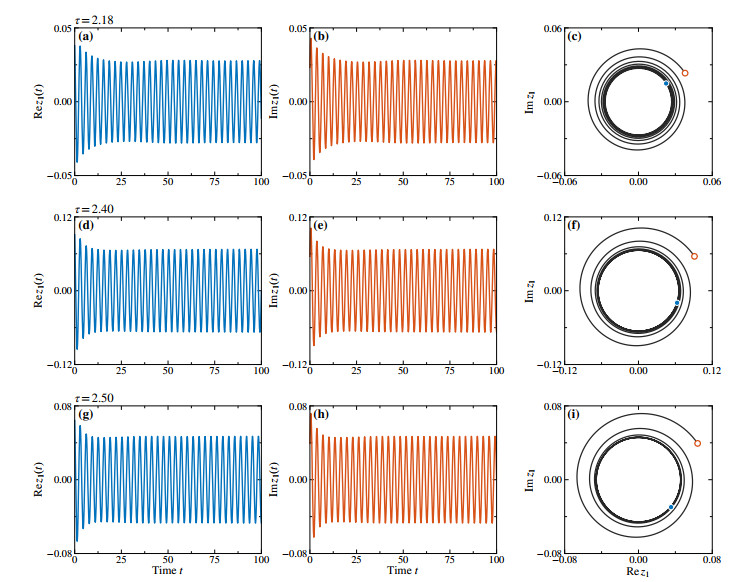
Deterministic DDE responses at $ \tau = 2.18 $, $ 2.40 $, and $ 2.50 $ (top to bottom). Columns show $ \operatorname{Re}z_1(t) $, $ \operatorname{Im}z_1(t) $, and complex-plane trajectories over $ 0\leq t\leq100 $
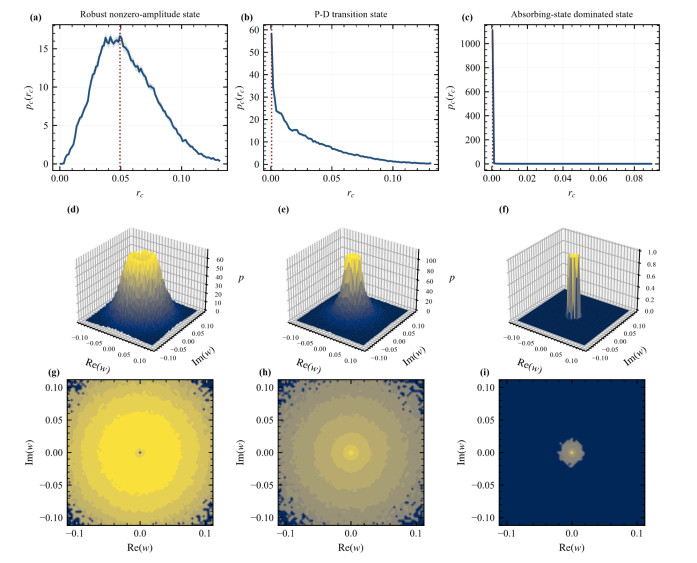
Auxiliary direct center-projection dynamics in the three regimes: (a)–(c) stationary amplitude densities; (d)–(f) joint center-plane densities
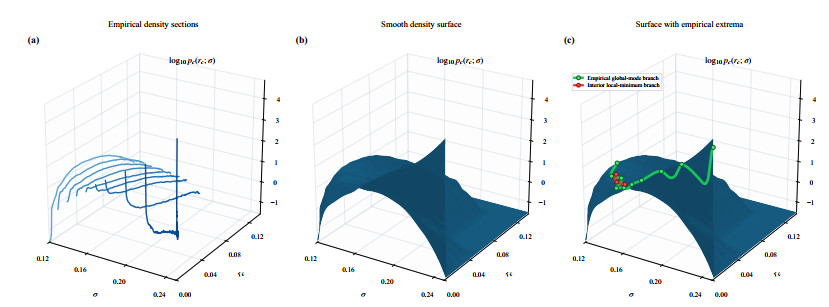
Full $ N = 8 $ SGK densities at $ \tau = 2.35 $: (a) empirical sections; (b) interpolated display surface; (c) sampled global modes (green) and local minima (red). Vertical axes show $ \log_{10}p_c(r_c; \sigma) $
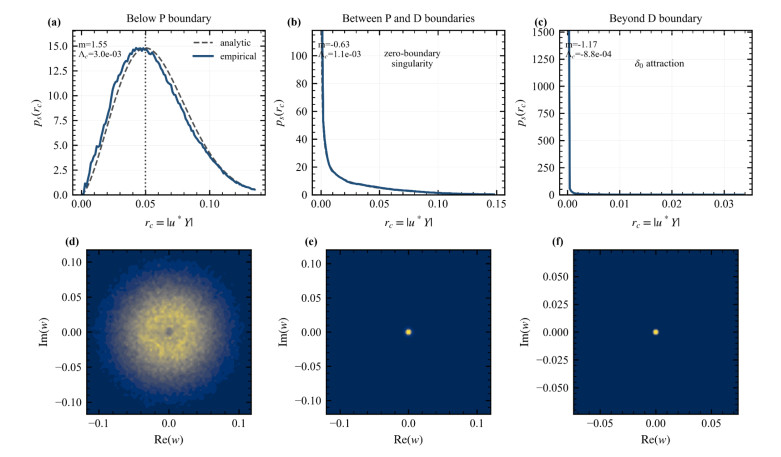
Full $ N = 8 $ SGK densities below the P bracket, between the P bracket and D estimate, and beyond the D estimate (left to right)
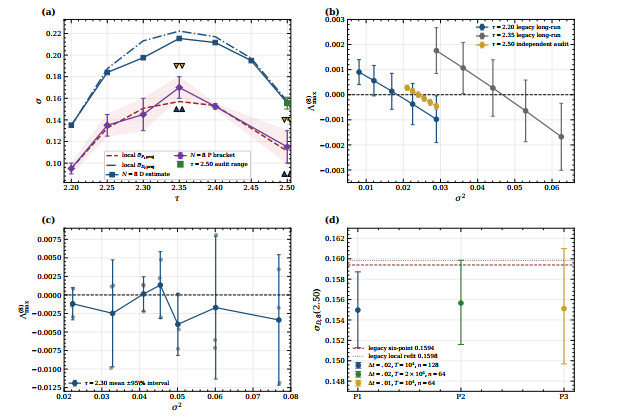
P brackets and SGK D diagnostics: (a) transition estimates; (b) Lyapunov scans; (c) seed diagnostics at $ \tau = 2.30 $; (d) protocol comparisons at $ \tau = 2.50 $
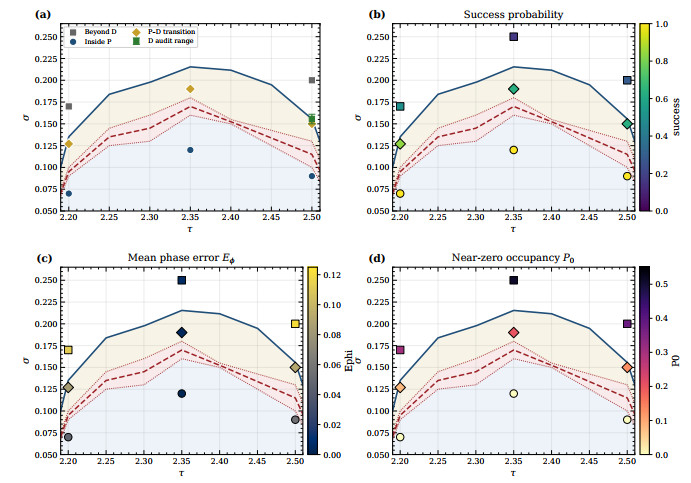
Full $ N = 8 $ SGK performance at nine sampled points: (a) P/D envelopes; (b) success probability; (c) mean phase error; (d) near-zero occupancy
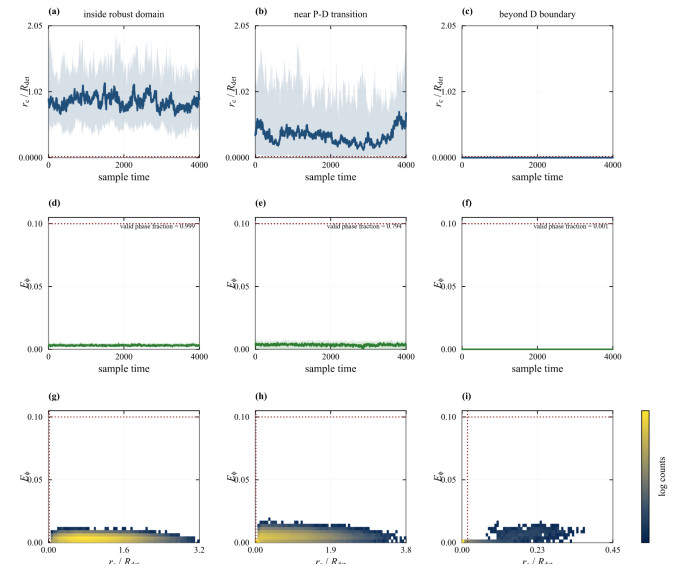
Single-realization diagnostics at $ \tau = 2.35 $ and $ \sigma = 0.12, 0.19, 0.25 $: normalized amplitude, phase error, and joint amplitude–phase distributions (top to bottom)
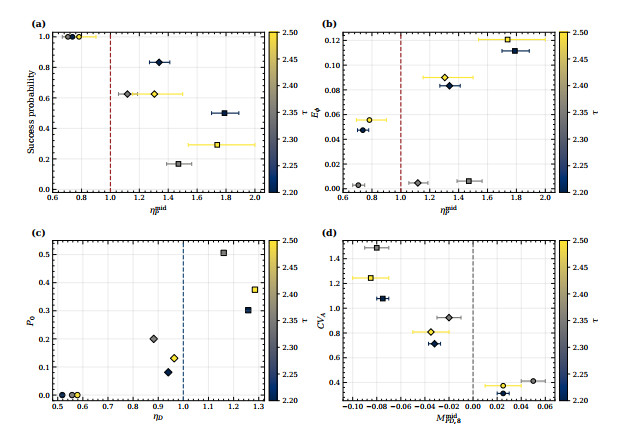
Dimensionless SGK performance: (a)–(b) success and phase error versus P distance; (c) near-zero occupancy versus D distance; (d) amplitude variability versus joint margin




 DownLoad: