We developed Lyapunov's first method for nonlinear fractional differential equations with the Caputo-tempered derivative of order $ \alpha\in(0, 1) $ and tempering parameter $ \lambda\ge 0 $. If every eigenvalue $ \mu $ of the linearization at the zero equilibrium satisfies $ \left\vert {\arg\mu}\right\vert > \alpha\pi/2 $, we proved that the trivial solution of the nonlinear tempered equation is asymptotically stable, with an explicit local envelope $ \left\Vert {x(t)}\right\Vert\le Me^{-\lambda t}\left\Vert {x(0)}\right\Vert $ and convergence of the weighted state $ e^{\lambda t}x(t) $ to zero. The proof rests on a tempered Lyapunov-Perron operator, built from the tempered variation of constants formula, which is a contraction on a small ball of an exponentially weighted space in which the tempering factors cancel exactly; for $ \lambda = 0 $, the argument recovers the classical linearization theorem for Caputo equations. Using subcritical exponential weights, we then extended the result to inner-sector eigenvalues with $ \operatorname{Re}(\mu^{1/\alpha}) < \lambda $; together, the two theorems show that, locally and under a smallness condition on the nonlinearity, the trivial solution is asymptotically stable whenever the spectrum lies in the open region of the complex plane in which the linear tempered modes decay. As an application, the zero equilibrium of a tempered fractional Lotka-Volterra model with intrinsic growth rate $ h $ was shown to be unstable for $ h > \lambda^{\alpha} $, asymptotically stable for $ h < \lambda^{\alpha} $, and stabilizable by linear state feedback for every $ h $; the critical case $ h = \lambda^{\alpha} $ was left open. Numerical experiments with a validated predictor-corrector scheme were consistent with the guaranteed decay rates.
Citation: Mohamed Rhaima. Linearized asymptotic stability for Caputo-tempered fractional differential equations[J]. AIMS Mathematics, 2026, 11(11): 37377-37410. doi: 10.3934/math.20261446
We developed Lyapunov's first method for nonlinear fractional differential equations with the Caputo-tempered derivative of order $ \alpha\in(0, 1) $ and tempering parameter $ \lambda\ge 0 $. If every eigenvalue $ \mu $ of the linearization at the zero equilibrium satisfies $ \left\vert {\arg\mu}\right\vert > \alpha\pi/2 $, we proved that the trivial solution of the nonlinear tempered equation is asymptotically stable, with an explicit local envelope $ \left\Vert {x(t)}\right\Vert\le Me^{-\lambda t}\left\Vert {x(0)}\right\Vert $ and convergence of the weighted state $ e^{\lambda t}x(t) $ to zero. The proof rests on a tempered Lyapunov-Perron operator, built from the tempered variation of constants formula, which is a contraction on a small ball of an exponentially weighted space in which the tempering factors cancel exactly; for $ \lambda = 0 $, the argument recovers the classical linearization theorem for Caputo equations. Using subcritical exponential weights, we then extended the result to inner-sector eigenvalues with $ \operatorname{Re}(\mu^{1/\alpha}) < \lambda $; together, the two theorems show that, locally and under a smallness condition on the nonlinearity, the trivial solution is asymptotically stable whenever the spectrum lies in the open region of the complex plane in which the linear tempered modes decay. As an application, the zero equilibrium of a tempered fractional Lotka-Volterra model with intrinsic growth rate $ h $ was shown to be unstable for $ h > \lambda^{\alpha} $, asymptotically stable for $ h < \lambda^{\alpha} $, and stabilizable by linear state feedback for every $ h $; the critical case $ h = \lambda^{\alpha} $ was left open. Numerical experiments with a validated predictor-corrector scheme were consistent with the guaranteed decay rates.

| [1] |
I. Podlubny, Fractional differential equations: an introduction to fractional derivatives, fractional differential equations, to methods of their solution and some of their applications, San Diego: Academic Press, 1999. |
| [2] |
A. A. Kilbas, H. M. Srivastava, J. J. Trujillo, Theory and applications of fractional differential equations, Amsterdam: Elsevier, 2006. |
| [3] |
K. Diethelm, The analysis of fractional differential equations: an application-oriented exposition using differential operators of Caputo type, Berlin: Springer, 2010. https://doi.org/10.1007/978-3-642-14574-2 |
| [4] |
C. Ran, X. Xu, C. Hou, X. Zhang, Numerical approximation of fourth-order fractional diffusion-wave systems using finite difference and discontinuous Galerkin method, Netw. Heterog. Media, 20 (2025), 1346–1366. https://doi.org/10.3934/nhm.2025058 doi: 10.3934/nhm.2025058
|
| [5] |
Y. Feng, X. Zhang, L. Wei, A high-order compact finite difference scheme for time-fractional generalized Burgers-Fisher and Burgers-Huxley equations, Commun. Nonlinear Sci., 163 (2026), 110788. https://doi.org/10.1016/j.cnsns.2026.110788 doi: 10.1016/j.cnsns.2026.110788
|
| [6] |
X. Zhang, Y. Feng, L. Wei, High-precision numerical simulation for fractional convection-diffusion-reaction equations, Math. Method. Appl. Sci., 49 (2026), 13928–13945. https://doi.org/10.1002/mma.70756 doi: 10.1002/mma.70756
|
| [7] |
F. Sabzikar, M. M. Meerschaert, J. Chen, Tempered fractional calculus, J. Comput. Phys., 293 (2015), 14–28. https://doi.org/10.1016/j.jcp.2014.04.024 doi: 10.1016/j.jcp.2014.04.024
|
| [8] |
C. Li, W. Deng, L. Zhao, Well-posedness and numerical algorithm for the tempered fractional differential equations, Discrete Cont. Dyn.-B, 24 (2019), 1989–2015. https://doi.org/10.3934/dcdsb.2019026 doi: 10.3934/dcdsb.2019026
|
| [9] |
Y. Mishura, K. Ralchenko, Asymptotic growth of sample paths of tempered fractional Brownian motions, with statistical applications to Vasicek-type models, Fractal Fract., 8 (2024), 79. https://doi.org/10.3390/fractalfract8020079 doi: 10.3390/fractalfract8020079
|
| [10] |
P. P. Mehta, Fractional and tempered fractional models for Reynolds-averaged Navier-Stokes equations, J. Turbul., 24 (2023), 507–553. https://doi.org/10.1080/14685248.2023.2274100 doi: 10.1080/14685248.2023.2274100
|
| [11] |
X. Zhang, J. Chen, P. Chen, L. Li, Y. Wu, Nonlocal changing-sign perturbation tempered fractional sub-diffusion model with weak singularity, Fractal Fract., 8 (2024), 337. https://doi.org/10.3390/fractalfract8060337 doi: 10.3390/fractalfract8060337
|
| [12] |
R. Almeida, N. Martins, J. V. da C. Sousa, Fractional tempered differential equations depending on arbitrary kernels, AIMS Mathematics, 9 (2024), 9107–9127. https://doi.org/10.3934/math.2024443 doi: 10.3934/math.2024443
|
| [13] |
I. Lamrani, H. Zitane, D. F. M. Torres, Controllability and observability of tempered fractional differential systems, Commun. Nonlinear Sci., 142 (2025), 108501. https://doi.org/10.1016/j.cnsns.2024.108501 doi: 10.1016/j.cnsns.2024.108501
|
| [14] |
J. Deng, W. Ma, K. Deng, Y. Li, Tempered Mittag-Leffler stability of tempered fractional dynamical systems, Math. Probl. Eng., 2020 (2020), 7962542. https://doi.org/10.1155/2020/7962542 doi: 10.1155/2020/7962542
|
| [15] |
A. Ben Makhlouf, D. Boucenna, A. M. Nagy, L. Mchiri, Some weakly singular integral inequalities and their applications to tempered fractional differential equations, J. Math., 2022 (2022), 1682942. https://doi.org/10.1155/2022/1682942 doi: 10.1155/2022/1682942
|
| [16] |
H. Zitane, D. F. M. Torres, Finite time stability of tempered fractional systems with time delays, Chaos Soliton. Fract., 177 (2023), 114265. https://doi.org/10.1016/j.chaos.2023.114265 doi: 10.1016/j.chaos.2023.114265
|
| [17] |
M. R. Lemnaouar, C. Taftaf, Y. Louartassi, Lyapunov theorems of tempered $\rho$-Caputo dynamical systems, Int. J. Syst. Sci., 57 (2026), 297–310. https://doi.org/10.1080/00207721.2025.2503197 doi: 10.1080/00207721.2025.2503197
|
| [18] |
H. Gassara, D. Kharrat, A. Ben Makhlouf, L. Mchiri, M. Rhaima, SOS approach for practical stabilization of tempered fractional-order power system, Mathematics, 11 (2023), 3024. https://doi.org/10.3390/math11133024 doi: 10.3390/math11133024
|
| [19] |
O. Kahouli, H. Gassara, S. Albadran, A. Aloui, B. Louhichi, Practical exponential stability and stabilization of polynomial fuzzy tempered fractional-order systems, Ain Shams Eng. J., 17 (2026), 104265. https://doi.org/10.1016/j.asej.2026.104265 doi: 10.1016/j.asej.2026.104265
|
| [20] |
H. Rguigui, M. Elghribi, Practical stabilization for a class of tempered fractional-order nonlinear fuzzy systems, Asian J. Control, 28 (2026), 294–300. https://doi.org/10.1002/asjc.3703 doi: 10.1002/asjc.3703
|
| [21] |
A. R. A. Alanzi, R. Fakhfakh, A. Ben Makhlouf, O. Naifar, Practical exponential stability of tempered $\varpi$-fractional systems: Lyapunov criteria and applications to perturbed and controlled systems, Fractal Fract., 10 (2026), 344. https://doi.org/10.3390/fractalfract10050344 doi: 10.3390/fractalfract10050344
|
| [22] |
L. Ma, R. Huang, Asymptotic stability and fold bifurcation analysis in Caputo-Hadamard type fractional differential system, Chinese J. Phys., 88 (2024), 171–197. https://doi.org/10.1016/j.cjph.2024.01.028 doi: 10.1016/j.cjph.2024.01.028
|
| [23] |
K. Diethelm, S. Hashemishahraki, H. D. Thai, H. T. Tuan, A constructive approach for investigating the stability of incommensurate fractional differential systems, J. Math. Anal. Appl., 540 (2024), 128642. https://doi.org/10.1016/j.jmaa.2024.128642 doi: 10.1016/j.jmaa.2024.128642
|
| [24] |
P. T. Anh, A. Czornik, M. Niezabitowski, Linearized asymptotic stability for nabla Riemann-Liouville fractional difference equation, Arch. Control Sci., 34 (2024), 569–588. https://doi.org/10.24425/acs.2024.149672 doi: 10.24425/acs.2024.149672
|
| [25] |
N. D. Cong, T. S. Doan, S. Siegmund, H. T. Tuan, Linearized asymptotic stability for fractional differential equations, Electron. J. Qual. Theory Differ. Equ., 2016 (2016), 1–13. https://doi.org/10.14232/ejqtde.2016.1.39 doi: 10.14232/ejqtde.2016.1.39
|
| [26] |
K. Diethelm, N. J. Ford, A. D. Freed, A predictor-corrector approach for the numerical solution of fractional differential equations, Nonlinear Dyn., 29 (2002), 3–22. https://doi.org/10.1023/A:1016592219341 doi: 10.1023/A:1016592219341
|
| [27] |
K. S. Miller, A note on the complete monotonicity of the generalized Mittag-Leffler function, Real Anal. Exchange, 23 (1997), 753–756. |
| [28] |
T. Yue, T. Wang, New Datko-type results for the uniform exponential instability in mean of cocycles, Dynam. Syst., 41 (2026), 128–134. https://doi.org/10.1080/14689367.2025.2596579 doi: 10.1080/14689367.2025.2596579
|
| [29] |
R. A. Horn, C. R. Johnson, Matrix analysis, Cambridge: Cambridge University Press, 2013. https://doi.org/10.1017/CBO9780511810817 |
| [30] |
T. Zhao, Efficient spectral collocation method for tempered fractional differential equations, Fractal Fract., 7 (2023), 277. https://doi.org/10.3390/fractalfract7030277 doi: 10.3390/fractalfract7030277
|
| [31] |
A. Bibi, M. ur Rehman, A numerical method for solutions of tempered fractional differential equations, J. Comput. Appl. Math., 443 (2024), 115772. https://doi.org/10.1016/j.cam.2024.115772 doi: 10.1016/j.cam.2024.115772
|
| [32] |
M. H. Heydari, D. Baleanu, M. Bayram, A cardinal-based approximation approach for a family of nonlinear fractional integro-differential equations involving Caputo tempered derivative, J. Appl. Math. Comput., 71 (2025), 4503–4527. https://doi.org/10.1007/s12190-025-02402-6 doi: 10.1007/s12190-025-02402-6
|
Figures(5) / Tables(4)

Mohamed Rhaima. Linearized asymptotic stability for Caputo-tempered fractional differential equations[J]. AIMS Mathematics, 2026, 11(11): 37377-37410. doi: 10.3934/math.20261446

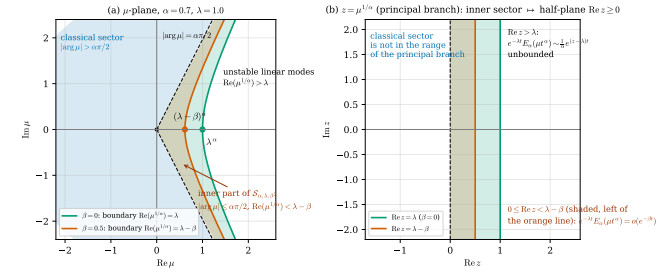
The spectral set $ \mathcal{S}_{\alpha, \lambda, \beta} $ of Theorem 3.2 for $ \alpha = 0.7 $, $ \lambda = 1 $, and $ \beta\in\{0, 0.5\} $. (a) In the $ \mu $-plane: the classical sector $ \left\vert {\arg\mu}\right\vert > \alpha\pi/2 $ (blue, Theorem 3.1), bounded by the dashed rays; the inner part is $ \{\left\vert {\arg\mu}\right\vert\le\alpha\pi/2, \ \operatorname{Re}(\mu^{1/\alpha}) < \lambda-\beta\} $ (shaded, Theorem 3.2), bounded by the curve $ \operatorname{Re}(\mu^{1/\alpha}) = \lambda-\beta $ (green for $ \beta = 0 $, orange for $ \beta = 0.5 $), which meets the real axis at $ (\lambda-\beta)^{\alpha} $ and is asymptotic to the rays; to the right of the green, curve the linear modes $ e^{-\lambda t}E_{\alpha}(\mu t^{\alpha}) $ are unbounded. (b) The same sets in the plane of $ z = \mu^{1/\alpha} $ (principal branch): the inner sector becomes the closed half-plane $ \operatorname{Re}z\ge0 $, its bounding rays become the imaginary axis, and the stability boundaries become the vertical lines $ \operatorname{Re}z = \lambda-\beta $
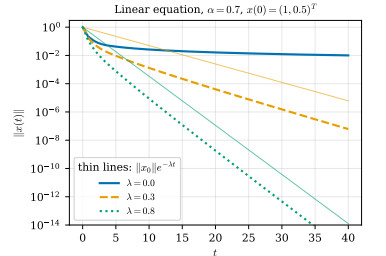
Example 4.1: Decay of $ \left\Vert {x(t)}\right\Vert $ for the linear tempered equation $ {}^{C}\!D^{{\alpha}, {\lambda}}_{0+}x = Ax $, this lines show the guaranteed envelopes $ \left\Vert {x_{0}}\right\Vert e^{-\lambda t} $ for $ \lambda = 0.3 $ and $ \lambda = 0.8 $
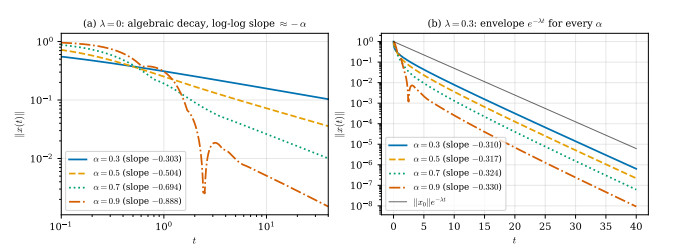
Example 4.2: $ \left\Vert {x(t)}\right\Vert $ for the linear equation of Example 4.1 with $ \alpha\in\{0.3, 0.5, 0.7, 0.9\} $ and $ x(0) = (1, 0.5)^{T} $: (a) $ \lambda = 0 $ (log-log scale), where the decay is algebraic with a slope close to $ -\alpha $; (b) $ \lambda = 0.3 $ (semi-logarithmic scale), where all curves lie below the guaranteed envelope $ \left\Vert {x_{0}}\right\Vert e^{-\lambda t} $ (thin black line). The legends report the observed least-squares slopes on $ [20,40] $
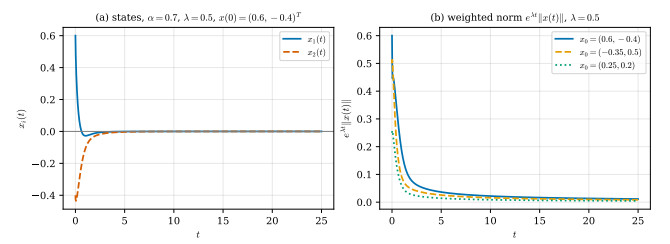
Example 4.3: (a) States of the nonlinear tempered system $ {}^{C}\!D^{{\alpha}, {\lambda}}_{0+}x = Ax+f(x) $. (b) weighted norm $ e^{\lambda t}\left\Vert {x(t)}\right\Vert $ for the three initial conditions $ x(0) = (0.6, -0.4)^{T} $, $ (-0.35, 0.5)^{T} $, and $ (0.25, 0.2)^{T} $
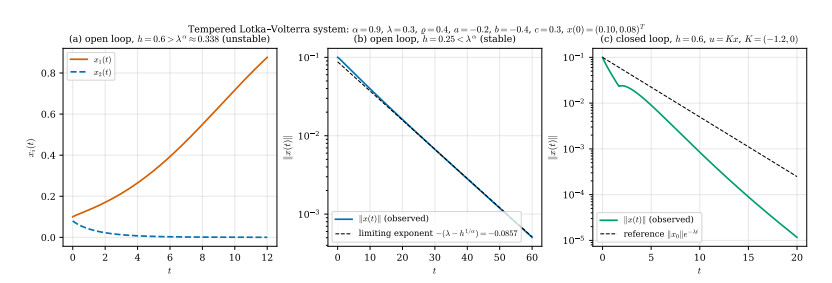
Example 4.4: Tempered Lotka-Volterra system (3.27) with $ \alpha = 0.9 $, $ \lambda = 0.3 $, $ \varrho = 0.4 $, $ a = -0.2 $, $ b = -0.4 $, $ c = 0.3 $, and $ x(0) = (0.10, 0.08)^{T} $: (a) open-loop system with $ h = 0.6 > \lambda^{\alpha}\approx0.338 $ (unstable): the two states; (b) open-loop system with $ h = 0.25 < \lambda^{\alpha} $ (stable): $ \left\Vert {x(t)}\right\Vert $ on a logarithmic scale, with a line of slope $ -(\lambda-h^{1/\alpha})\approx-0.0857 $ (dashed), the limiting exponent of the linear mode; (c) closed-loop system under the feedback $ u = Kx $ with $ B = (1, 1)^{T} $ and $ K = (-1.2, 0) $, with the reference curve $ \left\Vert {x_{0}}\right\Vert e^{-\lambda t} $ (dashed)




 DownLoad: