This paper addresses the matrix similarity equation problem by presenting the neurodynamic solution, and applies the solution to solve the output tracking control problem for time-invariant linear systems (TILSs). The feedback gain matrix in the control input is obtained by introducing the matrix similarity-based pole placement equation (MSBPPE) and transforming it into the form of a neurodynamic system. That is, a gradient neurodynamic (GN) model is constructed using an energy function to solve the MSBPPE, enabling the determination of the state feedback gain matrix. Additionally, a zeroing neurodynamic (ZN) model is employed to design the reference input and to ensure that the system output exponentially tracks the desired path. Theoretical analyses show that the proposed neurodynamic models can be asymptotically stable and exhibit exponential convergence. Numerical experiments are conducted under various pole configurations—including distinct real poles, repeated real poles, and complex conjugate poles—verifying the effectiveness and fast convergence of the models. The results show that the proposed models achieve precise output tracking under different dimensional and different types of desired path settings, confirming their theoretical applicability.
Citation: Zhengyang Tang, Yunong Zhang, Yanli Ji. Gradient neurodynamics (GN), zeroing neurodynamics (ZN), and combination application[J]. AIMS Mathematics, 2026, 11(11): 36634-36659. doi: 10.3934/math.20261416
This paper addresses the matrix similarity equation problem by presenting the neurodynamic solution, and applies the solution to solve the output tracking control problem for time-invariant linear systems (TILSs). The feedback gain matrix in the control input is obtained by introducing the matrix similarity-based pole placement equation (MSBPPE) and transforming it into the form of a neurodynamic system. That is, a gradient neurodynamic (GN) model is constructed using an energy function to solve the MSBPPE, enabling the determination of the state feedback gain matrix. Additionally, a zeroing neurodynamic (ZN) model is employed to design the reference input and to ensure that the system output exponentially tracks the desired path. Theoretical analyses show that the proposed neurodynamic models can be asymptotically stable and exhibit exponential convergence. Numerical experiments are conducted under various pole configurations—including distinct real poles, repeated real poles, and complex conjugate poles—verifying the effectiveness and fast convergence of the models. The results show that the proposed models achieve precise output tracking under different dimensional and different types of desired path settings, confirming their theoretical applicability.

| [1] |
F. Zhu, P. Li, Adaptive fuzzy consensus tracking control of multi-agent systems with predefined time, AIMS Mathematics, 10 (2025), 5307–5331. https://doi.org/10.3934/math.2025245 doi: 10.3934/math.2025245
|
| [2] |
J. Li, Y. Zhang, H. J. Lee, Y. Wang, Fuzzy tracking control of singular multi-agent systems under switching topology, AIMS Mathematics, 9 (2024), 29718–29735. https://doi.org/10.3934/math.20241440 doi: 10.3934/math.20241440
|
| [3] |
M. Aly, B. Ali, F. Y. Mekonnen, M. Elhesasy, M. Wang, M. M. Kamra, et al., Real-flight-path tracking control design for quadrotor UAVs: A precision-guided approach, Automation, 6 (2025), 93. https://doi.org/10.3390/automation6040093 doi: 10.3390/automation6040093
|
| [4] |
Y. Xu, J. Liu, H. Yan, A. Wang, H. Xu, Y. Ma, et al., Target tracking-based online calibration of UAV electro-optical pod installation errors, Automation, 7 (2026), 59. https://doi.org/10.3390/automation7020059 doi: 10.3390/automation7020059
|
| [5] |
D. Chen, Y. Zhang, S. Li, Tracking control of robot manipulators with unknown models: A Jacobian-matrix-adaption method, IEEE Trans. Ind. Inform., 14 (2018), 3044–3053. https://doi.org/10.1109/TII.2017.2766455 doi: 10.1109/TII.2017.2766455
|
| [6] |
J. Chen, Y. Pan, Y. Zhang, Model-free and pseudoinverse-free Zhang neurodynamics scheme for robotic arms' path tracking control, IEEE Trans. Neural Netw. Learn. Syst., 36 (2025), 10201–10212. https://doi.org/10.1109/TNNLS.2025.3540589 doi: 10.1109/TNNLS.2025.3540589
|
| [7] |
H. Zhong, W. Wen, J. Fan, W. Yang, Reinforcement learning-based adaptive tracking control for flexible-joint robotic manipulators, AIMS Mathematics, 9 (2024), 27330–27360. https://doi.org/10.3934/math.20241328 doi: 10.3934/math.20241328
|
| [8] |
L. Jin, L. Liu, X. Wang, M. Shang, F. Wang, Physical-informed neural network for MPC-based trajectory tracking of vehicles with noise considered, IEEE Trans. Intell. Veh., 9 (2024), 4493–4503. https://doi.org/10.1109/TIV.2024.3358229 doi: 10.1109/TIV.2024.3358229
|
| [9] |
Y. Liufu, L. Jin, M. Shang, X. Wang, F. Wang, ACP-incorporated perturbation-resistant neural dynamics controller for autonomous vehicles, IEEE Trans. Intell. Veh., 9 (2024), 4675–4686. https://doi.org/10.1109/TIV.2023.3348632 doi: 10.1109/TIV.2023.3348632
|
| [10] |
T. Belkebir, H. Belkebir, A. Mansouri, Real-time embedded NMPC for autonomous vehicle path tracking with curvature-aware speed adaptation and sensitivity analysis, Automation, 7 (2026), 44. https://doi.org/10.3390/automation7020044 doi: 10.3390/automation7020044
|
| [11] |
D. Xu, Y. Shi, Z. Ji, Model-free adaptive discrete-time integral sliding-mode-constrained-control for autonomous 4WMV parking systems, IEEE Trans. Ind. Electron., 65 (2018), 834–843. https://doi.org/10.1109/TIE.2017.2739680 doi: 10.1109/TIE.2017.2739680
|
| [12] |
S. Chaturvedi, N. Kumar, R. Kumar, A PSO-optimized novel PID neural network model for temperature control of jacketed CSTR: Design, simulation, and a comparative study, Soft Comput., 28 (2024), 4759–4773. https://doi.org/10.1007/s00500-023-09138-0 doi: 10.1007/s00500-023-09138-0
|
| [13] |
Y. Zhang, J. Wang, Global exponential stability of recurrent neural networks for synthesizing linear feedback control systems via pole assignment, IEEE Trans. Neural Netw., 13 (2002), 633–644. https://doi.org/10.1109/TNN.2002.1000129 doi: 10.1109/TNN.2002.1000129
|
| [14] |
F. M. Callier, C. A. Desoer, Linear system theory, New York: Springer, 1991. https://doi.org/10.1007/978-1-4612-0957-7 |
| [15] |
J. H. Mathews, K. D. Fink, Numerical methods using MATLAB, Prentice Hall, 2004. |
| [16] |
J. Kautsky, N. K. Nichols, P. V. Dooren, Robust pole assignment in linear state feedback, Int. J. Control, 41 (1985), 1129–1155. https://doi.org/10.1080/0020718508961188 doi: 10.1080/0020718508961188
|
| [17] |
P. Blanchard, Differential equations, Brooks/Cole Pub. Co., 1998. |
| [18] |
Y. Zhang, Y. Shi, K. Chen, C. Wang, Global exponential convergence and stability of gradient-based neural network for online matrix inversion, Appl. Math. Comput., 215 (2009), 1301–1306. https://doi.org/10.1016/j.amc.2009.06.048 doi: 10.1016/j.amc.2009.06.048
|
| [19] |
Y. Zhang, D. Jiang, J. Wang, A recurrent neural network for solving Sylvester equation with time-varying coefficients, IEEE Trans. Neural Netw., 13 (2002), 1053–1063. https://doi.org/10.1109/TNN.2002.1031938 doi: 10.1109/TNN.2002.1031938
|
| [20] |
Y. Zhang, S. Ge, Design and analysis of a general recurrent neural network model for time-varying matrix inversion, IEEE Trans. Neural Netw., 16 (2005), 1477–1490. https://doi.org/10.1109/TNN.2005.857946 doi: 10.1109/TNN.2005.857946
|
| [21] |
B. Liao, L. Han, X. Cao, S. Li, J. Li, Double integral-enhanced Zeroing neural network with linear noise rejection for time-varying matrix inverse, CAAI Trans. Intell. Technol., 9 (2024), 197–210. https://doi.org/10.1049/cit2.12161 doi: 10.1049/cit2.12161
|
| [22] |
Y. Yang, Y. Zhang, Superior robustness of power-sum activation functions in Zhang neural networks for time-varying quadratic programs perturbed with large implementation errors, Neural Comput. Appl., 22 (2013), 175–185. https://doi.org/10.1007/s00521-011-0692-5 doi: 10.1007/s00521-011-0692-5
|
| [23] |
Y. Zhang, G. Ruan, K. Li, Y. Yang, Robustness analysis of the Zhang neural network for online time-varying quadratic optimization, J. Phys. A: Math. Theor., 43 (2010), 245202. https://doi.org/10.1088/1751-8113/43/24/245202 doi: 10.1088/1751-8113/43/24/245202
|
| [24] |
B. Liao, Y. Zhang, L. Jin, Taylor ${O}(h^{3})$ discretization of ZNN models for dynamic equality-constrained quadratic programming with application to manipulators, IEEE Trans. Neural Netw. Learn. Syst., 27 (2016), 225–237. https://doi.org/10.1109/TNNLS.2015.2435014 doi: 10.1109/TNNLS.2015.2435014
|
| [25] |
Z. Zhang, Y. Zhang, Acceleration-level cyclic-motion generation of constrained redundant robots tracking different paths, IEEE Trans. Syst. Man Cybern., Part B, Cybern., 42 (2012), 1257–1269. https://doi.org/10.1109/TSMCB.2012.2189003 doi: 10.1109/TSMCB.2012.2189003
|
| [26] |
J. Li, Y. Zhang, S. Li, M. Mao, New discretization-formula-based Zeroing dynamics for real-time tracking control of serial and parallel manipulators, IEEE Trans. Ind. Inform., 14 (2018), 3416–3425. https://doi.org/10.1109/TII.2017.2780892 doi: 10.1109/TII.2017.2780892
|
| [27] |
Y. Ding, H. Jia, Y. Zhang, B. Qiu, High-order modeling, Zeroing dynamics control, and perturbations rejection for non-linear double-holding water tank, Mathematics, 11 (2023), 2989. https://doi.org/10.3390/math11132989 doi: 10.3390/math11132989
|
| [28] |
V. N. Katsikis, S. D. Mourtas, P. S. Stanimirović, Y. Zhang, Solving complex-valued time-varying linear matrix equations via QR decomposition with applications to robotic motion tracking and on angle-of-arrival localization, IEEE Trans. Neural Netw. Learn. Syst., 33 (2022), 3415–3424. https://doi.org/10.1109/TNNLS.2021.3052896 doi: 10.1109/TNNLS.2021.3052896
|
| [29] |
A. Winursito, G. N. P. Pratama, LQR state feedback controller with precompensator for magnetic levitation system, J. Phys. Conf. Ser., 2111 (2021), 012004. https://doi.org/10.1088/1742-6596/2111/1/012004 doi: 10.1088/1742-6596/2111/1/012004
|
| [30] |
E. J. Davison, H. W. Smith, A note on the design of industrial regulators: Integral feedback and feedforward controllers, Automatica, 10 (1974), 329–332. https://doi.org/10.1016/0005-1098(74)90044-2 doi: 10.1016/0005-1098(74)90044-2
|
| [31] |
E. J. Davison, The feedforward control of linear multivariable time-invariant systems, Automatica, 9 (1973), 561–573. https://doi.org/10.1016/0005-1098(73)90042-3 doi: 10.1016/0005-1098(73)90042-3
|
| [32] |
B. A. Francis, The linear multivariable regulator problem, SIAM J. Control Optim., 15 (1977), 486–505. https://doi.org/10.1137/0315033 doi: 10.1137/0315033
|
| [33] |
B. A. Francis, W. M. Wonham, The internal model principle of control theory, Automatica, 12 (1976), 457–465. https://doi.org/10.1016/0005-1098(76)90006-6 doi: 10.1016/0005-1098(76)90006-6
|
| [34] |
R. A. Horn, C. R. Johnson, Matrix analysis, Cambridge University Press, 2012. https://doi.org/10.1017/CBO9780511810817 |
| [35] |
W. Greub, Linear algebra, New York: Springer, 1975. https://doi.org/10.1007/978-1-4684-9446-4 |
| [36] |
Y. Zhang, K. Chen, H. Tan, Performance analysis of gradient neural network exploited for online time-varying matrix inversion, IEEE Trans. Automat. Control, 54 (2009), 1940–1945. https://doi.org/10.1109/TAC.2009.2023779 doi: 10.1109/TAC.2009.2023779
|
| [37] |
P. Guo, Y. Zhang, S. Li, Reciprocal-kind Zhang neurodynamics method for temporal-dependent Sylvester equation and robot manipulator motion planning, IEEE Trans. Neural Netw. Learn. Syst., 36 (2025), 15110–15124. https://doi.org/10.1109/TNNLS.2025.3525747 doi: 10.1109/TNNLS.2025.3525747
|
Figures(8) / Tables(3)

Zhengyang Tang, Yunong Zhang, Yanli Ji. Gradient neurodynamics (GN), zeroing neurodynamics (ZN), and combination application[J]. AIMS Mathematics, 2026, 11(11): 36634-36659. doi: 10.3934/math.20261416

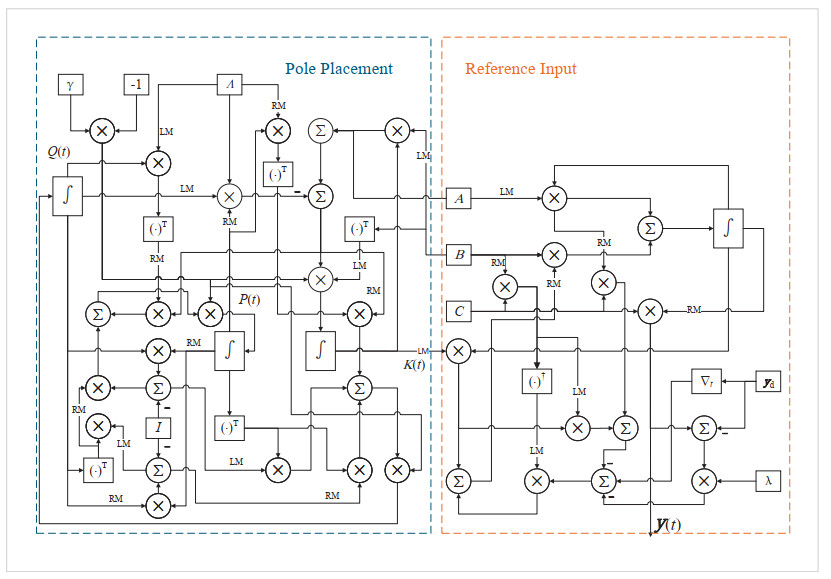
Structure diagram of neurodynamic solution for output tracking problem solving in TILS, where LM denotes left multiplication and RM denotes right multiplication
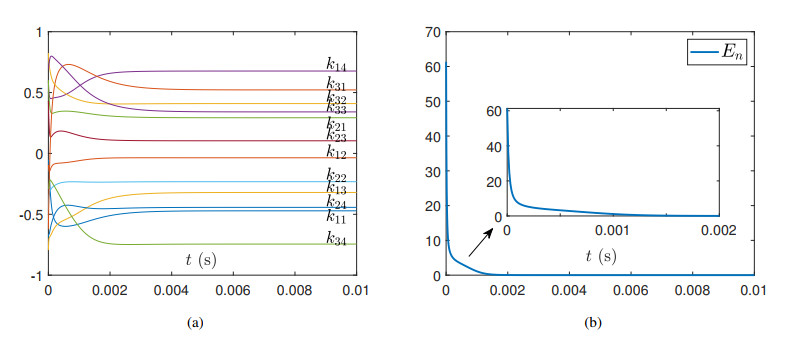
Numerical results of Example 1. (a) Elements trajectories $ k_{11}, k_{12}, \dots, k_{34} $ of matrix $ K_n $. (b) Discrete energy function trajectory $ E_n $
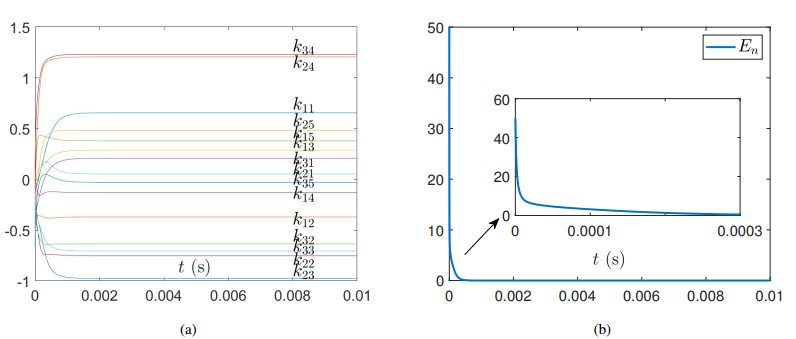
Numerical results of Example 2. (a) Elements trajectories $ k_{11}, k_{12}, \dots, k_{35} $ of matrix $ K_n $. (b) Discrete energy function $ E_n $ trajectory
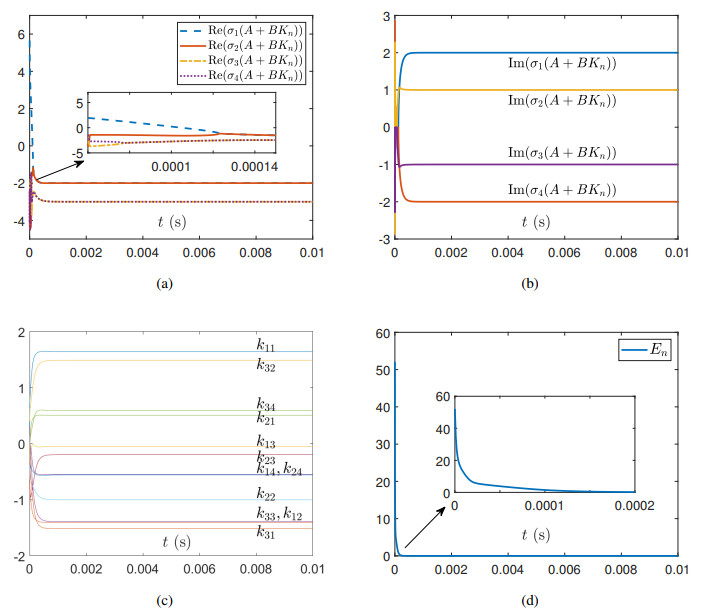
Numerical results of Example 3. (a) Real parts trajectories of eigenvalues of matrix $ A+BK_n $. (b) Imaginary parts trajectories of eigenvalues of matrix $ A+BK_n $. (c) Elements trajectories $ k_{11}, k_{12}, \dots, k_{35} $ of matrix $ K_n $. (d) Discrete energy function trajectory $ E_n $
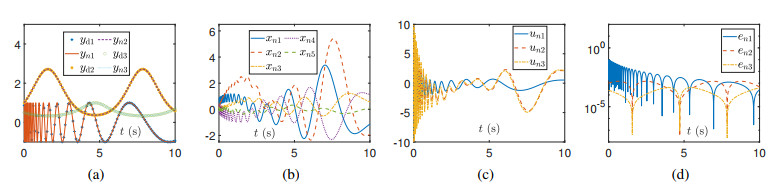
Numerical result of Example 4 based on Example 2. (a) Actual outputs $ y_{n1} $, $ y_{n2} $, $ y_{n3} $ and desired trajectories $ y_{\text{d}1} $, $ y_{\text{d}2} $, $ y_{\text{d}3} $. (b) States of system $ x_{n1} $, $ x_{n2} $, $ x_{n3} $, $ x_{n4} $, $ x_{n5} $. (c) Control inputs $ u_{n1} $, $ u_{n2} $, $ u_{n3} $. (d) Semi-logarithmic plot of output tracking errors $ e_{n1} $, $ e_{n2} $, $ e_{n3} $
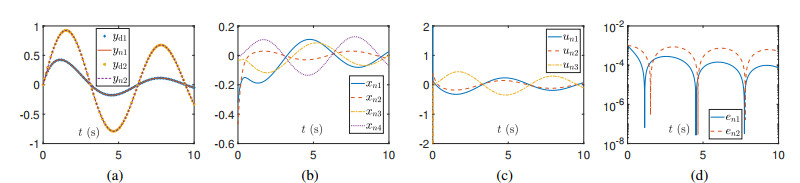
Numerical results of Example 4 based on Example 3. (a) Actual outputs $ y_{n1} $, $ y_{n2} $ and desired trajectories $ y_{\text{d}1} $, $ y_{\text{d}2} $. (b) States of system $ x_{n1} $, $ x_{n2} $, $ x_{n3} $. (c) Control inputs $ u_{n1} $, $ u_{n2} $, $ u_{n3} $. (d) Semi-logarithmic plot of output tracking errors $ e_{n1} $, $ e_{n2} $
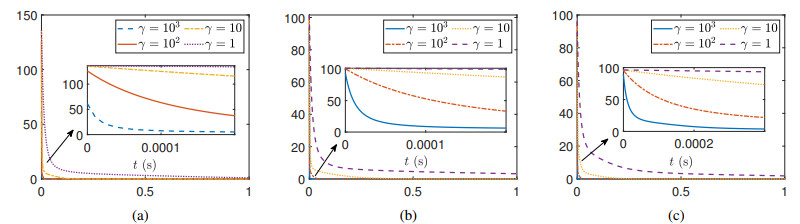
Numerical results of Example 5 based on Examples 1–3. (a) Discrete energy function trajectories on the system in Example 1 with $ \gamma = \{10^3, 10^2, 10, 1\} $. (b) Discrete energy function trajectories with $ \gamma = \{10^3, 10^2, 10, 1\} $. (c) Discrete energy function trajectories with $ \gamma = \{10^3, 10^2, 10, 1\} $
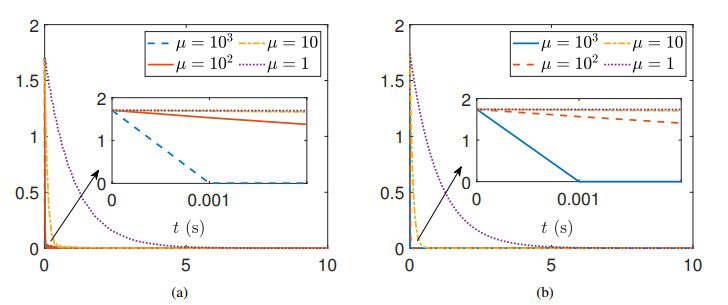
Numerical results of Example 5 based on Example 4. (a) $ \Vert {\bf e}_n\Vert_2 $ trajectories of Example 2 on system 1 in Example 4 with $ \mu = \{10^3, 10^2, 10, 1\} $. (b) $ \Vert {\bf e}_n\Vert_2 $ trajectories of Example 3 on system 2 in Example 4 with $ \mu = \{10^3, 10^2, 10, 1\} $




 DownLoad: