We address short-wave asymptotics for one class of quasi-linear second-order PDE's systems involving the cross-diffusion described by the so-called Patlak-Keller–Segel law. It is common to employ these equations for modeling the predator–prey community with the prey–taxis, which is the interaction of two species of particles or cells through which the predator species is capable of moving directionally while searching for the prey species. However, we suppose the predators to be sensitive not to the prey density but to another cue field produced by the prey. Additionally, producing the cue is assumed to be sensitive to the intensity of an external field, which is independent from the community state and mimics the environmental inhomogeneity due to natural or artificial reasons. This is what we call the "external signal". We assume that the external signal takes a general short-wave form and construct a formal asymptotic expansion for the short-wave solutions with no restrictions on the spatial dimension or kinetics of inter- or intra-specific reactions modulo solving a hierarchy of the so-called slow systems. With no special assumption, we explicitly write down both the leading term in the asymptotics and the leading slow system, which governs the slow evolution of the amplitude of the leading term. Further, we apply the leading approximation to study the stability or instability induced by the external signal following Kapitza's theory for the upside-down pendulum. Applying the general results to some special classes of external signals, we construct examples of suppressing the taxical transport, examples of the robustness of the species equilibrium to the signal up to a very strong stabilization, and, oppositely, destabilization and blurring the borderline in the parametric space between the areas of stability and instability of this equilibrium.
Citation: Andrey Morgulis, Karrar Malal. Short-wave signal versus the indirect prey-taxis[J]. AIMS Mathematics, 2026, 11(11): 36409-36443. doi: 10.3934/math.20261409
We address short-wave asymptotics for one class of quasi-linear second-order PDE's systems involving the cross-diffusion described by the so-called Patlak-Keller–Segel law. It is common to employ these equations for modeling the predator–prey community with the prey–taxis, which is the interaction of two species of particles or cells through which the predator species is capable of moving directionally while searching for the prey species. However, we suppose the predators to be sensitive not to the prey density but to another cue field produced by the prey. Additionally, producing the cue is assumed to be sensitive to the intensity of an external field, which is independent from the community state and mimics the environmental inhomogeneity due to natural or artificial reasons. This is what we call the "external signal". We assume that the external signal takes a general short-wave form and construct a formal asymptotic expansion for the short-wave solutions with no restrictions on the spatial dimension or kinetics of inter- or intra-specific reactions modulo solving a hierarchy of the so-called slow systems. With no special assumption, we explicitly write down both the leading term in the asymptotics and the leading slow system, which governs the slow evolution of the amplitude of the leading term. Further, we apply the leading approximation to study the stability or instability induced by the external signal following Kapitza's theory for the upside-down pendulum. Applying the general results to some special classes of external signals, we construct examples of suppressing the taxical transport, examples of the robustness of the species equilibrium to the signal up to a very strong stabilization, and, oppositely, destabilization and blurring the borderline in the parametric space between the areas of stability and instability of this equilibrium.

| [1] |
P. Kareiva, G. Odell, Swarms of predators exhibit 'preytaxis' if individual predators use area-restricted search, The Am. Nat., 130 (1987), 233–270. https://doi.org/10.1086/284707 doi: 10.1086/284707
|
| [2] |
H. Amann, Nonhomogeneous linear and quasilinear elliptic and parabolic boundary value problems, In: Function spaces, differential operators and nonlinear analysis (pp. 9–126), Springer Fachmedien Wiesbaden, 1993. https://doi.org/10.1007/978-3-663-11336-2 |
| [3] |
G. R. Ivanitskii, A. B. Medvinskii, M. A. Tsyganov, From the dynamics of population autowaves generated by living cells to neuroinformatics, Phys.-Usp., 37 (1994), 961–989. https://doi.org/10.1070/PU1994v037n10ABEH000049 doi: 10.1070/PU1994v037n10ABEH000049
|
| [4] |
D. Horstmann, From 1970 until present: The Keller–Segel model in chemotaxis and its consequences Ⅱ, Jahresber. Deutsch. Math.-Verein., 106 (2004), 51–69. |
| [5] |
T. Hillen, K. J. Painter, A user's guide to PDE models for chemotaxis, J. Math. Biol., 58 (2009), 183–217. https://doi.org/10.1007/s00285-008-0201-3 doi: 10.1007/s00285-008-0201-3
|
| [6] |
N. Bellomo, A. Bellouquid, Y. Tao, M. Winkler, Toward a mathematical theory of Keller–Segel models of pattern formation in biological tissues, Math. Mod. Meth. Appl. S., 25 (2015), 1663–1763. https://doi.org/10.1142/S021820251550044X doi: 10.1142/S021820251550044X
|
| [7] |
F. S. Berezovskaya, G. P. Karev, Bifurcations of traveling waves in population taxis models, Phys.-Usp., 42 (1999), 917–929. https://doi.org/10.1070/PU1999v042n09ABEH000564 doi: 10.1070/PU1999v042n09ABEH000564
|
| [8] |
V. Govorukhin, A. Morgulis, Y. Tyutyunov, Slow taxis in a predator–prey model, Dokl. Math., 61 (2000), 420–422. |
| [9] |
R. Arditi, Y. Tyutyunov, A. Morgulis, V. Govorukhin, I. Senina, Directed movement of predators and the emergence of density-dependence in predator–prey models, Theor. Popul. Biol., 59 (2001), 207–221. https://doi.org/10.1006/tpbi.2001.1513 doi: 10.1006/tpbi.2001.1513
|
| [10] |
N. Sapoukhina, Y. Tyutyunov, R. Arditi, The role of prey taxis in biological control: A spatial theoretical model, Am. Nat., 162 (2003), 61–76. https://doi.org/10.1086/375297 doi: 10.1086/375297
|
| [11] |
A. Chakraborty, M. Singh, D. Lucy, P. Ridland, Predator–prey model with prey-taxis and diffusion, Math. Comput. Model., 46 (2007), 482–498. https://doi.org/10.1016/j.mcm.2006.10.010 doi: 10.1016/j.mcm.2006.10.010
|
| [12] |
C. Mu, W. Tao, Z. A. Wang, Global dynamics and spatiotemporal heterogeneity of a prey-taxis model with prey-induced acceleration, Eur. J. Appl. Math., 2024, 1–33. https://doi.org/10.1017/S0956792523000347 |
| [13] |
J. M. Lee, T. Hillen, M. A. Lewis, Pattern formation in prey-taxis systems, J. Biol. Dynam., 3 (2009), 551–573. https://doi.org/10.1080/17513750802716112 doi: 10.1080/17513750802716112
|
| [14] |
K. J. Painter, T. Hillen, Spatio-temporal chaos in a chemotaxis model, Physica D, 240 (2011), 363–375. https://doi.org/10.1016/j.physd.2010.09.011 doi: 10.1016/j.physd.2010.09.011
|
| [15] |
M. Banerjee, S. Petrovskii, Self-organised spatial patterns and chaos in a ratio-dependent predator–prey system, Theor. Ecol., 4 (2011), 37–53. https://doi.org/10.1007/s12080-010-0073-1 doi: 10.1007/s12080-010-0073-1
|
| [16] |
I. G. Pearce, M. A. J. Chaplain, P. G. Schofield, A. R. A. Anderson, S. F. Hubbard, Chemotaxis-induced spatio-temporal heterogeneity in multi-species host-parasitoid systems, J. Math. Biol., 55 (2007), 365–388. https://doi.org/10.1007/s00285-007-0088-4 doi: 10.1007/s00285-007-0088-4
|
| [17] |
E. Giricheva, Taxis-driven pattern formation in tri-trophic food chain model with omnivory, Mathematics, 12 (2024), 290. https://doi.org/10.3390/math12020290 doi: 10.3390/math12020290
|
| [18] |
I. J. Tello, D. Wrzosek, Predator–prey model with diffusion and indirect prey-taxis, Math. Mod. Meth. Appl. S., 26 (2016), 2129–2162. https://doi.org/10.1142/S0218202516400108 doi: 10.1142/S0218202516400108
|
| [19] |
J. Wang, M. Wang, The dynamics of a predator–prey model with diffusion and indirect prey-taxis, J. Dyn. Differ. Equ., 32 (2020), 1291–1310. https://doi.org/10.1007/s10884-019-09778-7 doi: 10.1007/s10884-019-09778-7
|
| [20] |
S. Li, Positive steady-state solutions for a class of prey-predator systems with indirect prey-taxis, SIAM J. Math. Anal., 55 (2023), 6342–6374. https://doi.org/10.1137/22M1529518 doi: 10.1137/22M1529518
|
| [21] |
Y. V. Tyutyunov, D. Sen, L. I. Titova, M. Banerjee, Predator overcomes the Allee effect due to indirect prey–taxis, Ecol. Complex., 39 (2019), 100772. https://doi.org/10.1016/j.ecocom.2019.100772 doi: 10.1016/j.ecocom.2019.100772
|
| [22] |
Q. Wang, J. Yang, L. Zhang, Time-periodic and stable patterns of a two-competing-species Keller-Segel chemotaxis model: Effect of cellular growth, Discrete Cont. Dyn.-B, 22 (2017), 3547–3574. https://doi.org/10.3934/dcdsb.2017179 doi: 10.3934/dcdsb.2017179
|
| [23] |
S. Wu, Y. Wang, D. Geng, Dynamic and pattern formation of a diffusive predator–prey model with indirect prey-taxis and indirect predator-taxis, Nonlinear Anal.-Real, 84 (2025), 104299. https://doi.org/10.1016/j.nonrwa.2024.104299 doi: 10.1016/j.nonrwa.2024.104299
|
| [24] |
Z. Xie, Y. Li, Classical solutions to a pursuit-evasion model with prey-taxis and indirect predator-taxis, Math. Meth. Appl. Sci., 48 (2025), 4117–4143. https://doi.org/10.1002/mma.10536 doi: 10.1002/mma.10536
|
| [25] |
Y. Tyutyunov, L. Titova, I. Senina, Prey-taxis destabilizes homogeneous stationary state in spatial Gause–Kolmogorov-type model for predator–prey system, Ecol. Complex., 31 (2017), 170–180. https://doi.org/10.1016/j.ecocom.2017.07.001 doi: 10.1016/j.ecocom.2017.07.001
|
| [26] |
B. L. Southall, J. J. Finneran, C. Reichmuth, P. E. Nachtigall, D. R. Ketten, A. E. Bowles, et al., Marine mammal noise exposure criteria: Updated scientific recommendations for residual hearing effects, Aquat. Mamm., 45 (2019), 125–232. https://doi.org/10.1578/AM.45.2.2019.125 doi: 10.1578/AM.45.2.2019.125
|
| [27] |
A. C. Hsu, A. M. Boustany, J. J. Roberts, J. Chang, P. N. Halpin, Tuna and swordfish catch in the U.S. northwest Atlantic longline fishery in relation to mesoscale eddies, Fish. Oceanogr., 24 (2015), 508–520. https://doi.org/10.1111/fog.12125 doi: 10.1111/fog.12125
|
| [28] |
F. Royer, J. M. Fromentin, H. Farrugio, P. Gaspar, Determining bluefin tuna habitat through frontal features in the Mediterranean Sea, Collect. Vol. Sci. Pap., 58 (2005), 1275–1284. Available from: https://archimer.ifremer.fr/doc/00194/30504. |
| [29] |
D. C. Reese, R. T. O'Malley, R. D. Brodeur, J. H. Churnside, Epipelagic fish distributions in relation to thermal fronts in a coastal upwelling system using high-resolution remote-sensing techniques, ICES J. Mar. Sci., 68 (2011), 1865–1874. https://doi.org/10.1093/icesjms/fsr107 doi: 10.1093/icesjms/fsr107
|
| [30] |
P. Kratina, R. M. Lecraw, T. Ingram, B. R. Anholt, Stability and persistence of food webs with omnivory: Is there a general pattern?, Ecosphere, 3 (2012), 1–18. https://doi.org/10.1890/es12-00121.1 doi: 10.1890/es12-00121.1
|
| [31] |
P. R. Chowdhury, S. Petrovskii, M. Banerjee, Oscillations and pattern formation in a slow–fast prey–predator system, B. Math. Biol., 83 (2021), 1–41. https://doi.org/10.1007/s11538-021-00941-0 doi: 10.1007/s11538-021-00941-0
|
| [32] |
P. R. Chowdhury, S. Petrovskii, M. Banerjee, Effect of slow–fast time scale on transient dynamics in a realistic prey-predator system, Mathematics, 10 (2022), 699. https://doi.org/10.3390/math10050699 doi: 10.3390/math10050699
|
| [33] |
P. R. Chowdhury, M. Banerjee, S. Petrovskii, A two-timescale model of plankton–oxygen dynamics predicts formation of oxygen minimum zones and global anoxia, J. Math. Biol., 89 (2024), 8. https://doi.org/10.1007/s00285-024-02107-7 doi: 10.1007/s00285-024-02107-7
|
| [34] |
J. C. Poggiale, M. Gauduchon, A general class of growth models in a patchy environment exhibiting enhanced production, Mathematics, 14 (2026), 1165. https://doi.org/10.3390/math14071165 doi: 10.3390/math14071165
|
| [35] |
J. I. Tello, D. Wrzosek, From indirect to direct taxis by fast reaction limit, Math. Mod. Meth. Appl. S., 36 (2026), 173–204. https://doi.org/10.1142/S0218202526500041 doi: 10.1142/S0218202526500041
|
| [36] |
A. Morgulis, K. Ilin, Indirect taxis on a fluctuating environment, Mathematics, 8 (2020), 2052. https://doi.org/10.3390/math8112052 doi: 10.3390/math8112052
|
| [37] |
A. Morgulis, K. H. Malal, Prey-taxis vs. an external signal: Short-wave asymptotic and stability analysis, Mathematics, 13 (2025), 261. https://doi.org/10.3390/math13020261 doi: 10.3390/math13020261
|
| [38] |
A. Morgulis, K. Malal, Prey-taxis vs a shortwave external signal in multiple dimensions, J. Math. Sci., 2025. https://doi.org/10.1007/s10958-025-08063-x |
| [39] |
L. D. Landau, E. M. Lifshitz, Mechanics, 3 Eds., Elsevier, 1982,224. |
| [40] |
V. I. Yudovich, The dynamics of a particle on a smooth vibrating surface, J. Appl. Math. Mech., 62 (1998), 893–900. https://doi.org/10.1016/S0021-8928(98)00114-2 doi: 10.1016/S0021-8928(98)00114-2
|
| [41] |
V. I. Yudovich, Vibration dynamics of systems with constraints, Dokl. Math., 42 (1997), 322–325. |
| [42] |
S. M. Zen'kovskaya, I. B. Simonenko, Effect of high frequency vibration on convection initiation, Fluid Dynam., 1 (1966), 35–37. |
| [43] |
S. M. Zen'kovskaya, Study of convection in a liquid layer with vibrating forces, Fluid Dynam., 3 (1968), 35–36. |
| [44] |
V. A. Vladimirov, A. B. Morgulis, Relative equilibria in the Bjerknes problem, Siberian Math. J., 55 (2014), 35–48. https://doi.org/10.1134/S0037446614010054 doi: 10.1134/S0037446614010054
|
| [45] |
D. V. Lyubimov, T. P. Lyubimova, A. A. Tcherepanov, B. H. Roux, Vibration influence on fluid interfaces, Comptes Rendus. Mécanique, 332 (2004), 467–472. https://doi.org/10.1016/j.crme.2004.01.013 doi: 10.1016/j.crme.2004.01.013
|
| [46] |
A. K. Belyaev, N. F. Morozov, P. E. Tovstik, T. P. Tovstik, The stability of a flexible vertical rod on a vibrating support, Vestnik St. Petersb. Univ. Math., 51 (2018), 296–304. https://doi.org/10.3103/S1063454118030020 doi: 10.3103/S1063454118030020
|
| [47] |
A. V. Babenko, O. R. Polyakova, T. P. Tovstik, Conceptual generalizations of the Kapitsa problem, In: Altenbach, H., Irschik, H., Porubov, A.V. (eds) Progress in Continuum Mechanics, Advanced Structured Materials, vol 196, Cham: Springer, 2023. https://doi.org/10.1007/978-3-031-43736-6-4 |
| [48] |
G. Allaire, A brief introduction to homogenization and miscellaneous applications, ESAIM: Proceedings, 37 (2012), 1–49. https://doi.org/10.1051/proc/201237001 doi: 10.1051/proc/201237001
|
| [49] |
Y. V. Tyutyunov, L. I. Titova, Ratio-dependence in predator–prey systems as an edge and basic minimal model of predator interference, Front. Ecol. Evol., 9 (2021), 725041. https://doi.org/10.3389/fevo.2021.725041 doi: 10.3389/fevo.2021.725041
|
| [50] |
R. Arditi, L. R. Ginzburg, How species interact: Altering the standard view on trophic ecology, Oxford: Oxford University Press, 2012. |
| [51] |
L. Nirenberg, A strong maximum principle for parabolic equations, Commun. Pur. Appl. Math., 6 (1953), 167–177. |
| [52] |
E. M. Landis, Second order equations of elliptic and parabolic type, Providence: American Math. Soc., 1997,203. |
| [53] |
F. R. Gantmacher, Theory of matrices, Vol. 2, New York: Chelsea Publishing, 1959. |
| [54] |
V. B. Levenshtam, Justification of the averaging method for the convection problem with high-frequency vibrations, Siberian Math. J., 34 (1993), 280–296. https://doi.org/10.1007/BF00970954 doi: 10.1007/BF00970954
|
| [55] |
V. B. Levenshtam, Justification of the averaging method for parabolic equations containing rapidly oscillating terms with large amplitudes, Izv. Math., 70 (2006), 233–263. https://doi.org/10.1070/IM2006v070n02ABEH002311 doi: 10.1070/IM2006v070n02ABEH002311
|
| [56] |
V. B. Levenshtam, Justification of the averaging method for a system of equations with the Navier–Stokes operator in the principal part, St. Petersb. Math. J., 26 (2015), 69–90. https://doi.org/10.1090/S1061-0022-2014-01331-3 doi: 10.1090/S1061-0022-2014-01331-3
|
| [57] |
V. B. Levenshtam, Averaging a high-frequency hyperbolic system of quasilinear equations with large summands, Siberian Math. J., 65 (2024), 934–942. https://doi.org/10.1134/S0037446624040189 doi: 10.1134/S0037446624040189
|
| [58] |
G. Allaire, Homogenization and two-scale convergence, SIAM J. Math. Anal., 23 (1992), 1482–1518. https://doi.org/10.1137/0523084 doi: 10.1137/0523084
|
| [59] |
V. A. Marchenko, E. Y. Khruslov, Homogenization of partial differential equations, Birkhauser, 2006. https://doi.org/10.1007/978-0-8176-4468-0 |
| [60] |
X. Fu, Q. Griette, P. Magal, Sharp discontinuous traveling waves in a hyperbolic Keller–Segel equation, Math. Mod. Meth. Appl. S., 31 (2021), 861–905. https://doi.org/10.1142/S0218202521500214 doi: 10.1142/S0218202521500214
|
| [61] |
X. Fu, Q. Griette, P. Magal, A cell–cell repulsion model on a hyperbolic Keller–Segel equation, J. Math. Biol., 80 (2020), 2257–2300. https://doi.org/10.1007/s00285-020-01495-w doi: 10.1007/s00285-020-01495-w
|
Figures(2)

Andrey Morgulis, Karrar Malal. Short-wave signal versus the indirect prey-taxis[J]. AIMS Mathematics, 2026, 11(11): 36409-36443. doi: 10.3934/math.20261409

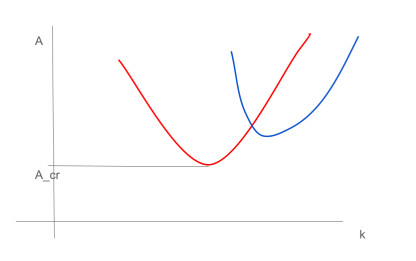
Scheme of the neutral set in the case of $ N = n = 1 $, where the parameter is $ A $, and the wave number is $ k $
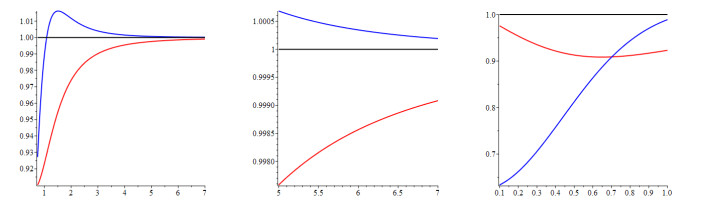
Three fragments of the graphs $ \chi_{nt}^- = \chi_{nt}^-(\omega) $ (red) and $ \mathcal{T}_{22} = \mathcal{T}_{22}(\omega) $ (blue). The black line corresponds to the critical value $ \chi_* $ for a stationary signal




 DownLoad: