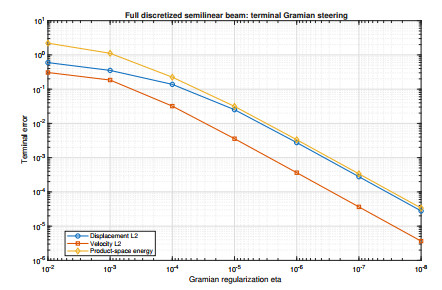
A conditional approximate-controllability framework is developed for a semilinear Euler–Bernoulli beam with delay, hereditary memory, and non-instantaneous impulses in a product Hilbert space. The linear steering mechanism uses a short terminal control window and a Tikhonov-regularized controllability Gramian. With this window shorter than the delay and located after the final impulse, the delayed nonlinear contributions are determined by the preceding history. We identify hypotheses under which these residuals vanish and exclude an earlier inappropriate vanishing-control-energy requirement. To provide corresponding numerical evidence, MATLAB R2025b calculations use a spatially distributed Gramian controller for every finite-difference beam mode, coupled with an implicit-midpoint structural scheme, nonlinear delayed forcing, exponentially fading memory, and a finite-duration impulse. The computed displacement, velocity, and full product-energy terminal errors decrease under regularization (from $ 2.2050 $ to $ 3.3683\times10^{-5} $ in the full product norm), while control cost rises. Direct full-grid propagation agrees with the Gramian residual prediction at the reported precision. These calculations support the specified finite-grid, control-affine benchmark; they do not themselves prove the infinite-dimensional theorem.
Citation: Boshra K. Alarfaj, Kawther K. Alarfaj, Fatema Al Najim, Maryam Khalid Alarfaj. Steering semilinear beam dynamics with memory, delay, and non-instantaneous impulses: Approximate controllability and numerical evidence[J]. AIMS Mathematics, 2026, 11(11): 36163-36187. doi: 10.3934/math.20261401
A conditional approximate-controllability framework is developed for a semilinear Euler–Bernoulli beam with delay, hereditary memory, and non-instantaneous impulses in a product Hilbert space. The linear steering mechanism uses a short terminal control window and a Tikhonov-regularized controllability Gramian. With this window shorter than the delay and located after the final impulse, the delayed nonlinear contributions are determined by the preceding history. We identify hypotheses under which these residuals vanish and exclude an earlier inappropriate vanishing-control-energy requirement. To provide corresponding numerical evidence, MATLAB R2025b calculations use a spatially distributed Gramian controller for every finite-difference beam mode, coupled with an implicit-midpoint structural scheme, nonlinear delayed forcing, exponentially fading memory, and a finite-duration impulse. The computed displacement, velocity, and full product-energy terminal errors decrease under regularization (from $ 2.2050 $ to $ 3.3683\times10^{-5} $ in the full product norm), while control cost rises. Direct full-grid propagation agrees with the Gramian residual prediction at the reported precision. These calculations support the specified finite-grid, control-affine benchmark; they do not themselves prove the infinite-dimensional theorem.

| [1] |
L. H. Eliasson, B. Grébert, S. B. Kuksin, KAM for the nonlinear beam equation, Geom. Funct. Anal., 26 (2016), 1588–1715. https://doi.org/10.1007/s00039-016-0390-7 doi: 10.1007/s00039-016-0390-7
|
| [2] |
A. S. Ackleh, H. T. Banks, G. A. Pinter, A nonlinear beam equation, Appl. Math. Lett., 15 (2002), 381–387. https://doi.org/10.1016/S0893-9659(01)00147-1 doi: 10.1016/S0893-9659(01)00147-1
|
| [3] |
J. N. Franklin, R. F. Scott, Beam equation with variable foundation coefficient, J. Eng. Mech. Div., 105 (1979), 811–827. https://doi.org/10.1061/JMCEA3.0002525 doi: 10.1061/JMCEA3.0002525
|
| [4] |
E. Hernández, D. O'Regan, On a new class of abstract impulsive differential equations, Proc. Amer. Math. Soc., 141 (2013), 1641–1649. https://doi.org/10.1090/S0002-9939-2012-11613-2 doi: 10.1090/S0002-9939-2012-11613-2
|
| [5] |
S. Lalvay, A. Padilla-Segarra, W. Zouhair, On the existence and uniqueness of solutions for non-autonomous semilinear systems with non-instantaneous impulses, delay, and nonlocal conditions, Miskolc Math. Notes, 23 (2022), 295–310. http://doi.org/10.18514/MMN.2022.3785 doi: 10.18514/MMN.2022.3785
|
| [6] |
Y. Chen, K. Meng, Stability and solvability for a class of optimal control problems described by non-instantaneous impulsive differential equations, Adv. Differ. Equ., 2020 (2020), 524. https://doi.org/10.1186/s13662-020-02919-z doi: 10.1186/s13662-020-02919-z
|
| [7] |
E. Zuazua, Exact controllability for the semilinear wave equation, J. Math. Pures Appl., 69 (1990), 1–31. |
| [8] |
J. Lagnese, J. L. Lions, Modelling, analysis and control of thin plates, Paris: Masson, 1988. |
| [9] |
A. Carrasco, H. Leiva, J. Sanchez, Controllability of the semilinear beam equation, J. Dyn. Control Syst., 19 (2013), 553–568. https://doi.org/10.1007/s10883-013-9193-4 doi: 10.1007/s10883-013-9193-4
|
| [10] |
J. A. Asadzade, N. I. Mahmudov, Approximate controllability of impulsive semilinear evolution equations in Hilbert spaces, Int. J. Control, 99 (2026), 336–357. https://doi.org/10.1080/00207179.2025.2516182 doi: 10.1080/00207179.2025.2516182
|
| [11] |
S. Priyadharshini, S. S. Santra, V. Sadhasivam, D. Majumder, P. Dhali, Forced oscillation of certain class of impulsive Euler–Bernoulli beam equations with damping term, In: Advances in mathematical modelling, applied analysis and computation, Springer, Cham, 2025,150–159. https://doi.org/10.1007/978-3-031-90917-7_10 |
| [12] |
A. E. Bashirov, N. Ghahramanlou, On partial approximate controllability of semilinear systems, Cogent Eng., 1 (2014), 965947. https://doi.org/10.1080/23311916.2014.965947 doi: 10.1080/23311916.2014.965947
|
| [13] |
A. Kumar, R. K. Vats, A. Kumar, D. N. Chalishajar, Numerical approach to the controllability of fractional order impulsive differential equations, Demonstr. Math., 53 (2020), 193–207. https://doi.org/10.1515/dema-2020-0015 doi: 10.1515/dema-2020-0015
|
| [14] |
A. Anguraj, S. Kanjanadevi, Existence of mild solutions of abstract fractional differential equations with non-instantaneous impulsive conditions, J. Stat. Sci. Appl., 4 (2016), 53–64. https://doi.org/10.17265/2328-224X/2016.0102.004 doi: 10.17265/2328-224X/2016.0102.004
|
| [15] |
P. Kumar, R. K. Vats, A. Kumar, Result on controllability of Hilfer fractional integro-differential equations of Sobolev type with non-instantaneous impulses, Filomat, 37 (2023), 10033–10053. https://doi.org/10.2298/FIL2329033K doi: 10.2298/FIL2329033K
|
| [16] |
V. Vijayakumar, R. Udhayakumar, Y. Zhou, N. Sakthivel, Approximate controllability results for Sobolev-type delay differential systems of fractional order without uniqueness, Numer. Meth. Part. Differ. Equ., 39 (2023), 3479–3498. https://doi.org/10.1002/num.22642 doi: 10.1002/num.22642
|
| [17] |
L. Sadek, A. Toukmati, Controllability of infinite-dimensional conformable $\Theta$-$H$-systems, Asian J. Control, 28 (2026), 124–137. https://doi.org/10.1002/asjc.3659 doi: 10.1002/asjc.3659
|
| [18] |
L. Sadek, A. Shafee, I. L. Popa, Exact controllability of linear $\psi$-fractional control systems, Results Control Optim., 23 (2026), 100703. https://doi.org/10.1016/j.rico.2026.100703 doi: 10.1016/j.rico.2026.100703
|
| [19] |
L. Guo, B. Zhang, C. Li, The controllability for the tempered fractional-order equation subjected to nonlocal delay and impulsive conditions, Indian J. Pure Appl. Math., 2026. https://doi.org/10.1007/s13226-026-00941-7 |
| [20] |
S. Kumar, Approximate controllability of nonlocal impulsive fractional order semilinear time varying delay systems, Nonlinear Dyn. Syst. Theor., 16 (2016), 420–430. |
| [21] |
S. Arora, M. T. Mohan, J. Dabas, Approximate controllability of fractional order non-instantaneous impulsive functional evolution equations with state-dependent delay in Banach spaces, IMA J. Math. Control Inform., 39 (2022), 1103–1142. https://doi.org/10.1093/imamci/dnac024 doi: 10.1093/imamci/dnac024
|
| [22] |
A. Kumar, A. Kumar, R. K. Vats, P. Kumar, Approximate controllability of neutral delay integro-differential inclusion of order $\alpha\in(1, 2)$ with non-instantaneous impulses, Evol. Equ. Control The., 11 (2022), 1635–1654. https://doi.org/10.3934/eect.2021058 doi: 10.3934/eect.2021058
|
| [23] |
M. Pierri, D. O'Regan, V. Rolnik, Existence of solutions for semilinear abstract differential equations with non-instantaneous impulses, Appl. Math. Comput., 219 (2013), 6743–6749. https://doi.org/10.1016/j.amc.2012.12.084 doi: 10.1016/j.amc.2012.12.084
|
| [24] |
R. F. Curtain, A. J. Pritchard, Infinite dimensional linear systems theory, Berlin: Springer, 1978. https://doi.org/10.1007/BFb0006761 |
| [25] |
R. F. Curtain, H. Zwart, An introduction to infinite-dimensional linear systems theory, New York: Springer, 1995. https://doi.org/10.1007/978-1-4612-4224-6 |
| [26] |
H. Leiva, N. Merentes, J. Sanchez, A characterization of semilinear dense range operators and applications, Abstr. Appl. Anal., 2013 (2013), 729093. https://doi.org/10.1155/2013/729093 doi: 10.1155/2013/729093
|
Figures(5) / Tables(4)

Boshra K. Alarfaj, Kawther K. Alarfaj, Fatema Al Najim, Maryam Khalid Alarfaj. Steering semilinear beam dynamics with memory, delay, and non-instantaneous impulses: Approximate controllability and numerical evidence[J]. AIMS Mathematics, 2026, 11(11): 36163-36187. doi: 10.3934/math.20261401

Finite-grid terminal errors under decreasing Gramian regularization. The complete product-space norm is plotted alongside displacement and velocity errors
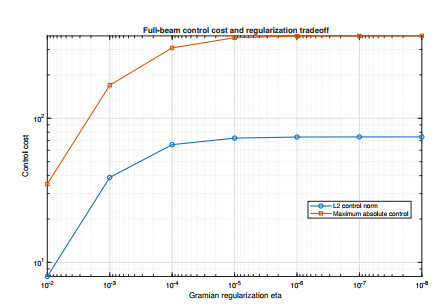
Control cost and peak control magnitude versus Gramian regularization. Smaller errors require larger controls in this benchmark
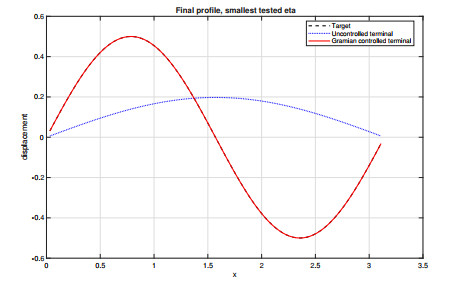
Terminal displacement at the smallest reported regularizer, compared with the prescribed target and the uncontrolled terminal profile
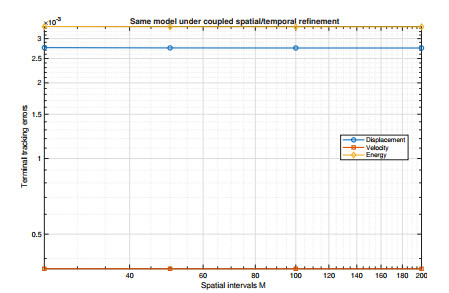
Terminal tracking errors under coupled spatial/time refinement with a fixed regularizer
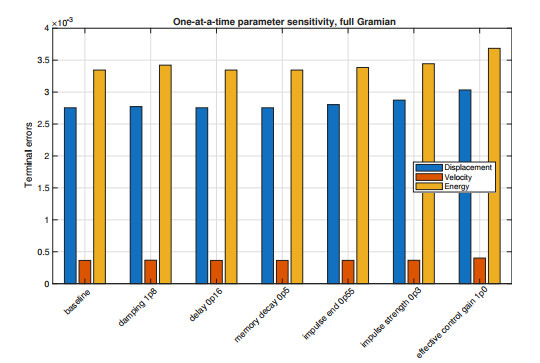
Sensitivity of the terminal displacement, velocity, and energy errors in the full-grid Gramian test




 DownLoad: