Analyzing large-scale networked evolutionary games (NEGs) with arbitrary network structures remains challenging due to complex network dynamics. Strategy consensus requires all players to adopt an identical strategy over long-term evolution. Different from existing studies, this paper investigated the strategy consensus of large-scale NEGs under profile constraints, where all profile trajectories must avoid a predefined restricted-profile set. Using network aggregation, we decomposed the original NEG into multiple smaller-size control subgames. We derived a reachability criterion for each subgame under local profile constraints and proposed a trajectory-matching condition for coupled subgames. We further discussed the expansion of restricted-profile sets through profile projection and derived a sufficient condition for global strategy consensus under profile constraints starting from an arbitrary initial profile. Examples were given to verify the effectiveness of the proposed method.
Citation: Huixin Kan, Shihua Fu, Rui Wang, Yifan Zhao. Strategy consensus of large-scale networked evolutionary games under profile constraints via network aggregation[J]. AIMS Mathematics, 2026, 11(10): 35047-35069. doi: 10.3934/math.20261364
Analyzing large-scale networked evolutionary games (NEGs) with arbitrary network structures remains challenging due to complex network dynamics. Strategy consensus requires all players to adopt an identical strategy over long-term evolution. Different from existing studies, this paper investigated the strategy consensus of large-scale NEGs under profile constraints, where all profile trajectories must avoid a predefined restricted-profile set. Using network aggregation, we decomposed the original NEG into multiple smaller-size control subgames. We derived a reachability criterion for each subgame under local profile constraints and proposed a trajectory-matching condition for coupled subgames. We further discussed the expansion of restricted-profile sets through profile projection and derived a sufficient condition for global strategy consensus under profile constraints starting from an arbitrary initial profile. Examples were given to verify the effectiveness of the proposed method.

| [1] |
A. Basak, S. Sengupta, Evolution of cooperation in multichannel games on multiplex networks, PLOS Comput. Biol., 20 (2024), e1012678. https://doi.org/10.1371/journal.pcbi.1012678 doi: 10.1371/journal.pcbi.1012678
|
| [2] |
Y. Kuo, O. Carja, Evolutionary graph theory beyond pairwise interactions: Higher-order network motifs shape times to fixation in structured populations, PLOS Comput. Biol., 20 (2024), e1011905. https://doi.org/10.1371/journal.pcbi.1011905 doi: 10.1371/journal.pcbi.1011905
|
| [3] |
B. Allen, G. Lippner, Y. Chen, B. Fotouhi, N. Momeni, S. Yau, et al., Evolutionary dynamics on any population structure, Nature, 544 (2017), 227–230. https://doi.org/10.1038/nature21723 doi: 10.1038/nature21723
|
| [4] |
Y. Hu, Z. Wang, X. Li, Impact of policies on electric vehicle diffusion: An evolutionary game of small world network analysis, J. Clean. Prod., 265 (2020), 121703. https://doi.org/10.1016/j.jclepro.2020.121703 doi: 10.1016/j.jclepro.2020.121703
|
| [5] |
Y. Jia, Y. Li, J. Feng, Networked evolutionary game-based demand response via feedback controls, IEEE Trans. Autom. Sci. Eng., 21 (2024), 1638–1646. https://doi.org/10.1109/TASE.2023.3249769 doi: 10.1109/TASE.2023.3249769
|
| [6] |
D. Cheng, H. Qi, Z. Li, Analysis and Control of Boolean Networks: A Semi-Tensor Product Approach, London: Springer, 2011. https://doi.org/10.1007/978-0-85729-097-7 |
| [7] |
D. Cheng, F. He, H. Qi, T. Xu, Modeling, analysis and control of networked evolutionary games, IEEE Trans. Autom. Control, 60 (2015), 2402–2415. https://doi.org/10.1109/TAC.2015.2404471 doi: 10.1109/TAC.2015.2404471
|
| [8] |
X. Yang, Z. Geng, H. Li, Matrix-based method for the analysis and control of networked evolutionary games: A survey, Games, 14 (2023), 22. https://doi.org/10.3390/g14020022 doi: 10.3390/g14020022
|
| [9] |
S. Fu, J. Wang, Z. Wang, C. D. Vecchio, J. Zhao, Equilibrium existence and convergence of congestion games with stochastic disturbances, Sci. China Inf. Sci., 69 (2026), 140209. https://doi.org/10.1007/s11432-025-4798-y doi: 10.1007/s11432-025-4798-y
|
| [10] |
L. Yu, S. Fu, J. Pan, J. E. Feng, Z. Wang, Weighted Nash equilibrium of incomplete-profile networked evolutionary games with multiple payoffs, Asian J. Control, 26 (2024), 1472–1482. https://doi.org/10.1002/asjc.3274 doi: 10.1002/asjc.3274
|
| [11] |
D. Wang, S. Fu, J. Wang, Y. Li, Z. Wang, The stability degree analysis of profiles for networked evolutionary games with switching topology, Nonlinear Anal. Hybrid Syst., 50 (2023), 101396. https://doi.org/10.1016/j.nahs.2023.101396 doi: 10.1016/j.nahs.2023.101396
|
| [12] |
Z. Wang, S. Fu, J. Wang, X. Zhao, Stable degree analysis for profile of networked evolutionary games with disturbances, Int. J. Control Autom. Syst., 22 (2024), 2064–2073. https://doi.org/10.1007/s12555-023-0314-x doi: 10.1007/s12555-023-0314-x
|
| [13] |
Y. Tang, L. Li, J. Lu, Modeling and optimization for networked evolutionary games with player exit mechanism: semi-tensor product of matrices method, Phys. A, 590 (2022), 126710. https://doi.org/10.1016/j.physa.2021.126710 doi: 10.1016/j.physa.2021.126710
|
| [14] |
S. Fu, L. Li, J. Feng, Strategy optimization of controlled evolutionary games on a two-layer coupled network using Lebesgue sampling, Nonlinear Anal. Hybrid Syst., 56 (2025), 101570. https://doi.org/10.1016/j.nahs.2024.101570 doi: 10.1016/j.nahs.2024.101570
|
| [15] |
K. Jiang, J. Wang, Y. Yan, C. Li, Y. Wu, Inertia-based strategy updating rule design for congestion games and its application to NFV networks, Inf. Sci., 755 (2026), 123817. https://doi.org/10.1016/j.ins.2026.123817 doi: 10.1016/j.ins.2026.123817
|
| [16] |
Q. Zhang, J. Wu, J. Xie, G. Wang, Y. Huang, Networked evolutionary game-based energy trading strategy for smart grid with time-varying delays, IEEE Trans. Ind. Inform., 21 (2025), 2659–2668. https://doi.org/10.1109/TII.2024.3514139 doi: 10.1109/TII.2024.3514139
|
| [17] |
Y. Sun, S. Fu, L. Xia, J. Xu, Minimal observability of switching Boolean networks, Math. Methods Appl. Sci., 48 (2025), 3291–3303. https://doi.org/10.1002/mma.10485 doi: 10.1002/mma.10485
|
| [18] |
L. Deng, S. Fu, X. Li, J. Wang, A matrix approach to the analysis and computation of robust cycles for Boolean control networks with disturbances, J. Appl. Math. Comput., 70 (2024), 4827–4850. http://doi.org/10.1007/s12190-024-02158-5 doi: 10.1007/s12190-024-02158-5
|
| [19] |
S. Fu, D. Cheng, J. Feng, J. Zhao, Matrix expression of finite Boolean-type algebras, Appl. Math. Comput., 395 (2021), 125880. https://doi.org/10.1016/j.amc.2020.125880 doi: 10.1016/j.amc.2020.125880
|
| [20] |
C. Huang, W. Xiong, J. Lu, D. Huang, Asymptotic stability of delayed Boolean networks with random data dropouts, IEEE Trans. Neural Netw. Learn. Syst., 35 (2024), 18886–18891. https://doi.org/10.1109/TNNLS.2023.3301220 doi: 10.1109/TNNLS.2023.3301220
|
| [21] |
J. Wang, W. Liu, S. Fu, J. Xia, On robust set stability and set stabilization of probabilistic Boolean control networks, Appl. Math. Comput., 422 (2022), 126992. https://doi.org/10.1016/j.amc.2022.126992 doi: 10.1016/j.amc.2022.126992
|
| [22] |
Y. Yan, D. Cheng, J. E. Feng, H. Li, J. Yue, Survey on applications of algebraic state space theory of logical systems to finite state machines, Sci. China Inf. Sci., 66 (2023), 111201. https://doi.org/10.1007/s11432-022-3538-4 doi: 10.1007/s11432-022-3538-4
|
| [23] |
C. Dong, Y. Yan, H. Li, J. Yue, Semi-tensor product approach to controllability, reachability, and stabilizability of extended finite state machines, Front. Inf. Technol. Electron. Eng., 25 (2024), 1370–1377. https://doi.org/10.1631/fitee.2300578 doi: 10.1631/fitee.2300578
|
| [24] |
S. Wang, S. Fu, J. Wang, X. Zhao, Nonsingularity of grain-like cascade feedback shift registers subject to fault attacks over finite fields, Nonlinear Anal. Hybrid Syst., 63 (2027), 101803. https://doi.org/10.1016/j.nahs.2026.101803 doi: 10.1016/j.nahs.2026.101803
|
| [25] |
H. Li, Z. Liu, W. Li, Nonsingularity of grain-like cascade feedback shift registers subject to fault attacks, Sci. China Inf. Sci., 67 (2024), 192203. https://doi.org/10.1007/s11432-023-4044-8 doi: 10.1007/s11432-023-4044-8
|
| [26] |
W. Ding, Y. Li, D. Wang, A real method for solving quaternion matrix equation $X-A\hat{X}B = C$ based on semi-tensor product of matrices, Adv. Appl. Clifford Algebras, 31 (2021), 4–17. http://doi.org/10.1007/s00006-021-01180-1 doi: 10.1007/s00006-021-01180-1
|
| [27] |
X. Fan, Y. Li, J. Sun, J. Zhao, Solving quaternion linear system $AXB = E$ based on semi-tensor product of quaternion matrices, Banach J. Math. Anal., 17 (2023), 25. https://doi.org/10.1007/s43037-023-00251-8 doi: 10.1007/s43037-023-00251-8
|
| [28] |
Z. Zhou, Z. Meng, Y. Zhang, Y. Song, F. Zhang, Real algorithms for special least squares solutions of the complex split quaternion matrix equations $AX = B$ and $AXC = B$, Numer. Algor., 102 (2026), 505–530. http://doi.org/10.1007/s11075-025-02138-1 doi: 10.1007/s11075-025-02138-1
|
| [29] |
A. Wei, Y. Li, W. Ding, J. Zhao, A new structure-preserving algorithm based on the semi-tensor product of matrices for split quaternion matrix LDU decomposition and its applications, J. Comput. Appl. Math., 451 (2024), 116072. https://doi.org/10.1016/j.cam.2024.116072 doi: 10.1016/j.cam.2024.116072
|
| [30] |
X. Liu, Y. Li, W. Ding, R. Tao, A real method for solving octonion matrix equation $AXB = C$ based on semi-tensor product of matrices, Adv. Appl. Clifford Algebras, 34 (2024), 12. https://doi.org/10.1007/s00006-024-01316-z doi: 10.1007/s00006-024-01316-z
|
| [31] |
X. Fan, Y. Li, W. Ding, J. Zhao, Semi-tensor product of quaternion matrices and its application, Math. Methods Appl. Sci., 46 (2023), 6450–6462. https://doi.org/10.1002/mma.8916 doi: 10.1002/mma.8916
|
| [32] |
W. Ding, Y. Li, Z. Liu, R. Tao, M. Zhang, Algebraic method for LU decomposition in commutative quaternion based on semi-tensor product of matrices and application to strict image authentication, Math. Methods Appl. Sci., 47 (2024), 6036–6050. https://doi.org/10.1002/mma.9905 doi: 10.1002/mma.9905
|
| [33] |
M. Zhang, Y. Li, J. Sun, W. Ding, The $\mathcal{L}_C$-structure-preserving algorithms of quaternion $LDL^{H}$ decomposition and Cholesky decomposition, Adv. Appl. Clifford Algebras, 33 (2023), 57. http://doi.org/10.1007/s00006-023-01298-4 doi: 10.1007/s00006-023-01298-4
|
| [34] |
Z. Wang, S. Fu, J. Wang, X. Zhao, Strategy consensus of networked evolutionary games with time invariant delays, Dyn. Games Appl., 14 (2024), 981–996. https://doi.org/10.1007/s13235-023-00522-x doi: 10.1007/s13235-023-00522-x
|
| [35] |
F. Sun, B. Wang, J. Feng, Approximate consensus of networked evolutionary matrix game: A finite-cost event-triggered mechanism, Nonlinear Anal. Hybrid Syst., 61 (2026), 101701. https://doi.org/10.1016/j.nahs.2026.101701 doi: 10.1016/j.nahs.2026.101701
|
| [36] |
Z. Deng, Distributed algorithm design for autonomous games with inviolable constraints and its application to smart grids, IEEE Trans. Autom. Control, Early access, 2026. http://doi.org/10.1109/TAC.2026.3724126 |
| [37] |
Z. Deng, X. Xie, Distributed strategy for autonomous nonlinear multi-coalition games of high-order players over unconnected intra-coalition communications, Automatica, 185 (2026), 112749. https://doi.org/10.1016/j.automatica.2025.112749 doi: 10.1016/j.automatica.2025.112749
|
| [38] |
L. Xia, J. Wang, S. Fu, Y. Gao, Control design to minimize the number of bankrupt players for networked evolutionary games with bankruptcy mechanism, AIMS Math., 9 (2024), 35702–35720. https://doi.org/10.3934/math.20241694 doi: 10.3934/math.20241694
|
| [39] |
Y. Li, X. Ding, H. Li, Robust consensus of networked evolutionary games with attackers and forbidden profiles, Entropy, 20 (2018), 15. https://doi.org/10.3390/e20010015 doi: 10.3390/e20010015
|
| [40] |
Y. Zhao, B. Ghosh, D. Cheng, Control of large-scale Boolean networks via network aggregation, IEEE Trans. Neural Netw. Learn. Syst., 27 (2016), 1527–1536. https://doi.org/10.1109/TNNLS.2015.2442593 doi: 10.1109/TNNLS.2015.2442593
|
| [41] |
W. Liu, S. Fu, J. Wang, R. D. Leone, J. Xia, Stability of large-scale probabilistic Boolean networks via network aggregation, Neural Netw., 194 (2026), 108108. https://doi.org/10.1016/j.neunet.2025.108108 doi: 10.1016/j.neunet.2025.108108
|
| [42] |
S. Wang, H. Li, Aggregation method to reachability and optimal control of large-size Boolean control networks, Sci. China Inf. Sci., 66 (2023), 179202. https://doi.org/10.1007/s11432-021-3388-y doi: 10.1007/s11432-021-3388-y
|
| [43] |
J. Zhong, Q. Pan, W. Xu, B. Chen, A framework of pinning control for nonperiodical stable behaviors of large-scale asynchronous Boolean networks, IEEE Trans. Autom. Control, 69 (2024), 5711–5726. https://doi.org/10.1109/TAC.2024.3351553 doi: 10.1109/TAC.2024.3351553
|
| [44] |
H. Li, X. Pang, A polynomial-time criterion for stability of large-scale switched conjunctive Boolean networks, Automatica, 159 (2024), 111340. https://doi.org/10.1016/j.automatica.2023.111340 doi: 10.1016/j.automatica.2023.111340
|
| [45] |
H. Li, S. Wang, W. Li, Aggregation method to strategy consensus of large-size networked evolutionary matrix games, IEEE Trans. Autom. Control, 69 (2024), 3975–3981. https://doi.org/10.1109/TAC.2023.3340558 doi: 10.1109/TAC.2023.3340558
|
| [46] |
M. Jiang, S. Yu, Y. Yan, Y. Zhao, Strategy consensus of evolutionary games on networks with degree-based pinning and incentive control, IEEE Trans. Comput. Soc. Syst., 13 (2026), 601–611. https://doi.org/10.1109/TCSS.2025.3589373 doi: 10.1109/TCSS.2025.3589373
|
Figures(2) / Tables(1)

Huixin Kan, Shihua Fu, Rui Wang, Yifan Zhao. Strategy consensus of large-scale networked evolutionary games under profile constraints via network aggregation[J]. AIMS Mathematics, 2026, 11(10): 35047-35069. doi: 10.3934/math.20261364

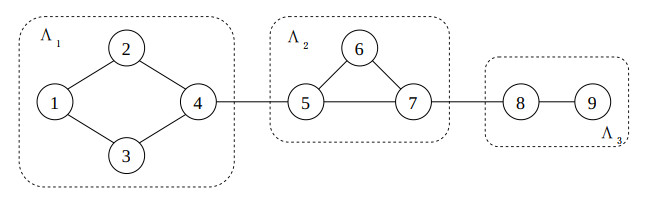
Network aggregation of the nine-player NEG
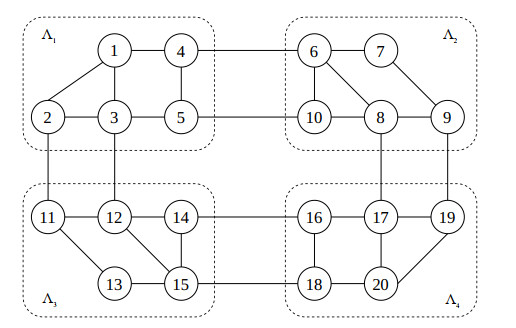
Network aggregation of the twenty-player NEG




 DownLoad: