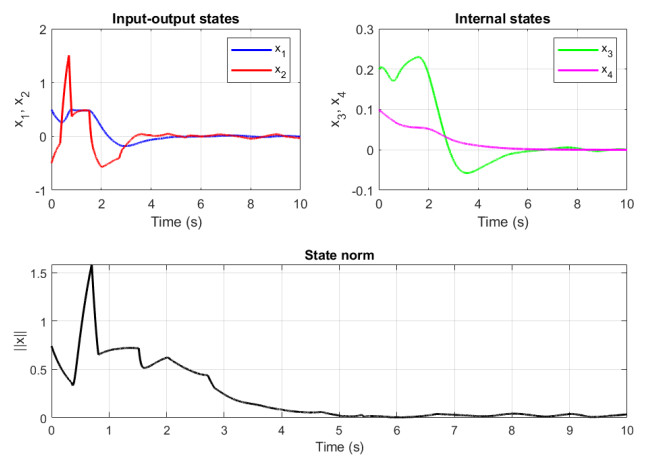
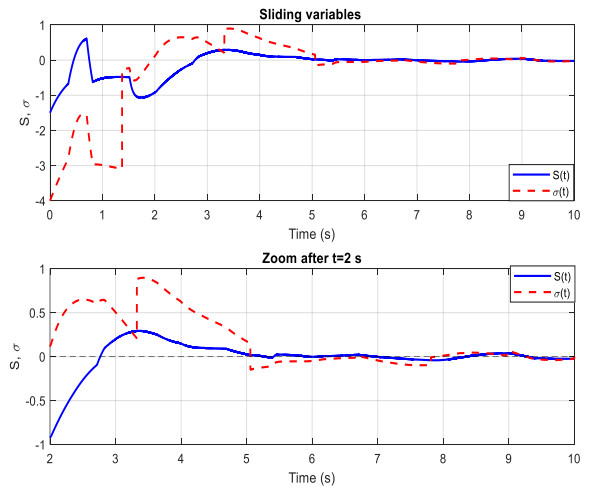
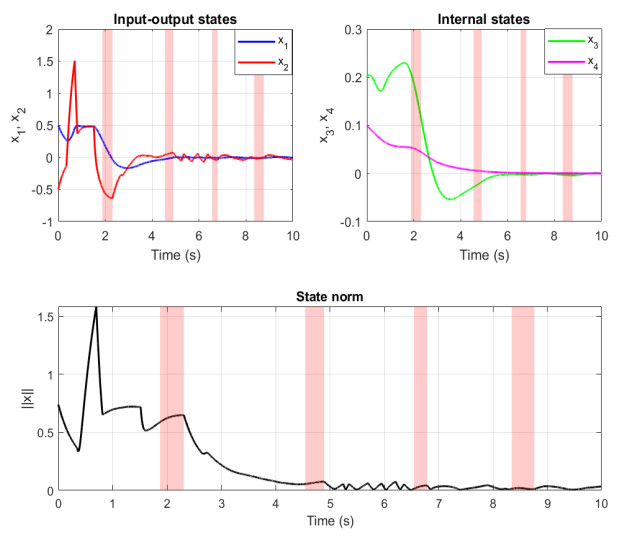
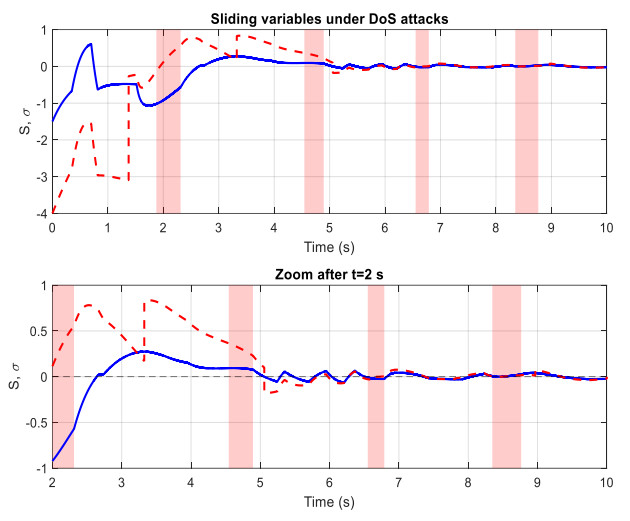
This work addresses the problem of robust stabilization for uncertain switched nonlinear systems with nonminimumphase behavior subject to aperiodic denial-of-service (DoS) attacks. A new event-triggered sliding mode control scheme is developed that simultaneously handles unstable internal dynamics and intermittent communication blockages. The method combines a mode-dependent event-triggered mechanism (MDETM) with a sample-and-hold control input, substantially reducing communication requirements. Each nonminimum phase subsystem is equipped with a virtual sliding manifold designed to stabilize its unstable internal dynamics. Control updates are triggered only when a dynamic threshold—function of the sliding variable and the disturbance bound—is violated. Between triggers, the control signal is held constant. Using piecewise Lyapunov functions and the admissible edge-dependent average dwell time (AED-ADT) approach, semiglobal input-to-state stability (ISS) is established despite external disturbances and aperiodic DoS attacks. Unlike existing event-triggered sliding mode control schemes, which typically assume minimum-phase dynamics or neglect the internal dynamics, the proposed approach explicitly stabilizes the zero dynamics of nonminimum phase switched systems while remaining resilient to aperiodic DoS attacks. The mechanism also prevents Zeno behavior by enforcing a positive minimum interevent time. Simulation results on a benchmark system confirm the robustness and efficiency of the proposed strategy.
Citation: Khalil Jouili, Mongi Ben Moussa, Monia Charfeddine. Event-triggered control of nonminimum phase-switched systems under denial-of-service attacks[J]. AIMS Mathematics, 2026, 11(10): 34805-34848. doi: 10.3934/math.20261356
This work addresses the problem of robust stabilization for uncertain switched nonlinear systems with nonminimumphase behavior subject to aperiodic denial-of-service (DoS) attacks. A new event-triggered sliding mode control scheme is developed that simultaneously handles unstable internal dynamics and intermittent communication blockages. The method combines a mode-dependent event-triggered mechanism (MDETM) with a sample-and-hold control input, substantially reducing communication requirements. Each nonminimum phase subsystem is equipped with a virtual sliding manifold designed to stabilize its unstable internal dynamics. Control updates are triggered only when a dynamic threshold—function of the sliding variable and the disturbance bound—is violated. Between triggers, the control signal is held constant. Using piecewise Lyapunov functions and the admissible edge-dependent average dwell time (AED-ADT) approach, semiglobal input-to-state stability (ISS) is established despite external disturbances and aperiodic DoS attacks. Unlike existing event-triggered sliding mode control schemes, which typically assume minimum-phase dynamics or neglect the internal dynamics, the proposed approach explicitly stabilizes the zero dynamics of nonminimum phase switched systems while remaining resilient to aperiodic DoS attacks. The mechanism also prevents Zeno behavior by enforcing a positive minimum interevent time. Simulation results on a benchmark system confirm the robustness and efficiency of the proposed strategy.

| [1] | D. Liberzon, Switching in systems and control, Boston: Birkhäuser, 2003. https://doi.org/10.1007/978-1-4612-0017-8 |
| [2] | Z. D. Sun, S. S. Ge, Switched linear systems: control and design, London: Springer, 2005. https://doi.org/10.1007/1-84628-131-8 |
| [3] | J. P. Hespanha, A. S. Morse, Stability of switched systems with average dwell-time, The 38th IEEE Conference on Decision and Control, Phoenix, USA, 1999, 2655–2660. https://doi.org/10.1109/CDC.1999.831330 |
| [4] |
J. Zhao, D. J. Hill, Dissipativity theory for switched systems, IEEE T. Automat. Contr., 53 (2008), 941–953. https://doi.org/10.1109/TAC.2008.920237 doi: 10.1109/TAC.2008.920237

|
| [5] |
B. Niu, X. D. Zhao, X. D. Fan, Y. Cheng, A new control method for state-constrained nonlinear switched systems with application to chemical process, Int. J. Control, 88 (2015), 1693–1701. https://doi.org/10.1080/00207179.2015.1013062 doi: 10.1080/00207179.2015.1013062
|
| [6] |
J. P. Hespanha, Uniform stability of switched linear systems: extensions of LaSalle's invariance principle, IEEE T. Automat. Contr., 49 (2004), 470–482. https://doi.org/10.1109/TAC.2004.825641 doi: 10.1109/TAC.2004.825641
|
| [7] |
H. Yang, B. Jiang, V. Cocquempot, H. G. Zhang, Stabilization of switched nonlinear systems with all unstable modes: Application to multi-agent systems, IEEE T. Automat. Contr., 56 (2011), 2230–2235. https://doi.org/10.1109/TAC.2011.2157413 doi: 10.1109/TAC.2011.2157413
|
| [8] | A. Isidori, Nonlinear control systems, 3 Eds., London: Springer, 1995. https://doi.org/10.1007/978-1-84628-615-5 |
| [9] | H. K. Khalil, Nonlinear systems, 3 Eds., New Jersey: Prentice Hall, 2002. |
| [10] | M. Oishi, C. Tomlin, Switching in non-minimum phase systems: Applications to a VSTOL aircraft, Proceedings of the American Control Conference, Chicago, USA, 2000, 1234–1238. https://doi.org/10.1109/ACC.2000.879365 |
| [11] | M. Benosman, K. Y. Lum, Output trajectory tracking for a switched nonlinear non-minimum phase system: The VSTOL aircraft, 2007 IEEE International Conference on Control Applications, Singapore, 2007,262–269. https://doi.org/10.1109/CCA.2007.4389241 |
| [12] |
M. T. Do, Z. H. Man, J. Jin, C. S. Zhang, J. C. Zheng, H. Wang, Sliding mode learning control of non-minimum phase nonlinear systems, Int. J. Robust Nonlin., 26 (2016), 2281–2298. https://doi.org/10.1002/rnc.3406 doi: 10.1002/rnc.3406
|
| [13] |
K. Jouili, Robust stabilization of non-minimum phase switched nonlinear systems with uncertainty, J. Syst. Sci. Complex., 33 (2020), 289–311. https://doi.org/10.1007/s11424-020-8200-6 doi: 10.1007/s11424-020-8200-6
|
| [14] |
P. Tabuada, Event-triggered real-time scheduling of stabilizing control tasks, IEEE T. Automat. Contr., 52 (2007), 1680–1685. https://doi.org/10.1109/TAC.2007.904277 doi: 10.1109/TAC.2007.904277
|
| [15] | W. P. M. H. Heemels, K. H. Johansson, P. Tabuada, An introduction to event-triggered and self-triggered control, 2012 IEEE 51st IEEE Conference on Decision and Control (CDC), Maui, USA, 2012, 3270–3285. https://doi.org/10.1109/CDC.2012.6425820 |
| [16] |
C. De Persis, P. Tesi, Input-to-state stabilizing control under denial-of-service, IEEE T. Automat. Contr., 60 (2015), 2930–2944. https://doi.org/10.1109/TAC.2015.2416924 doi: 10.1109/TAC.2015.2416924
|
| [17] | V. S. Dolk, P. Tesi, C. De Persis, W. P. M. H. Heemels, Event-triggered control systems under denial-of-service attacks, IEEE T. Control Netw., 4 (2017), 93–105. |
| [18] |
V. Utkin, Variable structure systems with sliding modes, IEEE T. Automat. Contr., 22 (1977), 212–222. https://doi.org/10.1109/TAC.1977.1101446 doi: 10.1109/TAC.1977.1101446
|
| [19] |
X. F. Wang, M. D. Lemmon, Event-triggering in distributed networked control systems, IEEE T. Automat. Contr., 56 (2011), 586–601. https://doi.org/10.1109/TAC.2010.2057951 doi: 10.1109/TAC.2010.2057951
|
| [20] |
L. J. Gao, M. J. Li, S. Yang, Input-to-state stability of switched systems under the new mode-dependent dynamic event-triggered impulsive control, Int. J. Robust Nonlin., 35 (2025), 3715–3727. https://doi.org/10.1002/rnc.7875 doi: 10.1002/rnc.7875
|
| [21] |
B. Niu, X. A. Wang, H. Q. Wang, P. L. Guo, B. Y. Zhang, Adaptive RL optimized bipartite consensus tracking for heterogeneous nonlinear MASs under a switching threshold event triggered strategy, IEEE T. Autom. Sci. Eng., 21 (2024), 7379–7389. https://doi.org/10.1109/TASE.2023.3341801 doi: 10.1109/TASE.2023.3341801
|
| [22] |
Y. Guo, W. Xing, X. D. Zhao, Y. H. Wang, Cooperative event-triggered forwarding with compressed sensing in multi-hop wireless sensor networks, Intelligence & Control, 2 (2026), 1. https://doi.org/10.53941/ic.2026.100008 doi: 10.53941/ic.2026.100008
|
| [23] |
S. Hong, C. Y. Cui, W. Peng, L. Yi, C. X. Huang, J. D. Cao, Further on pinning Quasi-Synchronization of switched directed networks with event-triggered communication, IEEE T. Automat. Contr., 70 (2025), 6127–6134. https://doi.org/10.1109/TAC.2025.3552027 doi: 10.1109/TAC.2025.3552027
|
| [24] |
T. T. Hu, M. M. Shi, K. B. Shi, X. Y. Wuliu, Hybrid impulsive and event-triggered intermittent guaranteed cost secure consensus control for multiagent systems under DoS attacks, Commun. Nonlinear Sci., 158 (2026), 109857. https://doi.org/10.1016/j.cnsns.2026.109857 doi: 10.1016/j.cnsns.2026.109857
|
| [25] |
X. Wang, Z. C. Yin, Y. Lei, T. W. Huang, J. Kurths, Secure consensus for switched multiagent systems under DoS attacks: hybrid event-triggered and impulsive control approach, IEEE T. Cybernetics, 55 (2025), 2400–2410. https://doi.org/10.1109/TCYB.2025.3546923 doi: 10.1109/TCYB.2025.3546923
|
| [26] | I. Stamova, G. Stamov, Applied impulsive mathematical models, Cham: Springer, 2016. https://doi.org/10.1007/978-3-319-28061-5 |
| [27] |
J. H. Zheng, L. J. Gao, Z. A. Duan, Aperiodic event-triggered impulsive control for impulsive switched systems under Denial-of-service attacks, Appl. Math. Comput., 527 (2026), 130098. https://doi.org/10.1016/j.amc.2026.130098 doi: 10.1016/j.amc.2026.130098
|
| [28] |
H. R. Ahmadzadeh, M. Shafiee, Event-triggered variable structure control of nonlinear switched descriptor systems subjected to matched/mismatched disturbances, Iran. J. Sci. Technol. Trans. Electr. Eng., 48 (2024), 1711–1727. https://doi.org/10.1007/s40998-024-00744-8 doi: 10.1007/s40998-024-00744-8
|
| [29] |
Z. Y. Bao, H. -K. Lam, X. M. Li, F. C. Liu, Relaxed stability and non-weighted L2-gain analysis for asynchronously switched polynomial fuzzy systems, Int. J. Fuzzy Syst., 27 (2025), 1373–1389. https://doi.org/10.1007/s40815-024-01840-x doi: 10.1007/s40815-024-01840-x
|
| [30] |
L. J. Gao, Y. F. Xie, S. Yang, Period-sampled switching event-triggered control of discrete-time impulsive switched systems under two asynchronous behaviors, Chao Soliton. Fract., 185 (2024), 115096. https://doi.org/10.1016/j.chaos.2024.115096 doi: 10.1016/j.chaos.2024.115096
|
| [31] |
Y. Yan, T. Y. Jin, X. H. Yu, S. H. Yu, G. Guo, Event-triggered nonsingular terminal sliding-mode control, IEEE T. Cybernetics, 55 (2025), 3356–3367. https://doi.org/10.1109/TCYB.2025.3553898 doi: 10.1109/TCYB.2025.3553898
|
| [32] | B. Bandyopadhyay, M. Patil, Discrete-time reduced order sliding mode tracking control for non-minimum phase systems, In: Output tracking in non-minimum phase systems, Cham: Springer, 2024,131–154. https://doi.org/10.1007/978-3-031-70988-3_6 |
| [33] |
H. L. Liu, D. B. Tong, Q. Y. Chen, W. N. Zhou, Adaptive predefined time intralayer and interlayer synchronization of multilayer networks, IEEE T. Syst. Man Cy. Syst., 2026 (2026), 3713217. https://doi.org/10.1109/TSMC.2026.3713217 doi: 10.1109/TSMC.2026.3713217
|
| [34] |
X. L. Ye, Q. Y. Chen, D. B. Tong, Event triggered exponential synchronization for delayed multi-agent systems with privacy-preserving, Commun. Nonlinear Sci., 162 (2026), 110444. https://doi.org/10.1016/j.cnsns.2026.110444 doi: 10.1016/j.cnsns.2026.110444
|
Figures(8) / Tables(5)

Khalil Jouili, Mongi Ben Moussa, Monia Charfeddine. Event-triggered control of nonminimum phase-switched systems under denial-of-service attacks[J]. AIMS Mathematics, 2026, 11(10): 34805-34848. doi: 10.3934/math.20261356





 DownLoad: