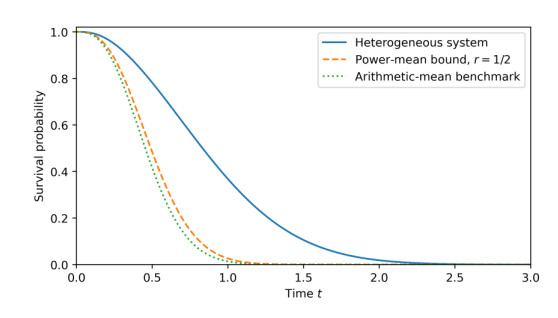
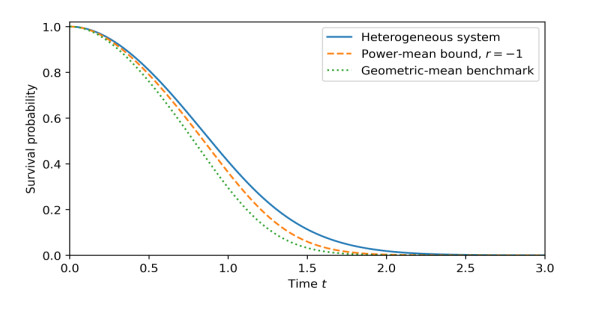
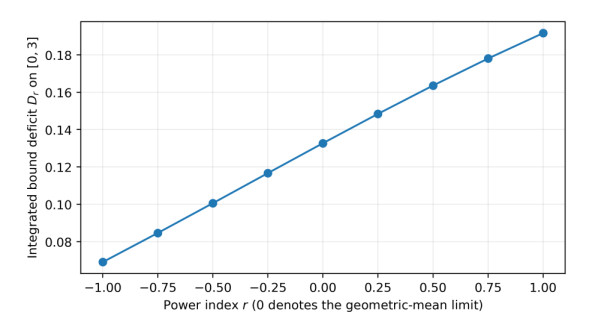
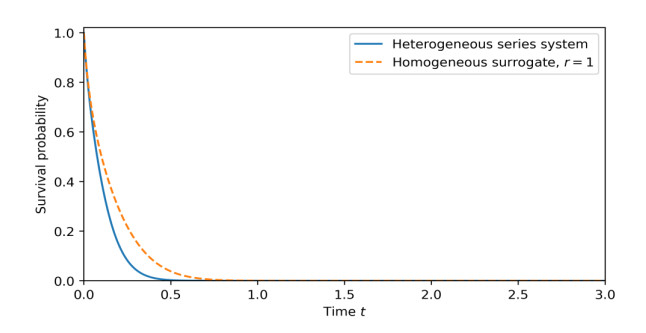
Replacing heterogeneous dependent component models with tractable homogeneous surrogates while preserving system-level stochastic comparisons is a recurring problem in reliability analysis. Existing mean-based results typically fix the surrogate parameter and do not identify the generator-dependent power-mean boundary for universal validity. In this paper, we developed a power-mean homogenization framework for parallel and series systems with proportional hazard rate (PHR) margins under Archimedean dependence. For parallel systems whose generator was valid in every dimension, we established an exact necessary-and-sufficient criterion: For every system size, every positive PHR parameter vector, and every non-degenerate baseline, the heterogeneous system dominated its homogeneous power-mean surrogate in the usual stochastic order if and only if a generator-induced one-variable transform was convex. The criterion yielded an exact critical power index and a constructive two-component counterexample below the admissible region. A relative-curvature condition characterized a dimension-free sufficient Jensen mechanism. For the Gumbel, Clayton, Ali-Mikhail-Haq, and Joe families, the exact and curvature-based criteria produced the same admissible sets over the studied nonzero power-index range with absolute value at most one. Strictness and equality conditions and a second-order local expansion quantified the heterogeneity gain over the arithmetic-mean benchmark. Complementary stochastic comparisons were established for series systems under appropriate convexity assumptions. Under decreasing-failure-rate baselines and additional generator-shape conditions, both system architectures admitted dispersive-order extensions; these results were sufficient rather than exact. The framework provided a rigorous basis for selecting homogeneous PHR benchmarks and comparing dependent heterogeneous systems.
Citation: Thamer Manshi, Maha Al-Mutairi. Power-mean homogenization of dependent PHR systems: Exact parallel-system thresholds under Archimedean copulas[J]. AIMS Mathematics, 2026, 11(10): 34635-34660. doi: 10.3934/math.20261350
Replacing heterogeneous dependent component models with tractable homogeneous surrogates while preserving system-level stochastic comparisons is a recurring problem in reliability analysis. Existing mean-based results typically fix the surrogate parameter and do not identify the generator-dependent power-mean boundary for universal validity. In this paper, we developed a power-mean homogenization framework for parallel and series systems with proportional hazard rate (PHR) margins under Archimedean dependence. For parallel systems whose generator was valid in every dimension, we established an exact necessary-and-sufficient criterion: For every system size, every positive PHR parameter vector, and every non-degenerate baseline, the heterogeneous system dominated its homogeneous power-mean surrogate in the usual stochastic order if and only if a generator-induced one-variable transform was convex. The criterion yielded an exact critical power index and a constructive two-component counterexample below the admissible region. A relative-curvature condition characterized a dimension-free sufficient Jensen mechanism. For the Gumbel, Clayton, Ali-Mikhail-Haq, and Joe families, the exact and curvature-based criteria produced the same admissible sets over the studied nonzero power-index range with absolute value at most one. Strictness and equality conditions and a second-order local expansion quantified the heterogeneity gain over the arithmetic-mean benchmark. Complementary stochastic comparisons were established for series systems under appropriate convexity assumptions. Under decreasing-failure-rate baselines and additional generator-shape conditions, both system architectures admitted dispersive-order extensions; these results were sufficient rather than exact. The framework provided a rigorous basis for selecting homogeneous PHR benchmarks and comparing dependent heterogeneous systems.

| [1] | G. Pledger, F. Proschan, Comparisons of order statistics and of spacings from heterogeneous distributions, In: Optimizing Methods in Statistics, J. S. Rustagi, Eds., New York: Academic Press, 1971, 89–113. https://doi.org/10.1016/B978-0-12-604550-5.50011-0 |
| [2] |
R. Dykstra, S. C. Kochar, J. Rojo, Stochastic comparisons of parallel systems of heterogeneous exponential components, J. Stat. Plan. Infer. , 65 (1997), 203–211. https://doi.org/10.1016/S0378-3758(97)00058-X doi: 10.1016/S0378-3758(97)00058-X

|
| [3] |
B. E. Khaledi, S. C. Kochar, Some new results on stochastic comparisons of parallel systems, J. Appl. Probab. , 37 (2000), 1123–1128. https://doi.org/10.1239/jap/1014843091 doi: 10.1239/jap/1014843091
|
| [4] | B. E. Khaledi, S. C. Kochar, Stochastic orderings among order statistics and sample spacings, In: Uncertainty and Optimality: Probability, Statistics and Operations Research, J. C. Misra, Eds., World Scientific, Singapore, 2002,167–203. https://doi.org/10.1142/9789812777010_0004 |
| [5] |
X. Li, R. Fang, Ordering properties of order statistics from random variables of Archimedean copulas with applications, J. Multivariate Anal. , 133 (2015), 304–320. https://doi.org/10.1016/j.jmva.2014.09.016 doi: 10.1016/j.jmva.2014.09.016
|
| [6] |
R. Fang, C. Li, X. Li, Stochastic comparisons on sample extremes of dependent and heterogenous observations, Statistics, 50 (2016), 930–955. https://doi.org/10.1080/02331888.2015.1119151 doi: 10.1080/02331888.2015.1119151
|
| [7] |
Y. Zhang, X. Cai, P. Zhao, H. Wang, Stochastic comparisons of parallel and series systems with heterogeneous resilience-scaled components, Statistics, 53 (2019), 126–147. https://doi.org/10.1080/02331888.2018.1546705 doi: 10.1080/02331888.2018.1546705
|
| [8] |
C. Li, X. Li, Hazard rate and reversed hazard rate orders on extremes of heterogeneous and dependent random variables, Stat. Probabil. Lett. , 146 (2019), 104–111. https://doi.org/10.1016/j.spl.2018.11.005 doi: 10.1016/j.spl.2018.11.005
|
| [9] |
T. Lando, I. Arab, P. E. Oliveira, Second-order stochastic comparisons of order statistics, Statistics, 55 (2021), 561–579. https://doi.org/10.1080/02331888.2021.1960527 doi: 10.1080/02331888.2021.1960527
|
| [10] |
M. Mesfioui, J. Trufin, Dispersive order comparisons on extreme order statistics from homogeneous dependent random vectors, Depend. Model. , 9 (2021), 385–393. https://doi.org/10.1515/demo-2021-0118 doi: 10.1515/demo-2021-0118
|
| [11] |
A. Panja, P. Kundu, B. Pradhan, Stochastic comparisons of lifetimes of series and parallel systems with dependent and heterogeneous components, Oper. Res. Lett. , 49 (2021), 176–183. https://doi.org/10.1016/j.orl.2020.12.009 doi: 10.1016/j.orl.2020.12.009
|
| [12] |
T. Sahoo, N. K. Hazra, Ordering and aging properties of systems with dependent components governed by the Archimedean copula, Probabab. Eng. Inform. Sc. , 37 (2023), 1–28. https://doi.org/10.1017/S0269964821000425 doi: 10.1017/S0269964821000425
|
| [13] |
E. Amini-Seresht, B. E. Khaledi, S. Izadkhah, Stochastic comparison of parallel systems with heterogeneous dependent exponential components, Stat. Probabil. Lett. , 215 (2024), 110242. https://doi.org/10.1016/j.spl.2024.110242 doi: 10.1016/j.spl.2024.110242
|
| [14] |
M. Datta, N. Gupta, Stochastic comparison for extreme order statistics arising from PHR, PRHR or location model, REVSTAT, 22 (2024), 387–410. https://doi.org/10.57805/revstat.v22i3.528 doi: 10.57805/revstat.v22i3.528
|
| [15] |
M. Shrahili, Stochastic ordering results on extreme order statistics from dependent samples with Archimedean copula, J. Inequal. Appl. , 2024 (2024), 120. https://doi.org/10.1186/s13660-024-03201-6 doi: 10.1186/s13660-024-03201-6
|
| [16] |
S. Das, S. Kayal, N. Torrado, Ordering results between extreme order statistics in models with dependence defined by Archimedean [survival] copulas, Ric. Mat. , 73 (2024), 1997–2033. https://doi.org/10.1007/s11587-022-00715-3 doi: 10.1007/s11587-022-00715-3
|
| [17] |
J. Zhong, R. Fang, Y. Chen, Stochastic comparisons on extremes of generalized scaled proportional hazard rate samples associated with Archimedean copula, Statistics, 60 (2026), 1208–1239. https://doi.org/10.1080/02331888.2025.2598385 doi: 10.1080/02331888.2025.2598385
|
| [18] | I. Arab, M. Hadjikyriakou, P. E. Oliveira, Stochastic ordering of dependent systems under transformation models and Archimedean copulas, arXiv Preprint, 2026. https://doi.org/10.48550/arXiv.2604.26026 |
| [19] |
G. Alomani, A. A. Alqefari, M. Kayid, Dispersive and hazard rate orderings of parallel systems with exponential dependent components, Statist. Probabil. Lett. , 227 (2026), 110514. https://doi.org/10.1016/j.spl.2025.110514 doi: 10.1016/j.spl.2025.110514
|
| [20] |
T. Manshi, A. A. Alqefari, M. Kayid, Preservation of hazard rate and relative average hazard rate orders in dependent series and parallel systems via Archimedean copulas, J. Inequal. Appl. , 2026 (2026), 52. https://doi.org/10.1186/s13660-026-03453-4 doi: 10.1186/s13660-026-03453-4
|
| [21] | A. W. Marshall, I. Olkin, B. C. Arnold, Inequalities: Theory of majorization and its applications, 2Eds., New York: Springer, 2011. https://doi.org/10.1007/978-0-387-68276-1 |
| [22] | A. Müller, D. Stoyan, Comparison methods for stochastic models and risks, Chichester: Wiley, 2002. |
| [23] | M. Shaked, J. G. Shanthikumar, Stochastic orders, New York: Springer, 2007. https://doi.org/10.1007/978-0-387-34675-5 |
| [24] | F. Belzunce, C. Martínez-Riquelme, J. Mulero, An introduction to stochastic orders, London: Academic Press, 2015. https://doi.org/10.1016/C2014-0-04775-2 |
| [25] | C. P. Niculescu, L. E. Persson, Convex functions and their applications: A contemporary approach, 2Eds., Springer, Cham, 2018. https://doi.org/10.1007/978-3-319-78337-6 |
Figures(4) / Tables(5)

Thamer Manshi, Maha Al-Mutairi. Power-mean homogenization of dependent PHR systems: Exact parallel-system thresholds under Archimedean copulas[J]. AIMS Mathematics, 2026, 11(10): 34635-34660. doi: 10.3934/math.20261350





 DownLoad: