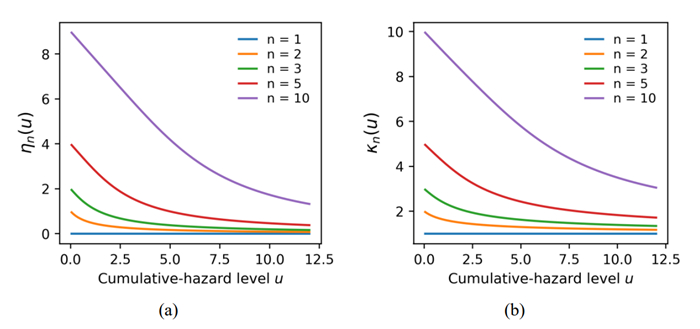
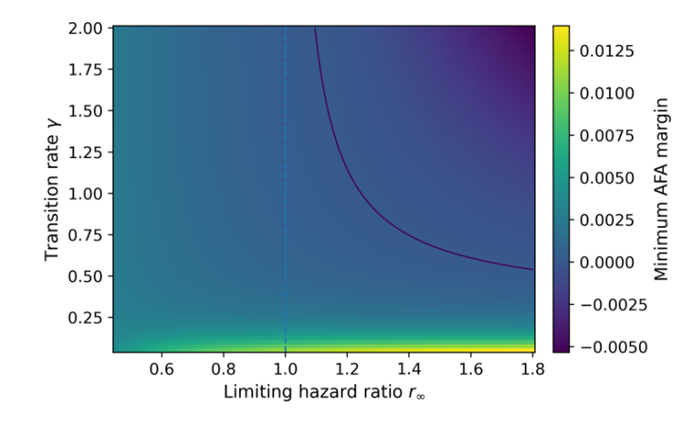
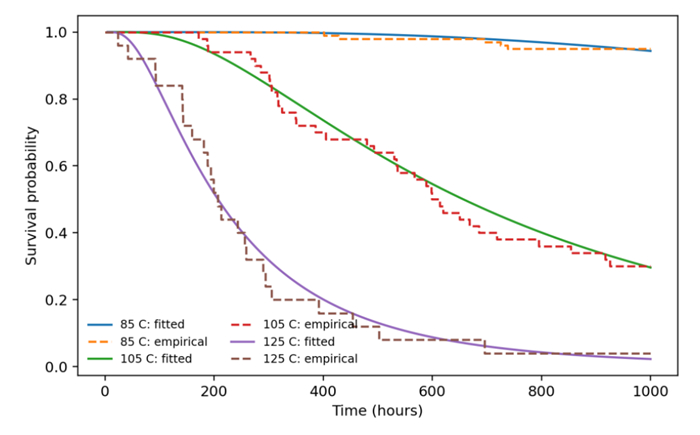
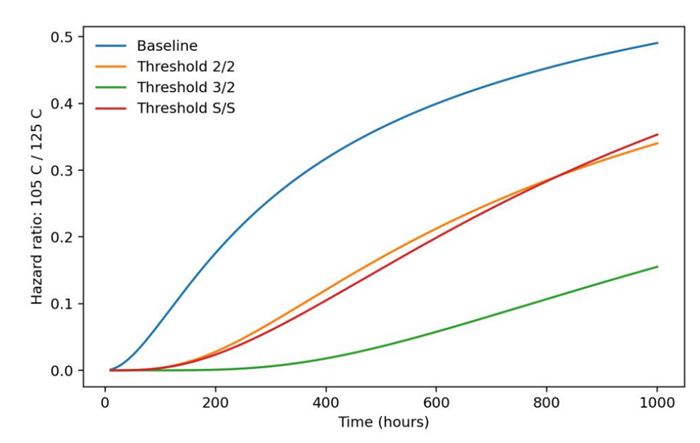
Preservation under a cumulative-hazard transformation is generally a sufficient-condition problem; universal preservation asks which generators work for every admissible baseline pair. We characterized this stronger property for the aging-faster (AF) and aging-faster-in-average (AFA) orders. For a proper survival generator $ {\mathit{\Phi}} $, put $ {\mathit{\Omega}} = -\mathrm{l}\mathrm{o}\mathrm{g}{\mathit{\Phi}} $, $ \omega = {\mathit{\Omega}} {'} $, $ {\eta }_{\omega }\left(u\right) = u\omega {'}\left(u\right)/\omega \left(u\right) $, and $ {\kappa }_{{\mathit{\Omega}} }\left(u\right) = u\omega \left(u\right)/{\mathit{\Omega}} \left(u\right) $. Among proper baselines with positive interior hazards and $ X{\ge }_{\mathrm{s}\mathrm{t}}Y $, universal AF preservation held if and only if $ \omega $ was nondecreasing and $ {\eta }_{\omega } $ was nonincreasing; universal AFA preservation held if and only if $ {\kappa }_{{\mathit{\Omega}} } $ was nonincreasing. The sufficient directions were established distortion-preservation results. Our constructive necessity argument used proportional exponential baselines and smooth hazard ratios reaching one. Different-generator comparisons were followed by transitivity, and gamma thresholds recovered known AF and AFA upper-record comparisons in nonhomogeneous Poisson epoch-time form. Analytical power-threshold consequences and a family-specific eventual-failure result distinguished global conclusions from finite-horizon numerical observations. A reproducible censored component-life-test calibration illustrated model-based use of the criteria while separating fitted-model implications from evidence about the underlying populations.
Citation: Ibrahim A. Nafisah, Mohamed Kayid, Tarek M. AlSayed. Preservation of relative aging orders under Cumulative-Hazard transformations[J]. AIMS Mathematics, 2026, 11(10): 34252-34279. doi: 10.3934/math.20261336
Preservation under a cumulative-hazard transformation is generally a sufficient-condition problem; universal preservation asks which generators work for every admissible baseline pair. We characterized this stronger property for the aging-faster (AF) and aging-faster-in-average (AFA) orders. For a proper survival generator $ {\mathit{\Phi}} $, put $ {\mathit{\Omega}} = -\mathrm{l}\mathrm{o}\mathrm{g}{\mathit{\Phi}} $, $ \omega = {\mathit{\Omega}} {'} $, $ {\eta }_{\omega }\left(u\right) = u\omega {'}\left(u\right)/\omega \left(u\right) $, and $ {\kappa }_{{\mathit{\Omega}} }\left(u\right) = u\omega \left(u\right)/{\mathit{\Omega}} \left(u\right) $. Among proper baselines with positive interior hazards and $ X{\ge }_{\mathrm{s}\mathrm{t}}Y $, universal AF preservation held if and only if $ \omega $ was nondecreasing and $ {\eta }_{\omega } $ was nonincreasing; universal AFA preservation held if and only if $ {\kappa }_{{\mathit{\Omega}} } $ was nonincreasing. The sufficient directions were established distortion-preservation results. Our constructive necessity argument used proportional exponential baselines and smooth hazard ratios reaching one. Different-generator comparisons were followed by transitivity, and gamma thresholds recovered known AF and AFA upper-record comparisons in nonhomogeneous Poisson epoch-time form. Analytical power-threshold consequences and a family-specific eventual-failure result distinguished global conclusions from finite-horizon numerical observations. A reproducible censored component-life-test calibration illustrated model-based use of the criteria while separating fitted-model implications from evidence about the underlying populations.

| [1] |
D. Sengupta, J. V. Deshpande, Some results on the relative ageing of two life distributions, J. Appl. Probab., 31 (1994), 991–1003. https://doi.org/10.2307/3215323 doi: 10.2307/3215323

|
| [2] |
G. Rowell, K. Siegrist, Relative aging of distributions, Probab. Eng. Inform. Sc., 12 (1998), 469–478. https://doi.org/10.1017/S0269964800005337 doi: 10.1017/S0269964800005337
|
| [3] |
K. Nanda, S. Bhattacharjee, S. S. Alam, Properties of aging intensity function, Stat. Probabil. Lett., 77 (2007), 365–373. https://doi.org/10.1016/j.spl.2006.08.002 doi: 10.1016/j.spl.2006.08.002
|
| [4] | M. Shaked, J. G. Shanthikumar, Stochastic orders, New York: Springer, 2007. |
| [5] | C. D. Lai, M. Xie, Stochastic ageing and dependence for reliability, New York: Springer, 2006. |
| [6] |
W. Ding, R. Fang, P. Zhao, Relative aging of coherent systems, Nav. Res. Log., 64 (2017), 345–354. https://doi.org/10.1002/nav.21752 doi: 10.1002/nav.21752
|
| [7] |
W. Ding, Y. Zhang, Relative ageing of series and parallel systems: Effects of dependence and heterogeneity among components, Oper. Res. Lett., 46 (2018), 219–224. https://doi.org/10.1016/j.orl.2018.01.005 doi: 10.1016/j.orl.2018.01.005
|
| [8] |
N. Misra, J. Francis, S. Naqvi, Some sufficient conditions for relative aging of life distributions, Probab. Eng. Inform. Sc., 31 (2017), 83–99. https://doi.org/10.1017/S0269964816000309 doi: 10.1017/S0269964816000309
|
| [9] |
S. Wang, Premium calculation by transforming the layer premium density, ASTIN Bull., 26 (1996), 71–92. https://doi.org/10.2143/AST.26.1.563234 doi: 10.2143/AST.26.1.563234
|
| [10] |
J. Navarro, Y. del Águila, M. A. Sordo, A. Suárez-Llorens, Preservation of reliability classes under the formation of coherent systems, Appl. Stoch. Model. Bus., 30 (2014), 444–454. https://doi.org/10.1002/asmb.1985 doi: 10.1002/asmb.1985
|
| [11] |
J. Navarro, Y. del Águila, M. A. Sordo, A. Suárez-Llorens, Preservation of stochastic orders under the formation of generalized distorted distributions: Applications to coherent systems, Methodol. Comput. Appl., 18 (2016), 529–545. https://doi.org/10.1007/s11009-015-9441-z doi: 10.1007/s11009-015-9441-z
|
| [12] |
Arriaza, M. A. Sordo, Preservation of some stochastic orders by distortion functions with application to coherent systems with exchangeable components, Appl. Stoch. Model. Bus., 37 (2021), 303–317. https://doi.org/10.1002/asmb.2565 doi: 10.1002/asmb.2565
|
| [13] |
M. Kayid, R. A. Almohsen, Preservation of relative hazard rate and relative reversed hazard rate orders by distorted distributions, Acta Appl. Math., 194 (2024), 14. https://doi.org/10.1007/s10440-024-00704-8 doi: 10.1007/s10440-024-00704-8
|
| [14] |
M. Kayid, R. A. Almohsen, Z. Kaabi, Preservation of the aging intensity order and the preservation of the monotonic aging intensity classes under distorted distributions, Heliyon, 10 (2024), e38202. https://doi.org/10.1016/j.heliyon.2024.e38202 doi: 10.1016/j.heliyon.2024.e38202
|
| [15] |
M. Kayid, Further results on relative aging orders and comparison of record statistics, Eksploat. Niezawodn., 27 (2025), 192756. https://doi.org/10.17531/ein/192756 doi: 10.17531/ein/192756
|
| [16] |
F. Belzunce, R. E. Lillo, J. M. Ruiz, M. Shaked, Stochastic comparisons of nonhomogeneous processes, Probab. Eng. Inform. Sc., 15 (2001), 199–224. https://doi.org/10.1017/S0269964801152058 doi: 10.1017/S0269964801152058
|
| [17] |
F. Belzunce, J. A. Mercader, J. M. Ruiz, Multivariate aging properties of epoch times of nonhomogeneous processes, J. Multivariate Anal., 84 (2003), 335–350. https://doi.org/10.1016/S0047-259X(02)00064-7 doi: 10.1016/S0047-259X(02)00064-7
|
| [18] |
F. G. Badía, C. Sangüesa, J. H. Cha, Stochastic comparisons and multivariate dependence for the epoch times of trend renewal processes, J. Multivariate Anal., 168 (2018), 174–184. https://doi.org/10.1016/j.jmva.2018.07.011 doi: 10.1016/j.jmva.2018.07.011
|
| [19] |
F. G. Badía, C. Sangüesa, J. H. Cha, Univariate and multivariate stochastic comparisons and ageing properties of the generalized Pólya process, J. Appl. Probab., 55 (2018), 233–253. https://doi.org/10.1017/jpr.2018.15 doi: 10.1017/jpr.2018.15
|
| [20] | M. Biernacki, J. Krzyż, On the monotonity of certain functionals in the theory of analytic functions, Ann. Univ. Mariae Curie-A, 9 (1955), 5–23. |
| [21] |
Z. H. Yang, Y. M. Chu, M. K. Wang, Monotonicity criterion for the quotient of power series with applications, J. Math. Anal. Appl., 428 (2015), 587–604. https://doi.org/10.1016/j.jmaa.2015.03.043 doi: 10.1016/j.jmaa.2015.03.043
|
| [22] | S. Karlin, Total positivity, Stanford: Stanford University Press, 1 (1968). |
| [23] |
M. Capaldo, J. M. Arevalillo, J. Navarro, Distorted distributions and ROC curves, Scand. J. Stat., 52 (2025), 1786–1815. https://doi.org/10.1111/sjos.70010 doi: 10.1111/sjos.70010
|
| [24] | NIST/SEMATECH, e-Handbook of statistical methods, Section 8.4. 2.1, Graphical estimation: Arrhenius model example. Available from: https://www.itl.nist.gov/div898/handbook/apr/section4/apr421.htm. |
 math-11-10-1336_Supplementary.pdf |
 |
Figures(7) / Tables(8)

Ibrahim A. Nafisah, Mohamed Kayid, Tarek M. AlSayed. Preservation of relative aging orders under Cumulative-Hazard transformations[J]. AIMS Mathematics, 2026, 11(10): 34252-34279. doi: 10.3934/math.20261336





 DownLoad: