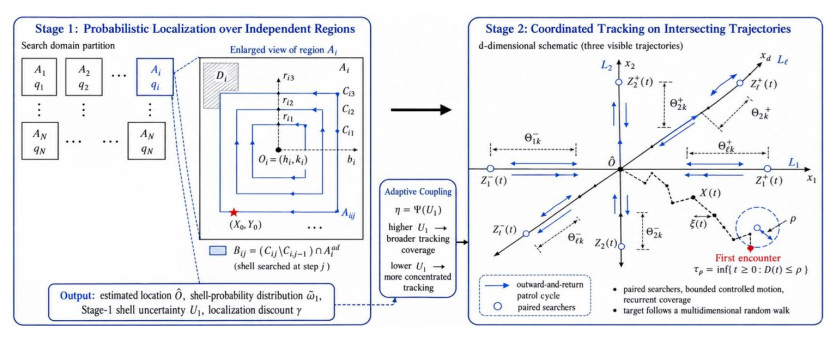
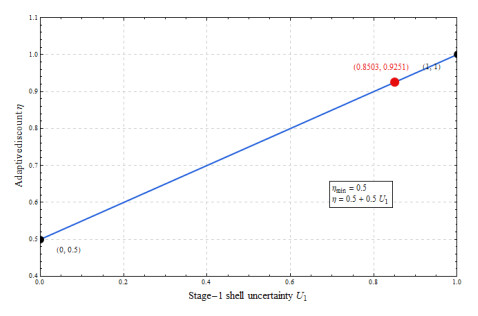
This paper developed an adaptive discounted two-stage stochastic transport model for locating and tracking a target governed by a multidimensional random walk. In the first stage, a discounted effort–reward criterion is incorporated into the regional search process to balance localization time, traveled distance, and detection probability. In the second stage, coordinated searchers track the target along intersecting trajectories while the target continues to move according to the multidimensional random-walk process. The tracking discount is adjusted according to the Stage-1 shell uncertainty, thereby linking the two stages within a unified framework. Coverage-preserving tracking distances are constructed to maintain recurrent exploration. Sufficient conditions are established for the existence of an optimal policy and complete coverage, while finiteness of the expected first-encounter time is obtained under an additional uniform positive finite-block encounter-probability assumption. The undiscounted model is recovered as the discount parameters approach 1. Numerical results illustrate the effects of discounting, uncertainty, and dimensionality on search effort and encounter performance.
Citation: Mohamed Abd Allah El-Hadidy, Alaa Awad Alzulaibani. Adaptive discounted optimization for multidimensional random-walk targets in a two-stage stochastic transport model: Coverage and finiteness of first-encounter times[J]. AIMS Mathematics, 2026, 11(10): 34215-34251. doi: 10.3934/math.20261335
This paper developed an adaptive discounted two-stage stochastic transport model for locating and tracking a target governed by a multidimensional random walk. In the first stage, a discounted effort–reward criterion is incorporated into the regional search process to balance localization time, traveled distance, and detection probability. In the second stage, coordinated searchers track the target along intersecting trajectories while the target continues to move according to the multidimensional random-walk process. The tracking discount is adjusted according to the Stage-1 shell uncertainty, thereby linking the two stages within a unified framework. Coverage-preserving tracking distances are constructed to maintain recurrent exploration. Sufficient conditions are established for the existence of an optimal policy and complete coverage, while finiteness of the expected first-encounter time is obtained under an additional uniform positive finite-block encounter-probability assumption. The undiscounted model is recovered as the discount parameters approach 1. Numerical results illustrate the effects of discounting, uncertainty, and dimensionality on search effort and encounter performance.

| [1] |
M. R. Evans, S. N. Majumdar, Diffusion with stochastic resetting, Phys. Rev. Lett., 106 (2011), 160601. https://doi.org/10.1103/PhysRevLett.106.160601 doi: 10.1103/PhysRevLett.106.160601

|
| [2] |
V. Méndez, R. Flaquer-Galmés, D. Campos, First-passage time of a Brownian searcher with stochastic resetting to random positions, Phys. Rev. E, 109 (2024), 044134. https://doi.org/10.1103/PhysRevE.109.044134 doi: 10.1103/PhysRevE.109.044134
|
| [3] |
A. Biswas, A. Dubey, A. Kundu, A. Pal, Drift-diffusive resetting search process with stochastic returns: Speedup beyond optimal instantaneous return, Phys. Rev. E, 111 (2025), 014142. https://doi.org/10.1103/PhysRevE.111.014142 doi: 10.1103/PhysRevE.111.014142
|
| [4] |
D. Zhang, H. Duan, Variational-resolution probability maps for multi-UAV search tasks with changeable searching behaviors, Aerosp. Sci. Technol., 155 (2024), 109669. https://doi.org/10.1016/j.ast.2024.109669 doi: 10.1016/j.ast.2024.109669
|
| [5] |
P. Xin, P. Dames, Comparison of stochastic optimization strategies in multi-robot multi-target tracking scenarios, Swarm Intell., 19 (2025), 215‒243. https://doi.org/10.1007/s11721-025-00249-y doi: 10.1007/s11721-025-00249-y
|
| [6] |
D. Boyer, G. Mercado-Vásquez, S. N. Majumdar, G. Schehr, Optimizing the random search of a finite-lived target by a Lévy flight, Phys. Rev. E, 109 (2024), L022103. https://doi.org/10.1103/PhysRevE.109.L022103 doi: 10.1103/PhysRevE.109.L022103
|
| [7] |
S. Feng, T. Weng, Y. Wang, Y. Xu, Z. Ren, L. Zhan, Random search processes on complex networks: From a static target to a moving object, Physica A, 636 (2024), 129544. https://doi.org/10.1016/j.physa.2024.129544 doi: 10.1016/j.physa.2024.129544
|
| [8] |
J. Lin, M. Wang, H. Yan, W. Yang, Prescribed-time optimal tracking control for a class of stochastic systems using reinforcement learning, J. Franklin Inst., 362 (2025), 107881. https://doi.org/10.1016/j.jfranklin.2025.107881 doi: 10.1016/j.jfranklin.2025.107881
|
| [9] |
J. Xiao, K. Shi, Y. Teng, J. Qi, H. Fan, Relaxed research on synchronization problem of fractional-order fuzzy octonion-valued BAM neural networks by the non-decomposition method on the high-dimension oblique field, Fractal Fract., 10 (2026), 414. https://doi.org/10.3390/fractalfract10060414 doi: 10.3390/fractalfract10060414
|
| [10] |
L. D. Stone, Necessary and sufficient conditions for optimal search plans for moving targets, Math. Oper. Res., 4 (1979), 303‒477. https://doi.org/10.1287/moor.4.4.431 doi: 10.1287/moor.4.4.431
|
| [11] |
S. S. Brown, Optimal search for a moving target in discrete time and space, Oper. Res., 28 (1980), 1259‒1453. https://doi.org/10.1287/opre.28.6.1275 doi: 10.1287/opre.28.6.1275
|
| [12] |
J. N. Eagle, J. R. Yee, An optimal branch-and-bound procedure for the constrained path, moving target search problem, Oper. Res., 38 (1990), 2‒184. https://doi.org/10.1287/opre.38.1.110 doi: 10.1287/opre.38.1.110
|
| [13] | L. D. Stone, J. O. Royset, A. R. Washburn, Optimal search for moving targets, Cham: Springer, 2016. https://doi.org/10.1007/978-3-319-26899-6 |
| [14] | S. Redner, A guide to first-passage processes, Cambridge: Cambridge University Press, 2012. https://doi.org/10.1017/CBO9780511606014 |
| [15] |
O. Bénichou, C. Loverdo, M. Moreau, R. Voituriez, Intermittent search strategies, Rev. Mod. Phys., 83 (2011), 81‒129. https://doi.org/10.1103/RevModPhys.83.81 doi: 10.1103/RevModPhys.83.81
|
| [16] |
T. Alam, L. Bobadilla, Multi-robot coverage and persistent monitoring in sensing-constrained environments, Robotics, 9 (2020), 47. https://doi.org/10.3390/robotics9020047 doi: 10.3390/robotics9020047
|
| [17] |
R. Hohzaki, K. Iida, Optimal strategy of route and look for the path constrained search problem with reward criterion, Eur. J. Oper. Res., 100 (1997), 236‒249. https://doi.org/10.1016/S0377-2217(96)00167-1 doi: 10.1016/S0377-2217(96)00167-1
|
| [18] |
M. A. El-Hadidy, On the maximum discounted effort-reward search problem, Asia-Pac. J. Oper. Res., 33 (2016), 1650019. https://doi.org/10.1142/S0217595916500196 doi: 10.1142/S0217595916500196
|
| [19] |
M. A. El-Hadidy, A. A. Alzulaibani, A multidimensional first-encounter time model for random-walk search based on a two-stage stochastic transport process, AIMS Math., 11 (2026), 17722‒17765. https://doi.org/10.3934/math.2026723 doi: 10.3934/math.2026723
|
| [20] |
M. A. El-Hadidy, A. A. Alzulaibani, A study on the finiteness of a tracking method with reduction in the collision time between a D-dimensional random-walk particle and one of multiple nano-sensors, J. Comput. Theor. Transp., 52 (2023), 506‒534. https://doi.org/10.1080/23324309.2024.2303506 doi: 10.1080/23324309.2024.2303506
|
| [21] |
L. Wang, W. Sun, S. F. Su, Adaptive asymptotic tracking control for nonlinear systems with state constraints and input saturation, Appl. Math. Comput., 431 (2022), 127342. https://doi.org/10.1016/j.amc.2022.127342 doi: 10.1016/j.amc.2022.127342
|
| [22] | M. Galewski, Basics of nonlinear optimization: Around the Weierstrass theorem, Cham: Birkhäuser, 2024. https://doi.org/10.1007/978-3-031-77160-6 |
| [23] | A. Beck, Introduction to nonlinear optimization: Theory, algorithms, and applications with Python and MATLAB, 2 Eds., Philadelphia: SIAM, 2023. https://doi.org/10.1137/1.9781611977622 |
| [24] | Ş. Cobzaş, R. Miculescu, A. Nicolae, Lipschitz functions, Cham: Springer, 2019. https://doi.org/10.1007/978-3-030-16489-8 |
| [25] | Y. Yu, J. Jiang, W. H. Chen, Y. Zuo, k-Step look-ahead active concurrent learning-based dual control of exploration and exploitation for auto-optimization, IEEE Trans. Cybern., 56 (2026), 3804‒3817. https://doi.org/10.1109/TCYB.2026.3660400 |
Figures(5) / Tables(10)

Mohamed Abd Allah El-Hadidy, Alaa Awad Alzulaibani. Adaptive discounted optimization for multidimensional random-walk targets in a two-stage stochastic transport model: Coverage and finiteness of first-encounter times[J]. AIMS Mathematics, 2026, 11(10): 34215-34251. doi: 10.3934/math.20261335





 DownLoad: