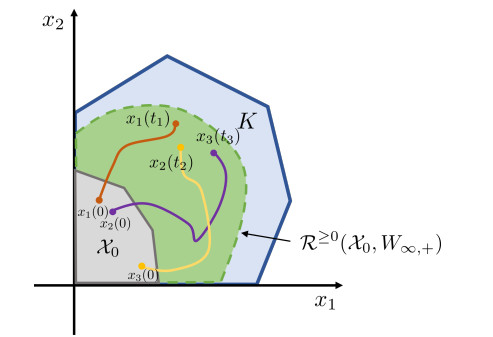
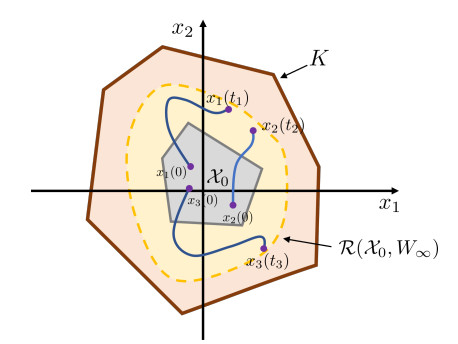
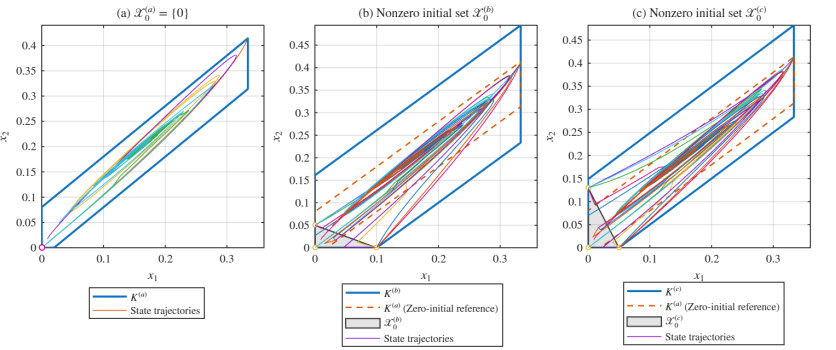
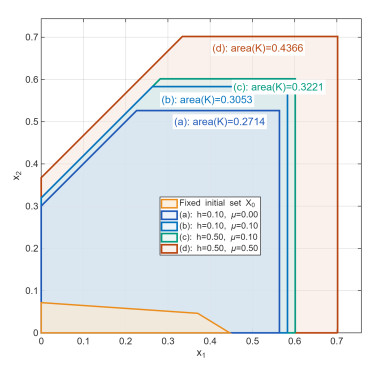
This work developed a polyhedral set-based approach for bounding reachable sets of linear systems with nonzero polyhedral initial sets. We first considered linear positive systems and established sufficient conditions for constructing polyhedral bounds of reachable sets in both delay-free and time-varying-delay cases. For systems without delays, the conventional polyhedral set-bounding approach was extended to accommodate nontrivial initial sets given in polyhedral form. For systems with time-varying delays, the conventional auxiliary functional used for reachable set bounding was generalized to account for the effect of time-varying delays. The proposed framework was then extended to general linear systems that are not necessarily positive. In particular, for the case with delays, the auxiliary functional established for positive systems was further generalized by employing absolute values of the state. The resulting sufficient conditions provided polyhedral reachable set bounds for both delay-free and time-varying-delay systems, and all the proposed bounding sets were shown to be computed via linear programming. Several numerical examples are provided to illustrate the effects of nonzero initial sets and time-varying delay parameters on the resulting bounds, and to demonstrate the applicability of the proposed approach to general linear systems.
Citation: Hyung Tae Choi, Jung Hoon Kim. Polyhedral-type reachable set estimation with generalized initial conditions: From positive systems to general linear delay systems[J]. AIMS Mathematics, 2026, 11(10): 34141-34171. doi: 10.3934/math.20261332
This work developed a polyhedral set-based approach for bounding reachable sets of linear systems with nonzero polyhedral initial sets. We first considered linear positive systems and established sufficient conditions for constructing polyhedral bounds of reachable sets in both delay-free and time-varying-delay cases. For systems without delays, the conventional polyhedral set-bounding approach was extended to accommodate nontrivial initial sets given in polyhedral form. For systems with time-varying delays, the conventional auxiliary functional used for reachable set bounding was generalized to account for the effect of time-varying delays. The proposed framework was then extended to general linear systems that are not necessarily positive. In particular, for the case with delays, the auxiliary functional established for positive systems was further generalized by employing absolute values of the state. The resulting sufficient conditions provided polyhedral reachable set bounds for both delay-free and time-varying-delay systems, and all the proposed bounding sets were shown to be computed via linear programming. Several numerical examples are provided to illustrate the effects of nonzero initial sets and time-varying delay parameters on the resulting bounds, and to demonstrate the applicability of the proposed approach to general linear systems.

| [1] | S. Boyd, L. El Ghaoui, E. Feron, V. Balakrishnan, Linear matrix inequalities in system and control theory, Society for Industrial and Applied Mathematics (SIAM), 1994. http://dx.doi.org/10.1137/1.9781611970777 |
| [2] |
C. Durieu, E. Walter, B. Polyak, Multi-input multi-output ellipsoidal state bounding, J. Optim. Theory Appl., 111 (2001), 273–303. http://dx.doi.org/10.1023/A:1011978200643 doi: 10.1023/A:1011978200643

|
| [3] |
E. Fridman, U. Shaked, On reachable sets for linear systems with delay and bounded peak inputs, Automatica, 39 (2003), 2005–2010. http://dx.doi.org/10.1016/S0005-1098(03)00204-8 doi: 10.1016/S0005-1098(03)00204-8
|
| [4] |
J. Kim, Improved ellipsoidal bound of reachable sets for time-delayed linear systems with disturbances, Automatica, 44 (2008), 2940–2943. http://dx.doi.org/10.1016/j.automatica.2008.03.015 doi: 10.1016/j.automatica.2008.03.015
|
| [5] |
Z. Zuo, D. W. C. Ho, Y. Wang, Reachable set bounding for delayed systems with polytopic uncertainties: The maximal Lyapunov-Krasovskii functional approach, Automatica, 46 (2010), 949–952. http://dx.doi.org/10.1016/j.automatica.2010.02.022 doi: 10.1016/j.automatica.2010.02.022
|
| [6] |
M. Vidyasagar, Optimal rejection of persistent bounded disturbances, IEEE Trans. Automat. Control, 31 (1986), 527–534. http://dx.doi.org/10.1109/TAC.1986.1104315 doi: 10.1109/TAC.1986.1104315
|
| [7] | D. Kwak, J. H. Kim, T. Hagiwara, Generalized kernel approximation approach to $\mathcal{L}_{1}$ optimal control of sampled-data systems, In: 2024 American control conference (ACC), Toronto: IEEE, 2024, 5177–5182. http://dx.doi.org/10.23919/ACC60939.2024.10644972 |
| [8] |
H. T. Choi, J. H. Kim, An $L_{\infty}$ performance control for time-delay systems with time-varying delays: Delay-independent approach via ellipsoidal D-invariance, AIMS Mathematics, 9 (2024), 30384–30405. http://dx.doi.org/10.3934/math.20241466 doi: 10.3934/math.20241466
|
| [9] |
D. Kwak, J. H. Kim, T. Hagiwara, A new quasi-finite-rank approximation of compression operators on $L_{\infty}[0, H)$ with applications to sampled-data and time-delay systems: Piecewise linear kernel approximation approach, J. Franklin Inst., 361 (2024), 107271. http://dx.doi.org/10.1016/j.jfranklin.2024.107271 doi: 10.1016/j.jfranklin.2024.107271
|
| [10] |
J. Kim, J. H. Kim, The $L_{1}$-induced norm analysis for linear multivariable differential equations, AIMS Mathematics, 9 (2024), 34205–34223. http://dx.doi.org/10.3934/math.20241629 doi: 10.3934/math.20241629
|
| [11] |
H. T. Choi, J. H. Kim, The $\mathcal{L}_{1}$ controller synthesis for piecewise continuous nonlinear systems via set invariance principles, Int. J. Robust Nonlinear Control, 33 (2023), 8670–8692. http://dx.doi.org/10.1002/rnc.6843 doi: 10.1002/rnc.6843
|
| [12] |
H. T. Choi, J. H. Kim, T. Hagiwara, Characterizing $\mathcal{L}_{1}$ output-feedback controller for nonlinear systems: Existence conditions via output controlled invariance domain, Int. J. Robust Nonlinear Control, 34 (2024), 11760–11785. http://dx.doi.org/10.1002/rnc.7589 doi: 10.1002/rnc.7589
|
| [13] | H. T. Choi, J. H. Kim, R. G. Sanfelice, A barrier function-based approach for nonlinear $\mathcal{L}_{1}$ control, In: 2025 IEEE 64th conference on decision and control (CDC), Brazil: IEEE, 2025, 2675–2680. http://dx.doi.org/10.1109/CDC57313.2025.11312011 |
| [14] |
O. R. Kang, J. H. Kim, Robust sliding mode control for robot manipulators with analysis on trade-off between reaching time and $L_{\infty}$ gain, Math. Methods Appl. Sci., 47 (2024), 7270–7287. http://dx.doi.org/10.1002/mma.9972 doi: 10.1002/mma.9972
|
| [15] |
W. Xiang, H. Tran, T. T. Johnson, Output reachable set estimation for switched linear systems and its application in safety verification, IEEE Trans. Automat. Control, 62 (2017), 5380–5387. http://dx.doi.org/10.1109/TAC.2017.2692100 doi: 10.1109/TAC.2017.2692100
|
| [16] | H. Y. Park, J. H. Kim, Robust balancing control of biped robots for external forces, In: 2024 IEEE International conference on robotics and automation (ICRA), Japan: IEEE, 2024, 13257–13262. http://dx.doi.org/10.1109/ICRA57147.2024.10611281 |
| [17] |
J. P. Richard, Time-delay systems: An overview of some recent advances and open problems, Automatica, 39 (2003), 1667–1694. http://dx.doi.org/10.1016/S0005-1098(03)00167-5 doi: 10.1016/S0005-1098(03)00167-5
|
| [18] |
E. Fridman, Tutorial on Lyapunov-based methods for time-delay systems, Eur. J. Control, 20 (2014), 271–283. http://dx.doi.org/10.1016/j.ejcon.2014.10.001 doi: 10.1016/j.ejcon.2014.10.001
|
| [19] |
G. I. Song, J. H. Kim, Time-delay compensation-based robust control of mechanical manipulators: Operator-theoretic analysis and experiment validation, Math. Methods Appl. Sci., 47 (2024), 318–335. http://dx.doi.org/10.1002/mma.9656 doi: 10.1002/mma.9656
|
| [20] |
J. Abedor, K. Nagpal, K. Poolla, A linear matrix inequality approach to peak-to-peak gain minimization, Int. J. Robust Nonlinear Control, 6 (1996), 899–927. http://dx.doi.org/10.1002/(SICI)1099-1239(199611)6:9/10<899::AID-RNC259>3.0.CO;2-G doi: 10.1002/(SICI)1099-1239(199611)6:9/10<899::AID-RNC259>3.0.CO;2-G
|
| [21] |
I. Pólik, T. Terlaky, A survey of the S-lemma, SIAM Rev., 49 (2007), 371–418. http://dx.doi.org/10.1137/S003614450444614X doi: 10.1137/S003614450444614X
|
| [22] |
B. Zhang, J. Lam, S. Xu, Relaxed results on reachable set estimation of time-delay systems with bounded peak inputs, Int. J. Robust Nonlinear Control, 26 (2016), 1994–2007. http://dx.doi.org/10.1002/rnc.3395 doi: 10.1002/rnc.3395
|
| [23] |
Y. Chen, J. Lam, B. Zhang, Estimation and synthesis of reachable set for switched linear systems, Automatica, 63 (2016), 122–132. http://dx.doi.org/10.1016/j.automatica.2015.10.033 doi: 10.1016/j.automatica.2015.10.033
|
| [24] | L. Farina, S. Rinaldi, Positive linear systems: Theory and applications, Chichester: John Wiley & Sons, 2000. http://dx.doi.org/10.1002/9781118033029 |
| [25] |
C. Briat, Robust stability and stabilization of uncertain linear positive systems via integral linear constraints: $L_{1}$-gain and $L_{\infty}$-gain characterization, Int. J. Robust Nonlinear Control, 23 (2013), 1932–1954. http://dx.doi.org/10.1002/rnc.2859 doi: 10.1002/rnc.2859
|
| [26] |
B. Du, J. Lam, Z. Shu, Y. Chen, On reachable sets for positive linear systems under constrained exogenous inputs, Automatica, 74 (2016), 230–237. http://dx.doi.org/10.1016/j.automatica.2016.07.048 doi: 10.1016/j.automatica.2016.07.048
|
| [27] |
Y. Chen, J. Lam, Y. Cui, J. Shen, K. W. Kwok, Reachable set estimation and synthesis for periodic positive systems, IEEE Trans. Cybern., 51 (2021), 501–511. http://dx.doi.org/10.1109/TCYB.2019.2908676 doi: 10.1109/TCYB.2019.2908676
|
| [28] |
J. Shen, J. Lam, Improved reachable set estimation for positive systems: A polyhedral approach, Automatica, 124 (2021), 109167. http://dx.doi.org/10.1016/j.automatica.2020.109167 doi: 10.1016/j.automatica.2020.109167
|
| [29] | J. C. Hennet, Une extension du Lemme de Farkas et son application au probleme de regulation lineaire sous contraintes, C. R. Acad. Sci. Paris, 308 (1989), 415–419. |
| [30] | H. T. Choi, J. H. Kim, Polyhedral-type reachable set estimation with generalized initial conditions: From positive systems to general linear delay systems. Available from: https://tinyurl.com/fvs2bwss. |
| [31] |
B. Bueno, L. Norford, G. Pigeon, R. Britter, A resistance-capacitance network model for the analysis of the interactions between the energy performance of buildings and the urban climate, Build. Environ., 54 (2012), 116–125. http://dx.doi.org/10.1016/j.buildenv.2012.01.023 doi: 10.1016/j.buildenv.2012.01.023
|
| [32] |
G. Zhang, J. Hu, Y. Shen, Exponential lag synchronization for delayed memristive recurrent neural networks, Neurocomputing, 154 (2015), 86–93. http://dx.doi.org/10.1016/j.neucom.2014.12.016 doi: 10.1016/j.neucom.2014.12.016
|
Figures(6) / Tables(2)

Hyung Tae Choi, Jung Hoon Kim. Polyhedral-type reachable set estimation with generalized initial conditions: From positive systems to general linear delay systems[J]. AIMS Mathematics, 2026, 11(10): 34141-34171. doi: 10.3934/math.20261332





 DownLoad: