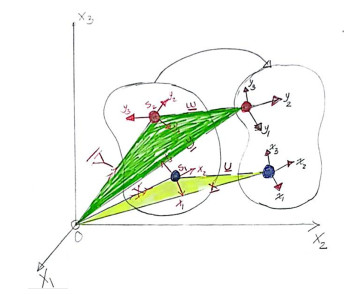
This manuscript presents a numerical investigation of a coupled system of nonlinear partial differential equations used to model wave propagation in a binary mixture composed of two elastic solids. The proposed model is derived by considering the Green-Lagrange strain tensor in a Lagrangian coordinate system, together with the constitutive relations and governing field equations, subject to appropriate boundary conditions that characterize the deformation of the individual constituents of the binary mixture. A finite difference scheme is employed to obtain numerical solutions for the one-dimensional case under prescribed initial and boundary conditions for the displacements of both constituents. The numerical results are fitted, plotted, and analyzed. Furthermore, it is shown that the induced waves propagate at relatively low velocities; they do not dissipate over time but gradually decay to zero as the distance tends to infinity.
Citation: A. R. El-Dhaba. Numerical investigation of nonlinear elastic wave propagation in a binary mixture of two elastic solids[J]. AIMS Mathematics, 2026, 11(10): 34119-34140. doi: 10.3934/math.20261331
This manuscript presents a numerical investigation of a coupled system of nonlinear partial differential equations used to model wave propagation in a binary mixture composed of two elastic solids. The proposed model is derived by considering the Green-Lagrange strain tensor in a Lagrangian coordinate system, together with the constitutive relations and governing field equations, subject to appropriate boundary conditions that characterize the deformation of the individual constituents of the binary mixture. A finite difference scheme is employed to obtain numerical solutions for the one-dimensional case under prescribed initial and boundary conditions for the displacements of both constituents. The numerical results are fitted, plotted, and analyzed. Furthermore, it is shown that the induced waves propagate at relatively low velocities; they do not dissipate over time but gradually decay to zero as the distance tends to infinity.

| [1] |
M. A. Biot, Theory of propagation of elastic waves in a fluid in a fluid-saturated porous solid. Ⅰ. Low frequency range, J. Acoust. Soc. Am., 28 (1956), 168–178. https://doi.org/10.1121/1.1908239 doi: 10.1121/1.1908239

|
| [2] |
M. A. Biot, Theory of propagation of elastic waves in a fluid-saturated porous solid. Ⅱ. Higher frequency range, J. Acoust. Soc. Am., 28 (1956), 179–191. https://doi.org/10.1121/1.1908241 doi: 10.1121/1.1908241
|
| [3] |
M. A. Biot, Mechanics of deformation and acoustic propagation in porous media, J. Appl. Phys., 33 (1962), 1482–1498. https://doi.org/10.1063/1.1728759 doi: 10.1063/1.1728759
|
| [4] |
N. Mills, T. R. Steel, Non-linear deformations of a mixture of two isotropic elastic solids, Acta Mech., 9 (1970), 229–244. https://doi.org/10.1007/BF01179823 doi: 10.1007/BF01179823
|
| [5] |
A. Bedford, D. S. Drumheller, A variational theory of immiscible mixtures, Arch. Ration. Mech. Anal., 68 (1978), 37–51. https://doi.org/10.1007/BF00276178 doi: 10.1007/BF00276178
|
| [6] |
J. J. Shi, K. R. Rajagopal, A. S. Wineman, Applications of the theory of interacting continua to the diffusion of a fluid through a non-linear elastic medium, Int. J. Eng. Sci., 19 (1981), 871–889. https://doi.org/10.1016/0020-7225(81)90121-X doi: 10.1016/0020-7225(81)90121-X
|
| [7] |
M. R. Baer, J. W. Nunziato, A two-phase mixture theory for the deflagration-to-detonation transition (DDT) in reactive granular materials, Int. J. Multiphase Flow, 12 (1986), 861–889. https://doi.org/10.1016/0301-9322(86)90033-9 doi: 10.1016/0301-9322(86)90033-9
|
| [8] |
D. Ieşan, A theory of mixtures of nonsimple elastic solids, Int. J. Eng. Sci., 30 (1992), 317–328. https://doi.org/10.1016/0020-7225(92)90076-S doi: 10.1016/0020-7225(92)90076-S
|
| [9] |
Y. Y. Rushchitskii, Nonlinear waves in solid mixtures (review), Int. Appl. Mech., 33 (1997), 1–34. https://doi.org/10.1007/BF02700883 doi: 10.1007/BF02700883
|
| [10] |
Y. Y. Rushchitskii, On the interaction between solitary waves in solid mixtures, Int. Appl. Mech., 34 (1998), 1086–1093. https://doi.org/10.1007/BF02700895 doi: 10.1007/BF02700895
|
| [11] |
Y. Y. Rushchitskii, Extension of the microstructural theory of two-phase mixtures to composite materials, Int. Appl. Mech., 36 (2000), 586–614. https://doi.org/10.1007/BF02682074 doi: 10.1007/BF02682074
|
| [12] |
A. C. Eringen, Micropolar mixture theory of porous media, J. Appl. Phys., 94 (2003), 4184–4190. https://doi.org/10.1063/1.1598640 doi: 10.1063/1.1598640
|
| [13] |
J. M. Carcione, F. Cavallini, J. E. Santos, C. L. Ravazzoli, P. M. Gauzellino, Wave propagation in partially saturated porous media: simulation of a second slow wave, Wave Motion, 39 (2004), 227–240. https://doi.org/10.1016/j.wavemoti.2003.10.001 doi: 10.1016/j.wavemoti.2003.10.001
|
| [14] |
C. Galeş, Potential method in the linear theory of swelling porous elastic soils, Eur. J. Mech. A/Solids, 23 (2004), 957–973. https://doi.org/10.1016/j.euromechsol.2004.07.003 doi: 10.1016/j.euromechsol.2004.07.003
|
| [15] |
C. Gales, A mixture theory for micropolar thermoelastic solids, Math. Probl. Eng., 2007 (2007), 090672. https://doi.org/10.1155/2007/90672 doi: 10.1155/2007/90672
|
| [16] |
D. Ieşan, A gradient theory of porous elastic solids, ZAMM, 100 (2020), e201900241. https://doi.org/10.1002/zamm.201900241 doi: 10.1002/zamm.201900241
|
| [17] |
R. Kumar, D. Batra, Fundamental solution of steady oscillation in swelling porous thermoelastic medium, Acta Mech., 231 (2020), 3247–3263. https://doi.org/10.1007/s00707-020-02704-9 doi: 10.1007/s00707-020-02704-9
|
| [18] | I. V. Andrianov, J. Awrejcewicz, V. Danishevskyy, Linear and nonlinear waves in microstructured solids: Homogenization and asymptotic approaches, Boca Raton: CRC Press, 2021. |
| [19] |
A. Magaña, M. Magaña, R. Quintanilla, Decay of solutions for strain gradient mixtures, ZAMM, 103 (2023), e202200089. https://doi.org/10.1002/zamm.202200089 doi: 10.1002/zamm.202200089
|
| [20] |
S. C. Schumacher, M. R. Baer, Generalized continuum mixture theory for multi-material shock physics, Int. J. Eng. Sci., 183 (2023), 103807. https://doi.org/10.1016/j.ijengsci.2022.103807 doi: 10.1016/j.ijengsci.2022.103807
|
| [21] |
M. I. M. Hilal, Dynamical interactions of the magnetic field in a binary mixture of interacting thermoelastic solids, J. Thermal Stresses, 47 (2024), 977–991. https://doi.org/10.1080/01495739.2024.2348523 doi: 10.1080/01495739.2024.2348523
|
| [22] |
W. S. Chen, X. J. Zhang, T. X. Dai, J. J. Peng, Z. W. Ni, Modeling seismic wave propagation in partially saturated porous media: a comparative study, Front. Earth Sci., 13 (2025), 1610897. https://doi.org/10.3389/feart.2025.1610897 doi: 10.3389/feart.2025.1610897
|
| [23] |
M. Ciarletta, On mixtures of nonsimple elastic solids, Int. J. Eng. Sci., 36 (1998), 655–668. https://doi.org/10.1016/S0020-7225(97)00094-3 doi: 10.1016/S0020-7225(97)00094-3
|
| [24] |
F. Passarella, V. Zampoli, Some results on the spatial behaviour for elastic mixtures, Eur. J. Mech. A/Solids, 25 (2006), 1031–1040. https://doi.org/10.1016/j.euromechsol.2006.01.004 doi: 10.1016/j.euromechsol.2006.01.004
|
| [25] |
L. Tebou, Exponential stability of a mixture of two elastic solids with a degenerate weak damping mechanism, J. Math. Anal. Appl., 491 (2020), 124336. https://doi.org/10.1016/j.jmaa.2020.124336 doi: 10.1016/j.jmaa.2020.124336
|
| [26] |
V. A. Yeremeyev, A. B. Freidin, L. L. Sharipova, The stability of the equilibrium of two-phase elastic solids, J. Appl. Math. Mech., 71 (2007), 61–84. https://doi.org/10.1016/j.jappmathmech.2007.03.007 doi: 10.1016/j.jappmathmech.2007.03.007
|
| [27] |
J. De Castro Motta, V. Zampoli, S. Chiriş, M. Ciarletta, On the structural stability for a model of mixture of porous solids, Math. Methods Appl. Sci., 47 (2024), 4513–4529. https://doi.org/10.1002/mma.9825 doi: 10.1002/mma.9825
|
| [28] |
Z. P. Yang, W. P. Zhong, M. Belić, Dark localized waves in shallow waters: analysis within an extended Boussinesq system, Chinese Phys. Lett., 41 (2024), 044201. https://doi.org/10.1088/0256-307X/41/4/044201 doi: 10.1088/0256-307X/41/4/044201
|
| [29] |
W. P. Zhong, Z. P. Yang, M. Belić, W. Y. Zhong, Rogue wave excitations of the (2+1)-dimensional nonlinear Zakharov system, Nonlinear Dyn., 111 (2023), 6621–6628. https://doi.org/10.1007/s11071-022-08031-z doi: 10.1007/s11071-022-08031-z
|
| [30] |
W. P. Zhong, M. Belić, Nonlinear wave excitations in the (2+1)-D asymmetric Nizhnik-Novikov-Veselov system, Chaos Solitons Fract., 176 (2023), 114075. https://doi.org/10.1016/j.chaos.2023.114075 doi: 10.1016/j.chaos.2023.114075
|
| [31] |
H. Wang, J. J. Liao, Y. Z. Nie, Z. X. Li, Z. Y. Luo, X. G. Wang, et al., Electronic structure and transport properties of novel arsenene and its analogs from first-principles calculations, Phys. Lett. A, 480 (2023), 128968. https://doi.org/10.1016/j.physleta.2023.128968 doi: 10.1016/j.physleta.2023.128968
|
| [32] | K. R. Rajagopal, L. Tao, Mechanics of mixtures, Singapore: World Scientific, 1995. https://doi.org/10.1142/9789812832009 |
| [33] |
H. Demiray, A continuum theory of chemically reacting mixtures of fluids and solids, Int. J. Eng. Sci., 19 (1981), 253–268. https://doi.org/10.1016/0020-7225(81)90026-4 doi: 10.1016/0020-7225(81)90026-4
|
| [34] |
A. Morro, A. I. Murdoch, Stress, body force, and momentum balance in mixture theory, Meccanica, 21 (1986), 184–190. https://doi.org/10.1007/BF01556484 doi: 10.1007/BF01556484
|
Figures(17) / Tables(1)

A. R. El-Dhaba. Numerical investigation of nonlinear elastic wave propagation in a binary mixture of two elastic solids[J]. AIMS Mathematics, 2026, 11(10): 34119-34140. doi: 10.3934/math.20261331





 DownLoad: