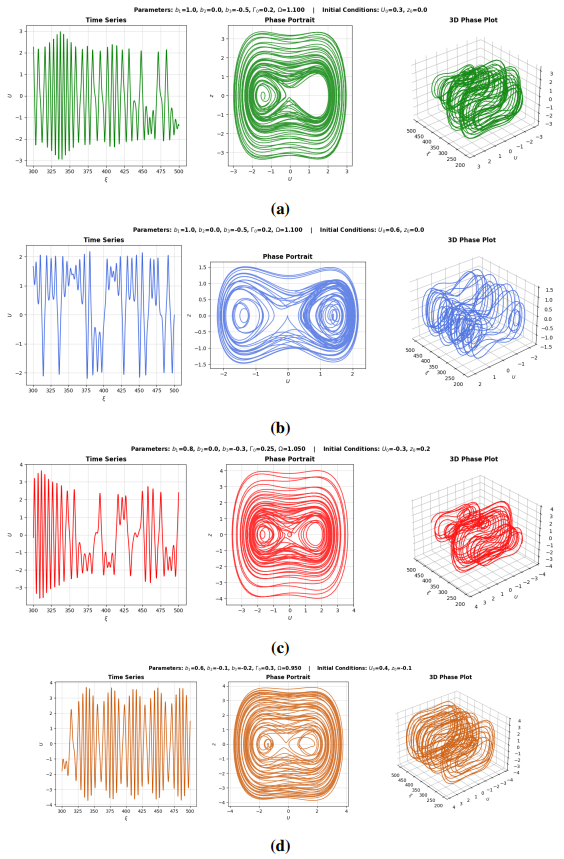
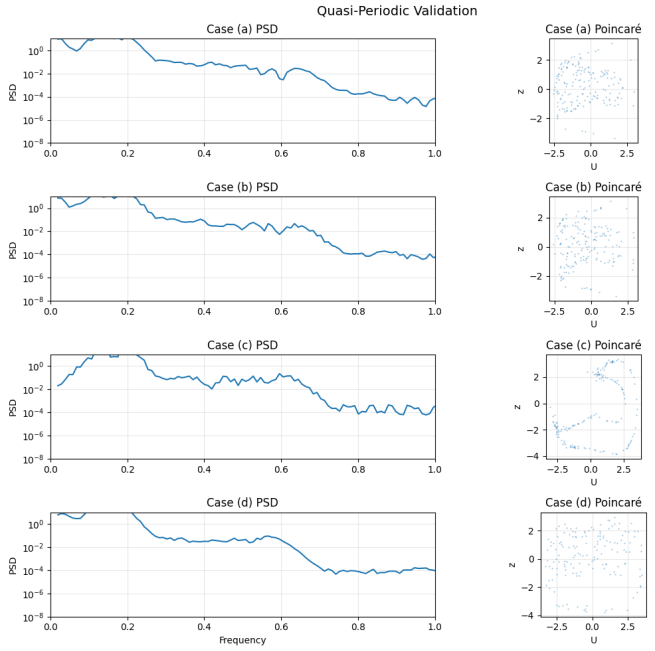
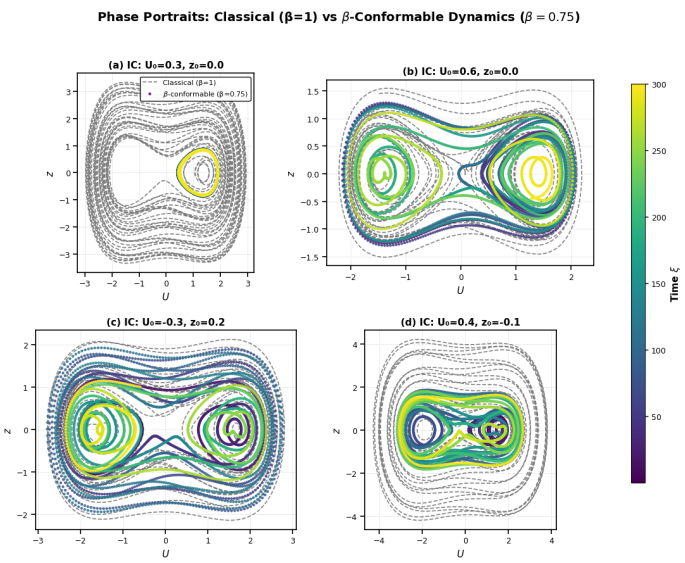
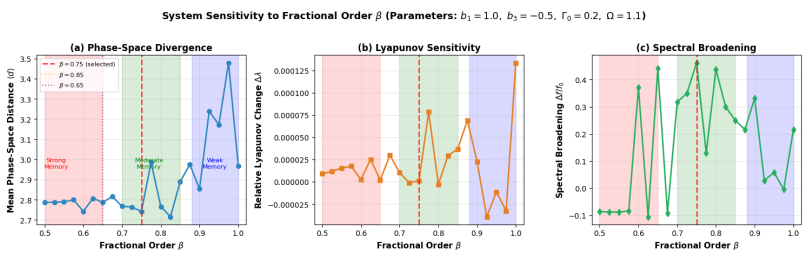
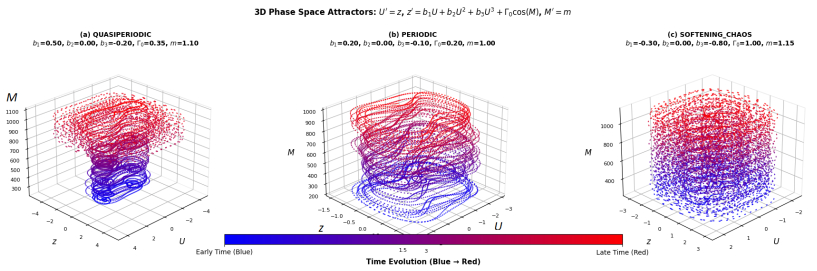
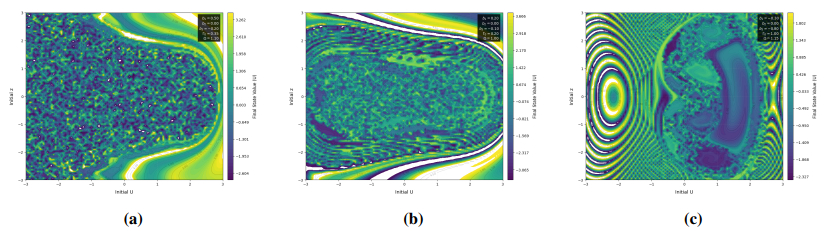
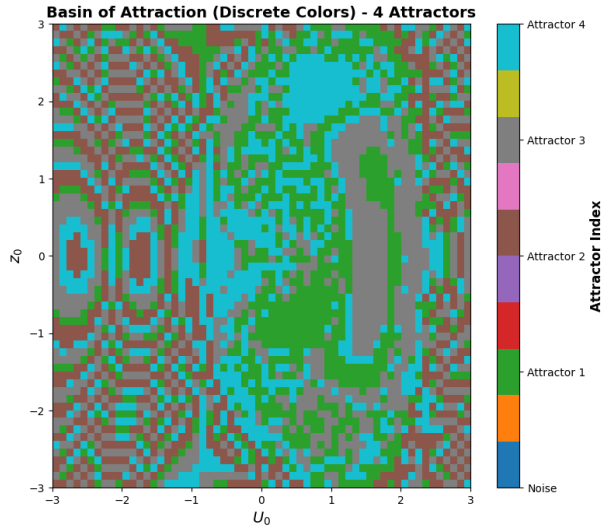
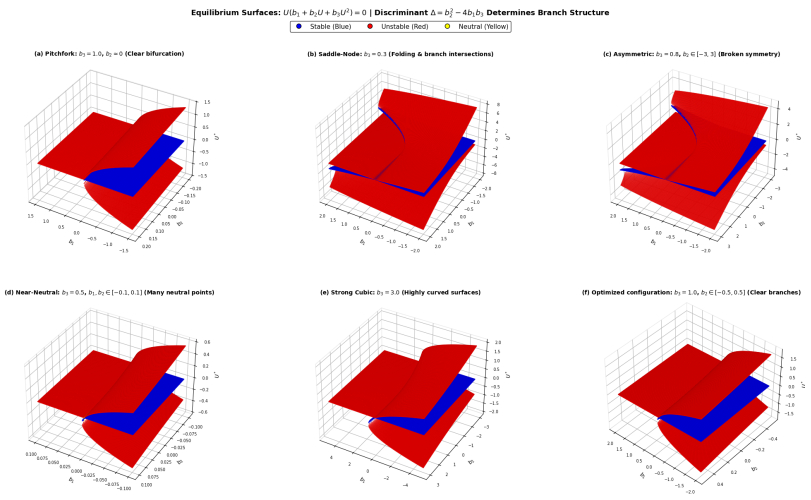
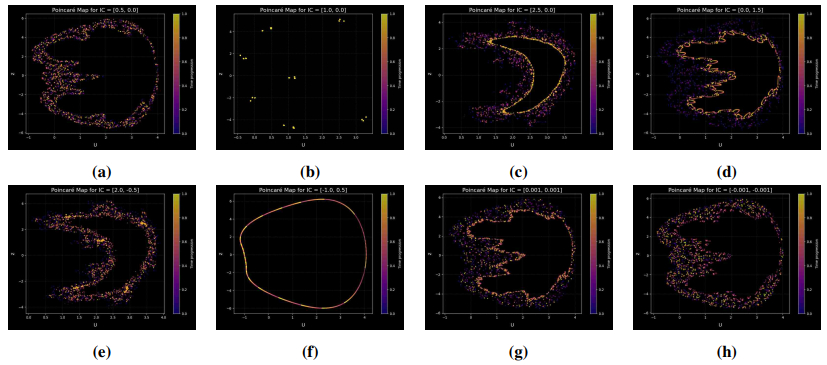
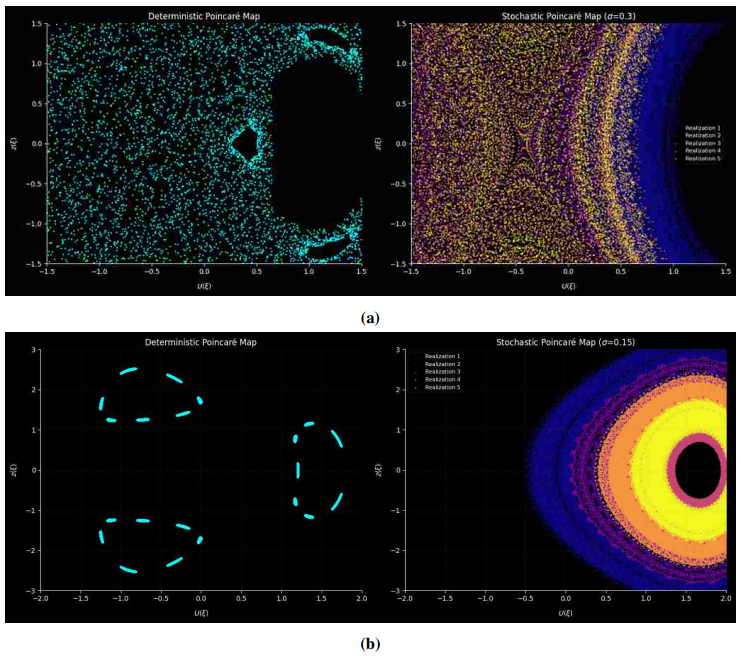
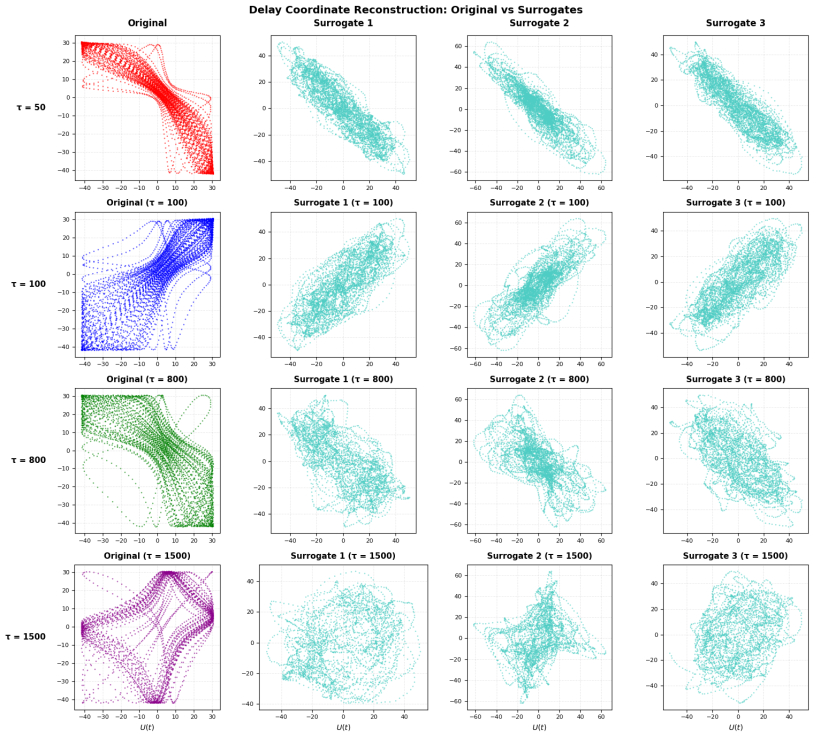
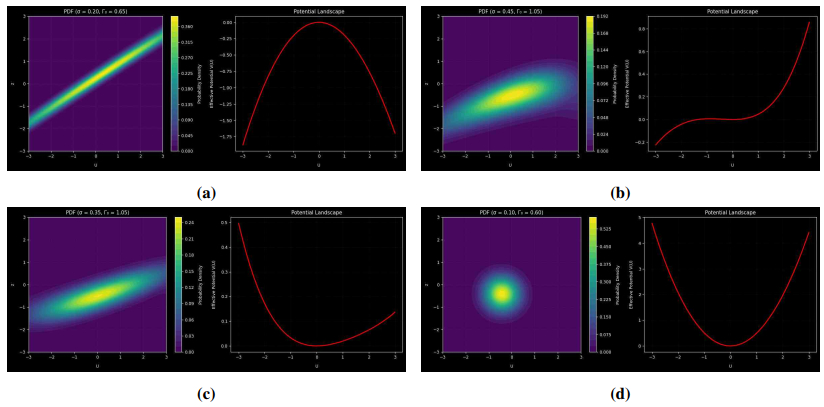
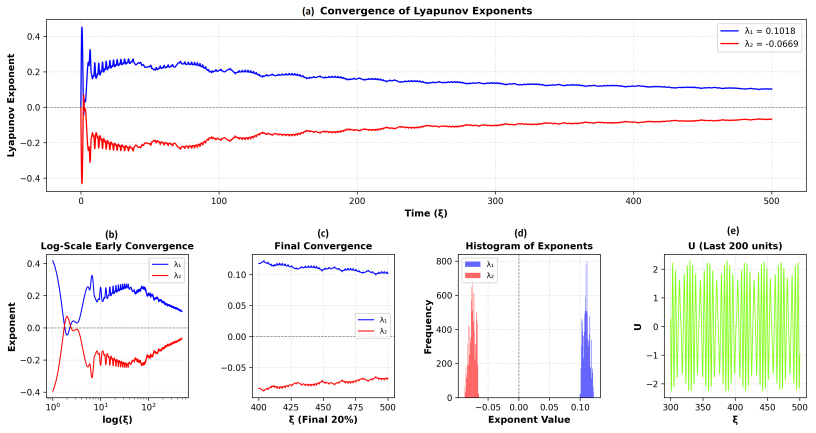
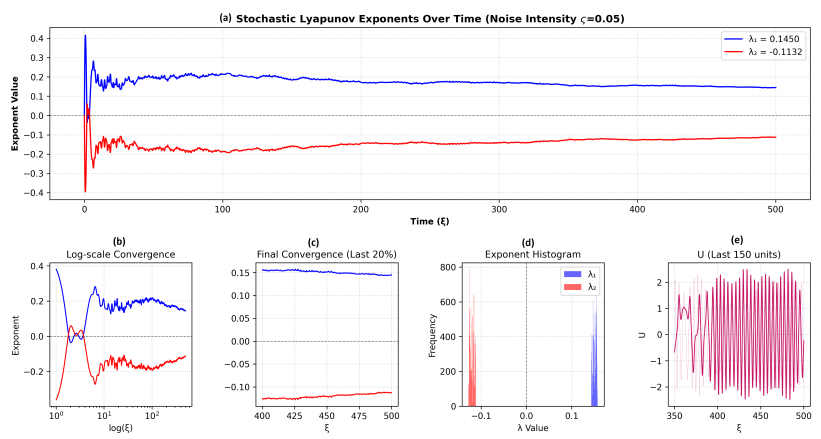
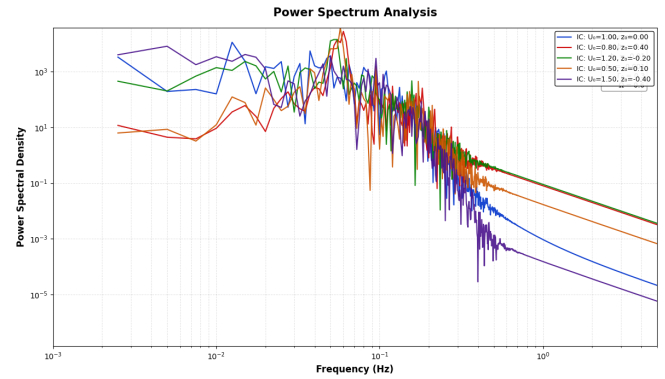
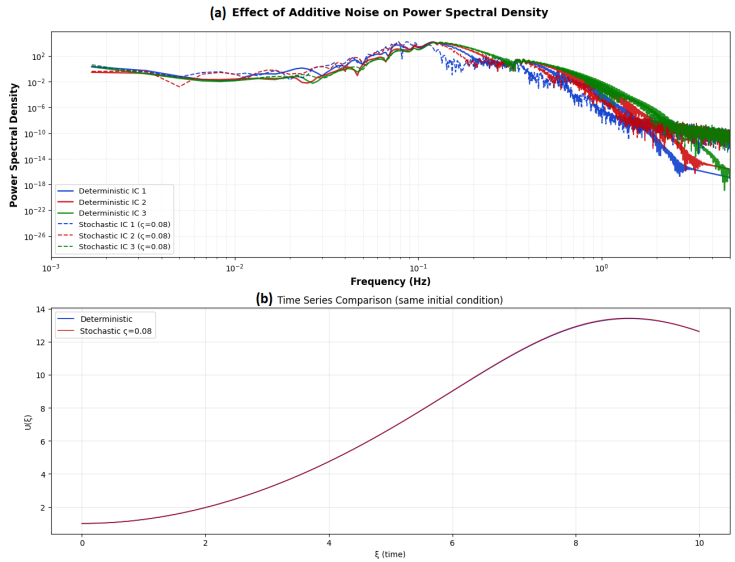
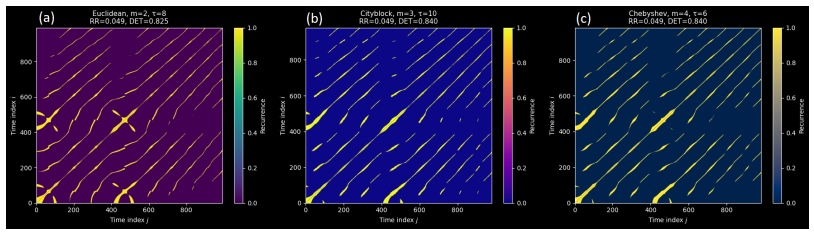
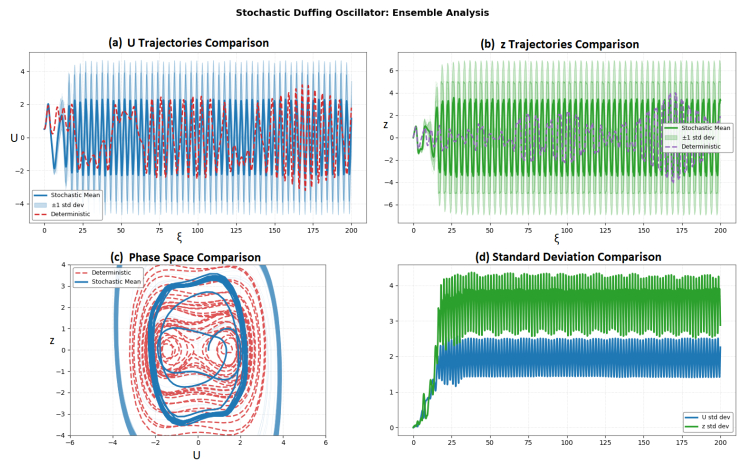
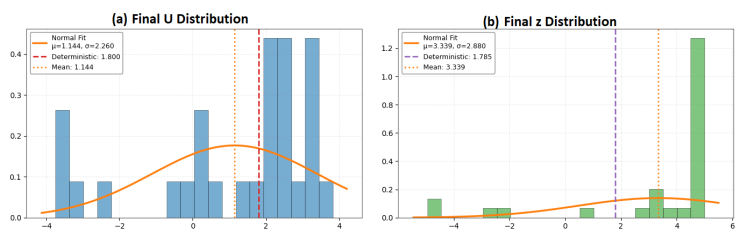
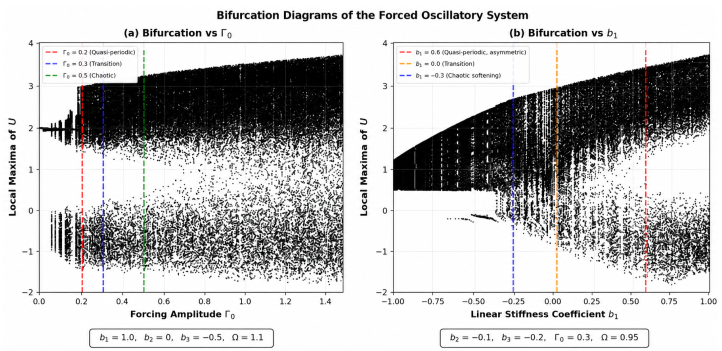
In this paper, a numerical study on the forced Duffing oscillator is performed, where its deterministic, stochastic, and fractional order dynamics are systematically investigated. Starting from the derivation of a planar dynamical system from a space-time fractional nonlinear model, it extends the formulation to include periodic forcing and Gaussian white noise to treat nonlinearity, external excitation, and uncertainty in a unified way. With the aid of the equilibrium manifold analysis, we find a rich structure of bifurcation points involving pitchfork and saddle-node bifurcations, which give rise to the global stability landscape from which we proceed to study the dynamics of the model. Three-dimensional phase space representations initial-condition dependence plots, and Poincaré section plots are used to show a hierarchy of regimes, including periodic, quasi-periodic, and deterministic chaos, with fractal sensitivity boundaries verifying sensitive dependence on initial conditions. Testing with surrogate data chaotic dynamics), positive Lyapunov exponents ($\lambda_1 \approx 0.1018$), and recurrence quantification analysis (DET $> 0.87$) further verifies the authenticity of the chaotic dynamics observed. The Fokker-Planck formalism offers a statistical view of the dynamics of noisy systems, showing how noise intensity affects stationary probability distributions and effective potential landscapes and how noise intensity affects the nature of the dynamics can be captured by power spectral analysis in the frequency domain. The results of the stochastic ensemble analysis show that moderate noise preserves chaotic signatures and gives rise to predictable statistical broadening, leading to final-state distributions that tend to normality following the central limit theorem. The conformable fractional-order extension ($\beta = 0.75$) shows that memory-dependent damping deforms the toroidal invariant sets in a systematic way over time, as it is able to model a history-dependent behavior that cannot be modeled using a classical integer-order model. A systematic bifurcation analysis is also presented to validate the choice of representative parameter values for the whole study, thus giving a parameter-dependent perspective of the transition between dynamical regimes.
Citation: Samina Samina, Maham Munawar, Adil Jhangeer, Mudassar Imran. Integrated diagnostic and visualization framework for characterizing nonlinear and chaotic oscillator dynamics[J]. AIMS Mathematics, 2026, 11(10): 33860-33910. doi: 10.3934/math.20261323
In this paper, a numerical study on the forced Duffing oscillator is performed, where its deterministic, stochastic, and fractional order dynamics are systematically investigated. Starting from the derivation of a planar dynamical system from a space-time fractional nonlinear model, it extends the formulation to include periodic forcing and Gaussian white noise to treat nonlinearity, external excitation, and uncertainty in a unified way. With the aid of the equilibrium manifold analysis, we find a rich structure of bifurcation points involving pitchfork and saddle-node bifurcations, which give rise to the global stability landscape from which we proceed to study the dynamics of the model. Three-dimensional phase space representations initial-condition dependence plots, and Poincaré section plots are used to show a hierarchy of regimes, including periodic, quasi-periodic, and deterministic chaos, with fractal sensitivity boundaries verifying sensitive dependence on initial conditions. Testing with surrogate data chaotic dynamics), positive Lyapunov exponents ($\lambda_1 \approx 0.1018$), and recurrence quantification analysis (DET $> 0.87$) further verifies the authenticity of the chaotic dynamics observed. The Fokker-Planck formalism offers a statistical view of the dynamics of noisy systems, showing how noise intensity affects stationary probability distributions and effective potential landscapes and how noise intensity affects the nature of the dynamics can be captured by power spectral analysis in the frequency domain. The results of the stochastic ensemble analysis show that moderate noise preserves chaotic signatures and gives rise to predictable statistical broadening, leading to final-state distributions that tend to normality following the central limit theorem. The conformable fractional-order extension ($\beta = 0.75$) shows that memory-dependent damping deforms the toroidal invariant sets in a systematic way over time, as it is able to model a history-dependent behavior that cannot be modeled using a classical integer-order model. A systematic bifurcation analysis is also presented to validate the choice of representative parameter values for the whole study, thus giving a parameter-dependent perspective of the transition between dynamical regimes.

| [1] |
A. Atangana, A. Secer, A note on fractional order derivatives and table of fractional derivatives of some special functions, Abstr. Appl. Anal., 2013 (2013), 279681. https://doi.org/10.1155/2013/279681 doi: 10.1155/2013/279681

|
| [2] |
X. J. Yang, J. A. Tenreiro Machado, J. Hristov, Nonlinear dynamics for local fractional Burgers' equation arising in fractal flow, Nonlinear Dyn., 84 (2016), 3–7. https://doi.org/10.1007/s11071-015-2085-2 doi: 10.1007/s11071-015-2085-2
|
| [3] |
C. Park, M. M. Khater, R. A. Attia, W. Alharbi, S. S. Alodhaibi, An explicit plethora of solution for the fractional nonlinear model of the low-pass electrical transmission lines via Atangana–Baleanu derivative operator, Alex. Eng. J., 59 (2020), 1205–1214. https://doi.org/10.1016/j.aej.2020.01.044 doi: 10.1016/j.aej.2020.01.044
|
| [4] |
S. A. El-Wakil, E. M. Abulwafa, Formulation and solution of space–time fractional Boussinesq equation, Nonlinear Dyn., 80 (2015), 167–175. https://doi.org/10.1007/s11071-014-1858-3 doi: 10.1007/s11071-014-1858-3
|
| [5] |
G. S. Teodoro, J. T. Machado, E. C. de Oliveira, A review of definitions of fractional derivatives and other operators, J. Comput. Phys., 388 (2019), 195–208. https://doi.org/10.1016/j.jcp.2019.03.008 doi: 10.1016/j.jcp.2019.03.008
|
| [6] |
H. Yepez-Martinez, J. F. Gómez-Aguilar, Optical solitons solution of resonance NLS type equation with Atangana's-conformable derivative using sub-equation method, Waves Random Complex Media, 31 (2021), 573–596. https://doi.org/10.1080/17455030.2019.1603413 doi: 10.1080/17455030.2019.1603413
|
| [7] | V. V. Uchaikin, Fractional derivatives for physicists and engineers, Berlin, Heidelberg: Springer, 2013. https://doi.org/10.1007/978-3-642-33911-0 |
| [8] |
D. Zhao, M. Luo, General conformable fractional derivative and its physical interpretation, Calcolo, 54 (2017), 903–917. https://doi.org/10.1007/s10092-017-0213-8 doi: 10.1007/s10092-017-0213-8
|
| [9] |
M. S. Osman, H. Rezazadeh, M. Eslami, Traveling wave solutions for (3+1) dimensional conformable fractional Zakharov–Kuznetsov equation with power law nonlinearity, Nonlinear Eng., 8 (2019), 559–567. https://doi.org/10.1515/nleng-2018-0163 doi: 10.1515/nleng-2018-0163
|
| [10] |
D. Kumar, G. C. Paul, J. Mondal, A. S. Islam, On the propagation of alphabetic-shaped solitons to the (2+1)-dimensional fractional electrical transmission line model with wave obliqueness, Results Phys., 19 (2020), 103641. https://doi.org/10.1016/j.rinp.2020.103641 doi: 10.1016/j.rinp.2020.103641
|
| [11] |
H. Qu, Z. She, X. Liu, Homotopy analysis method for three types of fractional partial differential equations, Complexity, 2020 (2020), 7232907. https://doi.org/10.1155/2020/7232907 doi: 10.1155/2020/7232907
|
| [12] |
J. G. Liu, X. J. Yang, Y. Y. Feng, P. Cui, On the (N+1)-dimensional local fractional reduced differential transform method and its applications, Math. Methods Appl. Sci., 43 (2020), 8856–8866. https://doi.org/10.1002/mma.6577 doi: 10.1002/mma.6577
|
| [13] |
W. Li, Y. Pang, Application of Adomian decomposition method to nonlinear systems, Adv. Differ. Equ., 2020 (2020), 67. https://doi.org/10.1186/s13662-020-2529-y doi: 10.1186/s13662-020-2529-y
|
| [14] |
M. Mirzazadeh, M. Eslami, A. Biswas, Soliton solutions of the generalized Klein–Gordon equation by using $\left(G'/G\right)$-expansion method, Comput. Appl. Math., 33 (2014), 831–839. https://doi.org/10.1007/s40314-013-0098-3 doi: 10.1007/s40314-013-0098-3
|
| [15] | K. Ayub, M. Y. Khan, Q. M. U. Hassan, F. Yasmeen, M. Saleem, M. Mansoor, On an efficient technique to solve nonlinear fractional order partial differential equations, J. Sci. Arts, 18 (2018), 565–572. |
| [16] |
N. Savaissou, B. Gambo, H. Rezazadeh, A. Bekir, S. Y. Doka, Exact optical solitons to the perturbed NLS equation with dual-power law of nonlinearity, Opt. Quantum Electron., 52 (2020), 318. https://doi.org/10.1007/s11082-020-02412-7 doi: 10.1007/s11082-020-02412-7
|
| [17] |
D. Kumar, A. R. Seadawy, M. R. Haque, Multiple soliton solutions of the nonlinear partial differential equations describing the wave propagation in nonlinear low-pass electrical transmission lines, Chaos Solitons Fractals, 115 (2018), 62–76. https://doi.org/10.1016/j.chaos.2018.08.016 doi: 10.1016/j.chaos.2018.08.016
|
| [18] |
D. Kumar, G. C. Paul, T. Biswas, A. R. Seadawy, R. Baowali, M. Kamal, et al., Optical solutions to the Kundu-Mukherjee-Naskar equation: Mathematical and graphical analysis with oblique wave propagation, Phys. Scr., 96 (2021), 025218. https://doi.org/10.1088/1402-4896/abd201 doi: 10.1088/1402-4896/abd201
|
| [19] |
S. T. Mohyud-Din, S. Bibi, Exact solutions for nonlinear fractional differential equations using $\left(G'/G^2\right)$-expansion method, Alex. Eng. J., 57 (2018), 1003–1008. https://doi.org/10.1016/j.aej.2017.01.035 doi: 10.1016/j.aej.2017.01.035
|
| [20] |
O. A. Arqub, M. Al-Smadi, H. Almusawa, D. Baleanu, T. Hayat, M. Alhodaly, et al., A novel analytical algorithm for generalized fifth-order time-fractional nonlinear evolution equations with conformable time derivative arising in shallow water waves, Alex. Eng. J., 61 (2022), 5753–5769. https://doi.org/10.1016/j.aej.2021.12.044 doi: 10.1016/j.aej.2021.12.044
|
| [21] |
E. M. Zayed, A. G. Al-Nowehy, M. E. M. Elshater, New $\phi^6$-model expansion method and its applications to the resonant NLS equation with parabolic law nonlinearity, Eur. Phys. J. Plus, 133 (2018), 417. https://doi.org/10.1140/epjp/i2018-12288-2 doi: 10.1140/epjp/i2018-12288-2
|
| [22] |
H. Almusawa, M. Nur Alam, M. Fayz-Al-Asad, M. S. Osman, New soliton configurations for two different models related to the NLS equation through a graded-index waveguide, AIP Adv., 11 (2021), 065320. https://doi.org/10.1063/5.0053565 doi: 10.1063/5.0053565
|
| [23] |
S. Malik, H. Almusawa, S. Kumar, A. M. Wazwaz, M. S. Osman, A (2+1)-dimensional Kadomtsev–Petviashvili equation with competing dispersion effect: Painlevé analysis, dynamical behavior and invariant solutions, Results Phys., 23 (2021), 104043. https://doi.org/10.1016/j.rinp.2021.104043 doi: 10.1016/j.rinp.2021.104043
|
| [24] |
S. Samina, M. Munawar, A. R. Ansari, A. Jhangeer, S. Wali, Nonlinear optical dynamics and complex wave structures in nonlinear dispersive media, Sci. Rep., 15 (2025), 15562. https://doi.org/10.1038/s41598-025-00100-8 doi: 10.1038/s41598-025-00100-8
|
| [25] |
A. Jhangeer, M. Munawar, M. Imran, A. A. Kader, Chaotic demonstration of the twin-core couplers with Kerr law non linearity employing beta derivative, Partial Differ. Equ. Appl. Math., 14 (2025), 101197. https://doi.org/10.1016/j.padiff.2025.101197 doi: 10.1016/j.padiff.2025.101197
|
| [26] |
H. Almusawa, A. Jhangeer, M. Munawar, Analytical analyses for a fractional low-pass electrical transmission line model with dynamic transition, Symmetry, 14 (2022), 1377. https://doi.org/10.3390/sym14071377 doi: 10.3390/sym14071377
|
| [27] |
Z. Wan, Y. F. Pu, Y. Liu, Q. Lai, Z. Yang, State-based nonlinear mapping method for constructing conservative oscillator generating cellular chaotic sea with hardware implementation, Chaos Solitons Fractals, 211 (2026), 118789. https://doi.org/10.1016/j.chaos.2026.118789 doi: 10.1016/j.chaos.2026.118789
|
| [28] |
L. Minati, V. R. F. Signing, L. K. Kengne, M. Zhao, P. A. Valdes-Sosa, H. Ito, et al., A three-dimensional non-autonomous conservative chaotic system based on cross-phase-coupled oscillators: theoretical analysis and electronic realization, Chaos Solitons Fractals, 200 (2025), 116877. https://doi.org/10.1016/j.chaos.2025.116877 doi: 10.1016/j.chaos.2025.116877
|
| [29] |
Y. Guang, Y. Zhang, Q. Ding, A multi -dimensional controllable multi -scroll conservative chaotic system with lightweight and high-throughput circuit implementation, Nonlinear Dyn., 113 (2025), 25219–25242. https://doi.org/10.1007/s11071-025-11413-8 doi: 10.1007/s11071-025-11413-8
|
| [30] |
P. Holmes, A nonlinear oscillator with a strange attractor, Phil. Trans. R. Soc. A, 292 (1979), 419–448. https://doi.org/10.1098/rsta.1979.0068 doi: 10.1098/rsta.1979.0068
|
| [31] |
F. C. Moon, P. J. Holmes, A magnetoelastic strange attractor, J. Sound Vib., 65 (1979), 275–296. https://doi.org/10.1016/0022-460X(79)90520-0 doi: 10.1016/0022-460X(79)90520-0
|
| [32] |
A. Wolf, J. B. Swift, H. L. Swinney, J. A. Vastano, Determining Lyapunov exponents from a time series, Physica D, 16 (1985), 285–317. https://doi.org/10.1016/0167-2789(85)90011-9 doi: 10.1016/0167-2789(85)90011-9
|
| [33] |
U. Parlitz, W. Lauterborn, Period-doubling cascades and devil's staircases of the driven van der Pol oscillator, Phys. Rev. A, 36 (1987), 1428–1434. https://doi.org/10.1103/PhysRevA.36.1428 doi: 10.1103/PhysRevA.36.1428
|
| [34] |
L. Gammaitoni, P. Hänggi, P. Jung, F. Marchesoni, Stochastic resonance, Rev. Mod. Phys., 70 (1998), 223–287. https://doi.org/10.1103/RevModPhys.70.223 doi: 10.1103/RevModPhys.70.223
|
| [35] |
H. Ma, Z. Liu, Y. Sun, J. Qi, Bifurcation and chaotic behaviors in nonlinear fractional electrical transmission line: solitons, 3D frameworks, and algorithmic advances, AIP Adv., 15 (2025), 075313. https://doi.org/10.1063/5.0281889 doi: 10.1063/5.0281889
|
| [36] |
Y. Ueda, Randomly transitional phenomena in the system governed by Duffing's equation, J. Stat. Phys., 20 (1979), 181–196. https://doi.org/10.1007/BF01011512 doi: 10.1007/BF01011512
|
| [37] | J. Guckenheimer, P. Holmes, Nonlinear oscillations, dynamical systems, and bifurcations of vector fields, New York: Springer, 1983. https://doi.org/10.1007/978-1-4612-1140-2 |
| [38] | T. S. Parker, L. O. Chua, Practical numerical algorithms for chaotic systems, New York: Springer, 1989. https://doi.org/10.1007/978-1-4612-3486-9 |
| [39] |
R. Hegger, H. Kantz, T. Schreiber, Practical implementation of nonlinear time series methods: the TISEAN package, Chaos, 9 (1999), 413–435. https://doi.org/10.1063/1.166424 doi: 10.1063/1.166424
|
| [40] | F. Moss, P. V. McClintock, Noise in nonlinear dynamical systems, Cambridge: Cambridge University Press, 1989. https://doi.org/10.1017/CBO9780511897832.002 |
| [41] |
A. Zakharova, T. Vadivasova, V. Anishchenko, A. Koseska, J. Kurths, Stochastic bifurcations and coherencelike resonance in a self-sustained bistable noisy oscillator, Phys. Rev. E, 81 (2010), 011106. https://doi.org/10.1103/PhysRevE.81.011106 doi: 10.1103/PhysRevE.81.011106
|
| [42] |
V. S. Anishchenko, M. V. Anufrieva, T. E. Vadivasova, Stochastic resonance in a bistable system driven by a chaotic signal, Tech. Phys. Lett., 32 (2006), 873–875. https://doi.org/10.1134/S1063785006100178 doi: 10.1134/S1063785006100178
|
| [43] | I. Podlubny, Fractional differential equations: An introduction to fractional derivatives, fractional differential equations, to methods of their solution and some of their applications, San Diego: Academic Press, 1998. |
| [44] |
J. T. Machado, V. Kiryakova, F. Mainardi, Recent history of fractional calculus, Commun. Nonlinear Sci. Numer. Simul., 16 (2011), 1140–1153. https://doi.org/10.1016/j.cnsns.2010.05.027 doi: 10.1016/j.cnsns.2010.05.027
|
| [45] |
X. J. Yang, H. M. Srivastava, J. T. Machado, A new fractional derivative without singular kernel: Application to the modelling of the steady heat flow, Therm. Sci., 20 (2016), 753–756. https://doi.org/10.2298/TSCI151224222Y doi: 10.2298/TSCI151224222Y
|
| [46] |
E. M. Almetwally, M. A. Zayed, S. I. Abo-Hashem, R. Sadat, S. M. Mabrouk, A. S. Rashed, Analytical investigation of soliton propagation in conformable fractional-order transmission line metamaterials, Sci. Rep., 16 (2026), 6335. https://doi.org/10.1038/s41598-025-31060-8 doi: 10.1038/s41598-025-31060-8
|
| [47] |
D. Chou, I. Iqbal, H. U. Rehman, H. Ahmad, T. Radwan, Dynamics of low-pass electrical transmission lines: Lie symmetries, solitons, bifurcations, and modulation instability, J. Nonlinear Math. Phys., 33 (2026), 5. https://doi.org/10.1007/s44198-025-00356-8 doi: 10.1007/s44198-025-00356-8
|
| [48] |
R. Khalil, M. Al Horani, A. Yousef, M. Sababheh, A new definition of fractional derivative, J. Comput. Appl. Math., 264 (2014), 65–70. https://doi.org/10.1016/j.cam.2014.01.002 doi: 10.1016/j.cam.2014.01.002
|
| [49] | A. H. Nayfeh, B. Balachandran, Applied nonlinear dynamics: Analytical, computational, and experimental methods, New York: Wiley, 1995. https://doi.org/10.1002/9783527617548 |
| [50] |
A. Jhangeer, A. Abdelkader, Noise-induced transitions in nonlinear oscillators: from quasi-periodic stability to stochastic chaos, Fractal Fract., 9 (2025), 550. https://doi.org/10.3390/fractalfract9080550 doi: 10.3390/fractalfract9080550
|
| [51] |
L. Petzold, Automatic selection of methods for solving stiff and nonstiff systems of ODEs, SIAM J. Sci. Stat. Comput., 4 (1983), 136–148. https://doi.org/10.1137/0904010 doi: 10.1137/0904010
|
| [52] | P. E. Kloeden, E. Platen, Numerical solution of stochastic differential equations, Berlin, Heidelberg: Springer, 1992. https://doi.org/10.1007/978-3-662-12616-5 |
| [53] |
G. Benettin, L. Galgani, A. Giorgilli, J. M. Strelcyn, Lyapunov characteristic exponents for smooth dynamical systems and for Hamiltonian systems; a method for computing all of them. Part 1: Theory, Meccanica, 15 (1980), 9–20. https://doi.org/10.1007/BF02128236 doi: 10.1007/BF02128236
|
| [54] | T. Sauer, Numerical solution of stochastic differential equations in finance, In: Handbook of computational finance, Berlin, Heidelberg: Springer, 2012,529–550. https://doi.org/10.1007/978-3-642-17254-0_19 |
| [55] |
P. Welch, The use of fast Fourier transform for the estimation of power spectra: a method based on time averaging over short, modified periodograms, IEEE Trans. Audio Electroacoust., 15 (1967), 70–73. https://doi.org/10.1109/TAU.1967.1161901 doi: 10.1109/TAU.1967.1161901
|
| [56] |
M. B. Kennel, R. Brown, H. D. Abarbanel, Determining embedding dimension for phase-space reconstruction using a geometrical construction, Phys. Rev. A, 45 (1992), 3403–3411. https://doi.org/10.1103/PhysRevA.45.3403 doi: 10.1103/PhysRevA.45.3403
|
| [57] |
A. M. Fraser, H. L. Swinney, Independent coordinates for strange attractors from mutual information, Phys. Rev. A, 33 (1986), 1134–1140. https://doi.org/10.1103/PhysRevA.33.1134 doi: 10.1103/PhysRevA.33.1134
|
| [58] |
N. Marwan, M. C. Romano, M. Thiel, J. Kurths, Recurrence plots for the analysis of complex systems, Phys. Rep., 438 (2007), 237–329. https://doi.org/10.1016/j.physrep.2006.11.001 doi: 10.1016/j.physrep.2006.11.001
|
| [59] |
S. Lloyd, Least squares quantization in PCM, IEEE Trans. Inf. Theory, 28 (1982), 129–137. https://doi.org/10.1109/TIT.1982.1056489 doi: 10.1109/TIT.1982.1056489
|
Figures(21) / Tables(2)

Samina Samina, Maham Munawar, Adil Jhangeer, Mudassar Imran. Integrated diagnostic and visualization framework for characterizing nonlinear and chaotic oscillator dynamics[J]. AIMS Mathematics, 2026, 11(10): 33860-33910. doi: 10.3934/math.20261323





 DownLoad: