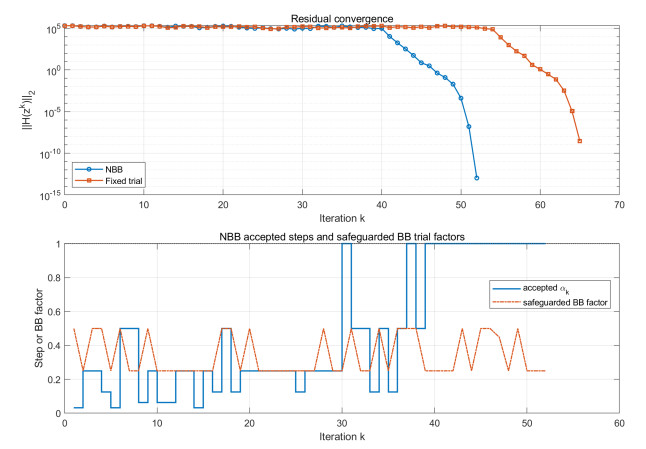
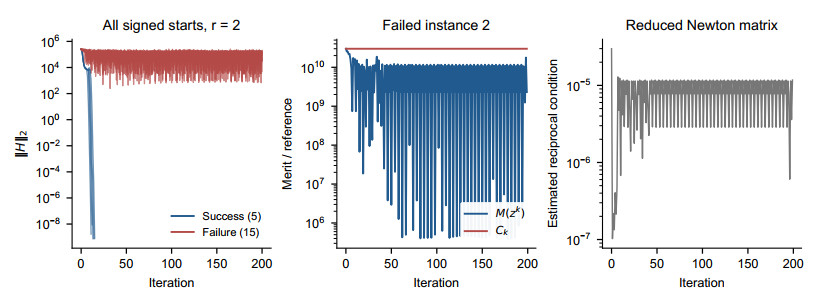
We developed a nonmonotone smoothing Newton method for weighted complementarity problems (WCPs) in $ \mathbb{R}^n $. After full-step rejection, a safeguarded Barzilai–Borwein (BB) factor with step-length memory initialized backtracking. Under the structural rank–monotonicity condition and a bounded initial level set, we proved that the residual tends to zero, and every accumulation point solves the WCP; uniqueness gives whole-sequence convergence. Nonsingularity of every matrix in the generalized Jacobian at an accumulation point, together with a locally Lipschitz derivative of the original equation block, yielded quadratic convergence and eventual full-step acceptance. For symmetric positive-definite linear problems, we verified level-set boundedness, uniqueness, and local regularity without strict complementarity. On 150 paired nonconvex instances, rejected-trial counts were significantly lower than those of a one-step comparator in five of six settings after Holm correction, whereas iteration-count differences were not significant. An ablation study supported the BB initializer's benefit without establishing a general timing or success-rate advantage. Further tests included an independent recent one-step comparator, monotone linear tests, sparse positive-weight problems with up to 102400 complementarity pairs, and three zero-weight partial differential equation (PDE) benchmarks with grid-refinement and independent reference checks. On nonconvex tests, success depends on the fixed complementarity parameter and initialization; failures at larger parameter values persist from the original signed starts. Some signed-start Bratu failures persisted under a larger budget. These results support reduced post-rejection line-search work, not uniform robustness across problem classes.
Citation: Teng Wu, Xiangjing Liu. A safeguarded nonmonotone Barzilai–Borwein smoothing Newton method for weighted complementarity problems: convergence analysis and numerical validation[J]. AIMS Mathematics, 2026, 11(10): 33673-33726. doi: 10.3934/math.20261317
We developed a nonmonotone smoothing Newton method for weighted complementarity problems (WCPs) in $ \mathbb{R}^n $. After full-step rejection, a safeguarded Barzilai–Borwein (BB) factor with step-length memory initialized backtracking. Under the structural rank–monotonicity condition and a bounded initial level set, we proved that the residual tends to zero, and every accumulation point solves the WCP; uniqueness gives whole-sequence convergence. Nonsingularity of every matrix in the generalized Jacobian at an accumulation point, together with a locally Lipschitz derivative of the original equation block, yielded quadratic convergence and eventual full-step acceptance. For symmetric positive-definite linear problems, we verified level-set boundedness, uniqueness, and local regularity without strict complementarity. On 150 paired nonconvex instances, rejected-trial counts were significantly lower than those of a one-step comparator in five of six settings after Holm correction, whereas iteration-count differences were not significant. An ablation study supported the BB initializer's benefit without establishing a general timing or success-rate advantage. Further tests included an independent recent one-step comparator, monotone linear tests, sparse positive-weight problems with up to 102400 complementarity pairs, and three zero-weight partial differential equation (PDE) benchmarks with grid-refinement and independent reference checks. On nonconvex tests, success depends on the fixed complementarity parameter and initialization; failures at larger parameter values persist from the original signed starts. Some signed-start Bratu failures persisted under a larger budget. These results support reduced post-rejection line-search work, not uniform robustness across problem classes.

| [1] |
F. A. Potra, Weighted complementarity problems–a new paradigm for computing equilibria, SIAM J. Optim., 22 (2012), 1634–1654. https://doi.org/10.1137/110837310 doi: 10.1137/110837310

|
| [2] |
S. Asadi, Z. Darvay, G. Lesaja, N. Mahdavi-Amiri, F. A. Potra, A full-Newton step interior-point method for monotone weighted linear complementarity problems, J. Optim. Theory Appl., 186 (2020), 864–878. https://doi.org/10.1007/s10957-020-01728-4 doi: 10.1007/s10957-020-01728-4
|
| [3] |
X. N. Chi, Z. P. Wan, Z. J. Hao, A full-modified-Newton step $O(n)$ infeasible interior-point method for the special weighted linear complementarity problem, J. Ind. Manag. Optim., 18 (2022), 2579–2598. https://doi.org/10.3934/jimo.2021082 doi: 10.3934/jimo.2021082
|
| [4] |
X. N. Chi, G. Q. Wang, A full-Newton step infeasible interior-point method for the special weighted linear complementarity problem, J. Optim. Theory Appl., 190 (2021), 108–129. https://doi.org/10.1007/s10957-021-01873-4 doi: 10.1007/s10957-021-01873-4
|
| [5] |
L. Qi, D. Sun, G. Zhou, A new look at smoothing Newton methods for nonlinear complementarity problems and box constrained variational inequalities, Math. Program., 87 (2000), 1–35. https://doi.org/10.1007/s101079900127 doi: 10.1007/s101079900127
|
| [6] |
J. Zhang, A smoothing Newton algorithm for weighted linear complementarity problem, Optim. Lett., 10 (2016), 499–509. https://doi.org/10.1007/s11590-015-0877-4 doi: 10.1007/s11590-015-0877-4
|
| [7] |
J. Y. Tang, A variant nonmonotone smoothing algorithm with improved numerical results for large-scale LWCPs, Comput. Appl. Math., 37 (2018), 3927–3936. https://doi.org/10.1007/s40314-017-0554-6 doi: 10.1007/s40314-017-0554-6
|
| [8] |
J. Tang, L. Dong, J. Zhou, L. Fang, A smoothing Newton method for nonlinear complementarity problems, Comput. Appl. Math., 32 (2013), 107–118. https://doi.org/10.1007/s40314-013-0015-9 doi: 10.1007/s40314-013-0015-9
|
| [9] |
J. Tang, H. Zhang, A nonmonotone smoothing Newton algorithm for weighted complementarity problem, J. Optim. Theory Appl., 189 (2021), 679–715. https://doi.org/10.1007/s10957-021-01839-6 doi: 10.1007/s10957-021-01839-6
|
| [10] |
J. Tang, J. Zhou, H. Zhang, An accelerated smoothing Newton method with cubic convergence for weighted complementarity problems, J. Optim. Theory Appl., 196 (2023), 641–665. https://doi.org/10.1007/s10957-022-02152-6 doi: 10.1007/s10957-022-02152-6
|
| [11] |
J. Tang, J. Zhou, The solvability of weighted complementarity problems and a smoothing Newton algorithm under the local error bound, Optimization, 74 (2025), 811–841. https://doi.org/10.1080/02331934.2023.2269943 doi: 10.1080/02331934.2023.2269943
|
| [12] | X. Liu, J. Zhang, J. Chen, A modified smoothing Newton method for solving weighted complementarity problems with a nonmonotone line search, Eng. Lett., 31 (2023), 1684–1690. |
| [13] |
J. Barzilai, J. M. Borwein, Two-point step size gradient methods, IMA J. Numer. Anal., 8 (1988), 141–148. https://doi.org/10.1093/imanum/8.1.141 doi: 10.1093/imanum/8.1.141
|
| [14] |
Y. H. Dai, A new analysis on the Barzilai–Borwein gradient method, J. Oper. Res. Soc. China, 1 (2013), 187–198. https://doi.org/10.1007/s40305-013-0007-x doi: 10.1007/s40305-013-0007-x
|
| [15] |
H. He, D. Han, Z. Li, Some projection methods with the BB step sizes for variational inequalities, J. Comput. Appl. Math., 236 (2012), 2590–2604. https://doi.org/10.1016/j.cam.2011.12.017 doi: 10.1016/j.cam.2011.12.017
|
| [16] |
Y. Zheng, B. Zheng, A new modified Barzilai–Borwein gradient method for the quadratic minimization problem, J. Optim. Theory Appl., 172 (2017), 179–186. https://doi.org/10.1007/s10957-016-1008-9 doi: 10.1007/s10957-016-1008-9
|
| [17] |
X. Li, Smoothing nonmonotone Barzilai–Borwein gradient method and its application to stochastic linear complementarity problems, Math. Probl. Eng., 2015 (2015), 425351. https://doi.org/10.1155/2015/425351 doi: 10.1155/2015/425351
|
| [18] |
K. Ma, J. Zeng, J. Xiong, Q. Xu, X. Cao, W. Liu, et al., Stochastic non-convex ordinal embedding with stabilized Barzilai–Borwein step size, Proceedings of the Thirty-Second AAAI Conference on Artificial Intelligence, 2018, 3738–3745. https://doi.org/10.1609/aaai.v32i1.11599 doi: 10.1609/aaai.v32i1.11599
|
| [19] |
J. Chen, L. Tang, X. Yang, A Barzilai–Borwein descent method for multiobjective optimization problems, Eur. J. Oper. Res., 311 (2023), 196–209. https://doi.org/10.1016/j.ejor.2023.04.022 doi: 10.1016/j.ejor.2023.04.022
|
| [20] |
X. Xu, A parameterized Barzilai–Borwein method via interpolated least squares, J. Ind. Manag. Optim., 21 (2025), 6246–6269. https://doi.org/10.3934/jimo.2025130 doi: 10.3934/jimo.2025130
|
| [21] |
L. Qi, J. Sun, A nonsmooth version of Newton's method, Math. Program., 58 (1993), 353–367. https://doi.org/10.1007/BF01581275 doi: 10.1007/BF01581275
|
| [22] |
L. Qi, Convergence analysis of some algorithms for solving nonsmooth equations, Math. Oper. Res., 18 (1993), 227–244. https://doi.org/10.1287/moor.18.1.227 doi: 10.1287/moor.18.1.227
|
| [23] | W. J. Conover, Practical Nonparametric Statistics, 3 Eds., Wiley, 1999. |
| [24] |
R. L. Wasserstein, N. A. Lazar, The ASA statement on $p$-values: context, process, and purpose, Am. Stat., 70 (2016), 129–133. https://doi.org/10.1080/00031305.2016.1154108 doi: 10.1080/00031305.2016.1154108
|
| [25] | S. Holm, A simple sequentially rejective multiple test procedure, Scand. J. Stat., 6 (1979), 65–70. |
| [26] | G. Duvaut, J. L. Lions, Inequalities in mechanics and physics, Springer, 1976. https://doi.org/10.1007/978-3-642-66165-5 |
| [27] | J. F. Rodrigues, Obstacle problems in mathematical physics, North-Holland Mathematics Studies, 1987. https://doi.org/10.1016/S0304-0208(08)X7010-0 |
| [28] | R. Glowinski, J. L. Lions, R. Trémolières, Numerical analysis of variational inequalities, North-Holland, 1981. |
| [29] |
G. Bratu, Sur les équations intégrales non linéaires, Bull. Soc. Math. Fr., 42 (1914), 113–142. https://doi.org/10.24033/bsmf.943 doi: 10.24033/bsmf.943
|
| [30] |
D. D. Joseph, T. S. Lundgren, Quasilinear Dirichlet problems driven by positive sources, Arch. Ration. Mech. Anal., 49 (1973), 241–269. https://doi.org/10.1007/BF00250508 doi: 10.1007/BF00250508
|
| [31] |
H. W. Swift, The stability of lubricating films in journal bearings, Minutes Proc. Inst. Civ. Eng., 233 (1932), 267–288. https://doi.org/10.1680/imotp.1932.13239 doi: 10.1680/imotp.1932.13239
|
| [32] | W. Stieber, Das schwimmlager: hydrodynamische theorie des gleitlagers, VDI-Verlag, 1933. |
| [33] |
G. Bayada, M. Chambat, The transition between the Stokes equations and the Reynolds equation: a mathematical proof, Appl. Math. Optim., 14 (1986), 73–93. https://doi.org/10.1007/BF01442229 doi: 10.1007/BF01442229
|
| [34] |
M. Giacopini, M. T. Fowell, D. Dini, A. Strozzi, A mass-conserving complementarity formulation to study lubricant films in the presence of cavitation, J. Tribol., 132 (2010), 041702. https://doi.org/10.1115/1.4002215 doi: 10.1115/1.4002215
|
| [35] |
P. J. Roache, Perspective: a method for uniform reporting of grid refinement studies, J. Fluids Eng., 116 (1994), 405–413. https://doi.org/10.1115/1.2910291 doi: 10.1115/1.2910291
|
| [36] |
M. Muchammad, D. D. P. Wibowo, M. Tauviqirrahman, B. Setiyana, E. Yohana, J. Jamari, Investigation of the influence of turbulence to tribological performance on smooth and multistep journal bearing with hydrodynamics simulation, Front. Mech. Eng., 8 (2022), 946074. https://doi.org/10.3389/fmech.2022.946074 doi: 10.3389/fmech.2022.946074
|
| [37] |
M. Muchammad, M. Tauviqirrahman, Y. M. Rizki, I. Syafaat, F. Maharani, M. I. Ammarullah, Elastohydrodynamic analysis of multistep texture effects and partial surface roughness on the tribological performance of steel journal bearings, Discov. Appl. Sci., 7 (2025), 301. https://doi.org/10.1007/s42452-025-06789-6 doi: 10.1007/s42452-025-06789-6
|
| [38] | The MathWorks, Inc., quadprog: quadratic programming, Optimization toolbox documentation. Available from: https://www.mathworks.com/help/optim/ug/quadprog.html. |
| [39] |
P. Harasim, J. Valdman, Verification of functional a posteriori error estimates for obstacle problem in 2D, Kybernetika, 50 (2014), 978–1002. https://doi.org/10.14736/kyb-2014-6-0978 doi: 10.14736/kyb-2014-6-0978
|
Figures(9) / Tables(19)

Teng Wu, Xiangjing Liu. A safeguarded nonmonotone Barzilai–Borwein smoothing Newton method for weighted complementarity problems: convergence analysis and numerical validation[J]. AIMS Mathematics, 2026, 11(10): 33673-33726. doi: 10.3934/math.20261317





 DownLoad: