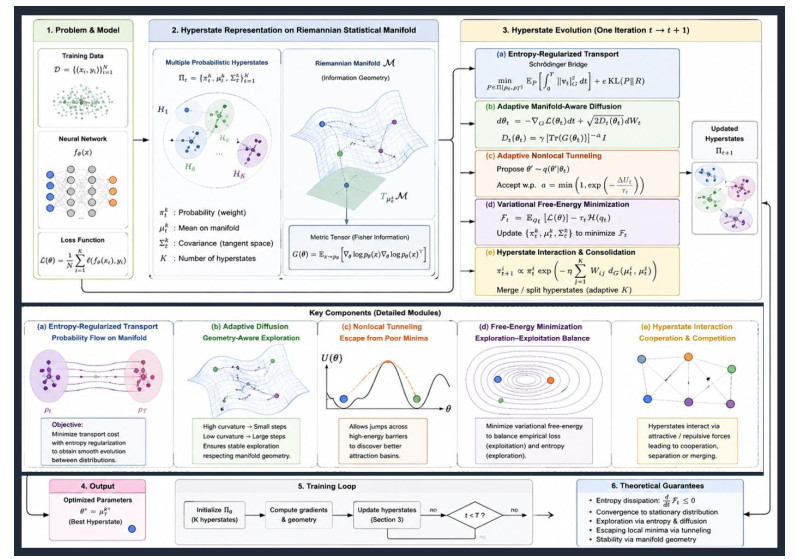
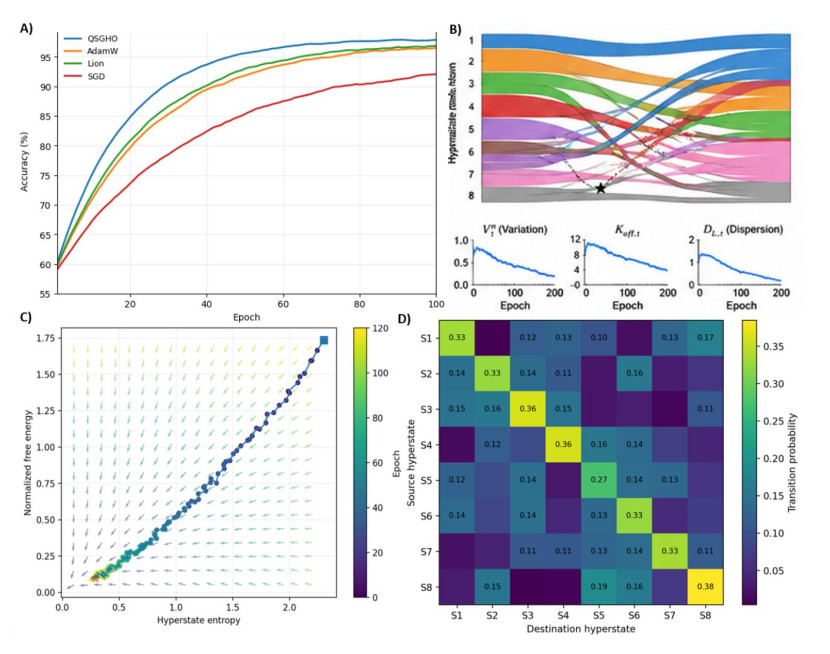
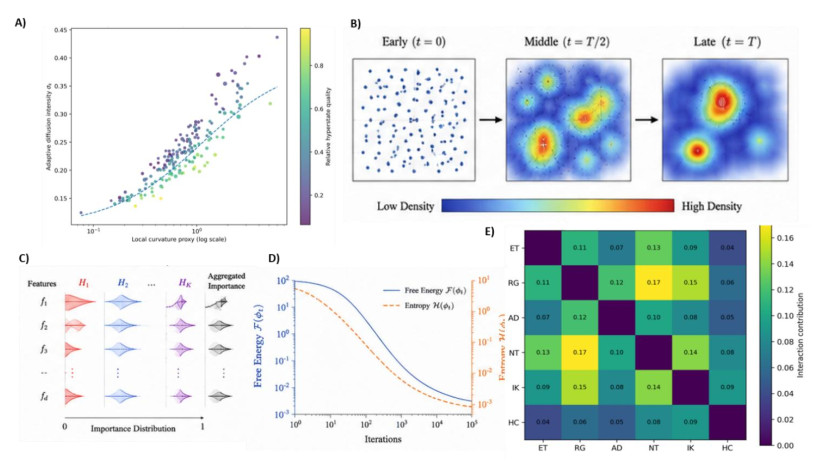
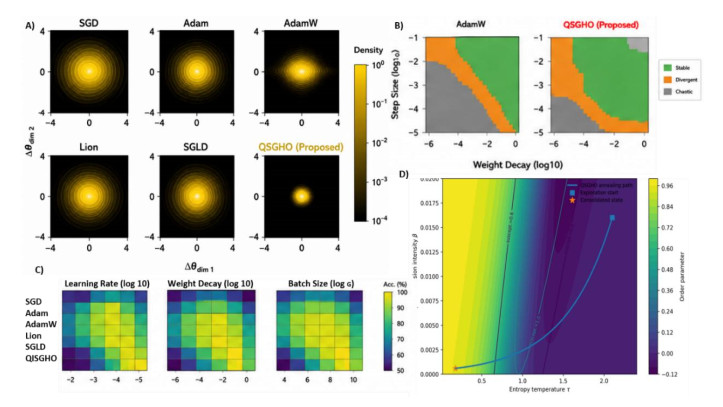
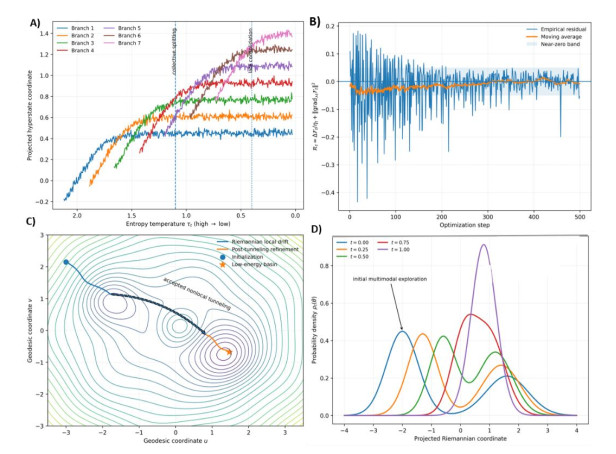
This study investigates an improved quantum-inspired stochastic geometric hyperstate optimization (QISGHO) method for stochastic deep neural optimization, where learning is viewed as the evolution and transport of multiple interacting probabilistic hyperstates on a Riemannian statistical manifold. The proposed optimization framework is based on the general stochastic-geometric hyperstate optimization paradigm, with a more explicit entropy-regularized Riemannian probability-transport mechanism, an interaction potential for hyperstates, geometry and uncertainty-adaptive diffusion, and an acceptance-controlled nonlocal tunneling process with loss barriers, manifold distance, local curvature, probability mass, and annealing temperature. The ensemble also includes a collapse-prevention, consolidation, and rejuvenation mechanism to preserve diversity within a hyperstate. The dynamics of these components are then linked to nonlinear Riemannian Fokker–Planck and nonlocal master-equation descriptions, thereby offering a population-level perspective on stochastic optimization, and are unified by a variational free-energy formulation. The framework establishes a principled balance between global exploration and local exploitation, optimization stability, uncertainty awareness, and geometric consistency. The paired-run experiments compare and contrast the algorithm's predictive performance, calibration, robustness to perturbations, optimization behavior, and computational cost with SGD, Adam, AdamW, Lion, and SGLD on one synthetic benchmark and four public ones. The reported estimates and multiplicity-controlled comparisons suggest the advantages of the full method and its components for the following architectures and computational budgets. While these are robust theoretical findings, the conclusions do not imply global convergence for a generic non-convex neural-network objective under the sum of diffusion, jump, consolidation, and rejuvenation perturbations.
Citation: Mashail M. AL Sobhi, Irsa Sajjad. Entropy-regularized Riemannian hyperstate transport with adaptive nonlocal tunneling for stochastic deep neural optimization[J]. AIMS Mathematics, 2026, 11(10): 33635-33672. doi: 10.3934/math.20261316
This study investigates an improved quantum-inspired stochastic geometric hyperstate optimization (QISGHO) method for stochastic deep neural optimization, where learning is viewed as the evolution and transport of multiple interacting probabilistic hyperstates on a Riemannian statistical manifold. The proposed optimization framework is based on the general stochastic-geometric hyperstate optimization paradigm, with a more explicit entropy-regularized Riemannian probability-transport mechanism, an interaction potential for hyperstates, geometry and uncertainty-adaptive diffusion, and an acceptance-controlled nonlocal tunneling process with loss barriers, manifold distance, local curvature, probability mass, and annealing temperature. The ensemble also includes a collapse-prevention, consolidation, and rejuvenation mechanism to preserve diversity within a hyperstate. The dynamics of these components are then linked to nonlinear Riemannian Fokker–Planck and nonlocal master-equation descriptions, thereby offering a population-level perspective on stochastic optimization, and are unified by a variational free-energy formulation. The framework establishes a principled balance between global exploration and local exploitation, optimization stability, uncertainty awareness, and geometric consistency. The paired-run experiments compare and contrast the algorithm's predictive performance, calibration, robustness to perturbations, optimization behavior, and computational cost with SGD, Adam, AdamW, Lion, and SGLD on one synthetic benchmark and four public ones. The reported estimates and multiplicity-controlled comparisons suggest the advantages of the full method and its components for the following architectures and computational budgets. While these are robust theoretical findings, the conclusions do not imply global convergence for a generic non-convex neural-network objective under the sum of diffusion, jump, consolidation, and rejuvenation perturbations.

| [1] |
Y. LeCun, Y. Bengio, G. Hinton, Deep learning, Nature, 521 (2015), 436–444. https://doi.org/10.1038/nature14539 doi: 10.1038/nature14539

|
| [2] | I. Goodfellow, Y. Bengio, A. Courville, Deep learning, MIT Press, 2016. |
| [3] |
L. Bottou, F. E. Curtis, J. Nocedal, Optimization methods for large-scale machine learning, SIAM Rev., 60 (2018), 223–311. https://doi.org/10.1137/16M1080173 doi: 10.1137/16M1080173
|
| [4] | J. Duchi, E. Hazan, Y. Singer, Adaptive subgradient methods for online learning and stochastic optimization, J. Mach. Learn. Res., 12 (2011), 2121–2159. |
| [5] | D. P. Kingma, J. Ba, Adam: A method for stochastic optimization, In: International conference on learning representations, 2015. |
| [6] | S. J. Reddi, S. Kale, S. Kumar, On the convergence of Adam and beyond, In: Proceedings of the international conference on learning representations, 2018. |
| [7] | I. Loshchilov, F. Hutter, Decoupled weight decay regularization, In: Proceedings of the international conference on learning representations, 2019. |
| [8] | X. Chen, C. Liang, D. Huang, E. Real, K. Wang, H. Pham, et al., Symbolic discovery of optimization algorithms, In: Advances in neural information processing systems, 36 (2023), 49205–49233. |
| [9] | M. Welling, Y. W. Teh, Bayesian learning via stochastic gradient Langevin dynamics, In: Proceedings of the 28th international conference on machine learning, 2011,681–688. |
| [10] | S. Mandt, M. D. Hoffman, D. M. Blei, Stochastic gradient descent as approximate Bayesian inference, J. Mach. Learn. Res., 18 (2017), 1–35. |
| [11] | M. Raginsky, A. Rakhlin, M. Telgarsky, Non-convex learning via stochastic gradient Langevin dynamics: A nonasymptotic analysis, Proc. Mach. Learn. Res., 65 (2017), 1674–1703. |
| [12] |
S. Amari, Natural gradient works efficiently in learning, Neural Comput., 10 (1998), 251–276. https://doi.org/10.1162/089976698300017746 doi: 10.1162/089976698300017746
|
| [13] | J. Martens, New insights and perspectives on the natural gradient method, J. Mach. Learn. Res., 21 (2020), 1–76. |
| [14] |
R. Jordan, D. Kinderlehrer, F. Otto, The variational formulation of the Fokker–Planck equation, SIAM J. Math. Anal., 29 (1998), 1–17. https://doi.org/10.1137/S0036141096303359 doi: 10.1137/S0036141096303359
|
| [15] | M. Cuturi, Sinkhorn distances: Lightspeed computation of optimal transport, In: Advances in neural information processing systems, 26 (2013), 2292–2300. |
| [16] |
G. Peyré, M. Cuturi, Computational optimal transport, Found. Trends Mach. Learn., 11 (2019), 355–607. https://doi.org/10.1561/2200000073 doi: 10.1561/2200000073
|
| [17] |
J. Biamonte, P. Wittek, N. Pancotti, P. Rebentrost, N. Wiebe, S. Lloyd, Quantum machine learning, Nature, 549 (2017), 195–202. https://doi.org/10.1038/nature23474 doi: 10.1038/nature23474
|
| [18] |
M. Cerezo, A. Arrasmith, R. Babbush, S. C. Benjamin, S. Endo, K. Fujii, et al., Variational quantum algorithms, Nat. Rev. Phys., 3 (2021), 625–644. https://doi.org/10.1038/s42254-021-00348-9 doi: 10.1038/s42254-021-00348-9
|
| [19] |
J. Preskill, Quantum computing in the NISQ era and beyond, Quantum, 2 (2018), 79. https://doi.org/10.22331/q-2018-08-06-79 doi: 10.22331/q-2018-08-06-79
|
| [20] |
J. R. McClean, S. Boixo, V. N. Smelyanskiy, R. Babbush, H. Neven, Barren plateaus in quantum neural network training landscapes, Nat. Commun., 9 (2018), 4812. https://doi.org/10.1038/s41467-018-07090-4 doi: 10.1038/s41467-018-07090-4
|
| [21] |
S. Wang, E. Fontana, M. Cerezo, K. Sharma, A. Sone, L. Cincio, et al., Noise-induced barren plateaus in variational quantum algorithms, Nat. Commun., 12 (2021), 6961. https://doi.org/10.1038/s41467-021-27045-6 doi: 10.1038/s41467-021-27045-6
|
| [22] |
A. Abbas, D. Sutter, C. Zoufal, A. Lucchi, A. Figalli, S. Woerner, The power of quantum neural networks, Nat. Comput. Sci., 1 (2021), 403–409. https://doi.org/10.1038/s43588-021-00084-1 doi: 10.1038/s43588-021-00084-1
|
| [23] |
M. Schuld, R. Sweke, J. J. Meyer, Effect of data encoding on the expressive power of variational quantum-machine-learning models, Phys. Rev. A, 103 (2021), 032430. https://doi.org/10.1103/PhysRevA.103.032430 doi: 10.1103/PhysRevA.103.032430
|
| [24] |
H. -Y. Huang, M. Broughton, M. Mohseni, R. Babbush, S. Boixo, H. Neven, et al., Power of data in quantum machine learning, Nat. Commun., 12 (2021), 2631. https://doi.org/10.1038/s41467-021-22539-9 doi: 10.1038/s41467-021-22539-9
|
| [25] |
G. Zhang, Quantum-inspired evolutionary algorithms: A survey and empirical study, J. Heuristics, 17 (2011), 303–351. https://doi.org/10.1007/s10732-010-9136-0 doi: 10.1007/s10732-010-9136-0
|
| [26] |
A. Manju, M. J. Nigam, Applications of quantum-inspired computational intelligence: A survey. Artif. Intell. Rev., 42 (2014), 79–156. https://doi.org/10.1007/s10462-012-9330-6 doi: 10.1007/s10462-012-9330-6
|
| [27] |
I. Sajjad, M. M. Al Sobhi, The quantum-inspired adaptive superposition optimization for neural network training. AIMS Mathematics, 11 (2026), 243–271. https://doi.org/10.3934/math.2026010 doi: 10.3934/math.2026010
|
| [28] |
I. Sajjad, H. M. Alshanbari, M. M. A. Almazah, H. Louati, S. Rauf, Adaptive Grover-driven optimization for quantum-inspired deep learning: A gradient-free training framework, AIMS Mathematics, 10 (2025), 26568–26592. https://doi.org/10.3934/math.20251168 doi: 10.3934/math.20251168
|
| [29] | C. Villani, Optimal transport: Old and new, Springer, 2009. https://doi.org/10.1007/978-3-540-71050-9 |
| [30] |
I. Sajjad, O. A. Alamri, M. Malik, M. H. Alhelali, Quantum-inspired stochastic geometric hyperstate optimization for explainable deep neural learning under nonlinear manifold dynamics, AIMS Mathematics, 11 (2026), 24419–24444. https://doi.org/10.3934/math.2026986 doi: 10.3934/math.2026986
|
| [31] |
J. Li, J. Zhang, J. Zhang, S. Zhang, Quantum KNN classification with $ K $ value selection and neighbor selection, IEEE Trans. Comput. Aided Des. Integr. Circuits Syst., 43 (2024), 1332–1345. https://doi.org/10.1109/TCAD.2023.3345251 doi: 10.1109/TCAD.2023.3345251
|
| [32] |
J. Li, Y. Li, J. Song, J. Zhang, S. Zhang, Quantum support vector machine for classifying noisy data, IEEE Trans. Comput., 73 (2024), 2233–2247. https://doi.org/10.1109/TC.2024.3416619 doi: 10.1109/TC.2024.3416619
|
| [33] |
H. Xu, J. Li, Intertwine: Nonlinear quantum feature selection with multikernel circuits, IEEE Trans. Comput. Aided Des. Integr. Circuits Syst., 45 (2026), 3346–3359. https://doi.org/10.1109/TCAD.2025.3635568 doi: 10.1109/TCAD.2025.3635568
|
Figures(5) / Tables(6)

Mashail M. AL Sobhi, Irsa Sajjad. Entropy-regularized Riemannian hyperstate transport with adaptive nonlocal tunneling for stochastic deep neural optimization[J]. AIMS Mathematics, 2026, 11(10): 33635-33672. doi: 10.3934/math.20261316





 DownLoad: