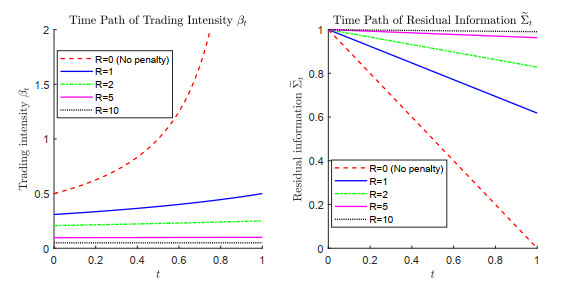
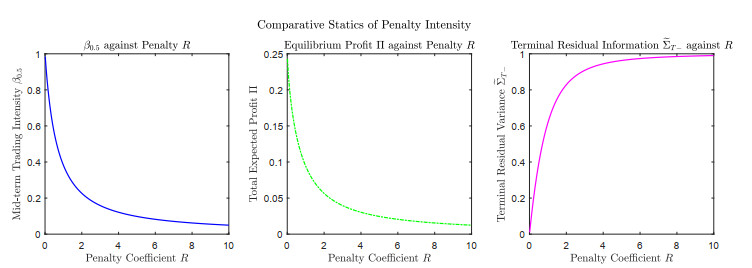
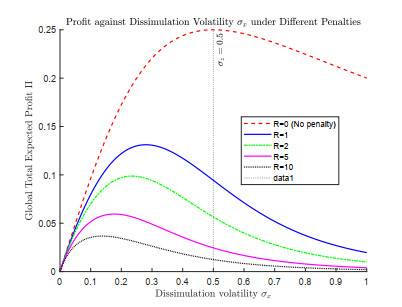
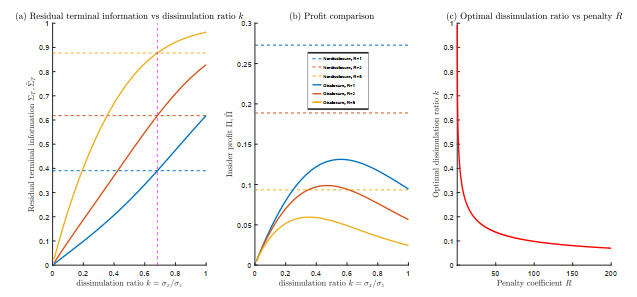
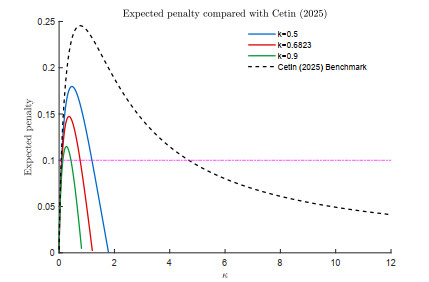
Within the continuous-time Kyle framework, this paper develops an equilibrium model of insider trading under dual regulatory constraints: Mandatory public disclosure and quadratic economic penalties. By applying the Pontryagin maximum principle, we derive explicit closed-form solutions for all market equilibrium parameters. Three core findings are obtained. First, regulatory penalties curb insiders' aggressive terminal trading, reducing trading intensity and profits while preventing full private information incorporation into prices, leading to non-zero terminal residual information. Second, penalty constraints endogenously distort insiders' dissimulation strategies. Without penalties, full dissimulation $ \sigma_x = \sigma_z $ (where $ \sigma_x $ denotes the insider's dissimulation noise volatility and $ \sigma_z $ denotes the market noise volatility) is optimal; with penalties, the optimal dissimulation volatility decreases with the growth of penalty intensity, and insiders abandon dissimulation entirely $ (\sigma_x = 0) $ as the penalty tends to infinity. Third, there exists a unique critical dissimulation ratio $ k^*\approx0.6823 $ for terminal residual information. When the dissimulation ratio is below this critical threshold, terminal residual information in the no-disclosure regime is larger than that under mandatory disclosure, and the opposite holds when the ratio exceeds the threshold. Moreover, insiders' equilibrium profit without mandatory disclosure is always higher than that under disclosure for any admissible dissimulation ratio. We also briefly examine the optimal penalty design within this framework. These results revise the oversimplified assumption widely adopted by existing analogous models that fixes dissimulation volatility equal to market noise volatility, and provide theoretical guidance for the design of insider trading regulatory policies.
Citation: Ji Wu, Qihong Nie, Yonghui Zhou. Optimal dissimulation control of insider trading under mandatory disclosure and quadratic penalty[J]. AIMS Mathematics, 2026, 11(10): 33485-33506. doi: 10.3934/math.20261310
Within the continuous-time Kyle framework, this paper develops an equilibrium model of insider trading under dual regulatory constraints: Mandatory public disclosure and quadratic economic penalties. By applying the Pontryagin maximum principle, we derive explicit closed-form solutions for all market equilibrium parameters. Three core findings are obtained. First, regulatory penalties curb insiders' aggressive terminal trading, reducing trading intensity and profits while preventing full private information incorporation into prices, leading to non-zero terminal residual information. Second, penalty constraints endogenously distort insiders' dissimulation strategies. Without penalties, full dissimulation $ \sigma_x = \sigma_z $ (where $ \sigma_x $ denotes the insider's dissimulation noise volatility and $ \sigma_z $ denotes the market noise volatility) is optimal; with penalties, the optimal dissimulation volatility decreases with the growth of penalty intensity, and insiders abandon dissimulation entirely $ (\sigma_x = 0) $ as the penalty tends to infinity. Third, there exists a unique critical dissimulation ratio $ k^*\approx0.6823 $ for terminal residual information. When the dissimulation ratio is below this critical threshold, terminal residual information in the no-disclosure regime is larger than that under mandatory disclosure, and the opposite holds when the ratio exceeds the threshold. Moreover, insiders' equilibrium profit without mandatory disclosure is always higher than that under disclosure for any admissible dissimulation ratio. We also briefly examine the optimal penalty design within this framework. These results revise the oversimplified assumption widely adopted by existing analogous models that fixes dissimulation volatility equal to market noise volatility, and provide theoretical guidance for the design of insider trading regulatory policies.

| [1] |
A. S. Kyle, Continuous auctions and insider trading, Econometrica, 53 (1985), 1315–1335. http://dx.doi.org/10.2307/1913210 doi: 10.2307/1913210

|
| [2] |
K. Back, Insider trading in continuous time, Rev. Financ. Stud., 5 (1992), 387–409. http://dx.doi.org/10.1093/rfs/5.3.387 doi: 10.1093/rfs/5.3.387
|
| [3] |
S. Huddart, J. S. Hughes, C. B. Levine, Public disclosure and dissimulation of insider trades, Econometrica, 69 (2001), 665–681. http://dx.doi.org/10.1111/1468-0262.00209 doi: 10.1111/1468-0262.00209
|
| [4] |
J. Han, X. Li, G. Ma, A. P. Kennedy, Strategic trading with information acquisition and long-memory stochastic liquidity, Eur. J. Oper. Res., 308 (2023), 480–495. http://dx.doi.org/10.1016/j.ejor.2022.11.028 doi: 10.1016/j.ejor.2022.11.028
|
| [5] |
Q. Nie, Y. Zhou, Equilibrium analysis of an insider trading model with constraints in transparent markets, Appl. Stoch. Model. Bus., 42 (2026), e70100. http://dx.doi.org/10.1002/asmb.70100 doi: 10.1002/asmb.70100
|
| [6] |
J. Shin, The optimal regulation of insider trading, J. Financ. Intermed., 5 (1996), 49–73. http://dx.doi.org/10.1006/JFIN.1996.0004 doi: 10.1006/JFIN.1996.0004
|
| [7] |
S. Carré, P. Collin-Dufresne, F. Gabriel, Insider trading with penalties, J. Econ. Theory, 203 (2022), 105461. http://dx.doi.org/10.1016/j.jet.2022.105461 doi: 10.1016/j.jet.2022.105461
|
| [8] |
U. Çetin, Insider trading with penalties in continuous time, J. Econ. Theory, 2025, 106061. http://dx.doi.org/10.1016/j.jet.2025.106061 doi: 10.1016/j.jet.2025.106061
|
| [9] |
F. Z. Gong, H. Liu, Inside trading, public disclosure and imperfect competition, Int. Rev. Econ. Financ., 24 (2012), 200–223. http://dx.doi.org/10.1016/j.iref.2012.03.003 doi: 10.1016/j.iref.2012.03.003
|
| [10] |
D. Zhou, Overconfidence, public disclosure and long-lived information, Econ. Lett., 116 (2012), 626–630. http://dx.doi.org/10.1016/j.econlet.2012.06.022 doi: 10.1016/j.econlet.2012.06.022
|
| [11] |
D. Easley, M. O'Hara, L. Yang, Opaque trading, disclosure, and asset prices: Implications for hedge fund regulation, Rev. Financ. Stud., 27 (2014), 1190–1237. http://dx.doi.org/10.1093/rfs/hht079 doi: 10.1093/rfs/hht079
|
| [12] |
S. L. Lenkey, Information-hedging disclosures and insider trading, J. Bus. Finan. Account., 43 (2016), 1280–1296. http://dx.doi.org/10.1111/jbfa.12224 doi: 10.1111/jbfa.12224
|
| [13] |
H. Liu, S. Chai, Risk aversion, public disclosure, and partially informed outsiders, N. Am. J. Econ. Financ., 54 (2020), 101279. http://dx.doi.org/10.1016/j.najef.2020.101279 doi: 10.1016/j.najef.2020.101279
|
| [14] |
X. Liu, S. Liu, L. Lu, Voluntary information disclosure with heterogeneous beliefs, J. Econ. Dynam. Control, 124 (2021), 104081. http://dx.doi.org/10.1016/j.jedc.2021.104081 doi: 10.1016/j.jedc.2021.104081
|
| [15] |
W. Xu, S. Pan, Y. Ji, Public disclosure with information sharing in financial market, Financ. Res. Lett., 53 (2023), 103652. http://dx.doi.org/10.1016/j.frl.2023.103652 doi: 10.1016/j.frl.2023.103652
|
| [16] |
J. Su, Y. Zhang, Disclosing information about the asset value range in market, Mathematics, 14 (2026), 428. http://dx.doi.org/10.3390/math14030428 doi: 10.3390/math14030428
|
| [17] |
P. M. DeMarzo, M. J. Fishman, K. M. Hagerty, The optimal enforcement of insider trading regulations, J. Polit. Econ., 106 (1998), 602–632. http://dx.doi.org/10.1086/250023 doi: 10.1086/250023
|
| [18] |
A. Frino, S. Satchell, B. Wong, H. Zheng, How much does an illegal insider trade, Int. Rev. Financ., 13 (2013), 241–263. http://dx.doi.org/10.1111/irfi.12006 doi: 10.1111/irfi.12006
|
| [19] |
H. Liu, L. Qi, Z. Li, Insider trading, representativeness heuristic insider, and market regulation, N. Am. J. Econ. Financ., 47 (2019), 48–64. http://dx.doi.org/10.1016/j.najef.2018.11.011 doi: 10.1016/j.najef.2018.11.011
|
| [20] |
W. Barger, R. Donnelly, Insider trading with temporary price impact, Int. J. Theor. Appl. Fin., 24 (2021), 2150006. http://dx.doi.org/10.1142/S0219024921500060 doi: 10.1142/S0219024921500060
|
| [21] |
H. Liu, Y. Jiang, H. Zhang, Asymmetric information, heterogeneous prior beliefs and market regulation, Acta Math. Appl. Sin.-E., 37 (2021), 459–476. http://dx.doi.org/10.1007/s10255-021-1023-y doi: 10.1007/s10255-021-1023-y
|
| [22] |
H. Liu, Z. Li, Inside trading with public information and market regulation, Financ. Res. Lett., 46 (2022), 102234. http://dx.doi.org/10.1016/j.frl.2021.102234 doi: 10.1016/j.frl.2021.102234
|
| [23] |
M. Kacperczyk, E. S. Pagnotta, Legal risk and insider trading, J. Financ., 79 (2024), 305–355. http://dx.doi.org/10.1111/jofi.13299 doi: 10.1111/jofi.13299
|
| [24] |
S. Peng, A general stochastic maximum principle for optimal control problems, SIAM J. Control Optim., 28 (1990), 966–979. http://dx.doi.org/10.1137/0328054 doi: 10.1137/0328054
|
| [25] |
E. C. Hui, H. Xiao, Maximum principle for differential games of forward-backward stochastic systems with applications, J. Math. Anal. Appl., 386 (2012), 412–427. http://dx.doi.org/10.1016/j.jmaa.2011.08.009 doi: 10.1016/j.jmaa.2011.08.009
|
| [26] |
K. Xiao, Y. H. Zhou, Insider trading with a random deadline under partial observations: Maximal principle method, Acta Math. Appl. Sin.-E., 38 (2022), 753–762. http://dx.doi.org/10.1007/s10255-022-1112-6 doi: 10.1007/s10255-022-1112-6
|
| [27] | P. E. Protter, Stochastic integration and differential equations, Berlin Heidelberg: Springer-Verlag, 1990. http://dx.doi.org/10.1007/978-3-662-10061-5 |
| [28] | R. S. Liptser, A. N. Shiryaev, Statistic of random process II, Berlin Heidelberg: Springer-Verlag, 2001. http://dx.doi.org/10.1007/978-3-662-10028-8 |
| [29] | J. M. Yong, X. Y. Zhou, Stochastic controls, New York: Springer, 1999. http://dx.doi.org/10.1007/978-1-4612-1466-3 |
Figures(5) / Tables(1)

Ji Wu, Qihong Nie, Yonghui Zhou. Optimal dissimulation control of insider trading under mandatory disclosure and quadratic penalty[J]. AIMS Mathematics, 2026, 11(10): 33485-33506. doi: 10.3934/math.20261310





 DownLoad: