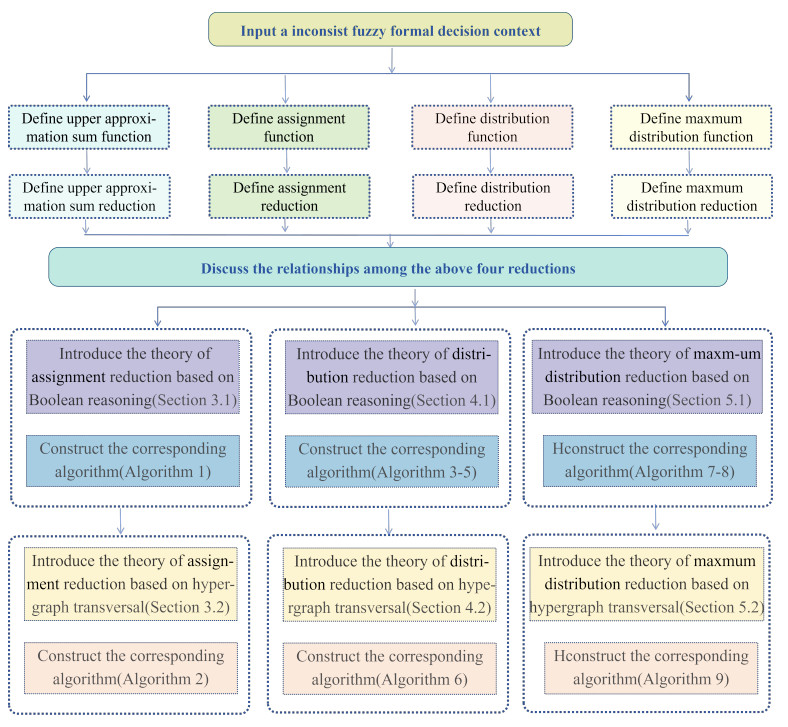
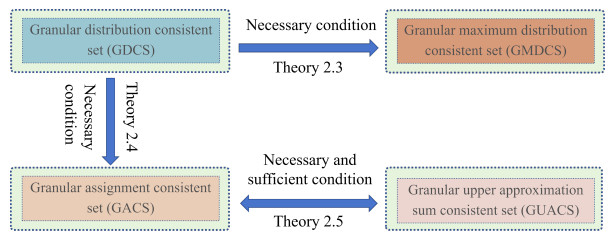
Attribute reduction in fuzzy formal concept analysis (FFCA) constitutes a core research issue of FFCA, which denotes the process of eliminating redundant attributes while preserving the specific structural properties of the concept lattice. Nevertheless, most existing attribute reduction methods work well merely for consistent fuzzy formal decision contexts (CFFDCs), yet fail to produce valid outcomes for inconsistent fuzzy formal decision contexts (IFFDCs). Motivated by this limitation, this paper concentrates on the research of IFFDCs. First, drawing on the upper and lower approximation operators of rough sets, this paper defines the assignment function, distribution function, maximum distribution function, upper approximation sum function, as well as their corresponding reductions, and further explores the internal relationships among these diverse reductions. Second, reduction approaches based on Boolean reasoning and hypergraph minimal transversals are investigated, and the consistency of results yielded by these two approaches is theoretically proven. On the basis of the above theoretical derivations, the algorithms corresponding to each reduction theory are developed. Numerical examples are further utilized to verify the validity and correctness of the proposed reduction theories and algorithms.
Citation: Jing Zhang, Zengtai Gong, Huai Yu. Attribute reduction approaches based on Boolean reasoning and hypergraph for inconsistent fuzzy formal decision contexts[J]. AIMS Mathematics, 2026, 11(10): 33422-33451. doi: 10.3934/math.20261308
Attribute reduction in fuzzy formal concept analysis (FFCA) constitutes a core research issue of FFCA, which denotes the process of eliminating redundant attributes while preserving the specific structural properties of the concept lattice. Nevertheless, most existing attribute reduction methods work well merely for consistent fuzzy formal decision contexts (CFFDCs), yet fail to produce valid outcomes for inconsistent fuzzy formal decision contexts (IFFDCs). Motivated by this limitation, this paper concentrates on the research of IFFDCs. First, drawing on the upper and lower approximation operators of rough sets, this paper defines the assignment function, distribution function, maximum distribution function, upper approximation sum function, as well as their corresponding reductions, and further explores the internal relationships among these diverse reductions. Second, reduction approaches based on Boolean reasoning and hypergraph minimal transversals are investigated, and the consistency of results yielded by these two approaches is theoretically proven. On the basis of the above theoretical derivations, the algorithms corresponding to each reduction theory are developed. Numerical examples are further utilized to verify the validity and correctness of the proposed reduction theories and algorithms.

| [1] | R. Wille, Restructuring lattice theory: an approach based on hierarchies of concepts, In: I. Rival, Ordered sets, Dordrecht-Boston, 1982,445–470. https://doi.org/10.1007/978-94-009-7798-3_15 |
| [2] | H. Xia, Y. Chen, H. C. Gao, Z. Z. Li, Y. P. Chen, Concept lattice-based semantic web service matchmaking, Communication Software and Networks, International Conference, 2010,439–443. https://doi.org/10.1109/ICCSN.2010.69 |
| [3] |
K. H. Yuan, D. Q. Miao, Y. Y. Yao, H. Y. Zhang, X. R. Zhao, Feature selection using zentropy-based uncertainty measure, IEEE Trans. Fuzzy Syst., 32 (2024), 2246–2260. https://doi.org/10.1109/TFUZZ.2023.3347757 doi: 10.1109/TFUZZ.2023.3347757

|
| [4] |
C. L. Zhang, G. M. Xue, W. H. Xu, H. L. Zhi, Y. F. Zhou, E. C. C. Tsang, Association-based concept-cognitive learning for classification: fusing knowledge with distance metric learning, Inf. Fusion, 124 (2025), 103386. https://doi.org/10.1016/j.inffus.2025.103386 doi: 10.1016/j.inffus.2025.103386
|
| [5] |
Y. N. Li, J. Long, Z. Yang, Asymmetric cross-modal hashing based on formal concept analysis, Proc. AAAI Conf. Artif. Intell., 39 (2025), 1392–1401. https://doi.org/10.1609/aaai.v39i2.32129 doi: 10.1609/aaai.v39i2.32129
|
| [6] |
C. F. Zou, D. Q. Zhang, J. F. Wan, M. M. Hassan, J. Lloret, Using concept lattice for personalized recommendation system design, IEEE Syst. J., 11 (2017), 305–314. https://doi.org/10.1109/JSYST.2015.2457244 doi: 10.1109/JSYST.2015.2457244
|
| [7] | W. X. Zhang, L. Wei, J. J. Qi, Attribute reduction theory and approach of concept lattices, Sci. China Ser. E Inf. Sci., 35 (2005), 628–639. |
| [8] |
W. Z. Wu, Y. Leung, J. S. Mi, Granular computing and knowledge reduction in formal contexts, IEEE Trans. Knowl. Data Eng., 21 (2009), 1461–1474. https://doi.org/10.1109/TKDE.2008.223 doi: 10.1109/TKDE.2008.223
|
| [9] |
J. K. Chen, J. S. Mi, Y. J. Lin, A graph approach for knowledge reduction in formal contexts, Knowl. Based Syst., 148 (2018), 177–188. https://doi.org/10.1016/j.knosys.2018.02.039 doi: 10.1016/j.knosys.2018.02.039
|
| [10] | L. A. Zadeh, Fuzzy sets and information granularity, North-Holland, 1979. |
| [11] | A. Burusco, R. Fuentes-Gonzalez, The study of the L-fuzzy concept lattices, Mathw. Soft Comput., 3 (1994), 209–218. |
| [12] | A. Burusco, R. Fuentes-Gonz${\rm{\acute{a}}} $lez, Concept lattices defined from implication operators, Fuzzy Sets Syst., 114 (2000), 431–436. https://doi.org/10.1016/S0165-0114(98)00182-1 |
| [13] | S. B. Yahia, K. Arour, A. Slimani, A. Jaoua, Discovery of compact rules in relational databases, Inf. Sci. J., 3 (2000), 497–511. |
| [14] | S. Kraj${\rm{\check{c}}}$i, Cluster based efficient generation of fuzzy concepts, Neural Netw. World, 5 (2003), 521–530. |
| [15] |
G. Addison, A. Izadpanahi, S. Saha, M. Winter, L-fuzzy concept analysis using fuzzy categories, Fuzzy Sets Syst., 460 (2023), 72–102. https://doi.org/10.1016/j.fss.2022.11.008 doi: 10.1016/j.fss.2022.11.008
|
| [16] |
Z. Zhang, Constructing L-fuzzy concept lattices without fuzzy Galois closure operation, Fuzzy Sets Syst., 333 (2018), 71–86. https://doi.org/10.1016/j.fss.2017.05.002 doi: 10.1016/j.fss.2017.05.002
|
| [17] | O. Kridlo, M. Ojeda-Aciego, Extending formal concept analysis using intuitionistic L-fuzzy sets, IEEE International Conference on Fuzzy Systems, IEEE, 2017. https://doi.org/10.1109/FUZZ-IEEE.2017.8015570 |
| [18] |
C. L. Zhang, E. C. C. Tsang, W. H. Xu, Y. D. Lin, Incremental concept-cognitive learning approach for concept classification oriented to weighted fuzzy concepts, Knowl. Based Syst., 260 (2023), 110093. https://doi.org/10.1016/j.knosys.2022.110093 doi: 10.1016/j.knosys.2022.110093
|
| [19] |
M. W. Shao, Y. Leung, X. Z. Wang, W. Z. Wu, Granular reducts of formal fuzzy contexts, Knowl. Based Syst., 114 (2016), 156–166. https://doi.org/10.1016/j.knosys.2016.10.010 doi: 10.1016/j.knosys.2016.10.010
|
| [20] |
Z. T. Gong, J. Zhang, Granular reduction in formal fuzzy contexts: graph representation, graph approach and its algorithm, Artif. Intell. Rev., 56 (2023), 15101–15127. https://doi.org/10.1007/s10462-023-10523-2 doi: 10.1007/s10462-023-10523-2
|
| [21] |
H. L. Fan, F. Hao, L. K. Zhang, J. Li, L. J. Guo, W. H. Xu, et al., Binary relations-preserving incremental pseudo-equiconcept reduction for symmetric formal context, Expert Syst. Appl., 276 (2025), 127086. https://doi.org/10.1016/j.eswa.2025.127086 doi: 10.1016/j.eswa.2025.127086
|
| [22] |
Z. T. Gong, L. L. He, An attribute reduction method of fuzzy formal contexts based on fuzzy hypergraphs in rough sets, Int. J. Mach. Learn. Cybern., 17 (2026), 166. https://doi.org/10.1007/s13042-025-02969-3 doi: 10.1007/s13042-025-02969-3
|
| [23] |
D. Y. Niu, J. S. Mi, Reductions of concept lattices based on Boolean formal contexts, Int. J. Approx. Reason., 179 (2025), 109372. https://doi.org/10.1016/j.ijar.2025.109372 doi: 10.1016/j.ijar.2025.109372
|
| [24] |
Q. Hu, K. Y. Qin, H. Yang, B. B. Xue, A novel approach to attribute reduction and rule acquisition of formal decision context, Appl. Intell., 53 (2023), 13834–13851. https://doi.org/10.1007/s10489-022-04139-2 doi: 10.1007/s10489-022-04139-2
|
| [25] |
Q. Zhang, J. J. Qi, L. Wei, S. Y. Zhao, Attribute combination reduction in formal concept analysis: a theoretical characterization, Int. J. Approx. Reason., 186 (2025), 109498. https://doi.org/10.1016/j.ijar.2025.109498 doi: 10.1016/j.ijar.2025.109498
|
| [26] |
Y. D. Lin, J. J. Li, A. H. Tan, J. Zhang, Granular matrix-based knowledge reductions of formal fuzzy contexts, Int. J. Mach. Learn. Cybern., 11 (2020), 643–656. https://doi.org/10.1007/s13042-019-01022-4 doi: 10.1007/s13042-019-01022-4
|
| [27] | Z. L. Li, J. S. Mi, B. Xie, Attribute reduction in inconsistent decision formal contexts, Comput. Sci., 46 (2019), 257–260. |
| [28] |
C. C. Huang, J. H. Li, S. M. Dias, Attribute significance, consistency measure and attribute reduction in formal concept analysis, Neural Netw. World, 26 (2016), 607–623. https://doi.org/10.14311/NNW.2016.26.035 doi: 10.14311/NNW.2016.26.035
|
| [29] | C. Berge, Graphs and Hypergraphs, North-Holland, 1973. |
| [30] | S. Listrovoy, S. Minukhin, The solution algorithms for problems on the minimal vertex cover in networks and the minimal cover in Boolean matrixes, Int. J. Comput. Sci. Issues, 9 (2012), 8–15. |
Figures(6) / Tables(7)

Jing Zhang, Zengtai Gong, Huai Yu. Attribute reduction approaches based on Boolean reasoning and hypergraph for inconsistent fuzzy formal decision contexts[J]. AIMS Mathematics, 2026, 11(10): 33422-33451. doi: 10.3934/math.20261308





 DownLoad: