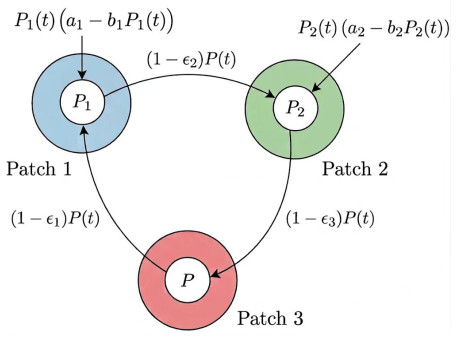
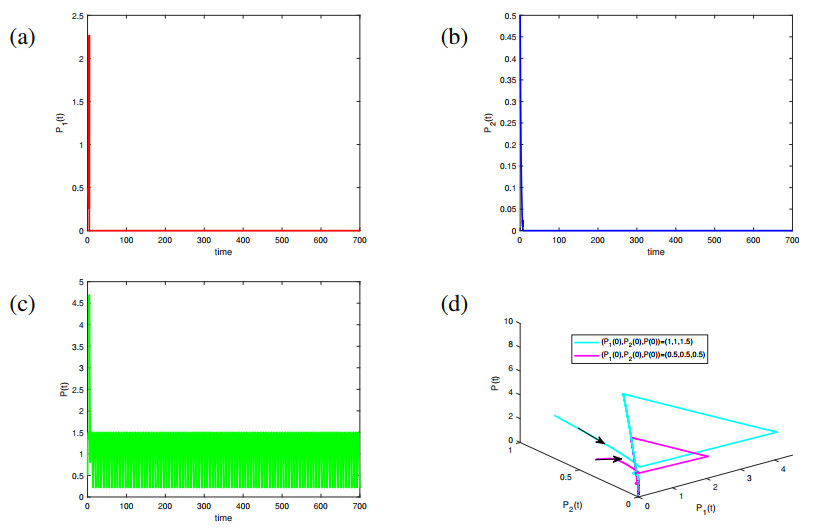
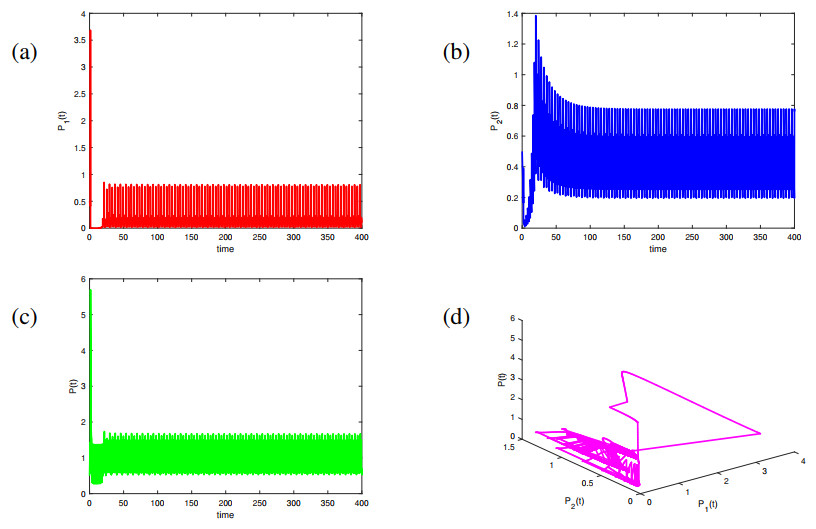
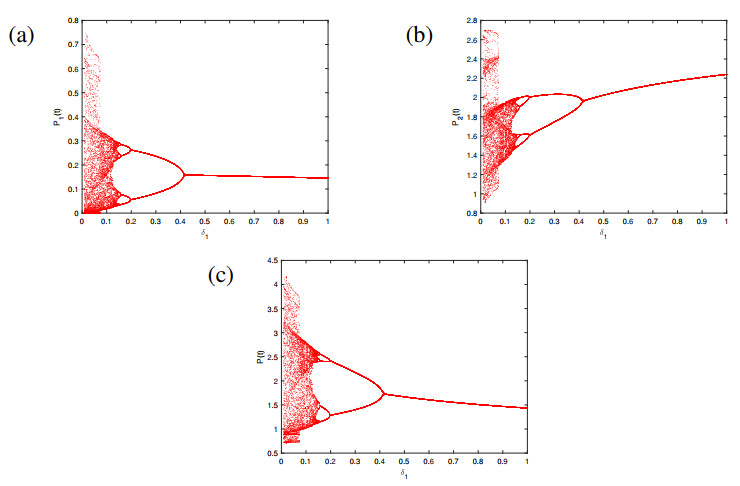
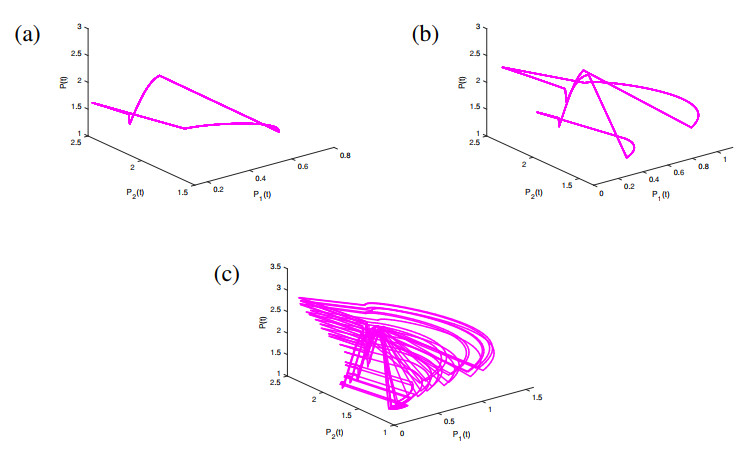
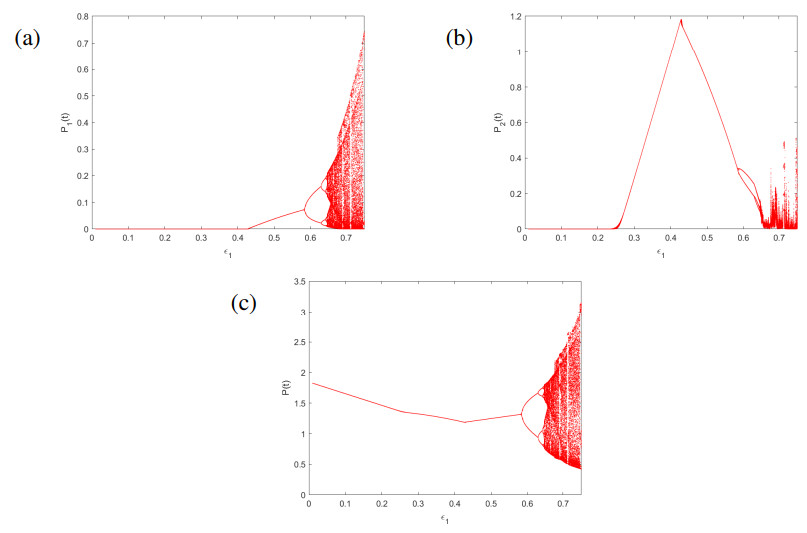
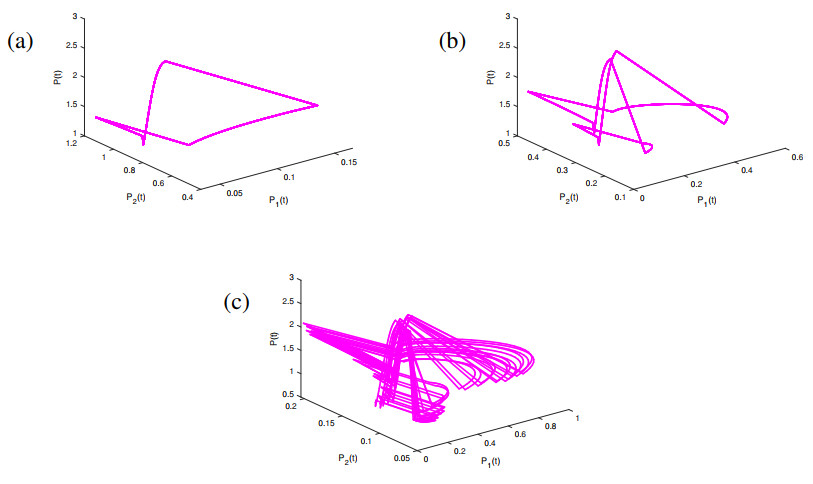
In view of seasonal birth, predation-induced fear, intraspecific cooperative hunting, and predator migrating for chasing foods, we constructed a new periodically switched predator-prey model for ecological protection. Exploiting theories of impulsive differential equations, we obtained the sufficient conditions for system persistence and the prey-eradication boundary periodic solution being globally asymptotically stable. Bifurcation analysis was used to reveal rich dynamical properties of system $ (2.1) $ with numerical simulations, including the periodic solution, period-doubling solutions, and chaos. We also found that the fear effect, intraspecific cooperative hunting, and predator seasonal migration have significant impacts on the persistence of system (2.1).
Citation: Hui Jiao, Akanat Wetayawanich, Jianjun Jiao. Dynamics of a periodically switched predator-prey model with seasonal birth, predation-induced fear, intraspecific cooperative hunting and predator migrating for chasing foods[J]. AIMS Mathematics, 2026, 11(10): 33045-33069. doi: 10.3934/math.20261296
In view of seasonal birth, predation-induced fear, intraspecific cooperative hunting, and predator migrating for chasing foods, we constructed a new periodically switched predator-prey model for ecological protection. Exploiting theories of impulsive differential equations, we obtained the sufficient conditions for system persistence and the prey-eradication boundary periodic solution being globally asymptotically stable. Bifurcation analysis was used to reveal rich dynamical properties of system $ (2.1) $ with numerical simulations, including the periodic solution, period-doubling solutions, and chaos. We also found that the fear effect, intraspecific cooperative hunting, and predator seasonal migration have significant impacts on the persistence of system (2.1).

| [1] | K. A. Hobson, L. I. Wassenaar, Tracking animal migration with stable isotopes, London: Academic Press, 2019. https://doi.org/10.1016/C2017-0-01125-4 |
| [2] |
Y. Cheng, Z. Wen, X. He, Z. Dong, M. Zhangshang, D. Li, et al., Ecological traits affect the seasonal migration patterns of breeding birds along a subtropical altitudinal gradient, Avian Res., 13 (2022), 100066. https://doi.org/10.1016/j.avrs.2022.100066 doi: 10.1016/j.avrs.2022.100066

|
| [3] |
Y. Liao, T. Zhao, W. Du, D. Wang, Z. Peng, S. Xue, et al., How virus migration and meteorological elements shape the seasonality of influenza A/H3N2: a case study in China, One Health, 20 (2025), 101037. https://doi.org/10.1016/j.onehlt.2025.101037 doi: 10.1016/j.onehlt.2025.101037
|
| [4] |
J. Zhang, P. Y. Tishchenko, Z. J. Jiang, P. Y. Semkin, P. P. Tishchenko, W. Zheng, et al., Diverse nature of the seasonally coastal eutrophication dominated by oceanic nutrients: an eco-system based analysis characterized by salmon migration and aquaculture, Mar. Pollut. Bull., 193 (2023), 115150. https://doi.org/10.1016/j.marpolbul.2023.115150 doi: 10.1016/j.marpolbul.2023.115150
|
| [5] |
J. Jiao, S. Cai, L. Li, Impulsive vaccination and dispersal on dynamics of an SIR epidemic model with restricting infected individuals boarding transports, Physica A, 449 (2016), 145–159. https://doi.org/10.1016/j.physa.2015.10.055 doi: 10.1016/j.physa.2015.10.055
|
| [6] |
J. Jiao, Y. Xiao, Dynamics of a pest-natural enemy model with natural enemy periodic migration described by time delay, Nonlinear Anal. Real World Appl., 87 (2026), 104454. https://doi.org/10.1016/j.nonrwa.2025.104454 doi: 10.1016/j.nonrwa.2025.104454
|
| [7] |
J. Jiao, Q. Quan, X. Dai, Dynamics of a new impulsive predator-prey model with predator population seasonally large-scale migration, Appl. Math. Lett., 132 (2022), 108096. https://doi.org/10.1016/j.aml.2022.108096 doi: 10.1016/j.aml.2022.108096
|
| [8] |
S. Creel, B. Goodheart, J. R. de Merkle, J. Redcliffe, H. Mwape, S. Matsushima, et al., Prey depletion and the effect of group size on cooperative hunting in African wild dogs, Anim. Behav., 234 (2026), 123504. https://doi.org/10.1016/j.anbehav.2026.123504 doi: 10.1016/j.anbehav.2026.123504
|
| [9] |
Shivam, K. Singh, M. Kumar, R. Dubey, T. Singh, Untangling role of cooperative hunting among predators and herd behavior in prey with a dynamical systems approach, Chaos Soliton Fract., 162 (2022), 112420. https://doi.org/10.1016/j.chaos.2022.112420 doi: 10.1016/j.chaos.2022.112420
|
| [10] |
Y. Mu, W. C. Lo, Y. S. Tan, Z. J. Liu, Hybrid control for the prey in a spatial prey-predator model with cooperative hunting and fear effect time lag, Appl. Math. Comput., 491 (2025), 129217. https://doi.org/10.1016/j.amc.2024.129217 doi: 10.1016/j.amc.2024.129217
|
| [11] |
J. A. Vucetich, R. O. Peterson, T. A. Waite, Raven scavenging favours group foraging in wolves, Anim. Behav., 67 (2004), 1117–1126. https://doi.org/10.1016/j.anbehav.2003.06.018 doi: 10.1016/j.anbehav.2003.06.018
|
| [12] |
S. Creel, N. M. Creel, Communal hunting and pack size in African wild dogs, Lycaon pictus, Anim. Behav., 50 (1995), 1325–1339. https://doi.org/10.1016/0003-3472(95)80048-4 doi: 10.1016/0003-3472(95)80048-4
|
| [13] |
L. Wu, J. Jiao, Q. Quan, H. Sun, Dynamics of a pest management model with nonlinearly impulsive releasing two types of natural enemies and their interspecific cooperation, Chaos Solitons Fract., 199 (2025), 116805. https://doi.org/10.1016/j.chaos.2025.116805 doi: 10.1016/j.chaos.2025.116805
|
| [14] | H. Jiao, Dynamics of a switched pest management model with seasonally migrating, predation-induced fear and unilaterally interspecific cooperative hunting, Int. J. Biomath., (2025), 2550118. https://doi.org/10.1142/S1793524525501189 |
| [15] |
S. Banerjee, A. Sha, J. Chattopadhyay, Cooperative predation on mutualistic prey communities, J. Theor. Biol., 490 (2020), 110156. https://doi.org/10.1016/j.jtbi.2020.110156 doi: 10.1016/j.jtbi.2020.110156
|
| [16] |
X. Wang, L. Zanette, X. Zou, Modelling the fear effect in predator-prey interactions, J. Math. Biol., 73 (2016), 1179–1204. https://doi.org/10.1007/s00285-016-0989-1 doi: 10.1007/s00285-016-0989-1
|
| [17] |
M. Hossain, N. Pal, S. Samanta, Impact of fear on an eco-epidemiological model, Chaos Solitons Fract., 134 (2020), 109718. https://doi.org/10.1016/j.chaos.2020.109718 doi: 10.1016/j.chaos.2020.109718
|
| [18] |
W. Cresswell, J. L. Quinn, Predicting the optimal prey group size from predator hunting behaviour, J. Anim. Ecol., 80 (2011), 310–319. https://doi.org/10.1111/j.1365-2656.2010.01775.x doi: 10.1111/j.1365-2656.2010.01775.x
|
| [19] |
J. S. Brown, J. W. Laundre, M. Gurung, The ecology of fear: optimal foraging, game theory and trophic interactions, J. Mammal., 80 (1999), 385–399. https://doi.org/10.2307/1383287 doi: 10.2307/1383287
|
| [20] |
L. Y. Zanette, A. F. White, M. C. Allen, M. Clinchy, Perceived predation risk reduces the number of offspring songbirds produce per year, Science, 334 (2011), 1398–1401. https://doi.org/10.1126/science.1210908 doi: 10.1126/science.1210908
|
| [21] |
R. Shi, Analysis of plankton-fish system with delay of fear effect, Phys. Lett. A, 551 (2025), 130583. https://doi.org/10.1016/j.physleta.2025.130583 doi: 10.1016/j.physleta.2025.130583
|
| [22] |
S. Saha, S. Pal, V. Melnik, Analysis of the impact of fear in the presence of additional food and prey refuge with nonlocal predator-prey models, Ecol. Model., 505 (2025), 111103. https://doi.org/10.1016/j.ecolmodel.2025.111103 doi: 10.1016/j.ecolmodel.2025.111103
|
| [23] |
V. Kumar, S. K. Bairwa, Tanvi, Influence of fear and Allee effects on stability and species survival in a tri-trophic food chain, Commun. Nonlinear Sci. Numer. Simul., 152 (2026), 109115. https://doi.org/10.1016/j.cnsns.2025.109115 doi: 10.1016/j.cnsns.2025.109115
|
| [24] |
H. Sun, J. Jiao, L. Wu, Dynamics of a periodic switched pest management model under the influence of fear effect, J. Math. Anal. Appl., 553 (2026), 129860. https://doi.org/10.1016/j.jmaa.2025.129860 doi: 10.1016/j.jmaa.2025.129860
|
| [25] |
S. A. Levin, Dispersion and population interactions, Am. Nat., 108 (1974), 207–228. https://doi.org/10.1086/282900 doi: 10.1086/282900
|
| [26] |
L. Xiong, K. Wu, Limit cycles for continuous piecewise linear systems with three zones having two degenerate subsystems, J. Math. Interdiscip. Appl., 1 (2025), 3–19. https://doi.org/10.62762/JMIA.2025.453419 doi: 10.62762/JMIA.2025.453419
|
| [27] |
B. Chang, Y. Tan, A stochastic impulsive competition model for tumor evolution under intermittent androgen deprivation therapy, J. Math. Interdiscip. Appl., 2 (2026), 36–53. https://doi.org/10.62762/JMIA.2025.355794 doi: 10.62762/JMIA.2025.355794
|
| [28] |
J. Jiao, Z. Liu, S. Cai, Dynamics of an SEIR model with infectivity in incubation period and homestead-isolation on the susceptible, Appl. Math. Lett., 107 (2020), 106442. https://doi.org/10.1016/j.aml.2020.106442 doi: 10.1016/j.aml.2020.106442
|
| [29] | L. Chen, X. Meng, J. Jiao, Biological dynamics (in Chinese), Beijing: Scientific Press, 2009. |
| [30] | V. Lakshmikantham, D. D. Bainov, P. S. Simeonov, Theory of impulsive differential equations, Singapore: World Scientific, 1989. https://doi.org/10.1142/0906 |
| [31] |
H. Jiao, S. Meleshko, Analysis of a pest-natural enemy model with time delay in impulsive releasing natural enemy, J. Math. Interdiscip. Appl., 1 (2025), 20–28. https://doi.org/10.62762/JMIA.2025.442174 doi: 10.62762/JMIA.2025.442174
|
| [32] |
J. Jiao, S. Cai, L. Li, Dynamics of a periodic switched predator-prey system with impulsive harvesting and hibernation of prey population, J. Franklin Inst., 353 (2016), 3818–3834. https://doi.org/10.1016/j.jfranklin.2016.06.035 doi: 10.1016/j.jfranklin.2016.06.035
|
| [33] |
X. Liu, L. Chen, Complex dynamics of Holling type Ⅱ Lotka-Volterra predator-prey system with impulsive perturbations on the predator, Chaos Solitons Fract., 16 (2003), 311–320. https://doi.org/10.1016/S0960-0779(02)00408-3 doi: 10.1016/S0960-0779(02)00408-3
|
| [34] |
J. Jiao, S. Cai, L. Chen, Analysis of a stage-structured predator-prey system with birth pulse and impulsive harvesting at different moments, Nonlinear Anal. Real World Appl., 12 (2011), 2232–2244. https://doi.org/10.1016/j.nonrwa.2011.01.005 doi: 10.1016/j.nonrwa.2011.01.005
|
| [35] |
J. Jiao, Y. Xiao, H. Jiao, Dynamics of a switched predator-prey breeding management model with impulsive nonlinear releasing and age-selective harvesting predator, Adv. Contin. Discret. M., 2025 (2025), 101. https://doi.org/10.1186/s13662-025-03960-6 doi: 10.1186/s13662-025-03960-6
|
| [36] |
H. J. Alsakaji, S. Kundu, F. A. Rihan, Delay differential model of one-predator two-prey system with Monod-Haldane and Holling type Ⅱ functional responses, Appl. Math. Comput., 397 (2021), 125919. https://doi.org/10.1016/j.amc.2020.125919 doi: 10.1016/j.amc.2020.125919
|
| [37] |
F. A. Rihan, H. J. Alsakaji, Persistence and extinction for stochastic delay differential model of prey predator system with hunting cooperation in predators, Adv. Differ. Equ., 2020 (2020), 124. https://doi.org/10.1186/s13662-020-02579-z doi: 10.1186/s13662-020-02579-z
|
| [38] |
Y. Wang, X. Meng, Strategy dynamics of three-strategy snowdrift game induced by reward strategy and payoff delay, J. Math. Interdiscip. Appl., 2 (2026), 74–90. https://doi.org/10.62762/JMIA.2026.346326 doi: 10.62762/JMIA.2026.346326
|
Figures(7)

Hui Jiao, Akanat Wetayawanich, Jianjun Jiao. Dynamics of a periodically switched predator-prey model with seasonal birth, predation-induced fear, intraspecific cooperative hunting and predator migrating for chasing foods[J]. AIMS Mathematics, 2026, 11(10): 33045-33069. doi: 10.3934/math.20261296





 DownLoad: