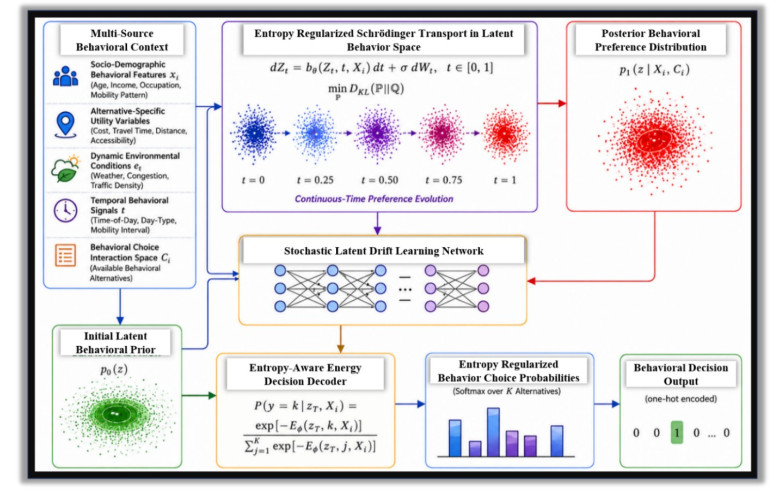
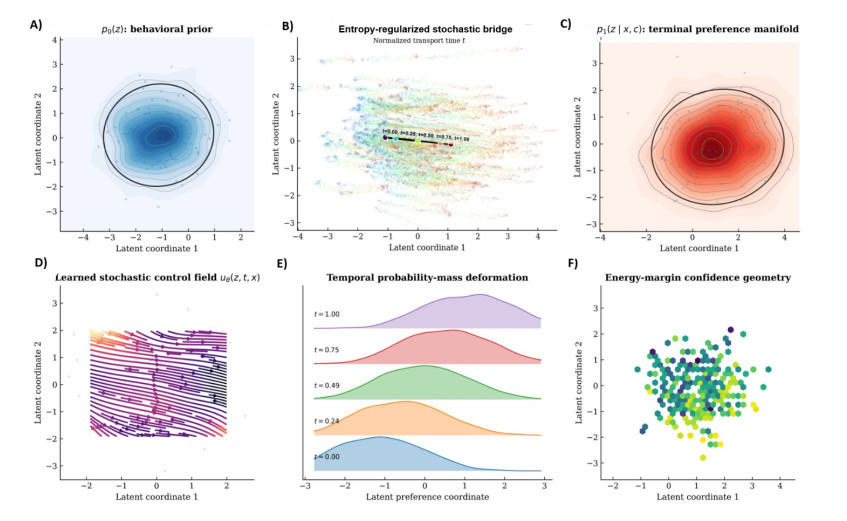
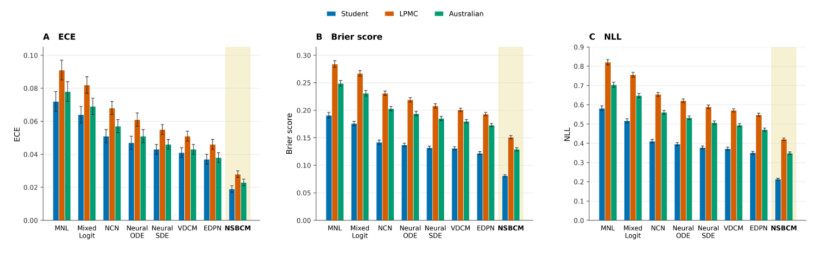
Entropy-regularized stochastic transport in latent utility space is explored as a tool for behavioral decision modeling under uncertainty in this study, proposing a neural Schrödinger bridge choice model (NSBCM). The NSBCM differs from traditional discrete choice models, which assume that preferences are either latent utilities or random coefficients that are constant across choice contexts. The NSBCM differs from traditional discrete choice models, which assume preferences are either latent utilities or random coefficients fixed across choice contexts. The terminal latent state is then decoded to alternative-specific choice probabilities using an energy-based decoder. The resulting architecture learns the neural drift field, stochastic transport process, and probabilistic choice decoder simultaneously. We test the NSBCM on the publicly available student travel mode choice dataset and benchmark it against the multinomial logit model, the mixed logit model, the neural choice network model, the variational diffusion choice model, and the energy-based preference network model. The proposed model achieves 95.84% accuracy, an F1 score of 0.947, a negative log-likelihood of 0.214, and a Brier score of 0.081. The ablation, transport stability, and contextual perturbation analyses also suggest that Schrödinger transport, entropy regularization, and energy-based decoding contribute to stable and calibrated predictions. The results corroborate the potential of continuous-time latent transport to represent dynamic and heterogeneous choice behavior under uncertainty.
Citation: Irsa Sajjad, Mashail M. Al Sobhi. Neural Schrödinger bridge choice modeling through entropy-regularized stochastic transport of latent behavioral preferences[J]. AIMS Mathematics, 2026, 11(10): 33012-33044. doi: 10.3934/math.20261295
Entropy-regularized stochastic transport in latent utility space is explored as a tool for behavioral decision modeling under uncertainty in this study, proposing a neural Schrödinger bridge choice model (NSBCM). The NSBCM differs from traditional discrete choice models, which assume that preferences are either latent utilities or random coefficients that are constant across choice contexts. The NSBCM differs from traditional discrete choice models, which assume preferences are either latent utilities or random coefficients fixed across choice contexts. The terminal latent state is then decoded to alternative-specific choice probabilities using an energy-based decoder. The resulting architecture learns the neural drift field, stochastic transport process, and probabilistic choice decoder simultaneously. We test the NSBCM on the publicly available student travel mode choice dataset and benchmark it against the multinomial logit model, the mixed logit model, the neural choice network model, the variational diffusion choice model, and the energy-based preference network model. The proposed model achieves 95.84% accuracy, an F1 score of 0.947, a negative log-likelihood of 0.214, and a Brier score of 0.081. The ablation, transport stability, and contextual perturbation analyses also suggest that Schrödinger transport, entropy regularization, and energy-based decoding contribute to stable and calibrated predictions. The results corroborate the potential of continuous-time latent transport to represent dynamic and heterogeneous choice behavior under uncertainty.

| [1] | K. E. Train, Discrete choice methods with simulation, 2 Eds., Cambridge: Cambridge University Press, 2012.https://doi.org/10.1017/CBO9780511805271 |
| [2] | D. McFadden, K. Train, Mixed MNL models for discrete response, J. Appl. Econ. , 15 (2000), 447–470.https://doi.org/10.1002/1099-1255(200009/10)15:5%3C447::AID-JAE570%3E3.0.CO;2-1 |
| [3] |
T. Hillel, M. Bierlaire, M. Z. E. B. Elshafie, Y. Jin, A systematic review of machine learning classification methodologies for modelling passenger mode choice, J. Choice Model. , 38 (2021), 100221.https://doi.org/10.1016/j.jocm.2020.100221 doi: 10.1016/j.jocm.2020.100221

|
| [4] | Y. M. Aboutaleb, M. Danaf, Y. Xie, M. Ben-Akiva, Discrete choice analysis with machine learning capabilities, arXiv, 2021, arXiv: 2101.10261.https://doi.org/10.48550/arXiv.2101.10261 |
| [5] |
L. Winkler, C. Ojeda, M. Opper, A score-based approach for training Schrödinger bridges for data modelling, Entropy, 25 (2023), 316.https://doi.org/10.3390/e25020316 doi: 10.3390/e25020316
|
| [6] |
F. Vargas, P. Thodoroff, A. Lamacraft, N. Lawrence, Solving Schrödinger bridges via maximum likelihood, Entropy, 23 (2021), 1134.https://doi.org/10.3390/e23091134 doi: 10.3390/e23091134
|
| [7] | S. Tang, Foundations of Schrödinger bridges for generative modeling, arXiv, 2026, arXiv: 2603.18992.https://doi.org/10.48550/arXiv.2603.18992 |
| [8] |
Y. Chen, T. T. Georgiou, M. Pavon, Stochastic control liaisons: Richard Sinkhorn meets Gaspard Monge on a Schrödinger bridge, SIAM Rev. , 63 (2021), 249–313.https://doi.org/10.1137/20M1339982 doi: 10.1137/20M1339982
|
| [9] | I. Sajjad, M. Malik, A hierarchical Bayesian discrete–continuous mixture model with nested Dirichlet processes, Statistics, 2026, 1–34.https://doi.org/10.1080/02331888.2026.2654459 |
| [10] |
I. Sajjad, I. A. Nafisah, M. M. A. Almazah, O. A. Alamri, J. G. Dar, A symmetrical analysis of decision making: Introducing the Gaussian negative binomial mixture with a latent class choice model, Symmetry, 16 (2024), 908.https://doi.org/10.3390/sym16070908 doi: 10.3390/sym16070908
|
| [11] |
I. Sajjad, M. A. Alomair, J. G. Dar, A statistical machine learning approach to multimodal data processing: Hierarchical generalized distribution matching networks (HGDM-Net), Phys. Scr. , 101 (2026), 186003.https://doi.org/10.1088/1402-4896/ae6402 doi: 10.1088/1402-4896/ae6402
|
| [12] |
I. A. Nafisah, I. Sajjad, M. A. Alshahrani, O. A. Alamri, M. M. A. Almazah, J. G. Dar, Statistical predictive hybrid choice modeling: Exploring embedded neural architecture, Mathematics, 12 (2024), 3115.https://doi.org/10.3390/math12193115 doi: 10.3390/math12193115
|
| [13] |
M. Haghani, M. C. J. Bliemer, D. A. Hensher, The landscape of econometric discrete choice modelling research, J. Choice Model. , 40 (2021), 100303.https://doi.org/10.1016/j.jocm.2021.100303 doi: 10.1016/j.jocm.2021.100303
|
| [14] |
A. Vij, J. L. Walker, How, when and why integrated choice and latent variable models are latently useful, Transp. Res. B Methodol. , 90 (2016), 192–217.https://doi.org/10.1016/j.trb.2016.04.021 doi: 10.1016/j.trb.2016.04.021
|
| [15] |
G. S. Crawford, R. Griffith, A. Iaria, A survey of preference estimation with unobserved choice set heterogeneity, J. Econometrics, 222 (2021), 4–43.https://doi.org/10.1016/j.jeconom.2020.07.024 doi: 10.1016/j.jeconom.2020.07.024
|
| [16] | F. Zhang, A Monte Carlo study of integrating discrete choice models and neural networks in transportation decision-making, In: Proceedings of the 2nd international conference on engineering management, information technology and intelligence (EMITI), 1 (2025), 522–526.https://doi.org/10.5220/0014362200004718 |
| [17] |
A. A. Pooladian, J. Niles-Weed, Plug-in estimation of Schrödinger bridges, SIAM J. Math. Data Sci. , 7 (2025), 1315–1336.https://doi.org/10.1137/24M1687340 doi: 10.1137/24M1687340
|
| [18] | J. Garg, X. Zhang, Q. Zhou, Soft-constrained Schrödinger bridge: A stochastic control approach, Proc. Mach. Learn. Res. , 238 (2024), 4429–4437. |
| [19] | S. De Marco, H. Pham, D. Zanni, Schrödinger bridges with jumps for time series generation, arXiv, 2026, arXiv: 2602.20011.https://doi.org/10.48550/arXiv.2602.20011 |
| [20] |
R. Krueger, M. Bierlaire, P. Bansal, A data fusion approach for ride-sourcing demand estimation: A discrete choice model with sampling and endogeneity corrections, Transp. Res. C Emerg. Technol. , 152 (2023), 104180.https://doi.org/10.1016/j.trc.2023.104180 doi: 10.1016/j.trc.2023.104180
|
| [21] |
R. Singh Chauhan, C. Riis, S. Adhikari, S. Derrible, E. Zheleva, C. F. Choudhury, et al., Determining causality in travel mode choice, Travel Behav. Soc. , 36 (2024), 100789.https://doi.org/10.1016/j.tbs.2024.100789 doi: 10.1016/j.tbs.2024.100789
|
| [22] | M. Grzenda, M. Luckner, J. Zawieska, P. Wrona, Combining data from multiple sources for urban travel mode choice modelling, arXiv, 2024, arXiv: 2407.12137.https://doi.org/10.48550/arXiv.2407.12137 |
| [23] |
J. Á. Martín-Baos, J. A. López-Gómez, L. Rodriguez-Benitez, T. Hillel, R. García-Ródenas, A prediction and behavioural analysis of machine learning methods for modelling travel mode choice, Transp. Res. C Emerg. Technol. , 156 (2023), 104318.https://doi.org/10.1016/j.trc.2023.104318 doi: 10.1016/j.trc.2023.104318
|
| [24] |
Q. Lai, M. Qin, X. W. Zhao, Reconfigurable multiscroll memristive neural network with application to telemedicine privacy protection, IEEE Trans. Cybern. , 56 (2026), 1910–1919.https://doi.org/10.1109/TCYB.2026.3664460 doi: 10.1109/TCYB.2026.3664460
|
| [25] |
X. Huang, S. Xu, Mitigating choice overload: The interactive effects of set size and overall preference revealed by hierarchical drift diffusion modeling and electroencephalography, NeuroImage, 321 (2025), 121542.https://doi.org/10.1016/j.neuroimage.2025.121542 doi: 10.1016/j.neuroimage.2025.121542
|
| [26] | R. T. Q. Chen, Y. Rubanova, J. Bettencourt, D. Duvenaud, Neural ordinary differential equations, Adv. Neural Inf. Process. Syst. , 31 (2018), 6572–6583. |
| [27] | Y. Song, J. Sohl-Dickstein, D. P. Kingma, A. Kumar, S. Ermon, B. Poole, Score-based generative modeling through stochastic differential equations, In: International conference on learning representations (ICLR), 2021. |
| [28] |
Z. Xu, Z. Lv, J. Li, Fast-TrafficNet: A hybrid model for efficient prediction of nonlinear traffic flow with sparse data, Chaos Solitons Fractals, 201 (2025), 117230.https://doi.org/10.1016/j.chaos.2025.117230 doi: 10.1016/j.chaos.2025.117230
|
| [29] | R. Ye, Z. Xu, Z. Lv, A spatio-temporal hypergraph fusion model for transportation revitalization index forecasting, Comput. J., 2026, bxag088.https://doi.org/10.1093/comjnl/bxag088 |
Figures(7) / Tables(5)

Irsa Sajjad, Mashail M. Al Sobhi. Neural Schrödinger bridge choice modeling through entropy-regularized stochastic transport of latent behavioral preferences[J]. AIMS Mathematics, 2026, 11(10): 33012-33044. doi: 10.3934/math.20261295





 DownLoad: