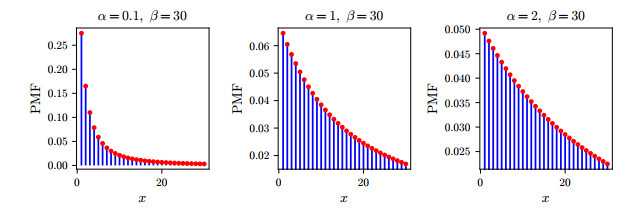
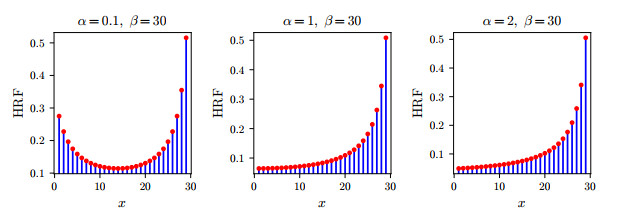
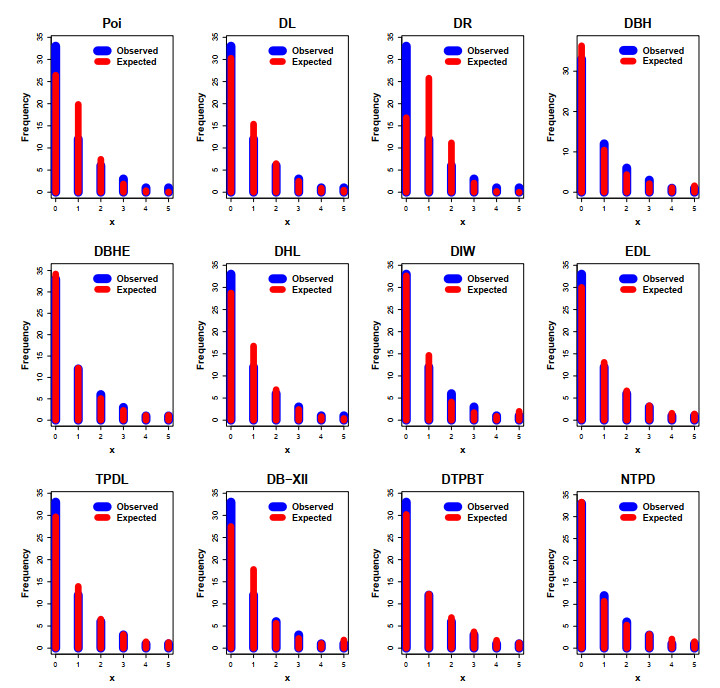
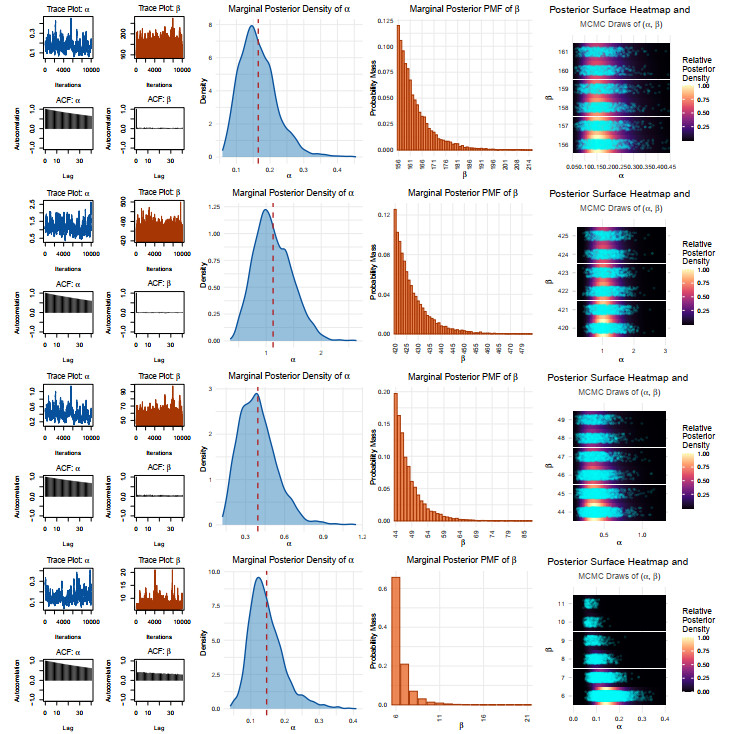
This work introduced a new two-parameter discrete distribution derived from a continuous truncated lifetime model. The proposed distribution features a flexible hazard rate function that can exhibit both increasing and bathtub-shaped behaviors depending on parameter configurations, allowing it to capture diverse patterns in discrete failure time data. Despite its flexibility, the model retains a parsimonious two-parameter structure, facilitating straightforward statistical inference. We derived key structural and statistical properties of the model and investigated parameter estimation under both maximum likelihood and Bayesian frameworks. Because closed-form expressions for the estimators are analytically intractable, numerical methods were developed; specifically, maximum likelihood estimates were obtained via numerical optimization in R, while Bayesian estimates were computed using a Markov chain Monte Carlo sampler. The finite-sample performance of both estimation procedures was evaluated through an extensive Monte Carlo simulation study. Finally, the practical utility of the distribution was demonstrated through applications to four real-world datasets across different fields, where it yielded competitive fits relative to several established discrete lifetime models.
Citation: Ammar M. Sarhan, Najwan Alsadat, M. E. Sobh. A flexible two-parameter discrete distribution with a bathtub-shaped hazard function: statistical properties and applications[J]. AIMS Mathematics, 2026, 11(10): 32945-32972. doi: 10.3934/math.20261292
This work introduced a new two-parameter discrete distribution derived from a continuous truncated lifetime model. The proposed distribution features a flexible hazard rate function that can exhibit both increasing and bathtub-shaped behaviors depending on parameter configurations, allowing it to capture diverse patterns in discrete failure time data. Despite its flexibility, the model retains a parsimonious two-parameter structure, facilitating straightforward statistical inference. We derived key structural and statistical properties of the model and investigated parameter estimation under both maximum likelihood and Bayesian frameworks. Because closed-form expressions for the estimators are analytically intractable, numerical methods were developed; specifically, maximum likelihood estimates were obtained via numerical optimization in R, while Bayesian estimates were computed using a Markov chain Monte Carlo sampler. The finite-sample performance of both estimation procedures was evaluated through an extensive Monte Carlo simulation study. Finally, the practical utility of the distribution was demonstrated through applications to four real-world datasets across different fields, where it yielded competitive fits relative to several established discrete lifetime models.

| [1] |
K. M. Alqahtani, M. El-Morshedy, H. S. Shahen, M. S. Eliwa, A discrete extension of the Burr-Hatke distribution: generalized hypergeometric functions, different inference techniques, simulation ranking with modeling and analysis of sustainable count data, AIMS Math., 9 (2024), 9394–9418. https://doi.org/10.3934/math.2024458 doi: 10.3934/math.2024458

|
| [2] | B. C. Arnold, N. Balakrishnan, H. N. Nagaraja, A first course in order statistics, Philadelphia: Society for Industrial and Applied Mathematics, 2008. https://doi.org/10.1137/1.9780898719062 |
| [3] |
A. Barbiero, A. Hitaj, Discrete half-logistic distributions with applications in reliability and risk analysis, Ann. Oper. Res., 340 (2024), 27–57. https://doi.org/10.1007/s10479-023-05807-3 doi: 10.1007/s10479-023-05807-3
|
| [4] | R. E. Barlow, F. Proschan, Statistical theory of reliability and life testing: probability models, New York: Holt, Rinehart and Winston, 1975. |
| [5] |
M. El-Morshedy, M. S. Eliwa, E. Altun, Discrete Burr-Hatke distribution with properties, estimation methods and regression model, IEEE Access, 8 (2020), 74359–74370. https://doi.org/10.1109/ACCESS.2020.2988431 doi: 10.1109/ACCESS.2020.2988431
|
| [6] |
M. El-Morshedy, M. S. Eliwa, H. Nagy, A new two-parameter exponentiated discrete Lindley distribution: properties, estimation and applications, J. Appl. Stat., 47 (2020), 354–375. https://doi.org/10.1080/02664763.2019.1638893 doi: 10.1080/02664763.2019.1638893
|
| [7] |
P. Feigl, M. Zelen, Estimation of exponential survival probabilities with concomitant information, Biometrics, 21 (1965), 826–838. https://doi.org/10.2307/2528247 doi: 10.2307/2528247
|
| [8] | A. Gelman, J. B. Carlin, H. S. Stern, D. B. Dunson, A. Vehtari, D. B. Rubin, Bayesian data analysis, Boca Raton: CRC Press, 2013. |
| [9] |
E. Gómez-Déniz, E. Calderín-Ojeda, The discrete Lindley distribution: properties and applications, J. Stat. Comput. Simul., 81 (2011), 1405–1416. https://doi.org/10.1080/00949655.2010.487825 doi: 10.1080/00949655.2010.487825
|
| [10] |
J. R. M. Hosking, L-moments: analysis and estimation of distributions using linear combinations of order statistics, J. R. Stat. Soc. Ser. B Stat. Methodol., 52 (1990), 105–124. https://doi.org/10.1111/j.2517-6161.1990.tb01775.x doi: 10.1111/j.2517-6161.1990.tb01775.x
|
| [11] | T. Hussain, M. Ahmad, Discrete inverse Rayleigh distribution, Pak. J. Stat., 30 (2014), 203–222. |
| [12] |
T. Hussain, M. Aslam, M. Ahmad, A two-parameter discrete Lindley distribution, Rev. Colomb. Estad., 39 (2016), 45–61. http://doi.org/10.15446/rce.v39n1.55138 doi: 10.15446/rce.v39n1.55138
|
| [13] |
M. A. Jazi, C. D. Lai, M. H. Alamatsaz, A discrete inverse Weibull distribution and estimation of its parameters, Stat. Methodol., 7 (2010), 121–132. http://doi.org/10.1016/j.stamet.2009.11.001 doi: 10.1016/j.stamet.2009.11.001
|
| [14] | C. D. Lai, M. Xie, Stochastic ageing and dependence for reliability, New York: Springer New York, 2006. https://doi.org/10.1007/0-387-34232-X |
| [15] | M. Muhammad, A new two-parameter distribution with a finite support, Appl. Math. Sci., 10 (2016), 1–12. |
| [16] | T. Nakagawa, Maintenance theory of reliability, London: Springer London, 2005. https://doi.org/10.1007/1-84628-221-7 |
| [17] |
B. A. Para, T. R. Jan, Discrete generalized burr-type Ⅻ distribution, J. Mod. Appl. Stat. Methods, 13 (2014), 244–258. https://doi.org/10.22237/jmasm/1414815120 doi: 10.22237/jmasm/1414815120
|
| [18] |
D. Roy, Discrete rayleigh distribution, IEEE Trans. Reliab., 53 (2004), 255–260. https://doi.org/10.1109/TR.2004.829161 doi: 10.1109/TR.2004.829161
|
| [19] |
A. M. Sarhan, A two-parameter discrete distribution with a bathtub hazard shape, Commun. Stat. Appl. Methods, 24 (2017), 15–27. https://doi.org/10.5351/CSAM.2017.24.1.015 doi: 10.5351/CSAM.2017.24.1.015
|
| [20] |
F. Z. Seghier, H. Zeghdoudi, A. Benchaabane, A size-biased Poisson-gamma Lindley distribution with application, Eur. J. Stat., 1 (2021), 132–147. https://doi.org/10.28924/ada/stat.1.132 doi: 10.28924/ada/stat.1.132
|
| [21] |
M. Xie, Y. Tang, T. N. Goh, A modified Weibull extension with bathtub-shaped failure rate function, Reliab. Eng. Syst. Saf., 76 (2002), 279–285. https://doi.org/10.1016/S0951-8320(02)00022-4 doi: 10.1016/S0951-8320(02)00022-4
|
| [22] |
A. Xu, Y. Miao, J. Sun, S. Zhou, Y. Tang, A hierarchical Bayesian multivariate Wiener process model with dependent degradation rates and volatilities, IEEE Trans. Reliab., 75 (2026), 1420–1433. https://doi.org/10.1109/TR.2026.3674703 doi: 10.1109/TR.2026.3674703
|
| [23] |
A. Xu, Z. Chen, H. Yin, Y. Tang, A bivariate Wiener degradation model with partially random scale weights, Reliab. Eng. Syst. Saf., 275 (2026), 112684. https://doi.org/10.1016/j.ress.2026.112684 doi: 10.1016/j.ress.2026.112684
|
| [24] |
D. Zhu, A. Xu, Z. Chen, S. Ding, G. Fang, An online Bayesian framework for identifying latent system degradation states, IEEE Trans. Reliab., 75 (2026), 542–554. https://doi.org/10.1109/TR.2025.3647489 doi: 10.1109/TR.2025.3647489
|
Figures(14) / Tables(7)

Ammar M. Sarhan, Najwan Alsadat, M. E. Sobh. A flexible two-parameter discrete distribution with a bathtub-shaped hazard function: statistical properties and applications[J]. AIMS Mathematics, 2026, 11(10): 32945-32972. doi: 10.3934/math.20261292





 DownLoad: