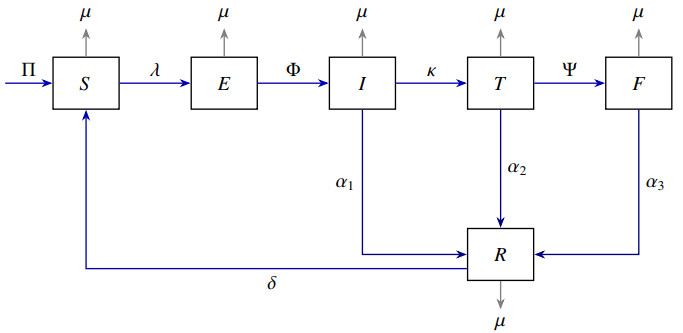
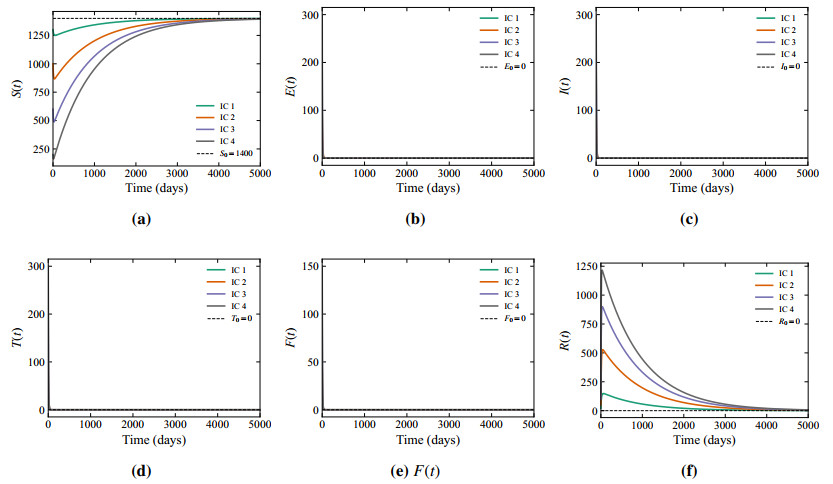
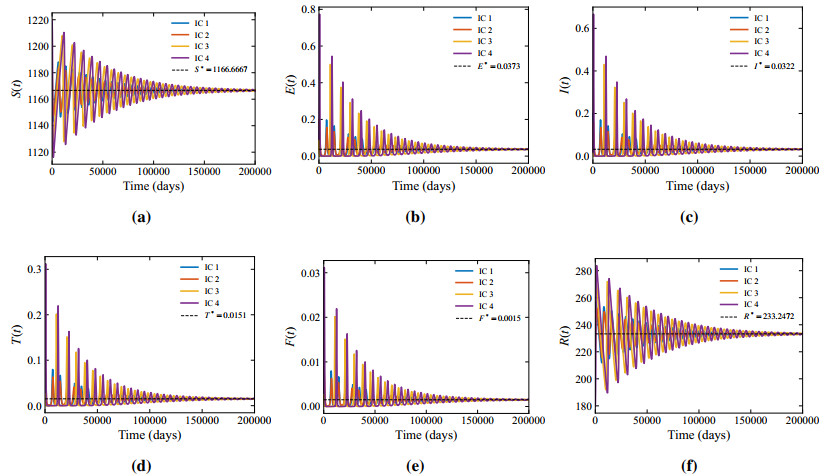
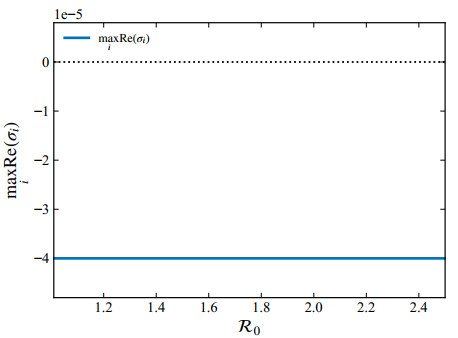
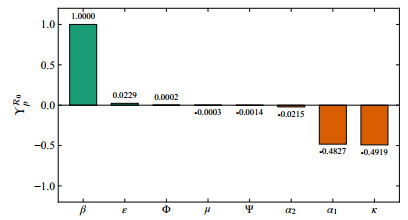
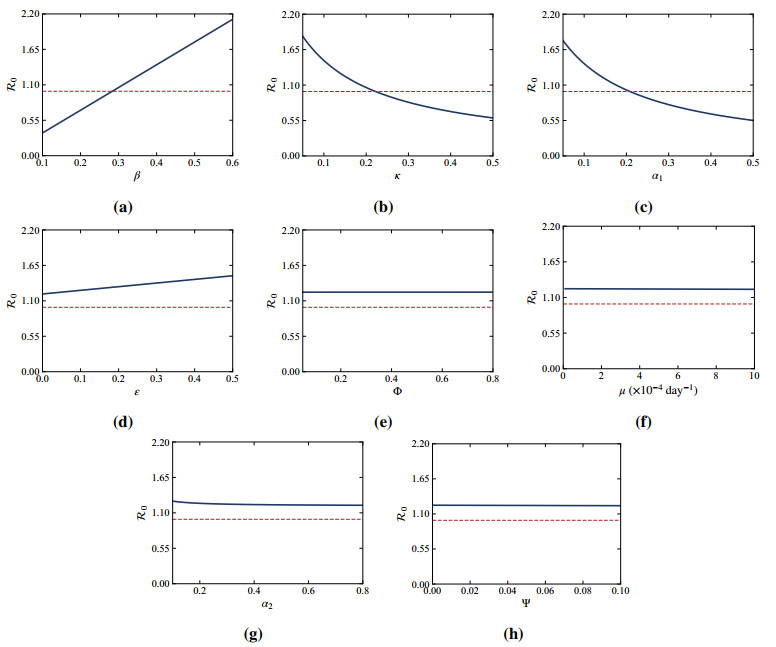
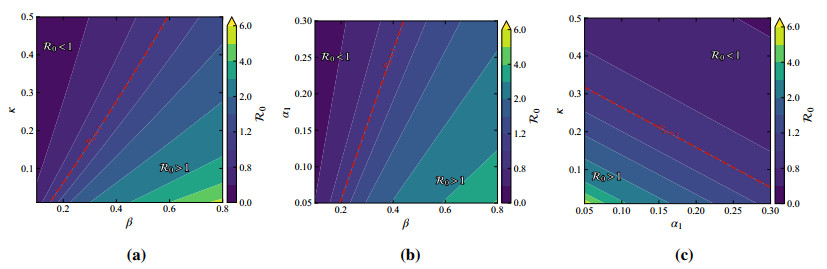
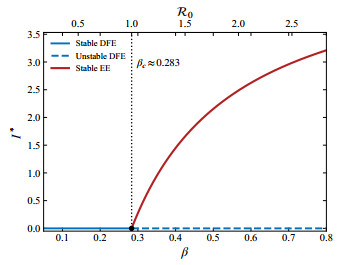
This study formulates and analyzes an susceptible–exposed–infectious–treated–failed treatment–recovered (SEITFR) model for conjunctivitis transmission. The compartments represent susceptible individuals, exposed individuals, infectious cases, treated cases, detected treatment failure cases, and recovered individuals. The model separates two clinically relevant effects: Treated individuals may still transmit infection at a reduced rate, while detected treatment-failure cases are assumed to be isolated or referred for further care and therefore do not contribute directly to community transmission. We prove the positivity, boundedness, and uniqueness of solutions; derive the basic reproduction number $ \mathcal{R}_0 $; and establish the local stability of the disease-free equilibrium for $ \mathcal{R}_0\leq 1 $ and its global stability for $ \mathcal{R}_0 < 1 $. The endemic equilibrium is globally asymptotically stable for $ \mathcal R_0>1 $ under a constant-population assumption and in the absence of immunity loss. Eigenvalue computations using the baseline loss-of-immunity rate further support the local stability of the endemic equilibrium over the tested supercritical range. A center manifold calculation for the full system confirms a forward transcritical bifurcation at $ \mathcal{R}_0 = 1 $. The sensitivity analysis shows that reducing contacts and residual infectiousness during treatment is essential and that increasing the treatment rate is beneficial only when treatment is accompanied by sufficient isolation or rapid clinical resolution. Numerical simulations illustrate the threshold behavior, the convergence to disease-free or endemic states, and the parameter regions where eradication is expected.
Citation: Bashir Al-Hdaibat, Mohammad A. Safi, Areej Almuneef, Zuhur Alqahtani, Mahmoud H. DarAssi, Omar Attoum. Bifurcation and stability analysis of an SEITFR conjunctivitis model with standard incidence and treatment failure[J]. AIMS Mathematics, 2026, 11(8): 26640-26676. doi: 10.3934/math.20261069
This study formulates and analyzes an susceptible–exposed–infectious–treated–failed treatment–recovered (SEITFR) model for conjunctivitis transmission. The compartments represent susceptible individuals, exposed individuals, infectious cases, treated cases, detected treatment failure cases, and recovered individuals. The model separates two clinically relevant effects: Treated individuals may still transmit infection at a reduced rate, while detected treatment-failure cases are assumed to be isolated or referred for further care and therefore do not contribute directly to community transmission. We prove the positivity, boundedness, and uniqueness of solutions; derive the basic reproduction number $ \mathcal{R}_0 $; and establish the local stability of the disease-free equilibrium for $ \mathcal{R}_0\leq 1 $ and its global stability for $ \mathcal{R}_0 < 1 $. The endemic equilibrium is globally asymptotically stable for $ \mathcal R_0>1 $ under a constant-population assumption and in the absence of immunity loss. Eigenvalue computations using the baseline loss-of-immunity rate further support the local stability of the endemic equilibrium over the tested supercritical range. A center manifold calculation for the full system confirms a forward transcritical bifurcation at $ \mathcal{R}_0 = 1 $. The sensitivity analysis shows that reducing contacts and residual infectiousness during treatment is essential and that increasing the treatment rate is beneficial only when treatment is accompanied by sufficient isolation or rapid clinical resolution. Numerical simulations illustrate the threshold behavior, the convergence to disease-free or endemic states, and the parameter regions where eradication is expected.

| [1] |
V. Mbazumutima, P. Nshimirimana, A. Dembele, F. Ndayiragije, L. Todjihounde, Mathematical modelling of conjunctivitis viral disease: case of Burundi, Open J. Appl. Sci., 15 (2025), 1366–1377. https://doi.org/10.4236/ojapps.2025.155096 doi: 10.4236/ojapps.2025.155096

|
| [2] |
R. ud Din, N. Ahmad, S. Ahmad, P. Pongsumpun, Modeling of eye infection transmitting by conjunctivitis adenovirus: deterministic and stochastic approach, Eur. J. Pure Appl. Math., 18 (2025), 6364. https://doi.org/10.29020/nybg.ejpam.v18i4.6364 doi: 10.29020/nybg.ejpam.v18i4.6364
|
| [3] | G. Sikazwe, Modelling acute hemorrhagic conjunctivitis in East Africa: an integrated approach to transmission dynamics and outbreak response strategies, Preprint at SSRN, 2025. |
| [4] | M. Zulfiqar, S. Rafique, A. Habib, A. Qader, A. Asghar, R. Riaz, Conjunctivitis infection: a brief review on its classification, etiology and therapeutic interventions, Biol. Clin. Sci. Res. J., 2024 (2024). https://doi.org/10.54112/bcsrj.v2024i1.780 |
| [5] | A. Mueller, Allergic conjunctivitis: an update, In: C. Traidl-Hoffmann, T. Zuberbier, T. Werfel, Allergic diseases – From basic mechanisms to comprehensive management and prevention, Springer, Cham, 2021, 95–99. https://doi.org/10.1007/164_2021_491 |
| [6] |
S. J. Ono, M. B. Abelson, Allergic conjunctivitis: update on pathophysiology and prospects for future treatment, J. Allergy Clin. Immunol., 115 (2005), 118–122. https://doi.org/10.1016/j.jaci.2004.10.042 doi: 10.1016/j.jaci.2004.10.042
|
| [7] | M. A. Pallansch, Enterovirus infections, including poliomyelitis, In: R. L. Guerrant, D. H. Walker, P. F. Weller, Tropical infectious diseases: principles, pathogens and practice, 3 Eds., Saunders, 2011,398–405. https://doi.org/10.1016/B978-0-7020-3935-5.00060-4 |
| [8] | S. Resnikoff, D. Pascolini, D. Etya'ale, I. Kocur, R. Pararajasegaram, G. P. Pokharel, et al., Global data on visual impairment in the year 2002, Bull. World Health Organ., 82 (2004), 844–851. |
| [9] |
V. H. Hu, E. M. Harding-Esch, M. J. Burton, R. L. Bailey, J. Kadimpeul, D. C. W. Mabey, Epidemiology and control of trachoma: systematic review, Trop. Med. Int. Health, 15 (2010), 673–691. https://doi.org/10.1111/j.1365-3156.2010.02521.x doi: 10.1111/j.1365-3156.2010.02521.x
|
| [10] | J. Suksawat, S. Naowarat, Effect of rainfall on the transmission model of conjunctivitis, Adv. Environ. Biol., 8 (2014), 99–104. |
| [11] |
G. Chowell, E. Shim, F. Brauer, P. Diaz-Dueñas, J. M. Hyman, C. Castillo-Chavez, Modelling the transmission dynamics of acute haemorrhagic conjunctivitis: application to the 2003 outbreak in Mexico, Stat. Med., 25 (2006), 1840–1857. https://doi.org/10.1002/sim.2352 doi: 10.1002/sim.2352
|
| [12] | B. Unyong, S. Naowarat, Stability analysis of conjunctivitis model with nonlinear incidence term, Aust. J. Basic Appl. Sci., 8 (2014), 52–58. |
| [13] |
O. M. Ogunmiloro, Stability analysis and optimal control strategies of direct and indirect transmission dynamics of conjunctivitis, Math. Methods Appl. Sci., 43 (2020), 10619–10636. https://doi.org/10.1002/mma.6756 doi: 10.1002/mma.6756
|
| [14] |
K. S. Nisar, A. Ahmad, M. Farman, E. Hincal, A. Zehra, Modeling and mathematical analysis of fractional order eye infection (conjunctivitis) virus model with treatment impact: prelicence and dynamical transmission, Alex. Eng. J., 107 (2024), 33–46. https://doi.org/10.1016/j.aej.2024.07.020 doi: 10.1016/j.aej.2024.07.020
|
| [15] |
S. Mangala, E. Bonyah, V. S. Sharma, Y. Yuan, A novel fractional-order stochastic epidemic model to analyze the role of media awareness in the spread of conjunctivitis, Healthcare Anal., 5 (2024), 100302. https://doi.org/10.1016/j.health.2024.100302 doi: 10.1016/j.health.2024.100302
|
| [16] |
F. Javed, A. Ahmad, A. H. Ali, E. Hincal, A. Amjad, Investigation of conjunctivitis adenovirus spread in human eyes by using bifurcation tool and numerical treatment approach, Phys. Scr., 99 (2024), 085253. https://doi.org/10.1088/1402-4896/ad62a5 doi: 10.1088/1402-4896/ad62a5
|
| [17] |
M. Tashfeen, H. S. Jassim, F. Dayan, M. A. Rehman, A. D. Zoltán, H. A. Neamah, An analytical approach to modeling conjunctival viral disease using fuzzy logic and time-delay dynamics, Healthcare Anal., 8 (2025), 100404. https://doi.org/10.1016/j.health.2025.100404 doi: 10.1016/j.health.2025.100404
|
| [18] |
W. Li, L. Yang, J. Cao, Threshold dynamics of a degenerated diffusive incubation period host-pathogen model with saturation incidence rate, Appl. Math. Lett., 160 (2025), 109312. https://doi.org/10.1016/j.aml.2024.109312 doi: 10.1016/j.aml.2024.109312
|
| [19] |
W. Li, Y. Zhang, J. Ji, L. Huang, Dynamics of a diffusion epidemic SIRI system in heterogeneous environment, Z. Angew. Math. Phys., 74 (2023), 104. https://doi.org/10.1007/s00033-023-02002-z doi: 10.1007/s00033-023-02002-z
|
| [20] |
W. Li, Y. Guan, J. Cao, F. Xu, A note on global stability of a degenerate diffusion avian influenza model with seasonality and spatial heterogeneity, Appl. Math. Lett., 148 (2024), 108884. https://doi.org/10.1016/j.aml.2023.108884 doi: 10.1016/j.aml.2023.108884
|
| [21] |
W. Li, L. Zhang, J. Cao, F. Xu, Z. Cai, Finite time attractivity and exponentially stable of a multi-stage epidemic system with discontinuous incidence, Qual. Theory Dyn. Syst., 24 (2025), 199. https://doi.org/10.1007/s12346-025-01358-z doi: 10.1007/s12346-025-01358-z
|
| [22] |
W. Li, Y. Zhang, Q. Ding, J. Yu, Exponential convergence of a diffusive SIRS epidemic model with standard incidence, J. Geom. Anal., 36 (2026), 13. https://doi.org/10.1007/s12220-025-02251-6 doi: 10.1007/s12220-025-02251-6
|
| [23] |
B. Al-Hdaibat, M. Z. Meetei, I. Ahmad, N. Althobaiti, M. A. Safi, M. A. Khan, et al., The dynamics of monkeypox disease under $\psi$–Hilfer fractional derivative: application to real data, Results Phys., 55 (2023), 107127. https://doi.org/10.1016/j.rinp.2023.107127 doi: 10.1016/j.rinp.2023.107127
|
| [24] |
Z. Alqahtani, A. Almuneef, M. H. DarAssi, Y. AbuHour, M. Al-arydah, M. A. Safi, et al., Mathematical analysis of fractional Chlamydia pandemic model, Sci. Rep., 14 (2024), 31113. https://doi.org/10.1038/s41598-024-82428-1 doi: 10.1038/s41598-024-82428-1
|
| [25] |
B. Al-Hdaibat, M. A. Khan, I. Ahmad, E. Alzahrani, A. Akgul, Modeling and analyzing the dynamics of brucellosis disease with vaccination in the fractional derivative under real cases, J. Appl. Math. Comput., 71 (2025), 5567–5588. https://doi.org/10.1007/s12190-025-02435-x doi: 10.1007/s12190-025-02435-x
|
| [26] |
M. Khader, M. H. DarAssi, Residual power series method for solving nonlinear reaction-diffusion-convection problems, Bol. Soc. Parana. Mat., 39 (2021), 177–188. https://doi.org/10.5269/bspm.41741 doi: 10.5269/bspm.41741
|
| [27] |
B. Al-Hdaibat, M. H. DarAssi, I. Ahmad, M. A. Khan, R. Algethamie, E. Alzahrani, Numerical investigation of an SIR fractional order delay epidemic model in the framework of Mittag–Leffler kernel, Nonlinear Dynam., 113 (2025), 17289–17309. https://doi.org/10.1007/s11071-025-11006-5 doi: 10.1007/s11071-025-11006-5
|
| [28] |
B. Al-Hdaibat, A. Alameer, Bifurcation and chaos in a nonlinear population model with delayed nonlinear interactions, Mathematics, 13 (2025), 2132. https://doi.org/10.3390/math13132132 doi: 10.3390/math13132132
|
| [29] |
H. Alrabaiah, M. A. Safi, M. H. DarAssi, B. Al-Hdaibat, S. Ullah, M. A. Khan, et al., Optimal control analysis of hepatitis B virus with treatment and vaccination, Results Phys., 19 (2020), 103599. https://doi.org/10.1016/j.rinp.2020.103599 doi: 10.1016/j.rinp.2020.103599
|
| [30] | B. Al-Hdaibat, M. H. DarAssi, I. Ahmad, M. A. Khan, R. Algethamie, Investigating tuberculosis dynamics under various control strategies: a comprehensive analysis using real statistical data, Math. Methods Appl. Sci., 2025. In press. https://doi.org/10.1002/mma.10779 |
| [31] | Centers for Disease Control and Prevention, Clinical overview of pink eye (conjunctivitis), 2024. Available from: https://www.cdc.gov/conjunctivitis/hcp/clinical-overview/index.html. |
| [32] | G. Teschl, Ordinary differential equations and dynamical systems, Providence, RI: American Mathematical Society, 2024. |
| [33] |
O. Diekmann, J. A. P. Heesterbeek, M. G. Roberts, The construction of next-generation matrices for compartmental epidemic models, J. R. Soc. Interface, 47 (2010), 873–885. https://doi.org/10.1098/rsif.2009.0386 doi: 10.1098/rsif.2009.0386
|
| [34] |
P. van den Driessche, J. Watmough, Reproduction numbers and sub-threshold endemic equilibria for compartmental models of disease transmission, Math. Biosci., 180 (2002), 29–48. https://doi.org/10.1016/s0025-5564(02)00108-6 doi: 10.1016/s0025-5564(02)00108-6
|
| [35] | L. J. S. Allen, An introduction to mathematical biology, Pearson/Prentice Hall, Upper Saddle River, NJ, 2007. |
| [36] |
J. E. Mahbuba, X. S. Wang, Stability analysis of biological systems under threshold conditions, Symmetry, 17 (2025), 1193. https://doi.org/10.3390/sym17081193 doi: 10.3390/sym17081193
|
| [37] | J. P. LaSalle, The stability of dynamical systems, Society for Industrial and Applied Mathematics, Philadelphia, PA, 1976. https://doi.org/10.1137/1.9781611970432 |
| [38] |
C. Castillo-Chavez, B. Song, Dynamical models of tuberculosis and their applications, Math. Biosci. Eng., 1 (2004), 361–404. https://doi.org/10.3934/mbe.2004.1.361 doi: 10.3934/mbe.2004.1.361
|
| [39] |
S. Nana-Kyere, K. K. Danquah, G. K. Hoggar, J. K. K. Asamoah, E. Acheampong, E. Okyere, Dynamical modelling and optimal control of conjunctivitis epidemic, Eng. Rep., 7 (2025), e70542. https://doi.org/10.1002/eng2.70542 doi: 10.1002/eng2.70542
|
| [40] | G. Chowell, C. Castillo-Chavez, P. Diaz-Duenas, Characterization of an outbreak of acute hemorrhagic conjunctivitis in Mexico, 2003, Digital J. Ophthalm., 2005. |
Figures(11) / Tables(2)

Bashir Al-Hdaibat, Mohammad A. Safi, Areej Almuneef, Zuhur Alqahtani, Mahmoud H. DarAssi, Omar Attoum. Bifurcation and stability analysis of an SEITFR conjunctivitis model with standard incidence and treatment failure[J]. AIMS Mathematics, 2026, 11(8): 26640-26676. doi: 10.3934/math.20261069





 DownLoad: