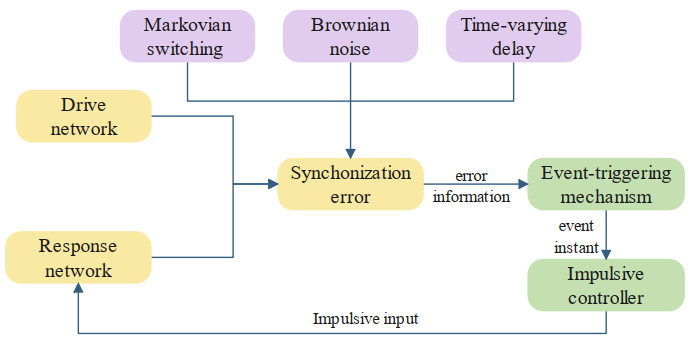
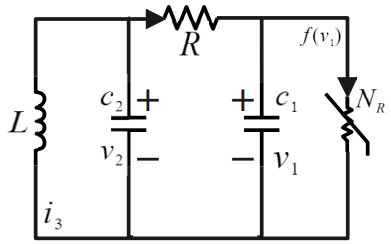
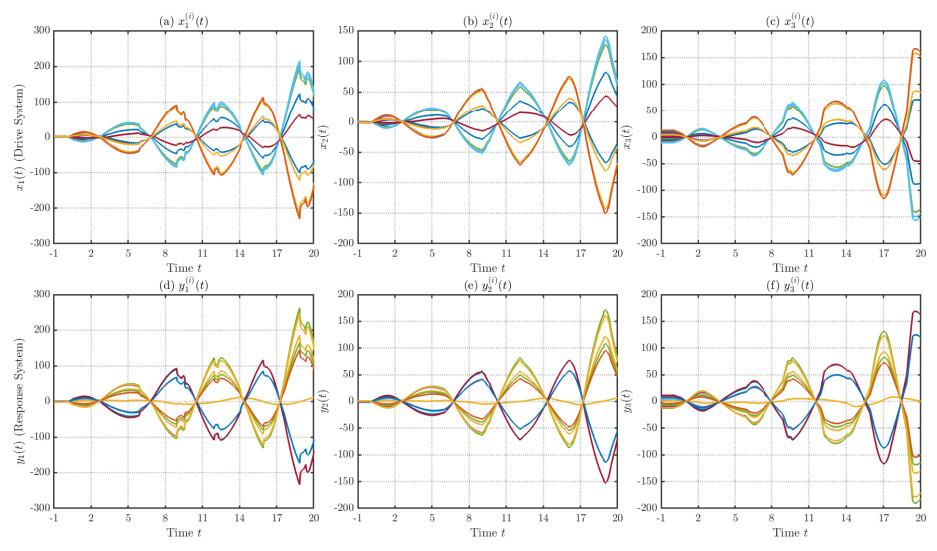
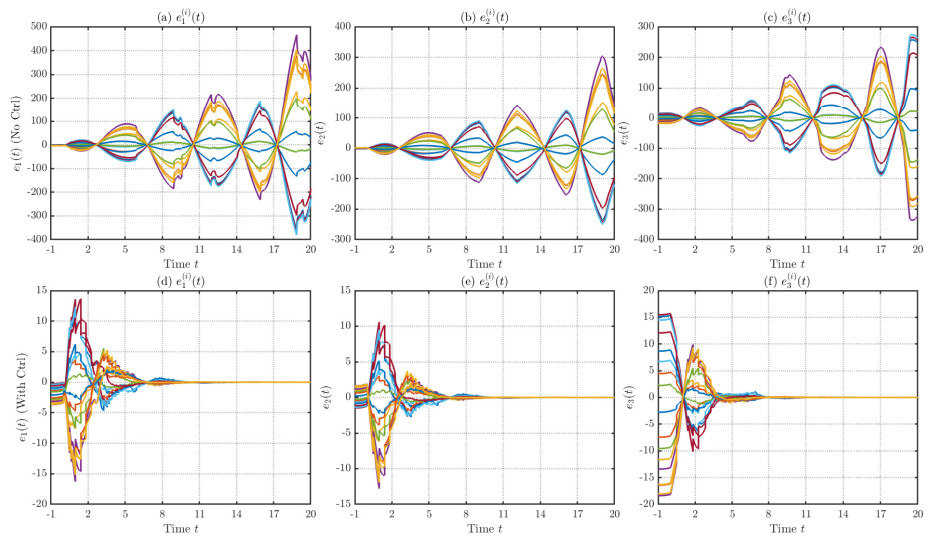
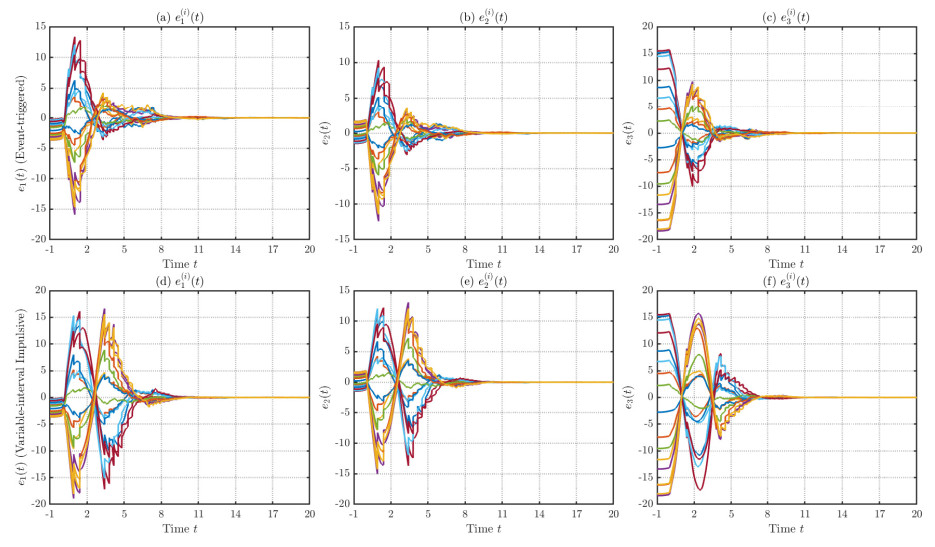
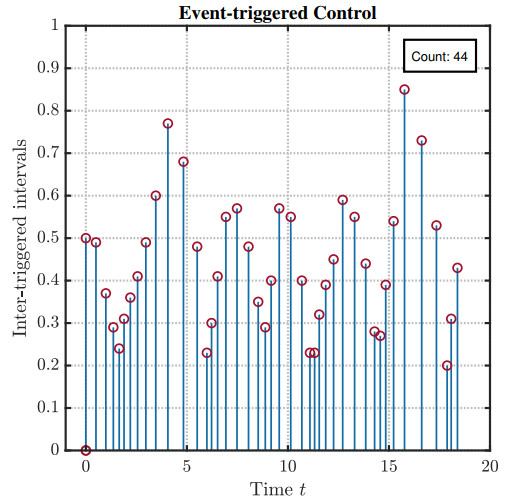
This work focused on the synchronization of stochastic complex networks with time-varying delays and state-dependent countably infinite-state Markovian switching under event-triggered impulsive control. A drive–response framework was adopted, and the synchronization problem was reduced to the $ p $-th moment exponential stability of an associated error system. The response network was regulated by a state-dependent impulsive mechanism whose triggering instants were generated by the evolution of the synchronization error, thereby avoiding unnecessary control updates. To handle the countably infinite switching state space, Lyapunov methods were combined with uniform strong exponential ergodicity of the switching process and mode-uniform coefficient bounds. Within this framework, a general Lyapunov-type criterion was first established for the error dynamics, and a more explicit coefficient-based criterion was then derived to facilitate verification in applications. These results yield sufficient conditions for $ p $-th moment exponential synchronization of the drive and response networks. In addition, an explicit positive lower bound on the inter-event intervals was obtained, which excludes Zeno behavior and ensures implementability of the proposed control law. Numerical experiments on a coupled Chua circuit network with finite-state switching were presented as a special-case illustration of the theory. The simulations showed that the proposed event-triggered impulsive strategy effectively suppresses the synchronization error while remaining consistent with the theoretical lower-bound estimate for the triggering intervals.
Citation: Zezhen Feng, Sihan Zhao, Jiqiang Feng, Chen Xu. State-dependent event-triggered impulsive synchronization of stochastic delayed networks under countably infinite-state Markovian switching[J]. AIMS Mathematics, 2026, 11(8): 26614-26639. doi: 10.3934/math.20261068
This work focused on the synchronization of stochastic complex networks with time-varying delays and state-dependent countably infinite-state Markovian switching under event-triggered impulsive control. A drive–response framework was adopted, and the synchronization problem was reduced to the $ p $-th moment exponential stability of an associated error system. The response network was regulated by a state-dependent impulsive mechanism whose triggering instants were generated by the evolution of the synchronization error, thereby avoiding unnecessary control updates. To handle the countably infinite switching state space, Lyapunov methods were combined with uniform strong exponential ergodicity of the switching process and mode-uniform coefficient bounds. Within this framework, a general Lyapunov-type criterion was first established for the error dynamics, and a more explicit coefficient-based criterion was then derived to facilitate verification in applications. These results yield sufficient conditions for $ p $-th moment exponential synchronization of the drive and response networks. In addition, an explicit positive lower bound on the inter-event intervals was obtained, which excludes Zeno behavior and ensures implementability of the proposed control law. Numerical experiments on a coupled Chua circuit network with finite-state switching were presented as a special-case illustration of the theory. The simulations showed that the proposed event-triggered impulsive strategy effectively suppresses the synchronization error while remaining consistent with the theoretical lower-bound estimate for the triggering intervals.

| [1] |
T. Ding, X. Hou, Z. Zhang, J. Wang, J. Du, C. Jiang, et al., Disturbance-resilient uav formation control for low-altitude economy: elliptical configuration tracking via a generalized predefined-time approach, IEEE Trans. Veh. Technol., 75 (2026), 1934–1947. https://doi.org/10.1109/TVT.2025.3601551 doi: 10.1109/TVT.2025.3601551

|
| [2] |
H. Kim, S. Kim, S. C. Jun, C. S. Nam, Is what I think what you think? multilayer network-based inter-brain synchrony approach, Social Cognitive and Affective Neuroscience, 20 (2025), nsaf028. https://doi.org/10.1093/scan/nsaf028 doi: 10.1093/scan/nsaf028
|
| [3] |
S. Ansarinasab, S. Panahi, F. Ghassemi, D. Ghosh, S. Jafari, Synchronization stability analysis of functional brain networks in boys with adhd during facial emotions processing, Physica A, 603 (2022), 127848. https://doi.org/10.1016/j.physa.2022.127848 doi: 10.1016/j.physa.2022.127848
|
| [4] |
Z. Chen, C. Huo, X. Zou, W. Li, Delayed impulsive control for synchronization of complex-valued stochastic complex network with unbounded delays under cyber attacks, Chaos Soliton. Fract., 180 (2024), 114526. https://doi.org/10.1016/j.chaos.2024.114526 doi: 10.1016/j.chaos.2024.114526
|
| [5] |
R. Guo, J. Feng, Y. Zhao, T. Huang, X. Liu, J. Wang, Robust model predictive control for perturbed nonlinear multi-agent systems via dynamic event-triggered scheme, Sci. China Inf. Sci., 69 (2026), 142205. https://doi.org/10.1007/s11432-024-4807-5 doi: 10.1007/s11432-024-4807-5
|
| [6] |
D. He, Z. Yang, J. Mu, Y. Li, Distributed model predictive platooning control of heterogenous cavs under markovian switching communication topologies, IEEE Trans. Veh. Technol., 75 (2026), 145–155. https://doi.org/10.1109/TVT.2025.3592526 doi: 10.1109/TVT.2025.3592526
|
| [7] |
W. Qi, M. Sha, G. Zong, S.-F. Su, J. Cao, R.-H. Yeh, et al., Adaptive fuzzy control of networked hidden stochastic switching power systems under cyber attacks, IEEE Trans. Cybernetics, 55 (2025), 3182–3192. https://doi.org/10.1109/TCYB.2025.3567360 doi: 10.1109/TCYB.2025.3567360
|
| [8] |
Y.-N. Sun, X.-Z. Liu, Y.-M. Lei, Dynamic balance and reliability of a stochastic ecosystem with markov switching, Chinese Phys. B, 35 (2026), 010507. https://doi.org/10.1088/1674-1056/adea58 doi: 10.1088/1674-1056/adea58
|
| [9] |
S. Li, H. Su, X. Ding, The existence of inner synchronized stationary distribution for stochastic coupled systems on networks, Physica A, 538 (2020), 122828. https://doi.org/10.1016/j.physa.2019.122828 doi: 10.1016/j.physa.2019.122828
|
| [10] |
Y. Liu, S. Zhao, D. Chu, W. Li, Synchronized stationary distribution and synchronization of stochastic coupled networks with markovian switching via periodically intermittent control, Neurocomputing, 410 (2020), 28–40. https://doi.org/10.1016/j.neucom.2020.05.051 doi: 10.1016/j.neucom.2020.05.051
|
| [11] |
W. Zhang, S. Zhong, X. Jiang, Finite-time annular domain stability and asynchronous $h_{\infty }$ control for stochastic switching markov jump systems, IEEE Trans. Automat. Contr., 69 (2024), 6277–6284. https://doi.org/10.1109/TAC.2024.3379248 doi: 10.1109/TAC.2024.3379248
|
| [12] |
D. He, L. Xu, Ultimate boundedness of nonautonomous dynamical complex networks under impulsive control, IEEE Trans. Circuits Syst. II, 62 (2015), 997–1001. https://doi.org/10.1109/TCSII.2015.2436191 doi: 10.1109/TCSII.2015.2436191
|
| [13] |
X. He, Y. Wang, X. Li, Uncertain impulsive control for leader-following synchronization of complex networks, Chaos Soliton. Fract., 147 (2021), 110980. https://doi.org/10.1016/j.chaos.2021.110980 doi: 10.1016/j.chaos.2021.110980
|
| [14] |
Y. Guan, G. Ping, W. X. Zheng, H. Yao, Distributed event-triggered scheduling in networked interconnected systems with sparse connections, Neurocomputing, 400 (2020), 420–428. https://doi.org/10.1016/j.neucom.2019.04.080 doi: 10.1016/j.neucom.2019.04.080
|
| [15] |
Q. Li, B. Shen, Z. Wang, T. Huang, J. Luo, Synchronization control for a class of discrete time-delay complex dynamical networks: a dynamic event-triggered approach, IEEE Trans. Cybernetics, 49 (2019), 1979–1986. https://doi.org/10.1109/TCYB.2018.2818941 doi: 10.1109/TCYB.2018.2818941
|
| [16] |
H. J. Kim, S. J. Yoo, Dynamic event-triggered impulsive control for prescribed-time trajectory tracking of uncertain underactuated underwater vehicles with input saturation, Ocean Eng., 358 (2026), 125789. https://doi.org/10.1016/j.oceaneng.2026.125789 doi: 10.1016/j.oceaneng.2026.125789
|
| [17] |
A. Lamperski, A. D. Ames, Lyapunov theory for zeno stability, IEEE Trans. Automat. Contr., 58 (2013), 100–112. https://doi.org/10.1109/TAC.2012.2208292 doi: 10.1109/TAC.2012.2208292
|
| [18] |
N. Que, W. Deng, J. Yao, H. Liu, Z. Zhou, Prescribed-time output feedback tracking control of nonlinear systems with mismatched uncertainties, J. Franklin I., 363 (2026), 108626. https://doi.org/10.1016/j.jfranklin.2026.108626 doi: 10.1016/j.jfranklin.2026.108626
|
| [19] |
J. Yang, H. Liu, X. Tian, Q. Mai, J. Zhang, Adaptive prescribed-time trajectory tracking control for uvms based on error transformation and adaptive prescribed-time filter, Ocean Eng., 338 (2025), 121993. https://doi.org/10.1016/j.oceaneng.2025.121993 doi: 10.1016/j.oceaneng.2025.121993
|
| [20] | H. Li, Y. Li, Y. Gao, Prescribed-time observer-based output feedback control for nonlinear systems with full-state constraints, Asian J. Control, in press. https://doi.org/10.1002/asjc.70167 |
| [21] |
C. Li, M. Z. Q. Chen, J. Lam, X. Mao, On exponential almost sure stability of random jump systems, IEEE Trans. Automat. Contr., 57 (2012), 3064–3077. https://doi.org/10.1109/TAC.2012.2200369 doi: 10.1109/TAC.2012.2200369
|
| [22] |
J. Shao, Strong solutions and strong feller properties for regime-switching diffusion processes in an infinite state space, SIAM J. Control Optim., 53 (2015), 2462–2479. https://doi.org/10.1137/15M1013584 doi: 10.1137/15M1013584
|
| [23] |
G. Sui, J. Hu, Stationary oscillation of delayed complex dynamical networks under impulsive control involving delays, AIMS Math., 11 (2026), 20389–20406. https://doi.org/10.3934/math.2026828 doi: 10.3934/math.2026828
|
| [24] |
J. Zhu, G. Zhang, L. Wang, Quasi-projective and finite-time synchronization of fractional-order memristive complex-valued delay neural networks via hybrid control, AIMS Math., 9 (2024), 7627–7644. https://doi.org/10.3934/math.2024370 doi: 10.3934/math.2024370
|
| [25] |
R. Guo, J. Feng, J. Wang, G. Chen, T. Huang, X. Liu, Dynamic event-triggered DMPC with variable prediction horizon for disturbed nonlinear multiagent systems, IEEE Trans. Control Netw. Syst., 12 (2025), 3073–3085. https://doi.org/10.1109/TCNS.2025.3609433 doi: 10.1109/TCNS.2025.3609433
|
| [26] |
Y. Liu, Y. Shi, N. Zhang, Bipartite synchronization of fuzzy functional coupled systems with markov jumps via intermittent control and dupire itô's formula, Nonlinear Dyn., 114 (2026), 506. https://doi.org/10.1007/s11071-026-12376-0 doi: 10.1007/s11071-026-12376-0
|
| [27] |
J. Cai, J. Yu, Z. You, C. Jing, Event-triggered synchronization for delayed dynamic complex networks via impulsive control strategy, AIMS Math., 11 (2026), 11173–11193. https://doi.org/10.3934/math.2026460 doi: 10.3934/math.2026460
|
| [28] |
D. H. Nguyen, G. Yin, Stability of regime-switching diffusion systems with discrete states belonging to a countable set, SIAM J. Control Optim., 56 (2018), 3893–3917. https://doi.org/10.1137/17M1118476 doi: 10.1137/17M1118476
|
| [29] |
M. Y. Li, Z. Shuai, Global-stability problem for coupled systems of differential equations on networks, J. Differ. Equations, 248 (2010), 1–20. https://doi.org/10.1016/j.jde.2009.09.003 doi: 10.1016/j.jde.2009.09.003
|
| [30] |
H. Liu, X. Li, Q. Yang, The ergodic property and positive recurrence of a multi‑group lotka–volterra mutualistic system with regime switching, Syst. Control Lett., 62 (2013), 805–810. https://doi.org/10.1016/j.sysconle.2013.06.002 doi: 10.1016/j.sysconle.2013.06.002
|
| [31] |
Y. Liu, J. Liu, W. Li, Stabilization of highly nonlinear stochastic coupled systems via periodically intermittent control, IEEE Trans. Automat. Contr., 66 (2021), 4799–4806. https://doi.org/10.1109/TAC.2020.3036035 doi: 10.1109/TAC.2020.3036035
|
| [32] |
Y. Wu, B. Shen, C. K. Ahn, W. Li, Intermittent dynamic event-triggered control for synchronization of stochastic complex networks, IEEE Trans. Circuits Syst. I, 68 (2021), 2639–2650. https://doi.org/10.1109/TCSI.2021.3071034 doi: 10.1109/TCSI.2021.3071034
|
| [33] |
Y. Xu, Z. Chen, W. Li, Y. Wu, Exponential stability of fractional-order fuzzy multilayer networks with short memory and noninstantaneous impulses via intermittent control, IEEE Trans. Fuzzy Syst., 33 (2025), 1639–1649. https://doi.org/10.1109/TFUZZ.2025.3528975 doi: 10.1109/TFUZZ.2025.3528975
|
| [34] |
M. Wang, R. Zheng, J. Feng, S. Qin, W. Li, Aperiodically intermittent control for exponential bipartite synchronization of delayed signed networks with multi-links, Chaos, 30 (2020), 033110. https://doi.org/10.1063/1.5126464 doi: 10.1063/1.5126464
|
Figures(8) / Tables(1)

Zezhen Feng, Sihan Zhao, Jiqiang Feng, Chen Xu. State-dependent event-triggered impulsive synchronization of stochastic delayed networks under countably infinite-state Markovian switching[J]. AIMS Mathematics, 2026, 11(8): 26614-26639. doi: 10.3934/math.20261068





 DownLoad: