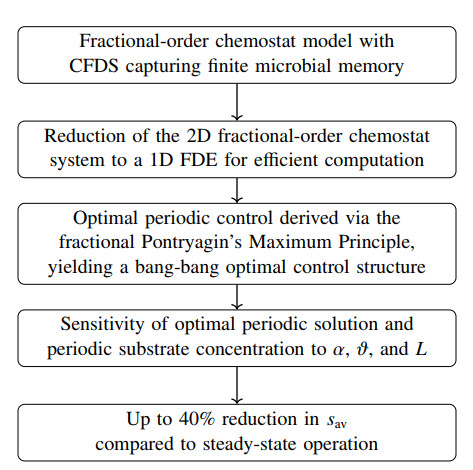
This paper develops a fractional-order chemostat model for biological water treatment using a Caputo fractional derivative with sliding memory (CFDS) to represent history-dependent microbial dynamics. We pose an optimal control problem that minimizes average pollutant concentration through periodic dilution-rate modulation subject to operational constraints. The analysis reduces the dynamics to a one-dimensional fractional differential equation, establishes existence and uniqueness of an optimal periodic solution, and derives the corresponding bang-bang control via the fractional Pontryagin maximum principle combined with a Fourier–Gegenbauer pseudospectral scheme. Sensitivity results show that the fractional order $ \alpha $, scaling parameter $ \vartheta $, and memory length $ L $ significantly influence treatment performance. Numerical simulations demonstrate substantial reductions in substrate levels compared with steady-state operation, underscoring the potential of fractional modeling for improving water treatment efficiency.
Citation: Kareem T. Elgindy, Muneerah AL Nuwairan, Liew Siaw Ching. Periodic fractional control in bioprocesses for clean water and ecosystem health[J]. AIMS Mathematics, 2026, 11(1): 1712-1760. doi: 10.3934/math.2026072
This paper develops a fractional-order chemostat model for biological water treatment using a Caputo fractional derivative with sliding memory (CFDS) to represent history-dependent microbial dynamics. We pose an optimal control problem that minimizes average pollutant concentration through periodic dilution-rate modulation subject to operational constraints. The analysis reduces the dynamics to a one-dimensional fractional differential equation, establishes existence and uniqueness of an optimal periodic solution, and derives the corresponding bang-bang control via the fractional Pontryagin maximum principle combined with a Fourier–Gegenbauer pseudospectral scheme. Sensitivity results show that the fractional order $ \alpha $, scaling parameter $ \vartheta $, and memory length $ L $ significantly influence treatment performance. Numerical simulations demonstrate substantial reductions in substrate levels compared with steady-state operation, underscoring the potential of fractional modeling for improving water treatment efficiency.

| [1] |
T. Bayen, A. Rapaport, F. Z. Tani, Improvement of performances of the chemostat used for continuous biological water treatment with periodic controls, Automatica, 121 (2020), 109199. https://doi.org/10.1016/j.automatica.2020.109199 doi: 10.1016/j.automatica.2020.109199

|
| [2] |
K. T. Elgindy, Sustainable water treatment through fractional-order chemostat modeling with sliding memory and periodic boundary conditions: A mathematical framework for clean water and sanitation, Fractal Fract., 10 (2026), 1–25. https://doi.org/10.3390/fractalfract10010004 doi: 10.3390/fractalfract10010004
|
| [3] |
K. T. Elgindy, New optimal periodic control policy for the optimal periodic performance of a chemostat using a Fourier–Gegenbauer-based predictor-corrector method, J. Process Contr., 127 (2023), 102995. https://doi.org/10.1016/j.jprocont.2023.102995 doi: 10.1016/j.jprocont.2023.102995
|
| [4] | V. E. Tarasov, Fractional dynamics: Applications of fractional calculus to dynamics of particles, fields and media, New York: Springer Science & Business Media, 2011. https://doi.org/10.1007/978-3-642-14003-7 |
| [5] |
R. Magin, Fractional calculus in bioengineering, part 1, Crit. Rev. Biomed. Eng., 32 (2004), 1–104. https://doi.org/10.1615/CritRevBiomedEng.v32.i1.10 doi: 10.1615/CritRevBiomedEng.v32.i1.10
|
| [6] | R. Caponetto, G. Dongola, L. Fortuna, I. Petras, Fractional order systems: Modeling and control applications, New Jersey: World Scientific, 72 (2010). https://doi.org/10.1142/7709 |
| [7] |
V. V. Kulish, J. L. Lage, Application of fractional calculus to fluid mechanics, J. Fluid. Eng., 124 (2002), 803–806. https://doi.org/10.1115/1.1478062 doi: 10.1115/1.1478062
|
| [8] |
B. Ghanbari, H. Günerhan, H. Srivastava, An application of the Atangana-Baleanu fractional derivative in mathematical biology: A three-species predator-prey model, Chaos Soliton. Fract., 138 (2020), 109910. https://doi.org/10.1016/j.chaos.2020.109910 doi: 10.1016/j.chaos.2020.109910
|
| [9] |
A. Charkaoui, A. B. Loghfyry, A novel multi-frame image super-resolution model based on regularized nonlinear diffusion with Caputo time fractional derivative, Commun. Nonlinear Sci., 139 (2024), 108280. https://doi.org/10.1016/j.cnsns.2024.108280 doi: 10.1016/j.cnsns.2024.108280
|
| [10] |
L. Loudahi, A. Ali, J. Yuan, J. Ahmad, L. G. Amin, Y. Wei, Fractal–fractional analysis of a water pollution model using fractional derivatives, Fractal Fract., 9 (2025), 321. https://doi.org/10.3390/fractalfract9050321 doi: 10.3390/fractalfract9050321
|
| [11] |
M. Du, Z. Wang, H. Hu, Measuring memory with the order of fractional derivative, Sci. Rep., 3 (2013), 3431. https://doi.org/10.1038/srep03431 doi: 10.1038/srep03431
|
| [12] |
C. Ionescu, A. Lopes, D. Copot, J. T. Machado, J. H. Bates, The role of fractional calculus in modeling biological phenomena: A review, Commun. Nonlinear Sci., 51 (2017), 141–159. https://doi.org/10.1016/j.cnsns.2017.04.001 doi: 10.1016/j.cnsns.2017.04.001
|
| [13] |
K. T. Elgindy, Fourier–Gegenbauer pseudospectral method for solving periodic fractional optimal control problems, Math. Comput. Simulat., 225 (2024), 148–164. https://doi.org/10.1016/j.matcom.2024.05.003 doi: 10.1016/j.matcom.2024.05.003
|
| [14] |
K. T. Elgindy, Fourier–Gegenbauer pseudospectral method for solving periodic higher-order fractional optimal control problems, Int. J. Comput. Meth., 21 (2024), 2450015. https://doi.org/10.1142/S0219876224500154 doi: 10.1142/S0219876224500154
|
| [15] |
K. T. Elgindy, Fourier-Gegenbauer pseudospectral method for solving time-dependent one-dimensional fractional partial differential equations with variable coefficients and periodic solutions, Math. Comput. Simulat., 218 (2024), 544–555. https://doi.org/10.1016/j.matcom.2023.11.034 doi: 10.1016/j.matcom.2023.11.034
|
| [16] | I. Podlubny, Fractional differential equations: An introduction to fractional derivatives, fractional differential equations, to methods of their solution and some of their applications, San Diego: Academic Press, 198 (1998). |
| [17] | A. Kilbas, Theory and applications of fractional differential equations, North-Holland Math. Stud., 204 (2006). |
| [18] |
S. Bourafa, M. S. Abdelouahab, R. Lozi, On periodic solutions of fractional-order differential systems with a fixed length of sliding memory, J. Innov. Appl. Math. Comput. Sci., 1 (2021), 64–78. 10.58205/jiamcs.v1i1.6 doi: 10.58205/jiamcs.v1i1.6
|
| [19] |
C. S. Gokhale, S. Giaimo, P. Remigi, Memory shapes microbial populations, PLoS Comput. Biol., 17 (2021), e1009431. https://doi.org/10.1371/journal.pcbi.1009431 doi: 10.1371/journal.pcbi.1009431
|
| [20] |
R. F. Romm, N. Yedidi, O. Gefen, N. K. Nagar, L. Aroeti, I. Ronin, et al., Uncovering phenotypic inheritance from single cells with Microcolony-seq, Cell, 188 (2025), 5313–5331. https://doi.org/10.1016/j.cell.2025.08.001 doi: 10.1016/j.cell.2025.08.001
|
| [21] |
M. Khalighi, G. S. Klein, D. Gonze, K. Faust, L. Lahti, Quantifying the impact of ecological memory on the dynamics of interacting communities, PLoS Comput. Biol., 18 (2022), e1009396. https://doi.org/10.1371/journal.pcbi.1009396 doi: 10.1371/journal.pcbi.1009396
|
| [22] |
M. M. Amirian, A. J. Irwin, Z. V. Finkel, Extending the monod model of microbal growth with memory, Front. Mar. Sci., 9 (2022), 963734. https://doi.org/10.3389/fmars.2022.963734 doi: 10.3389/fmars.2022.963734
|
| [23] |
K. P. Rumbaugh, K. Sauer, Biofilm dispersion, Nat. Rev. Microbiol., 18 (2020), 571–586. https://doi.org/10.1038/s41579-020-0385-0 doi: 10.1038/s41579-020-0385-0
|
| [24] |
M. Raboni, V. Torretta, G. Urbini, Influence of strong diurnal variations in sewage quality on the performance of biological denitrification in small community wastewater treatment plants (WWTPs), Sustainability, 5 (2013), 3679–3689. https://doi.org/10.3390/su5093679 doi: 10.3390/su5093679
|
| [25] |
A. Novick, M. Weiner, Enzyme induction as an all-or-none phenomenon, P. Natl. Acad. Sci. USA, 43 (1957), 553–566. https://doi.org/10.1073/pnas.43.7.553 doi: 10.1073/pnas.43.7.553
|
| [26] |
G. Lambert, E. Kussell, Memory and fitness optimization of bacteria under fluctuating environments, PLoS Genet., 10 (2014), e1004556. https://doi.org/10.1371/journal.pgen.1004556 doi: 10.1371/journal.pgen.1004556
|
| [27] |
A. Mitchell, G. H. Romano, B. Groisman, A. Yona, E. Dekel, M. Kupiec, et al., Adaptive prediction of environmental changes by microorganisms, Nature, 460 (2009), 220–224. https://doi.org/10.1038/nature08112 doi: 10.1038/nature08112
|
| [28] |
M. B. Miller, B. L. Bassler, Quorum sensing in bacteria, Annu. Rev. Microbiol., 55 (2001), 165–199. https://doi.org/10.1146/annurev.micro.55.1.165 doi: 10.1146/annurev.micro.55.1.165
|
| [29] | S. Renes, Shaped by the past: Resilience and ecological memory in microbial communities, Acta Univ. Agric. Sueciae, 2021. |
| [30] |
M. Vass, S. Langenheder, The legacy of the past: Effects of historical processes on microbial metacommunities, Aquat. Microb. Ecol., 79 (2017), 13–19. https://doi.org/10.3354/ame01816 doi: 10.3354/ame01816
|
| [31] | G. H. Chen, M. C. van Loosdrecht, G. A. Ekama, D. Brdjanovic, Biological wastewater treatment: Principles, modeling and design, London: IWA publishing, 2020. https://doi.org/10.2166/9781789060362 |
| [32] | F. Clarke, Functional analysis, calculus of variations and optimal control, London: Springer, 264 (2013). https://doi.org/10.1007/978-1-4471-4820-3 |
| [33] | N. Ahmed, S. Wang, Optimal control: Existence theory, In: Optimal Control of Dynamic Systems Driven by Vector Measures: Theory and Applications, Cham: Springer, 2021,109–149. doi.org/10.1007/978-3-030-82139-5_4 |
| [34] | D. Liberzon, Calculus of variations and optimal control theory: A concise introduction, Princeton: Princeton University Press, 2011. |
| [35] |
O. P. Agrawal, A general formulation and solution scheme for fractional optimal control problems, Nonlinear Dynam., 38 (2004), 323–337. https://doi.org/10.1007/s11071-004-3764-6 doi: 10.1007/s11071-004-3764-6
|
| [36] |
R. Kamocki, Pontryagin maximum principle for fractional ordinary optimal control problems, Math. Method. Appl. Sci., 37 (2014), 1668–1686. https://doi.org/10.1002/mma.2928 doi: 10.1002/mma.2928
|
| [37] |
M. Sahabi, A. Y. Cherati, Fractional pseudospectral schemes with applications to fractional optimal control problems, J. Math., 2024 (2024), 9917116. https://doi.org/10.1155/jom/9917116 doi: 10.1155/jom/9917116
|
| [38] |
Y. Yang, M. N. Skandari, J. Zhang, A pseudospectral method for continuous-time nonlinear fractional programming, Filomat, 38 (2024), 1947–1961. https://doi.org/10.2298/FIL2406947Y doi: 10.2298/FIL2406947Y
|
| [39] |
M. S. Ali, M. Shamsi, H. K. Arab, D. F. Torres, F. Bozorgnia, A space–time pseudospectral discretization method for solving diffusion optimal control problems with two-sided fractional derivatives, J. Vib. Control, 25 (2019), 1080–1095. https://doi.org/10.1177/107754631881119 doi: 10.1177/107754631881119
|
| [40] | C. L. Grady Jr, G. T. Daigger, N. G. Love, C. D. Filipe, Biological wastewater treatment, 3 Eds., New York: CRC press, 2011. https://doi.org/10.1201/b13775 |
| [41] |
K. T. Elgindy, Optimal periodic control of unmanned aerial vehicles based on Fourier integral pseudospectral and edge-detection methods, Unmanned Syst., 2024, 1–19. https://doi.org/10.1142/S230138502550075X doi: 10.1142/S230138502550075X
|
| [42] | P. W. Smeets, Stochastic modelling of drinking water treatment in quantitative microbial risk assessment, London: IWA Publishing, 2010. |
| [43] | R. Goebel, R. G. Sanfelice, A. R. Teel, Hybrid dynamical systems: Modeling, stability, and robustness, Princeton University Press, 2012. |
| [44] |
M. Lowe, R. Qin, X. Mao, A review on machine learning, artificial intelligence, and smart technology in water treatment and monitoring, Water, 14 (2022), 1384. https://doi.org/10.3390/w14091384 doi: 10.3390/w14091384
|
| [45] | G. Olsson, B. Newell, Wastewater treatment systems: Modelling, diagnosis and control, London: IWA Publishing, 2005. |
| [46] |
K. V. Gernaey, M. C. van Loosdrecht, M. Henze, M. Lind, S. B. Jørgensen, Activated sludge wastewater treatment plant modelling and simulation: state of the art, Environ. Modell. Softw., 19 (2004), 763–783. https://doi.org/10.1016/j.envsoft.2003.03.005 doi: 10.1016/j.envsoft.2003.03.005
|
| [47] |
S. Revollar, R. Vilanova, P. Vega, M. Francisco, M. Meneses, Wastewater treatment plant operation: Simple control schemes with a holistic perspective, Sustainability, 12 (2020), 768. https://doi.org/10.3390/su12030768 doi: 10.3390/su12030768
|
| [48] |
L. Åmand, G. Olsson, B. Carlsson, Aeration control–a review, Water Sci. Technol., 67 (2013), 2374–2398. https://doi.org/10.2166/wst.2013.139 doi: 10.2166/wst.2013.139
|
| [49] |
D. Vrecko, N. Hvala, A. Stare, O. Burica, M. Strazar, M. Levstek, Improvement of ammonia removal in activated sludge process with feedforward-feedback aeration controllers, Water Sci. Technol., 53 (2006), 125–132. https://doi.org/10.2166/wst.2006.098 doi: 10.2166/wst.2006.098
|
| [50] |
U. Jeppsson, M. N. Pons, The cost benchmark simulation model—current state and future perspective, Control Eng. Pract., 12 (2004), 299–304. https://doi.org/10.1016/j.conengprac.2003.07.001 doi: 10.1016/j.conengprac.2003.07.001
|
| [51] |
U. Jeppsson, M. N. Pons, I. Nopens, J. Alex, J. Copp, K. V. Gernaey, et al., Benchmark simulation model no. 2: general protocol and exploratory case studies, Water Sci. Technol., 56 (2007), 67–78. https://doi.org/10.2166/wst.2007.604 doi: 10.2166/wst.2007.604
|
| [52] |
I. Santín, C. Pedret, R. Vilanova, Applying variable dissolved oxygen set point in a two level hierarchical control structure to a wastewater treatment process, J. Process Control, 28 (2015), 40–55. https://doi.org/10.1016/j.jprocont.2015.02.005 doi: 10.1016/j.jprocont.2015.02.005
|
| [53] |
J. Guerrero, A. Guisasola, J. A. Baeza, The nature of the carbon source rules the competition between PAO and denitrifiers in systems for simultaneous biological nitrogen and phosphorus removal, Water Res., 45 (2011), 4793–4802. https://doi.org/10.1016/j.watres.2011.06.019 doi: 10.1016/j.watres.2011.06.019
|
| [54] | H. K. Khalil, J. W. Grizzle, Nonlinear systems, 3 Eds., Upper Saddle River: Prentice Hall, 2002. |
| [55] |
C. Li, F. Zhang, A survey on the stability of fractional differential equations, Eur. Phys. J.-Spec. Top., 193 (2011), 27–47. https://doi.org/10.1140/epjst/e2011-01379-1 doi: 10.1140/epjst/e2011-01379-1
|
| [56] | J. Guckenheimer, P. Holmes, Nonlinear oscillations, dynamical systems, and bifurcations of vector fields, New York: Springer Science & Business Media, 42 (2013). https://doi.org/10.1007/978-1-4612-1140-2 |
Figures(13) / Tables(2)

Kareem T. Elgindy, Muneerah AL Nuwairan, Liew Siaw Ching. Periodic fractional control in bioprocesses for clean water and ecosystem health[J]. AIMS Mathematics, 2026, 11(1): 1712-1760. doi: 10.3934/math.2026072





 DownLoad: