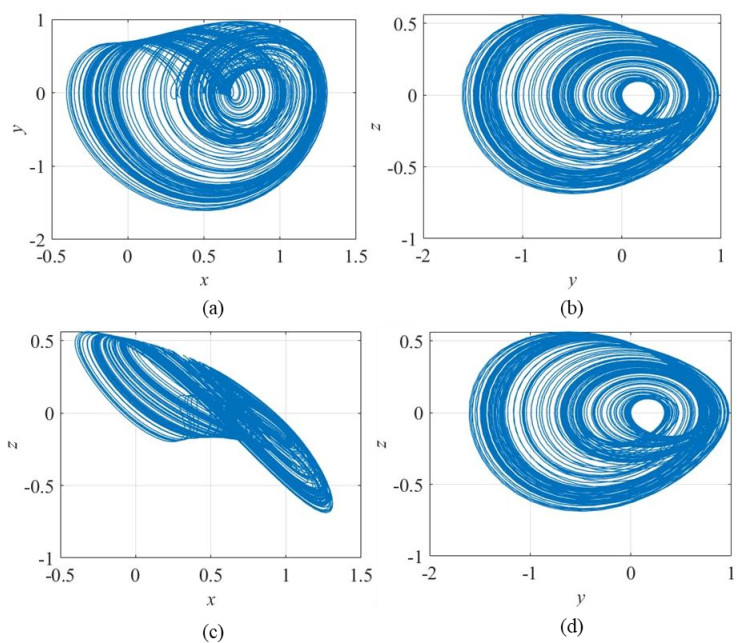
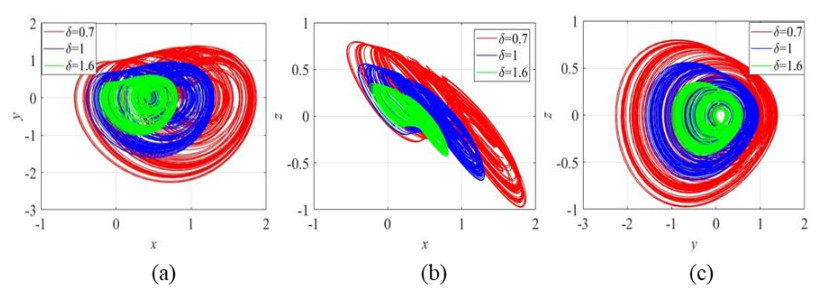
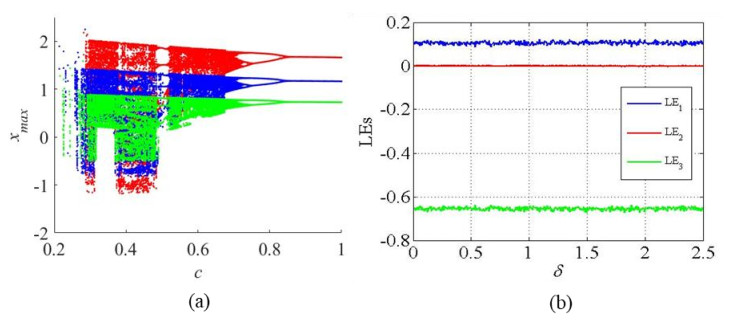
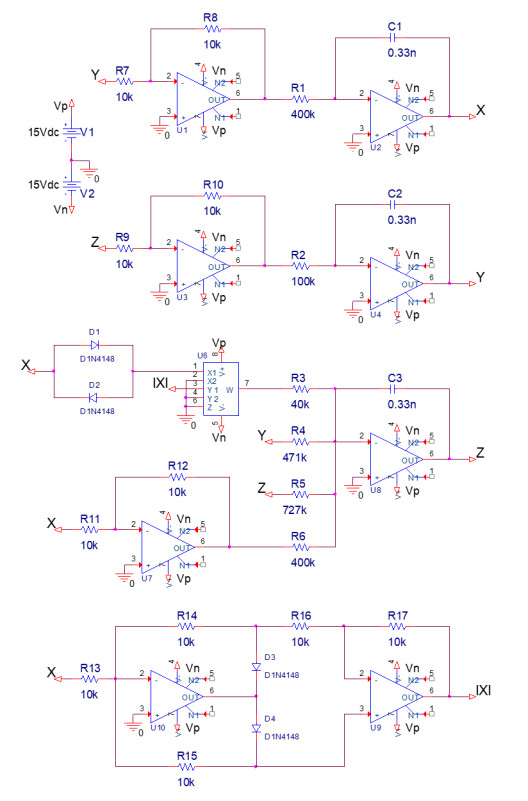
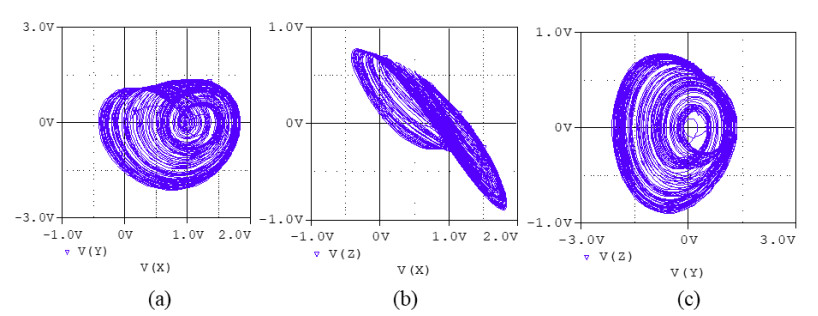
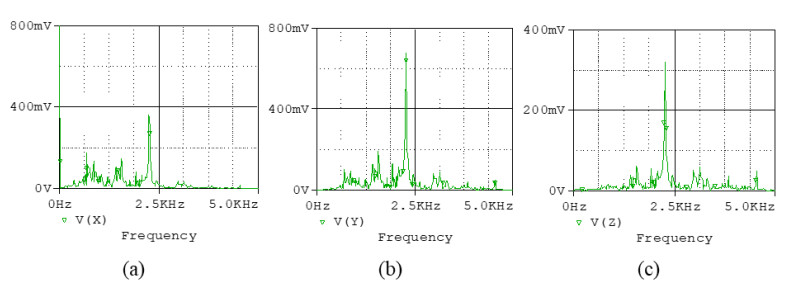
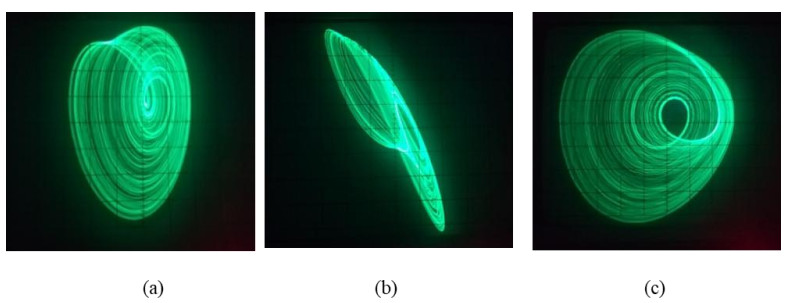
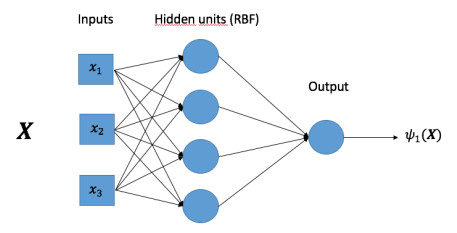
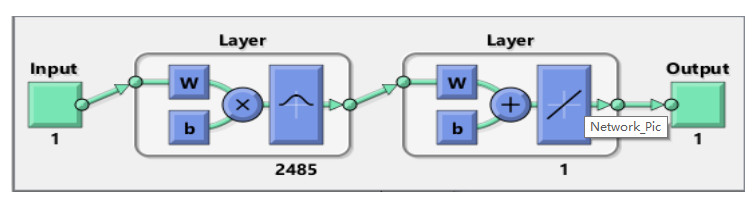
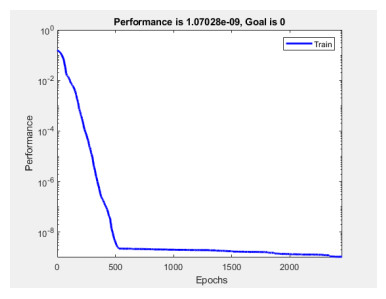
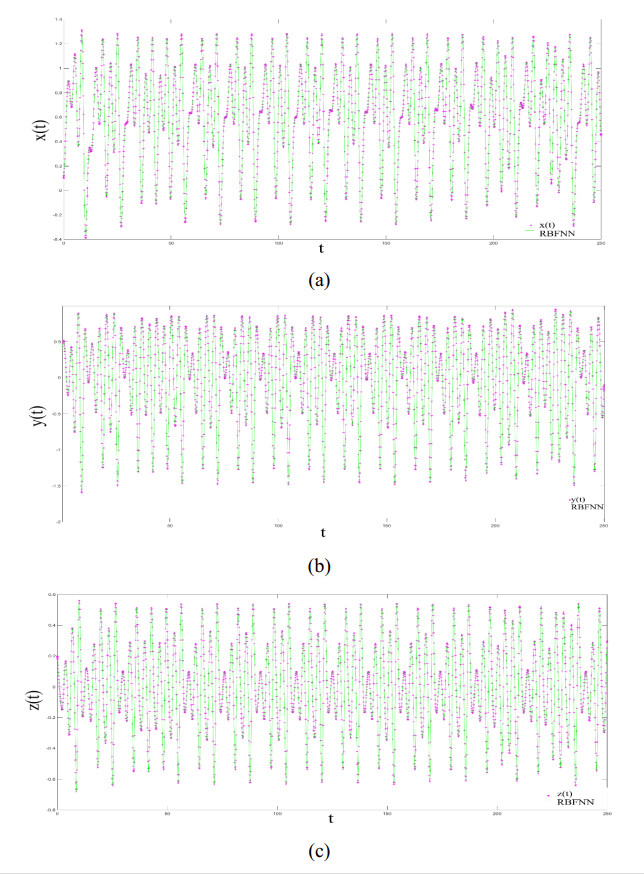
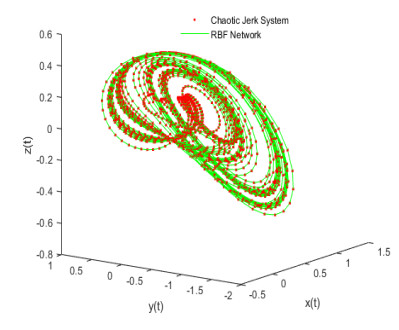
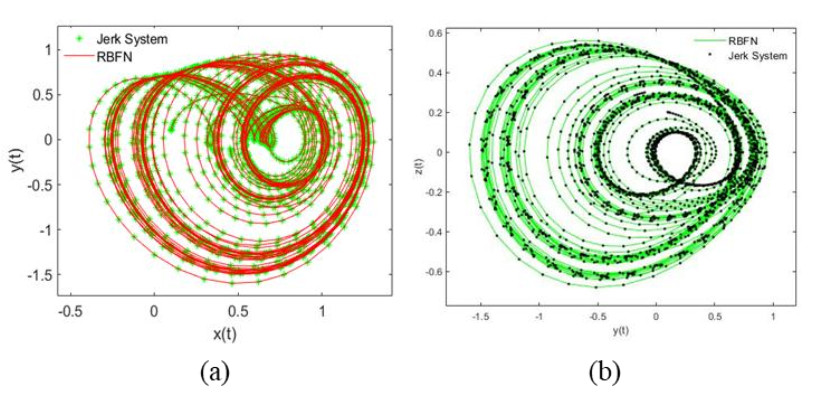
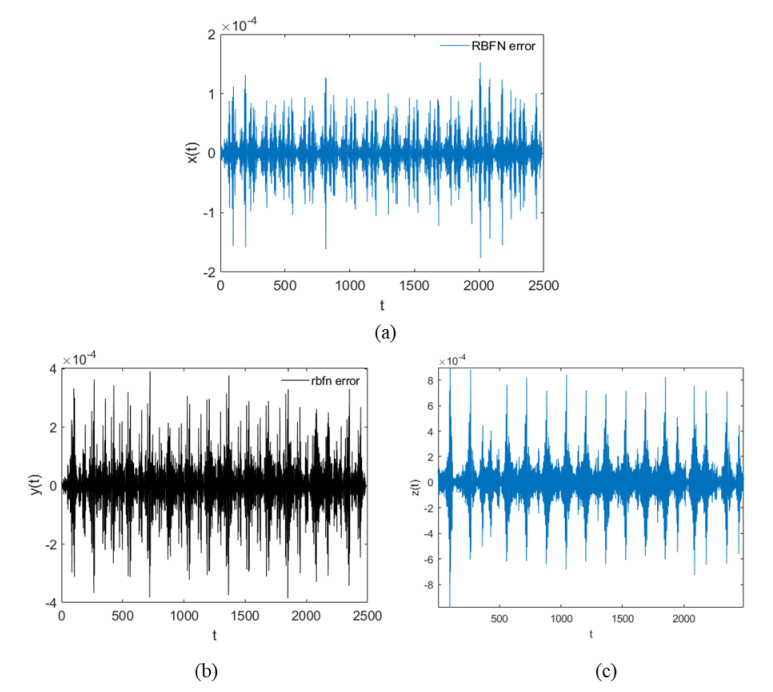
In this paper, we investigated the chaotic behavior of a Jerk system proposed by Sambas et al. (2024), which features symmetrical attractors arising from the interplay of sinusoidal, hyperbolic, and absolute nonlinearities. The system's complex dynamics were analyzed using established numerical methods such as phase portraits, stability analysis, bifurcation diagrams, and Lyapunov exponents. Furthermore, through amplitude modulation, we showed that the control parameter δ can enhance or attenuate signal amplitudes without disrupting the system's stability or chaotic nature. The theoretical findings were further validated through Multisim circuit simulations, with experimental attractors closely matching the numerical results. In addition, a Radial Basis Function Neural Network (RBFNN) was implemented to approximate the chaotic trajectories of the system. The model was trained using simulated data and optimized via the least squares method. Network performance was evaluated using Root Mean Square Error (RMSE) and relative error. The results showed that the RBFNN accurately predicts the system's state variables, achieving MSE values on the order of 10-10–10-9 and relative error below 1.1 × 10⁻⁸.
Citation: Aceng Sambas, Hatem E. Semary, Abdullah Gokyildirim, Sadam Hussain, Rameshbabu Ramar, Sulaiman M. Ibrahim, A. S. Al-Moisheer, Rabiu Bashir Yunus. Chaos modeling of a symmetrical Jerk system via analog circuit design and radial basis function neural network[J]. AIMS Mathematics, 2026, 11(1): 1616-1636. doi: 10.3934/math.2026067
In this paper, we investigated the chaotic behavior of a Jerk system proposed by Sambas et al. (2024), which features symmetrical attractors arising from the interplay of sinusoidal, hyperbolic, and absolute nonlinearities. The system's complex dynamics were analyzed using established numerical methods such as phase portraits, stability analysis, bifurcation diagrams, and Lyapunov exponents. Furthermore, through amplitude modulation, we showed that the control parameter δ can enhance or attenuate signal amplitudes without disrupting the system's stability or chaotic nature. The theoretical findings were further validated through Multisim circuit simulations, with experimental attractors closely matching the numerical results. In addition, a Radial Basis Function Neural Network (RBFNN) was implemented to approximate the chaotic trajectories of the system. The model was trained using simulated data and optimized via the least squares method. Network performance was evaluated using Root Mean Square Error (RMSE) and relative error. The results showed that the RBFNN accurately predicts the system's state variables, achieving MSE values on the order of 10-10–10-9 and relative error below 1.1 × 10⁻⁸.

| [1] |
X. Xu, W. Guo, Chaotic behavior of turbine regulating system for hydropower station under effect of nonlinear turbine characteristics, Sustain. Energy Technol. Assess., 44 (2021), 101088. https://doi.org/10.1016/j.seta.2021.101088 doi: 10.1016/j.seta.2021.101088

|
| [2] |
M. Ikeda, R. Tada, Reconstruction of the chaotic behavior of the Solar System from geologic records, Earth Planet. Sci. Lett., 537 (2020), 116168. https://doi.org/10.1016/j.epsl.2020.116168 doi: 10.1016/j.epsl.2020.116168
|
| [3] | A. Sambas, W. S. M. Sanjaya, M. Mamat, O. Tacha, Design and numerical simulation of unidirectional chaotic synchronization and its application in secure communication system, J. Eng. Sci. Tech. Rev., 6 (2013), 66–73. |
| [4] |
A. Sambas, S. Vaidyanathan, M. Mamat, M. A. Mohamed, W. S. M. Sanajaya, A new chaotic system with a pear-shaped equilibrium and its circuit simulation, Int. J. Electr. Comput. Eng., 8 (2018), 4951. http://doi.org/10.11591/ijece.v8i6.pp4951-4958 doi: 10.11591/ijece.v8i6.pp4951-4958
|
| [5] |
X. Deng, S. Ding, H. Lin, L. Jiang, H. Sun, J. Jin, Privacy-preserving online medical image exchange via hyperchaotic memristive neural networks and DNA encoding, Neurocomputing, 653 (2025), 131132. https://doi.org/10.1016/j.neucom.2025.131132 doi: 10.1016/j.neucom.2025.131132
|
| [6] |
Z. Wang, A. Ahmadi, H. Tian, S. Jafari, G. Chen, Lower-dimensional simple chaotic systems with spectacular features, Chaos Solitons Fract., 169 (2023), 113299. https://doi.org/10.1016/j.chaos.2023.113299 doi: 10.1016/j.chaos.2023.113299
|
| [7] |
Y. Wei, X. Wang, T. Zhao, B. Du, Symmetric coexistence, complete control, circuit implementation, and synchronization of a memristor-coupled jerk chaotic system, AEU-Int. J. Electron. Commun., 197 (2025), 155820. https://doi.org/10.1016/j.aeue.2025.155820 doi: 10.1016/j.aeue.2025.155820
|
| [8] |
P. Li, T. Zheng, C. Li, X. Wang, W. Hu, A unique jerk system with hidden chaotic oscillation, Nonlinear Dyn., 86 (2016), 197–203. https://doi.org/10.1007/s11071-016-2882-2 doi: 10.1007/s11071-016-2882-2
|
| [9] |
Z. Kohl, R. Senani, D. Biolek, Chaos generation via inductorless jerk circuit: the engineering approach to circuit design and implementation, IEEE Circ. Syst. Mag., 25 (2025), 56–65. https://doi.org/10.1109/MCAS.2025.3559469 doi: 10.1109/MCAS.2025.3559469
|
| [10] |
A. Ahmadi, S. Sriram, A. M. Ali, K. Rajagopal, N. Pal, S. Jafari, A nonlinear megastable system with diamond-shaped oscillators, Int. J. Bifurcat. Chaos, 34 (2024), 2450053. https://doi.org/10.1142/S0218127424500536 doi: 10.1142/S0218127424500536
|
| [11] |
B. Srisuchinwong, R. Treetanakorn, Current‐tunable chaotic jerk circuit based on only one unity‐gain amplifier, Electron. Lett., 50 (2014), 1815–1817. https://doi.org/10.1049/el.2014.3079 doi: 10.1049/el.2014.3079
|
| [12] |
J. Kengne, R. L. T. Mogue, T. F. Fozin, A. N. K. Telem, Effects of symmetric and asymmetric nonlinearity on the dynamics of a novel chaotic jerk circuit: Coexisting multiple attractors, period doubling reversals, crisis, and offset boosting, Chaos Solitons Fract., 121 (2019), 63–84. https://doi.org/10.1016/j.chaos.2019.01.033 doi: 10.1016/j.chaos.2019.01.033
|
| [13] |
R. Chiu, D. López-Mancilla, C. E. Castañeda, O. Orozco-López, E. Villafaña-Rauda, R. Sevilla-Escoboza, Design and implementation of a jerk circuit using a hybrid analog–digital system, Chaos, Soliton. Fract., 119 (2019), 255–262. https://doi.org/10.1016/j.chaos.2018.12.029 doi: 10.1016/j.chaos.2018.12.029
|
| [14] |
P. Chansangiam, Three-saddle-foci chaotic behavior of a modified jerk circuit with Chua's diode, Symmetry, 12 (2020), 1803. https://doi.org/10.3390/sym12111803 doi: 10.3390/sym12111803
|
| [15] |
P. Ding, X. Feng, Generation of multi-scroll chaotic attractors from a jerk circuit with a special form of a sine function, Electronics, 9 (2020), 842. https://doi.org/10.3390/electronics9050842 doi: 10.3390/electronics9050842
|
| [16] |
P. Li, T. Zheng, C. Li, X. Wang, W. Hu, A unique jerk system with hidden chaotic oscillation, Nonlinear Dyn., 86 (2016), 197–203. https://doi.org/10.1007/s11071-016-2882-2 doi: 10.1007/s11071-016-2882-2
|
| [17] |
M. Joshi, A. Ranjan, An autonomous simple chaotic jerk system with stable and unstable equilibria using reverse sine hyperbolic functions, Int. J. Bifurcat. Chaos, 30 (2020), 2050070. https://doi.org/10.1142/S0218127420500704 doi: 10.1142/S0218127420500704
|
| [18] |
J. R. Mboupda Pone, V. Kamdoum Tamba, G. H. Kom, A. B. Tiedeu, Period-doubling route to chaos, bistability and antimononicity in a jerk circuit with quintic nonlinearity, Int. J. Dyn. Control, 7 (2019), 1–22. https://doi.org/10.1007/s40435-018-0431-1 doi: 10.1007/s40435-018-0431-1
|
| [19] |
C. Ainamon, S. T. Kingni, V. K. Tamba, J. B. C. Orou, P. Woafo, Dynamics, circuitry implementation and control of an autonomous Helmholtz jerk oscillator, J. Control Autom. Electr. Syst., 30 (2019), 501–511. https://doi.org/10.1007/s40313-019-00463-0 doi: 10.1007/s40313-019-00463-0
|
| [20] |
I. Ahmad, B. Srisuchinwong, Simple chaotic jerk flows with families of self-excited and hidden attractors: Free control of amplitude, frequency, and polarity, IEEE Access, 8 (2020), 46459–46471. https://doi.org/10.1109/ACCESS.2020.2978660 doi: 10.1109/ACCESS.2020.2978660
|
| [21] |
A. Sambas, X. Zhang, I. A. Moghrabi, S. Vaidyanathan, K. Benkouider, M. Alçın, et al., ANN-based chaotic PRNG in the novel jerk chaotic system and its application for the image encryption via 2-D Hilbert curve, Sci. Rep., 14 (2024), 29602. https://doi.org/10.1038/s41598-024-80969-z doi: 10.1038/s41598-024-80969-z
|
| [22] |
M. H. Arshad, M. Kassas, A. E. Hussein, M. A. Abido, A simple technique for studying chaos using jerk equation with discrete time sine map, Appl. Sci., 11 (2021), 437. https://doi.org/10.3390/app11010437 doi: 10.3390/app11010437
|
| [23] |
Q. Xu, S. Cheng, Z. Ju, M. Chen, H. Wu, Asymmetric coexisting bifurcations and multi-stability in an asymmetric memristive diode-bridge-based jerk circuit, Chin. J. Phys., 70 (2021), 69–81. https://doi.org/10.1016/j.cjph.2020.11.007 doi: 10.1016/j.cjph.2020.11.007
|
| [24] |
S. Sahoo, R. Nathasarma, B. K. Roy, Time-synchronized predefined-time synchronization between two non-identical chaotic systems, Chaos Solitons Fract., 181 (2024), 114662. https://doi.org/10.1016/j.chaos.2024.114662 doi: 10.1016/j.chaos.2024.114662
|
| [25] |
C. Zhang, B. Zhang, J. Chen, A. Pan, Z. Tan, Y. Yao, et al., Controllable multi-scroll with multi-wing, grid-scroll, and multi-directional grid-scroll chaotic attractors in a chaotic system with implicit Duffing equation, Eur. Phys. J. Plus, 139 (2024), 492. https://doi.org/10.1140/epjp/s13360-024-05295-9 doi: 10.1140/epjp/s13360-024-05295-9
|
| [26] |
A. Gokyildirim, H. Calgan, M. Demirtas, Fractional-order sliding mode control of a 4D memristive chaotic system, J. Vib. Control, 30 (2024), 1604–1620. https://doi.org/10.1177/10775463231166 doi: 10.1177/10775463231166
|
| [27] |
H. Liu, W. Niu, Y. Guo, Direct torque control for PMSM based on the RBFNN surrogate model of electromagnetic torque and stator flux linkage, Control Eng. Pract., 148 (2024), 105943. https://doi.org/10.1016/j.conengprac.2024.105943 doi: 10.1016/j.conengprac.2024.105943
|
| [28] |
F. A. Jibon, A. Tasbir, M. A. Talukder, M. A. Uddin, F. Rabbi, M. S. Uddin, et al., Parkinson's disease detection from EEG signal employing autoencoder and RBFNN-based hybrid deep learning framework utilizing power spectral density, Digit. Health, 10 (2024), 7355. https://doi.org/10.1177/20552076241297355 doi: 10.1177/20552076241297355
|
| [29] |
P. M. Kumar, R. Dhilipkumar, G. Geethamahalakshmi, Efficient distribution network based on photovoltaic fed electric vehicle charging station using WSO-RBFNN approach, J. Energy Storage, 106 (2025), 114728. https://doi.org/10.1016/j.est.2024.114728 doi: 10.1016/j.est.2024.114728
|
| [30] |
A. Z. Messaoui, O. Mechali, A. A. Messaoui, I. E. Smaali, F. Demim, D. B. Djilali, RBFNN-based optimized PID control for a 3-DOF helicopter system: Design and validation, 2024 8th International Conference on Image and Signal Processing and their Applications, 2024, 1–5. https://doi.org/10.1109/ISPA59904.2024.10536810 doi: 10.1109/ISPA59904.2024.10536810
|
| [31] |
Y. Li, W. Sun, D. Yu, RBFNN-based global fast terminal sliding mode control for fully controlled doubly fed induction generator, J. Franklin Inst., 361 (2024), 107196. https://doi.org/10.1016/j.jfranklin.2024.107196 doi: 10.1016/j.jfranklin.2024.107196
|
| [32] |
T. Yuan, C. Zhang, F. Yi, P. Lv, M. Zhang, S. Li, RBFNN-based adaptive integral sliding mode feedback and feedforward control for a lower limb exoskeleton robot, Electronics, 13 (2024), 1043. https://doi.org/10.3390/electronics13061043 doi: 10.3390/electronics13061043
|
| [33] |
Z. Zhang, E. Zhu, B. Wang, Y. Chen, Application and comparison of GRNN, BPNN and RBFNN in the prediction of suspender frequency and tension on arch bridge, J. Civ. Struct. Health Monit., 14 (2024), 1839–1855. https://doi.org/10.1007/s13349-024-00816-7 doi: 10.1007/s13349-024-00816-7
|
| [34] |
M. Lu, W. Yang, Z. Xiong, F. Liao, S. Wu, Y. Su, et al., RBFNN-based adaptive fixed-time sliding mode tracking control for coaxial hybrid aerial–underwater vehicles under multivariant ocean disturbances, Drones, 8 (2024), 745. https://doi.org/10.3390/drones8120745 doi: 10.3390/drones8120745
|
| [35] |
A. Nanfak, J. de Dieu Nkapkop, K. Zourmba, J. M. Ngono, M. F. Moreno-López, E. Tlelo-Cuautle, et al., Dynamic analysis and FPGA implementation of a 2D fractional sine-cosine map for image encryption using bit-level permutation and genetic algorithm, Math. Comput. Simul., 240 (2026), 105–136. https://doi.org/10.1016/j.matcom.2025.07.022 doi: 10.1016/j.matcom.2025.07.022
|
| [36] |
J. Zhang, N. Cheng, P. Wang, Dynamics analysis, FPGA implementation, and application in image encryption of a quadruple-wing chaotic system based on hyperbolic sine functions, Integration, 104 (2025), 102437. https://doi.org/10.1016/j.vlsi.2025.102437 doi: 10.1016/j.vlsi.2025.102437
|
| [37] |
E. Juárez-Mendoza, G. Zamora-Mejia, E. Tlelo-Cuautle, A. Díaz-Sánchez, CMOS design of a chaos-based masking system for biomedical signals applications, Int. J. Circuit Theory Appl., 53 (2025), 5802–5815. https://doi.org/10.1002/cta.4500 doi: 10.1002/cta.4500
|
| [38] |
Z. Duan, X. Zhang, S. He, X. Yu, P. Xiong, J. Chen, et al., Implementation of a fully integrated memristive Chua's chaotic circuit with a voltage-controlled oscillator, Integration, 99 (2024), 102258. https://doi.org/10.1016/j.vlsi.2024.102258 doi: 10.1016/j.vlsi.2024.102258
|
| [39] |
C. K. Volos, L. Moysis, G. D. Roumelas, A. Giakoumis, H. E. Nistazakis, G. S. Tombras, Circuit implementation of a modified chaotic system with hyperbolic sine nonlinearities using bi-color LED, Technologies, 9 (2021), 15. https://doi.org/10.3390/technologies9010015 doi: 10.3390/technologies9010015
|
| [40] |
J. Kengne, L. K. Kengne, J. C. Chedjou, K. Nosirov, A simple anti-parallel diode based chaotic jerk circuit with arcsinh function: Theoretical analysis and experimental verification, Analog Integr. Circuits Signal Process., 108 (2021), 597–623. https://doi.org/10.1007/s10470-021-01876-1 doi: 10.1007/s10470-021-01876-1
|
Figures(15) / Tables(3)

Aceng Sambas, Hatem E. Semary, Abdullah Gokyildirim, Sadam Hussain, Rameshbabu Ramar, Sulaiman M. Ibrahim, A. S. Al-Moisheer, Rabiu Bashir Yunus. Chaos modeling of a symmetrical Jerk system via analog circuit design and radial basis function neural network[J]. AIMS Mathematics, 2026, 11(1): 1616-1636. doi: 10.3934/math.2026067





 DownLoad: