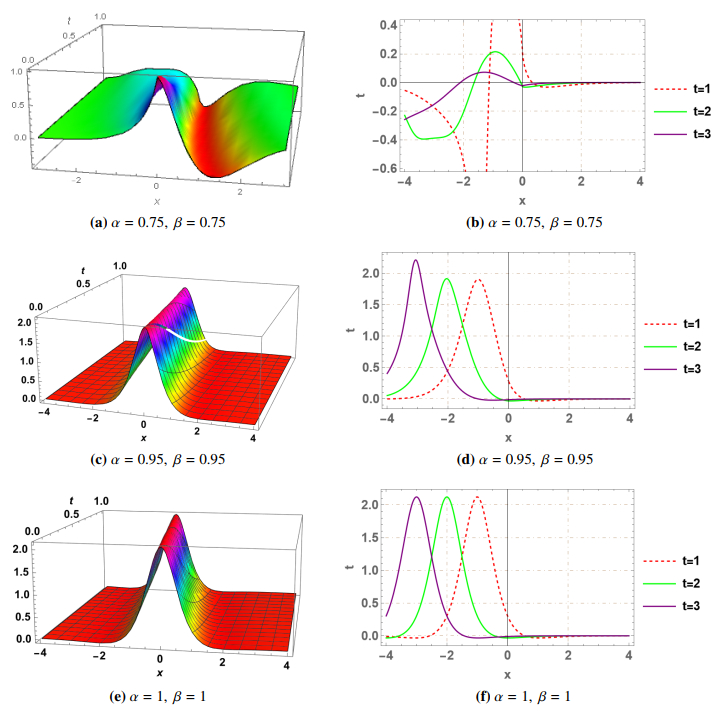
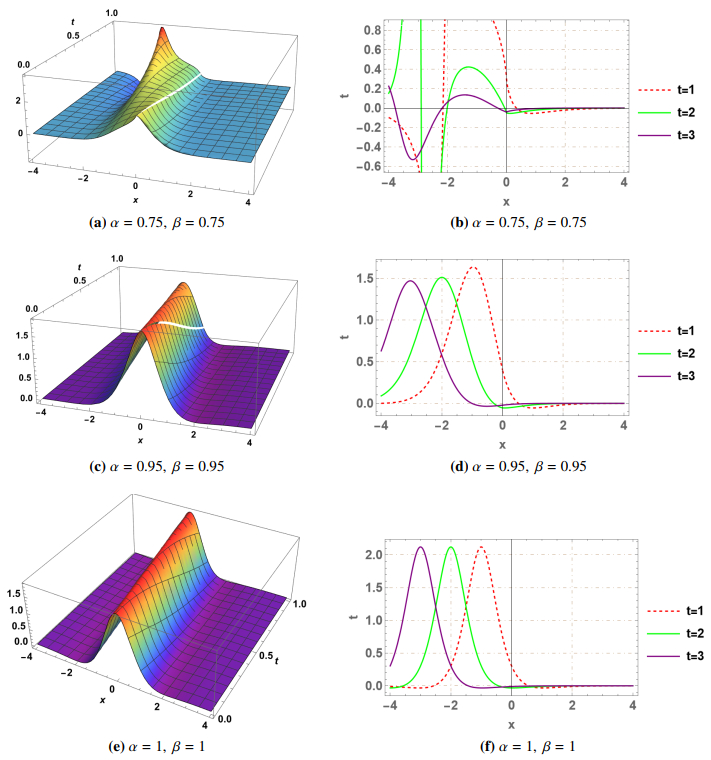
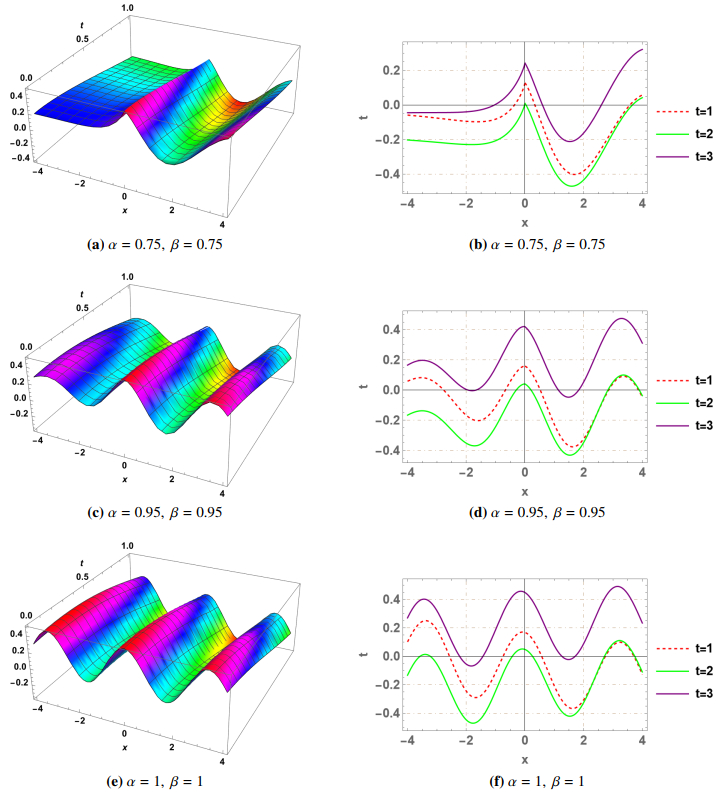
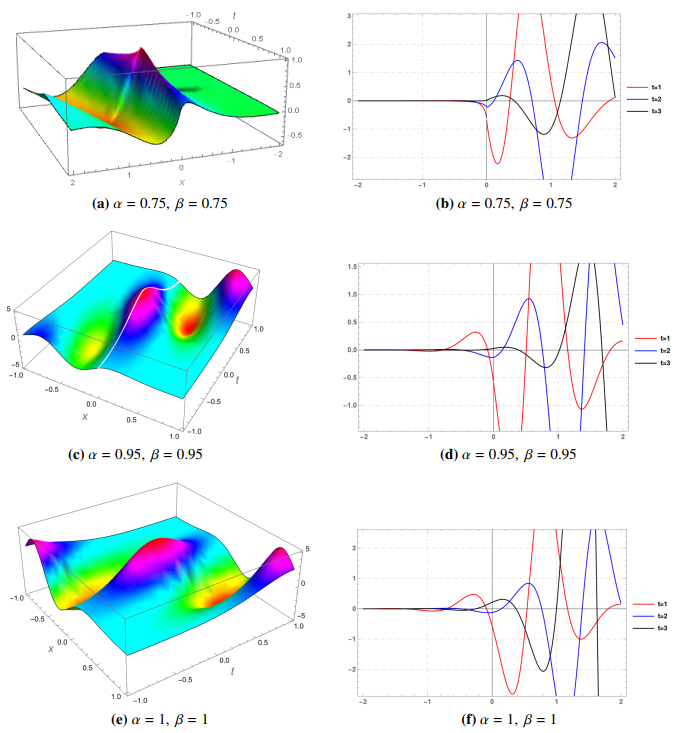
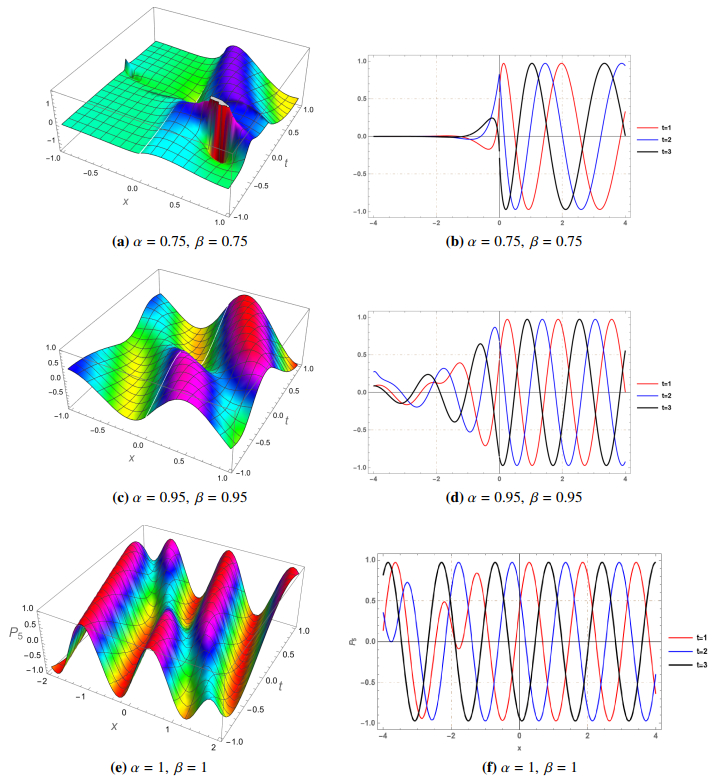
New traveling wave solutions for the nonlinear fractional Schrödinger equation (FSE), obtained using conformable fractional derivatives, are presented in this paper. Despite extensive research on classical and fractional Schrödinger models, a systematic development of accurate traveling wave solutions employing conformable operators in conjunction with effective symbolic approaches remains lacking. To bridge this gap, we employ a Hamiltonian-based technique, a variational formulation via the Ritz method, and the modified Sardar subequation method. The fractional governing model is reduced to a nonlinear ordinary differential equation through a complex traveling wave transformation, which is analytically solved to yield new families of solutions. Two- and three-dimensional graphical representations of the solution's physical properties are presented, emphasizing the wave dynamics of the proposed fractional model.
Citation: Tahani A. Alrebdi, Nauman Raza, Saima Arshed, F. Alkallas, Abdel-Haleem Abdel-Aty. New solitary wave solutions for the triplet coupled nonlinear Schrödinger system incorporating fractional effects[J]. AIMS Mathematics, 2026, 11(1): 420-443. doi: 10.3934/math.2026018
New traveling wave solutions for the nonlinear fractional Schrödinger equation (FSE), obtained using conformable fractional derivatives, are presented in this paper. Despite extensive research on classical and fractional Schrödinger models, a systematic development of accurate traveling wave solutions employing conformable operators in conjunction with effective symbolic approaches remains lacking. To bridge this gap, we employ a Hamiltonian-based technique, a variational formulation via the Ritz method, and the modified Sardar subequation method. The fractional governing model is reduced to a nonlinear ordinary differential equation through a complex traveling wave transformation, which is analytically solved to yield new families of solutions. Two- and three-dimensional graphical representations of the solution's physical properties are presented, emphasizing the wave dynamics of the proposed fractional model.

| [1] |
S. Saifullah, N. Fatima, S. Abdelmohsen, M. Alanazi, S. Ahmad, D. Baleanu, Analysis of a conformable generalized geophysical KdV equation with Coriolis effect, Alex. Eng. J., 73 (2023), 651–663. https://doi.org/10.1016/j.aej.2023.04.058 doi: 10.1016/j.aej.2023.04.058

|
| [2] |
C. Qiao, X. Long, L. Yang, Y. Zhu, W. Cai, Calculation of a dynamical substitute for the real Earth-Moon system based on Hamiltonian analysis, ApJ, 991 (2025), 46. https://doi.org/10.3847/1538-4357/adf73a doi: 10.3847/1538-4357/adf73a
|
| [3] |
P. Li, R. Gao, C. Xu, Y. Li, A. Akgül, D. Baleanu, Dynamics exploration for a fractional-order delayed zooplankton phytoplankton system, Chaos Soliton. Fract., 166 (2023), 112975. https://doi.org/10.1016/j.chaos.2022.112975 doi: 10.1016/j.chaos.2022.112975
|
| [4] |
C. Xu, E. Balci, Hunting cooperation and gestation delay in a prey-predator model with fractional derivative, J. Appl. Anal. Comput., 16 (2026), 1035–1053. https://doi.org/10.11948/20250147 doi: 10.11948/20250147
|
| [5] |
W. Sun, Y. Jin, G. Lu, Y. Liu, Stabilizer testing and central limit theorem, Phys. Rev. A, 111 (2025), 32421. https://doi.org/10.1103/PhysRevA.111.032421 doi: 10.1103/PhysRevA.111.032421
|
| [6] |
A. Kumar, H. Chauhan, C. Ravichandran, K. Nisar, D. Baleanu, Existence of solutions of non-autonomous fractional differential equations with integral impulse condition, Adv. Differ. Equ., 2020 (2020), 434. https://doi.org/10.1186/s13662-020-02888-3 doi: 10.1186/s13662-020-02888-3
|
| [7] |
A. Freihet, S. Hasan, M. Al-Smadi, M. Gaith, S. Momani, Construction of fractional power series solutions to fractional stiff system using residual functions algorithm, Adv. Differ. Equ., 2019 (2019), 95. https://doi.org/10.1186/s13662-019-2042-3 doi: 10.1186/s13662-019-2042-3
|
| [8] |
N. Laskin, Fractional Schrödinger equation, Phys. Rev. E, 66 (2002), 056108. https://doi.org/10.1103/PhysRevE.66.056108 doi: 10.1103/PhysRevE.66.056108
|
| [9] |
N. Laskin, Fractional quantum mechanics and Lévy path integrals, Phys. Lett. A, 268 (2000), 298–305. https://doi.org/10.1016/S0375-9601(00)00201-2 doi: 10.1016/S0375-9601(00)00201-2
|
| [10] |
N. Raza, M. Rafiq, A. Bekir, H. Rezazadeh, Optical solitons related to (2+1)-dimensional Kundu-Mukherjee-Naskar model using an innovative integration architecture, J. Nonlinear Opt. Phys., 31 (2022), 2250014. https://doi.org/10.1142/S021886352250014X doi: 10.1142/S021886352250014X
|
| [11] |
M. Naber, Time fractional Schrödinger equation, J. Math. Phys., 45 (2004), 3339–3352. https://doi.org/10.1063/1.1769611 doi: 10.1063/1.1769611
|
| [12] |
B. Guo, Y. Han, J. Xin, Existence of the global smooth solution to the period boundary value problem of fractional nonlinear Schrödinger equation, Appl. Math. Comput., 204 (2008), 468–477. https://doi.org/10.1016/j.amc.2008.07.003 doi: 10.1016/j.amc.2008.07.003
|
| [13] |
D. Yang, Z. Du, Asymptotic analysis of double-hump solitons for a coupled fourth-order nonlinear Schrödingier system in a birefringent optical fiber, Chaos Soliton. Fract., 199 (2025), 116831. https://doi.org/10.1016/j.chaos.2025.116831 doi: 10.1016/j.chaos.2025.116831
|
| [14] |
R. Eid, S. Muslih, D. Baleanu, E. Rabei, On fractional Schrödinger equation in $\alpha$-dimensional fractional space, Nonlinear Anal.-Real, 10 (2009), 1299–1304. https://doi.org/10.1016/j.nonrwa.2008.01.007 doi: 10.1016/j.nonrwa.2008.01.007
|
| [15] |
S. Muslih, O. Agrawal, D. Baleanu, A fractional Schrödinger equation and its solution, Int. J. Theor. Phys., 49 (2010), 1746–1752. https://doi.org/10.1007/s10773-010-0354-x doi: 10.1007/s10773-010-0354-x
|
| [16] |
J. Gomez-Aguilar, D. Baleanu, Schrödinger equation involving fractional operators with non-singular kernel, J. Electromagnet. Wave., 31 (2017), 752–761. https://doi.org/10.1080/09205071.2017.1312556 doi: 10.1080/09205071.2017.1312556
|
| [17] |
T. Bakkyaraj, R. Sahadevan, Approximate analytical solution of two coupled time fractional nonlinear Schrödinger equations, Int. J. Appl. Comput. Math., 2 (2016), 113–135. https://doi.org/10.1007/s40819-015-0049-3 doi: 10.1007/s40819-015-0049-3
|
| [18] |
S. Longhi, Fractional Schrödinger equation in optics, Opt. Lett., 40 (2015), 1117–1120. https://doi.org/10.1364/OL.40.001117 doi: 10.1364/OL.40.001117
|
| [19] |
G. P. Agrawal, Nonlinear fiber optics: its history and recent progress, J. Opt. Soc. Am. B, 22 (2011), A1–A10. https://doi.org/10.1364/JOSAB.28.0000A1 doi: 10.1364/JOSAB.28.0000A1
|
| [20] |
B. Malomed, Multidimensional solitons: well-established results and novel findings, Eur. Phys. J. Spec. Top., 225 (2016), 2507–2532. https://doi.org/10.1140/epjst/e2016-60025-y doi: 10.1140/epjst/e2016-60025-y
|
| [21] |
C. Xu, M. Ur Rahman, H. Emadifar, Bifurcations, chaotic behavior, sensitivity analysis and soliton solutions of the extended Kadometsevâ-Petviashvili equation, Opt. Quant. Electron., 56 (2024), 405. https://doi.org/10.1007/s11082-023-05958-4 doi: 10.1007/s11082-023-05958-4
|
| [22] |
J. He, Variational principles for some nonlinear partial differential equations with variable coefficients, Chaos Soliton. Fract., 19 (2004), 847–851. https://doi.org/10.1016/S0960-0779(03)00265-0 doi: 10.1016/S0960-0779(03)00265-0
|
| [23] |
M. Murad, H. Ismael, T. Sulaiman, Various exact solutions to the time-fractional nonlinear Schrödinger equation via the new modified Sardar sub-equation method, Phys. Scr., 99 (2024), 085252. https://doi.org/10.1088/1402-4896/ad62a6 doi: 10.1088/1402-4896/ad62a6
|
| [24] |
M. Alabedalhadi, Exact travelling wave solutions for nonlinear system of spatiotemporal fractional quantum mechanics equations, Alex. Eng. J., 61 (2022), 1033–1044. https://doi.org/10.1016/j.aej.2021.07.019 doi: 10.1016/j.aej.2021.07.019
|
| [25] |
Q. Wang, Homotopy perturbation method for fractional KdV-Burgers equation, Chaos Soliton. Fract., 35 (2008), 843–850. https://doi.org/10.1016/j.chaos.2006.05.074 doi: 10.1016/j.chaos.2006.05.074
|
| [26] |
Y. Tian, J. Liu, A modified exp-function method for fractional partial differential equations, Therm. Sci., 25 (2021), 1237–1241. https://doi.org/10.2298/TSCI200428017T doi: 10.2298/TSCI200428017T
|
| [27] |
M. Bayrak, A. Demir, A new approach for space-time fractional partial differential equations by residual power series method, Appl. Math. Comput., 336 (2018), 215–230. https://doi.org/10.1016/j.amc.2018.04.032 doi: 10.1016/j.amc.2018.04.032
|
| [28] |
A. Esen, F. Bulut, Ö. Oruç, A unified approach for the numerical solution of time fractional Burgersâ type equations, Eur. Phys. J. Plus, 131 (2016), 116. https://doi.org/10.1140/epjp/i2016-16116-5 doi: 10.1140/epjp/i2016-16116-5
|
| [29] |
O. Abu Arqub, Numerical simulation of time-fractional partial differential equations arising in fluid flows via reproducing Kernel method, Int. J. Numer. Method. H., 30 (2020), 4711–4733. https://doi.org/10.1108/HFF-10-2017-0394 doi: 10.1108/HFF-10-2017-0394
|
| [30] |
M. Eslami, B. Fathi Vajargah, M. Mirzazadeh, A. Biswas, Application of first integral method to fractional partial differential equations, Indian J. Phys., 88 (2014), 177–184. https://doi.org/10.1007/s12648-013-0401-6 doi: 10.1007/s12648-013-0401-6
|
| [31] |
A. Gaber, H. Ahmad, Solitary wave solutions for space-time fractional coupled integrable dispersionless system via generalized kudryashov method, FU-Math. Inform., 35 (2020), 1439–1449. https://doi.org/10.22190/FUMI2005439G doi: 10.22190/FUMI2005439G
|
| [32] |
R. Shah, H. Khan, P. Kumam, M. Arif, D. Baleanu, Natural transform decomposition method for solving fractional-order partial differential equations with proportional delay, Mathematics, 7 (2019), 532. https://doi.org/10.3390/math7060532 doi: 10.3390/math7060532
|
| [33] | M. Sarıkaya, H. Budak, H. Usta, On generalized the conformable fractional calculus, TWMS J. Appl. Eng. Math., 9 (2019), 792–799. |
Figures(5) / Tables(1)

Tahani A. Alrebdi, Nauman Raza, Saima Arshed, F. Alkallas, Abdel-Haleem Abdel-Aty. New solitary wave solutions for the triplet coupled nonlinear Schrödinger system incorporating fractional effects[J]. AIMS Mathematics, 2026, 11(1): 420-443. doi: 10.3934/math.2026018





 DownLoad: