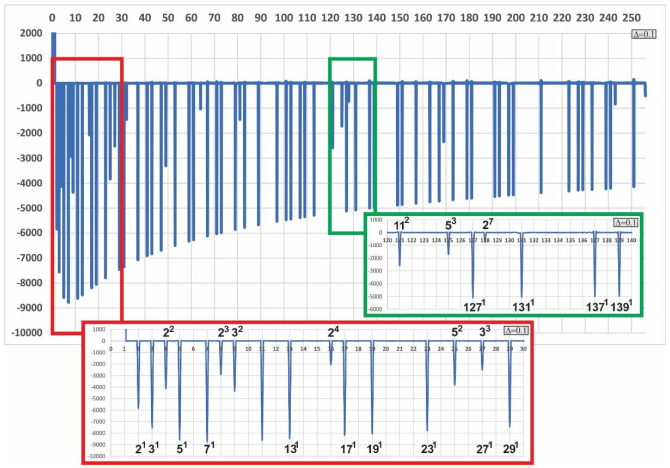
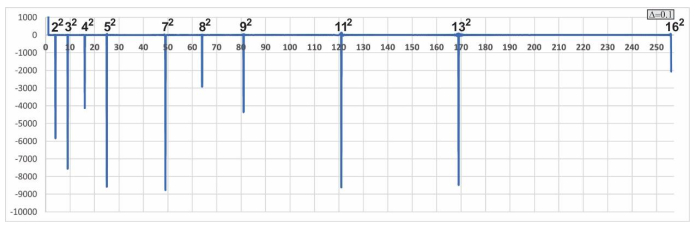
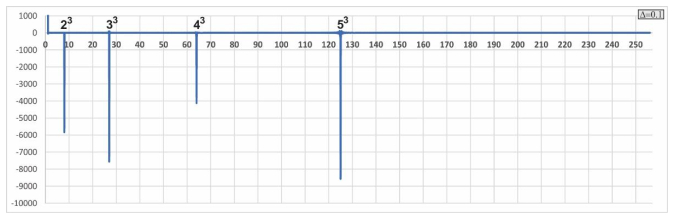
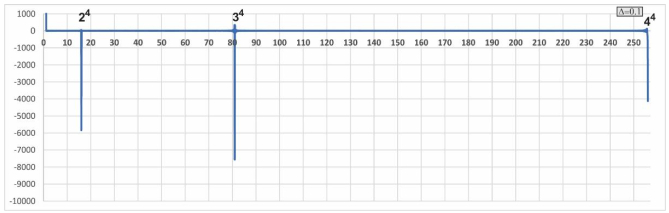
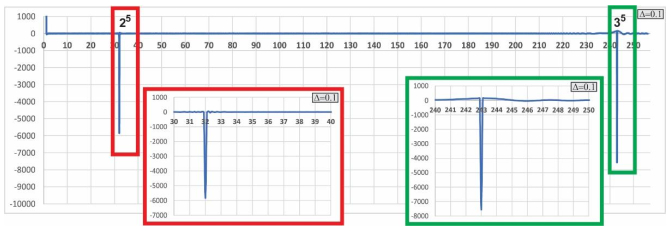
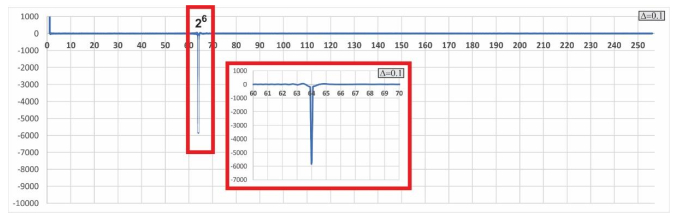
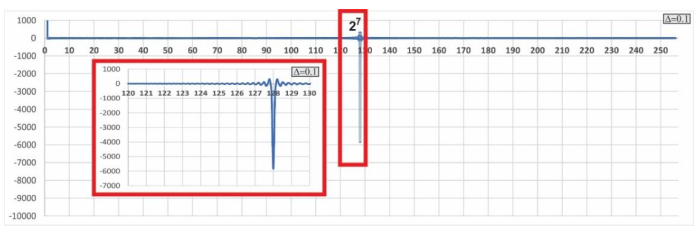
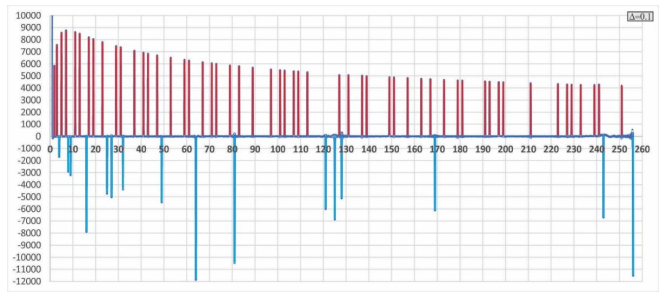
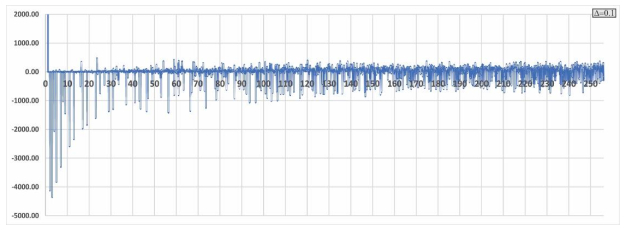
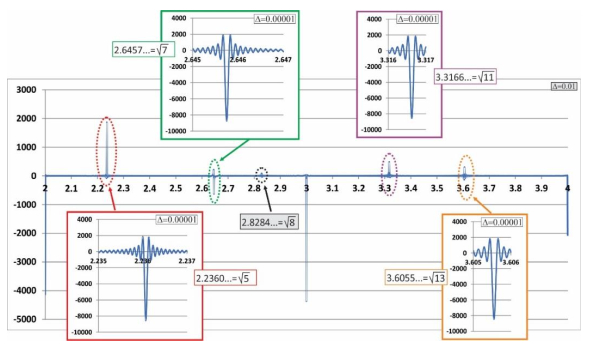
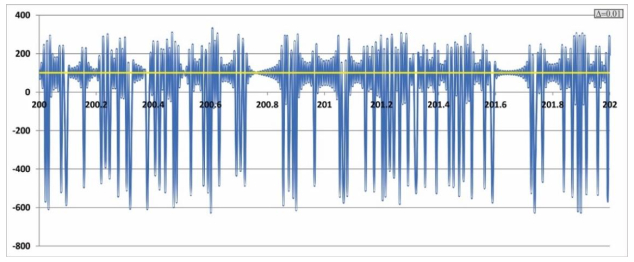
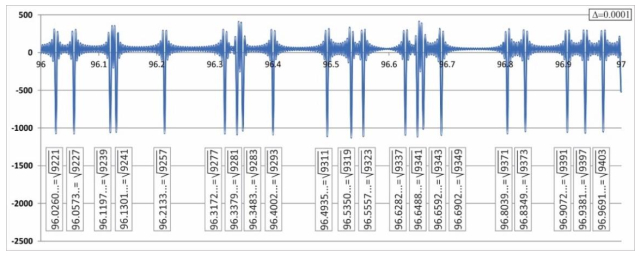
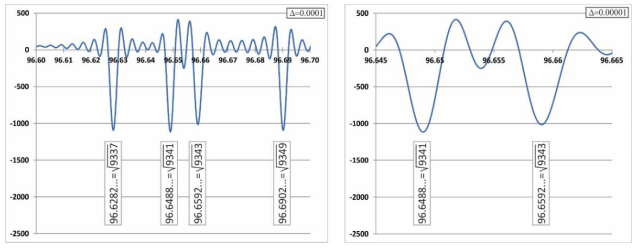
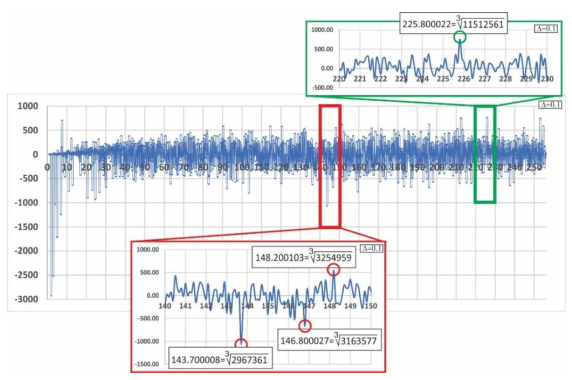
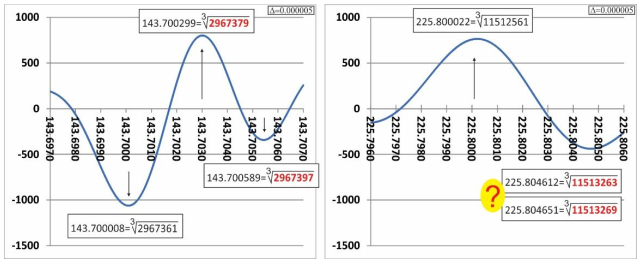
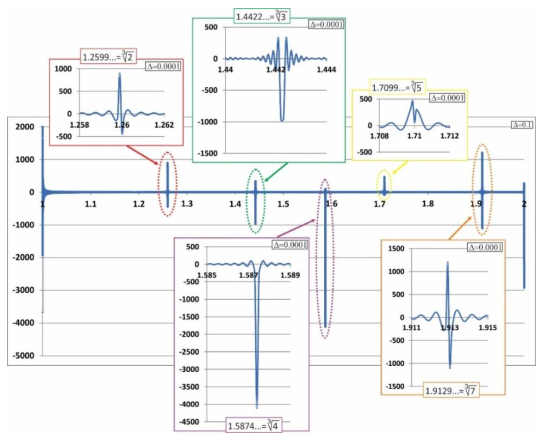
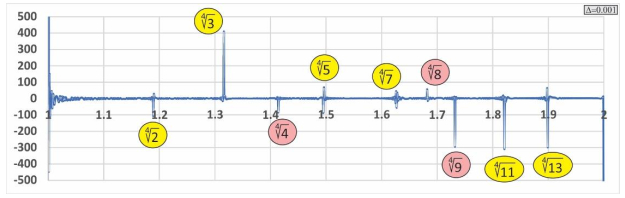
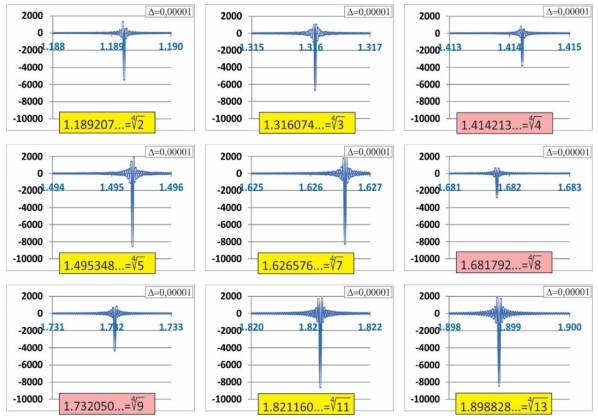
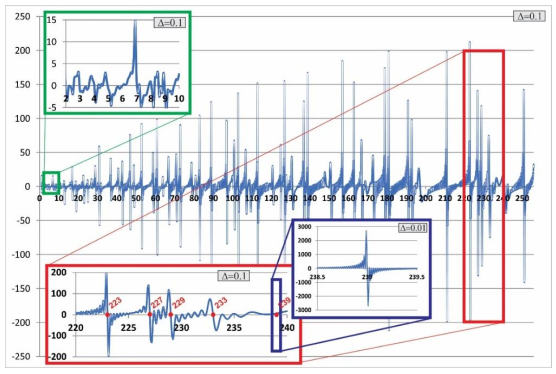
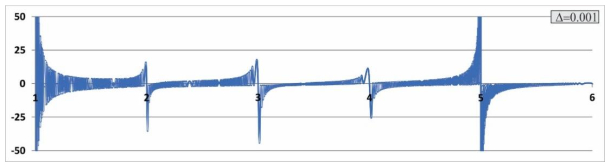
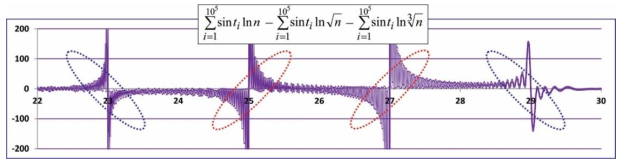
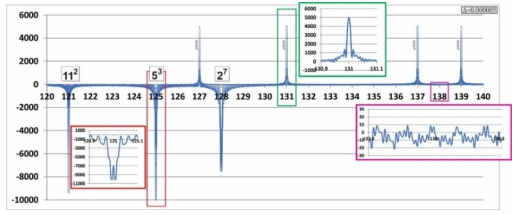
Spectrum RCS(n) = ∑cos(tjlnn), j∈[1, ∞), based on imaginary values of non-trivial zeros of the zeta function ζ(s) = ζ(½±itj) = 0, Im(s) = ±tj, results in "high peaks" (i.e., resonant values of cosine amplitudes at the prime powers n = pk, k∈ℕ in the negative part of the spectrum). The spectrum of the rth root RCS(n1/r) = ∑cos(tjlnn1/r), r∈ℕ exclusively reaches its resonance values in the values of the degree n = pr. Owing to that fact, prime numbers p1 can be separated from prime powers p1/r, r≥2. The spectrum of the dth degree RCS(nd) = ∑cos(tjlnnd), d∈ℕ exclusively reaches its resonant values exclusively in the values of the root p1/d, d≥2. The spectrum of the dth degree "compresses" the number axis. For an arbitrary real interval (a, b), all the resonances pd of all prime numbers from the interval (ad, bd) are contained in the interval (a, b). The imaginary sine spectrum-ISS and the composite spectrum of the RCS and ISS is developed.
Citation: Ilija Tanackov, Ivan Pavkov, Dejan Ćebić, Željko Stević. Spectrum of non-trivial zeros, distribution and magnitude of prime numbers[J]. AIMS Mathematics, 2026, 11(1): 399-419. doi: 10.3934/math.2026017
Spectrum RCS(n) = ∑cos(tjlnn), j∈[1, ∞), based on imaginary values of non-trivial zeros of the zeta function ζ(s) = ζ(½±itj) = 0, Im(s) = ±tj, results in "high peaks" (i.e., resonant values of cosine amplitudes at the prime powers n = pk, k∈ℕ in the negative part of the spectrum). The spectrum of the rth root RCS(n1/r) = ∑cos(tjlnn1/r), r∈ℕ exclusively reaches its resonance values in the values of the degree n = pr. Owing to that fact, prime numbers p1 can be separated from prime powers p1/r, r≥2. The spectrum of the dth degree RCS(nd) = ∑cos(tjlnnd), d∈ℕ exclusively reaches its resonant values exclusively in the values of the root p1/d, d≥2. The spectrum of the dth degree "compresses" the number axis. For an arbitrary real interval (a, b), all the resonances pd of all prime numbers from the interval (ad, bd) are contained in the interval (a, b). The imaginary sine spectrum-ISS and the composite spectrum of the RCS and ISS is developed.

| [1] | C. L. Siegel, Uber Riemanns Nachlaß zur analytischen Zahlentheorie, Quellen Stud. Gesch. Math. Astron. Phys. Abt. B, 2 (1932), 45–80. |
| [2] |
J. P. Gram, Note sur les zeros de la fonction de Riemann, Acta Math., 27 (1903), 289–304. https://doi.org/10.1007/BF02421310 doi: 10.1007/BF02421310

|
| [3] |
J. I. Hutchinson, On the roots of the Riemann zeta function, T. Am. Math. Soc., 27 (1925), 49–60. https://doi.org/10.2307/1989163 doi: 10.2307/1989163
|
| [4] |
E. C. Titchmarsh. The zeros of the Riemann zeta-function. Proc. A, 157 (1936), 261–263. https://doi.org/10.1098/rspa.1936.0192 doi: 10.1098/rspa.1936.0192
|
| [5] |
D. H. Lehmer, On the roots of the Riemann zeta-function, Acta Math., 95 (1956), 291–298. https://doi.org/10.1007/BF02401102 doi: 10.1007/BF02401102
|
| [6] |
R. S. Leghman, Separation of zeros of the Riemann zeta-function, Math. Comput., 20 (1966), 523–541. https://doi.org/10.1090/S0025-5718-1966-0203909-5 doi: 10.1090/S0025-5718-1966-0203909-5
|
| [7] | J. B. Rosser, J. M. Yohe, L. Schoenfeld, Rigorous computation and the zeros of the Riemann zeta-function, In: Proceedings of IFIP Congress, 1 (1968), 70–76. |
| [8] | R. P. Brent, The first 40,000,000 zeros of ζ(s) lie on the critical line, Notices Am. Math. Soc., 24 (1977), 417–477. |
| [9] |
R. P. Brent, J. V. D. Lune, H. J. J. T. Riele, D. T. Winter, On the zeros of the Riemann zeta function in the critical strip, Ⅱ, Math. Comput., 39 (1982), 681–688. https://doi.org/10.1090/S0025-5718-1982-0669660-1 doi: 10.1090/S0025-5718-1982-0669660-1
|
| [10] |
J. V. D. Lune, H. J. J. T. Riele, D. T. Winter, On the zeros of the Riemann zeta function in the critical strip, Ⅳ, Math. Comput., 46 (1986), 667–681. https://doi.org/10.2307/2008005 doi: 10.2307/2008005
|
| [11] | S. Wedeniwski, Zetagrid-computational verification of the Riemann hypothesis, In: Conference in Number Theory in Honour of Professor H. C. Williams, Alberta, Canda, May 2003. |
| [12] |
D. Platt, T. Trudgian, The Riemann hypothesis is true up to 3·1012, B. Lond. Math. Soc., 53 (2021), 792–797, https://doi.org/10.1112/blms.12460 doi: 10.1112/blms.12460
|
| [13] | E. C. Titchmarsh, The Zeta-function of Riemann, Cambridge University Press, 1930. |
| [14] | A. Kawalec, The recurrence formulas for primes and non-trivial zeros of the Riemann zeta function, arXiv Preprint, 2021. https://doi.org/10.48550/arXiv.2009.02640 |
| [15] | B. Mazur, W. Stein, Primes: What is Riemann's hypothesis? Cambridge University Press, 2016. |
| [16] |
E. Hasanalizade, Q. Shen, P. J. Wong, Counting zeros of the Riemann zeta function, J. Number Theory, 235 (2022), 219–241. https://doi.org/10.1016/j.jnt.2021.06.032 doi: 10.1016/j.jnt.2021.06.032
|
| [17] |
E. P. Balanzario, A note on the distribution of clusters and deserts of prime numbers, Indagat. Math., 5 (2025), 1276–1287. https://doi.org/10.1016/j.indag.2025.03.007 doi: 10.1016/j.indag.2025.03.007
|
| [18] |
M. C. Hugill, Primes between consecutive powers, J. Number Theory, 247 (2023), 100–117. https://doi.org/10.1016/j.jnt.2022.12.002 doi: 10.1016/j.jnt.2022.12.002
|
| [19] |
Y. Matiyasevich, Towards non-iterative calculation of the zeros of the Riemann zeta function, Inf. Comput., 296 (2024), 105130. https://doi.org/10.1016/j.ic.2023.105130 doi: 10.1016/j.ic.2023.105130
|
| [20] |
V. Starichkova, A note on zero-density approaches for the difference between consecutive primes, J. Number Theory, 278 (2026), 245–266. https://doi.org/10.1016/j.jnt.2025.04.007 doi: 10.1016/j.jnt.2025.04.007
|
| [21] |
E. Madison, P. A. Madison, S. V. Kozyrev, Aperiodic crystals, Riemann zeta function, and primes, Struct. Chem., 34 (2023), 777–790. https://doi.org/10.1007/s11224-022-01906-2 doi: 10.1007/s11224-022-01906-2
|
Figures(22) / Tables(4)

Ilija Tanackov, Ivan Pavkov, Dejan Ćebić, Željko Stević. Spectrum of non-trivial zeros, distribution and magnitude of prime numbers[J]. AIMS Mathematics, 2026, 11(1): 399-419. doi: 10.3934/math.2026017





 DownLoad: