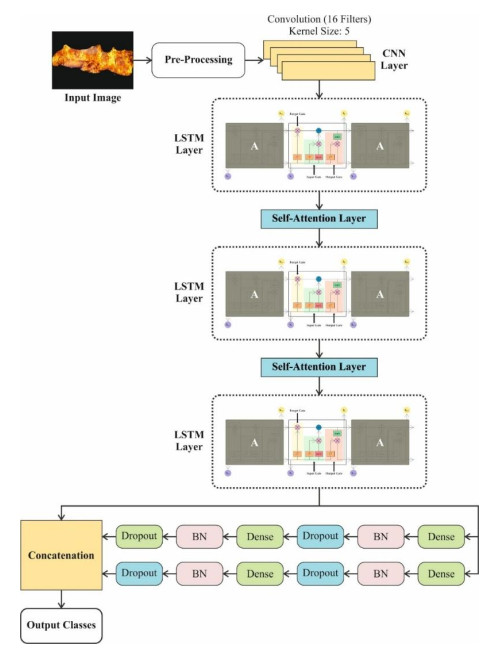
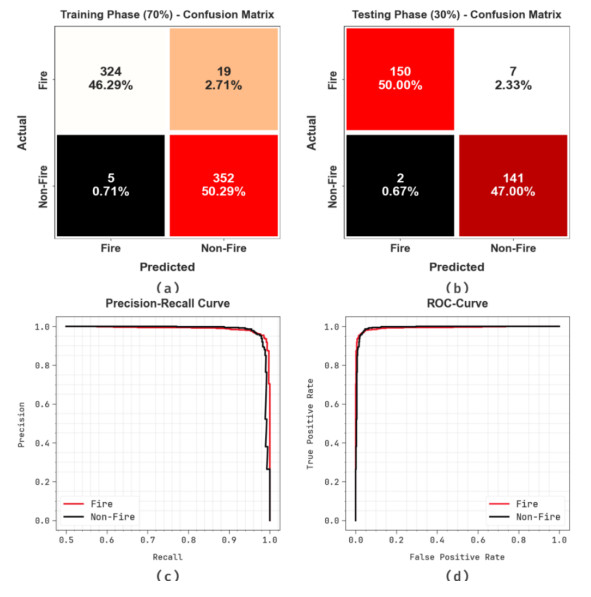
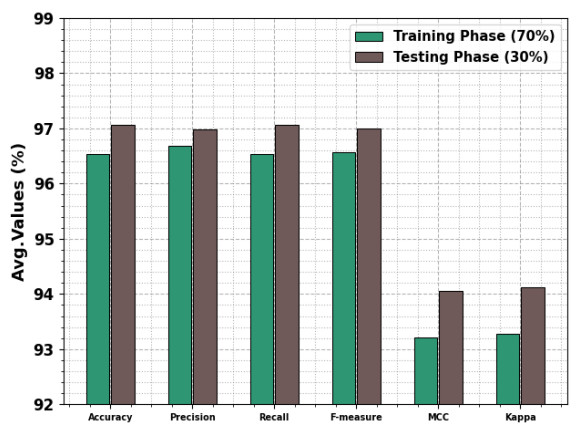
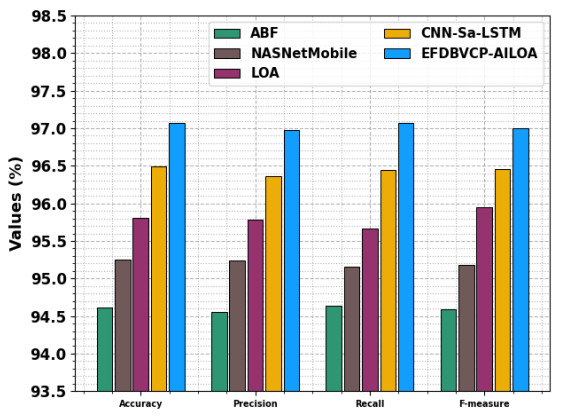
An increased number of older people suffer from higher levels of cognitive and vision impairments, which usually results in loss of independence. Fire detection systems play a crucial role in providing timely alerts to blind and visually impaired (BVI) individuals during indoor emergencies. As fire detection is complex and critical for safety, deep learning (DL) has recently been adopted for precise recognition. Efficient algorithms are crucial for hardware-constrained devices like embedded systems, robots, and mobiles to ensure high performance with low power use. In this paper, an enhanced fire detection system for blind and visually challenged people using artificial intelligence (AI) and Lemurs Optimisation Algorithm (EFDBVCP-AILOA) model is proposed. The aim is to assist visually impaired individuals by using DL techniques. Primarily, the adaptive bilateral filtering (ABF) method is used to reduce noise while preserving essential edges in fire images. For feature extraction, the NASNetMobile method is employed to capture complex features from the image data. Furthermore, the EFDBVCP-AILOA method implements self‐attention with a convolutional neural network and long short-term memory (CNN-Sa-LSTM) model for classification. Finally, the Lemur's Optimisation (LO) model is employed as a parameter-tuning approach for the CNN-Sa-LSTM model. A wide-ranging experimentation of the EFDBVCP-AILOA approach is accomplished under the fire detection dataset. The comparative results of the EFDBVCP-AILOA approach demonstrated superior $ acc{u}_{y} $ of 97.07%, with $ pre{c}_{n} $, $ rec{a}_{l} $, and $ {F}_{measure} $ values of 96.98%, 97.07%, and 97.00%, respectively. The EFDBVCP-AILOA approach applied four performance metrics to evaluate and compared done with seven recent models.
Citation: Fahd N. Al-Wesabi, Abdulaziz Alhefdhi. Enhancing safety for blind and visually impaired people: intelligent fire detection using deep learning and the lemurs optimization algorithm[J]. AIMS Mathematics, 2025, 10(9): 21617-21641. doi: 10.3934/math.2025961
An increased number of older people suffer from higher levels of cognitive and vision impairments, which usually results in loss of independence. Fire detection systems play a crucial role in providing timely alerts to blind and visually impaired (BVI) individuals during indoor emergencies. As fire detection is complex and critical for safety, deep learning (DL) has recently been adopted for precise recognition. Efficient algorithms are crucial for hardware-constrained devices like embedded systems, robots, and mobiles to ensure high performance with low power use. In this paper, an enhanced fire detection system for blind and visually challenged people using artificial intelligence (AI) and Lemurs Optimisation Algorithm (EFDBVCP-AILOA) model is proposed. The aim is to assist visually impaired individuals by using DL techniques. Primarily, the adaptive bilateral filtering (ABF) method is used to reduce noise while preserving essential edges in fire images. For feature extraction, the NASNetMobile method is employed to capture complex features from the image data. Furthermore, the EFDBVCP-AILOA method implements self‐attention with a convolutional neural network and long short-term memory (CNN-Sa-LSTM) model for classification. Finally, the Lemur's Optimisation (LO) model is employed as a parameter-tuning approach for the CNN-Sa-LSTM model. A wide-ranging experimentation of the EFDBVCP-AILOA approach is accomplished under the fire detection dataset. The comparative results of the EFDBVCP-AILOA approach demonstrated superior $ acc{u}_{y} $ of 97.07%, with $ pre{c}_{n} $, $ rec{a}_{l} $, and $ {F}_{measure} $ values of 96.98%, 97.07%, and 97.00%, respectively. The EFDBVCP-AILOA approach applied four performance metrics to evaluate and compared done with seven recent models.

| [1] |
F. Khan, Z. G. Xu, J. L. Sun, F. M. Khan, A. Ahmed, Y. Zhao, Recent advances in sensors for fire detection, Sensors, 22 (2022), 3310. https://doi.org/10.3390/s22093310 doi: 10.3390/s22093310

|
| [2] |
A. H. Altowaijri, M. S. Alfaifi, T. A. Alshawi, A. B. Ibrahim, S. A. Alshebeili, A privacy-preserving IoT-based fire detector, IEEE Access, 9 (2021), 51393–51402. https://doi.org/10.1109/ACCESS.2021.3069588 doi: 10.1109/ACCESS.2021.3069588
|
| [3] |
O. K. Abbas, F. Abdullah, N. A. M. Radzi, A. D. Salman, New adaptive-clustered routing protocol for indoor fire emergencies using hybrid CNN-BiLSTM model: development and validation, Journal of Intelligent Systems and Internet of Things, 14 (2025), 08–24. https://doi.org/10.54216/JISIoT.140202 doi: 10.54216/JISIoT.140202
|
| [4] |
Z. Fadhel, H. Attia, Y. H. Ali, Optimized and comprehensive fake review detection based on Harris Hawks optimization integrated with machine mearning techniques, Journal of Cybersecurity & Information Management, 15 (2025), 11–21. https://doi.org/10.54216/JCIM.150102 doi: 10.54216/JCIM.150102
|
| [5] | A. Jadon, M. Omama, A. Varshney, M. S. Ansari, R. Sharma, FireNet: A specialized lightweight fire & smoke detection model for real-time IoT applications, 2019, arXiv: 1905.11922. |
| [6] |
L. M. Yuan, R. A. Thomas, J. H. Rowland, L. H. Zhou, Early fire detection for underground diesel fuel storage areas, Process Saf. Environ. , 119 (2018), 69–74. https://doi.org/10.1016/j.psep.2018.07.022 doi: 10.1016/j.psep.2018.07.022
|
| [7] |
M. Altaee, A. Talib, M. A. Jalil, J. Ali, T. A. Alalwani, Intelligent multi-level feature fusion using remote sensing and CNN image classification algorithm, Journal of Intelligent Systems & Internet of Things, 9 (2023), 36–48. https://doi.org/10.54216/JISIoT.090103 doi: 10.54216/JISIoT.090103
|
| [8] | A. Ayala, B. Fernandes, F. Cruz, D. Macedo, A. L. I. Oliveira, C. Zanchettin, KutralNet: A portable deep learning model for fire recognition, 2020 International Joint Conference on Neural Networks (IJCNN), Glasgow, UK, 2020, 1–8. https://doi.org/10.1109/IJCNN48605.2020.9207202 |
| [9] |
K. Muhammad, J. Ahmad, I. Mehmood, S. Rho, S. W. Baik, Convolutional neural networks based fire detection in surveillance videos, IEEE Access, 6 (2018), 18174–18183. https://doi.org/10.1109/ACCESS.2018.2812835 doi: 10.1109/ACCESS.2018.2812835
|
| [10] | J. Gotthans, T. Gotthans, R. Marsalek, Deep convolutional neural network for fire detection, 2020 30th International Conference Radioelektronika (RADIOELEKTRONIKA), Bratislava, Slovakia, 2020, 1–6. https://doi.org/10.1109/RADIOELEKTRONIKA49387.2020.9092344 |
| [11] |
Z. Y. Yang, M. Gao, J. Choi, Smart walking cane based on triboelectric nanogenerators for assisting the visually impaired, Nano Energy, 124 (2014), 109485. https://doi.org/10.1016/j.nanoen.2024.109485 doi: 10.1016/j.nanoen.2024.109485
|
| [12] | I. M. Kamal, M. Salah Abd-elhafeez, A. Farghal, Camera-based navigation system for blind and visually impaired people, Sohag Engineering Journal, 3 (2023), 1–13. |
| [13] | T. Sugashini, G. Balakrishnan, Visually impaired object segmentation and detection using hybrid Canny edge detector, Hough transform, and improved momentum search in YOLOv7, Signal Image Video P, 18 (2024), 251–265. https://doi.org/10.1007/s11760-024-03149-6 |
| [14] |
Y. Said, M. Atri, M. A. Albahar, A. Ben Atitallah, Y. A. Alsariera, Obstacle detection system for navigation assistance of visually impaired people based on deep learning techniques, Sensors, 23 (2023), 5262. https://doi.org/10.3390/s23115262 doi: 10.3390/s23115262
|
| [15] | L. Kumar, A. S. Kushwaha, A. Jain, An auditory system interface for augmented accessibility: empowering the visually impaired, Eng. Proc., 62 (2024.), 8. https://doi.org/10.3390/engproc2024062008 |
| [16] |
B. Kuriakose, R. Shrestha, F. E. Sandnes, DeepNAVI: A deep learning based smartphone navigation assistant for people with visual impairments, Expert Syst. Appl. , 212 (2023), 118720. https://doi.org/10.1016/j.eswa.2022.118720 doi: 10.1016/j.eswa.2022.118720
|
| [17] |
N. Yunusov, B. M. S. Islam, A. Abdusalomov, W. Kim, Robust forest fire detection method for surveillance systems based on you only look once version 8 and transfer learning approaches, Processes, 12 (2024), 1039. https://doi.org/10.3390/pr12051039 doi: 10.3390/pr12051039
|
| [18] |
F. N. Al-Wesabi, A. A. K. Alharbi, I. Yaseen, An advanced fire detection system for assisting visually challenged people using recurrent neural network and seahorse optimizer algorithm, Sci. Rep. , 15 (2025), 21493. https://doi.org/10.1038/s41598-025-91829-9 doi: 10.1038/s41598-025-91829-9
|
| [19] |
S. Chitram, S. Kumar, S. Thenmalar, Enhancing fire and smoke detection using deep learning techniques, Eng. Proc. , 62 (2024), 7. https://doi.org/10.3390/engproc2024062007 doi: 10.3390/engproc2024062007
|
| [20] |
A. S. Buriboev, A. Abduvaitov, H. S. Jeon, Integrating color and contour analysis with deep learning for robust fire and smoke detection, Sensors, 25 (2025), 2044. https://doi.org/10.3390/s25072044 doi: 10.3390/s25072044
|
| [21] |
A. S. Buriboev, K. Rakhmanov, T. Soqiyev, A. J. Choi, Improving fire detection accuracy through enhanced convolutional neural networks and contour techniques, Sensors, 24 (2024), 5184. https://doi.org/10.3390/s24165184 doi: 10.3390/s24165184
|
| [22] | D. C. Sujatha, P. Singh, C. Vallikannu, R. Varman, M. G. Skanda, T. Gavaskar, Enhanced fire detection for industrial and environmental safety using iot-integrated vision sensors and residual clutch attention network and depthwise distinguishable convolutional neural networks, 2025 3rd International Conference on Intelligent Data Communication Technologies and Internet of Things (IDCIoT), Bengaluru, India, 2025,627–632. https://doi.org/10.1109/IDCIOT64235.2025.10914734 |
| [23] | O. Said, B. M. Hamza, M. Hibatallah, E. M. Ali, E. A. Abdellatif, Low-cost real-time fire detection in smart cities: logistic regression is all you need, 2024 Mediterranean Smart Cities Conference (MSCC), Martil-Tetuan, Morocco, 2024, 1–6. https://doi.org/10.1109/MSCC62288.2024.10697062 |
| [24] |
S.-J. Lee, H.-S. Yun, Y.-B. Sim, S.-H. Lee, Design and validation of an edge-ai fire safety system with smartthings integration for accelerated detection and targeted suppression, Appl. Sci. , 15 (2025), 8118. https://doi.org/10.3390/app15148118 doi: 10.3390/app15148118
|
| [25] |
B. Wang, G. Z. Huang, H. X. Li, X. L. Chen, L. Zhang, X. H. Gao, Hybrid CBAM-EfficientNetV2 fire image recognition method with label smoothing in detecting tiny targets, Mach. Intell. Res. , 21 (2024), 1145–1161. https://doi.org/10.1007/s11633-023-1445-5 doi: 10.1007/s11633-023-1445-5
|
| [26] | M. Khan, N. K. Mahala, P. Kumar, Leveraging mixed data cnn-lstm with fractional order optical flow for early fire detection and xai-guided segmentation, submitted for publication. |
| [27] |
N. Jahan, T. B. M. Niloy, J. F. Silvi, M. Hasan, I. J. Nashia, R. Khan, Development of an IoT-based firefighting drone for enhanced safety and efficiency in fire suppression, Meas. Control, 57 (2024), 1464–1479. https://doi.org/10.1177/00202940241238674 doi: 10.1177/00202940241238674
|
| [28] |
H. P. Yu, F. Z. He, Y. T. Pan, A scalable region-based level set method using adaptive bilateral filter for noisy image segmentation, Multimed. Tools Appl. , 79 (2020), 5743–5765. https://doi.org/10.1007/s11042-019-08493-1 doi: 10.1007/s11042-019-08493-1
|
| [29] |
A. W. A. Ameer, P. Salehpour, M. Asadpour, Deep transfer learning for lip reading based on nasnetmobile pretrained model in wild dataset, IEEE Access, 13 (2024), 11623–11638. https://doi.org/10.1109/ACCESS.2024.3470521 doi: 10.1109/ACCESS.2024.3470521
|
| [30] |
A. Baihan, A. I. Alutaibi, Mohammed Alshehri, S. K. Sharma, Sign language recognition using modified deep learning network and hybrid optimization: A hybrid optimizer (HO) based optimized CNNSa-LSTM approach, Sci. Rep. , 14 (2024), 26111. https://doi.org/10.1038/s41598-024-76174-7 doi: 10.1038/s41598-024-76174-7
|
| [31] |
R. M. Al-Khatib, N. E. A. Al-qudah, M. S. Jawarneh, A. Al-Khateeb, A novel improved lemurs optimization algorithm for feature selection problems, J. King Saud Univ.-Com. , 35 (2023), 101704. https://doi.org/10.1016/j.jksuci.2023.101704 doi: 10.1016/j.jksuci.2023.101704
|
| [32] | Fire detection dataset, Kaggle. Available from: https://www.kaggle.com/datasets/kabilan03/fire-detection-dataset/data. |
| [33] |
D.-L. Nguyen, M. D. Putro, K.-H. Jo, Lightweight convolutional neural network for fire classification in surveillance system, IEEE Access, 11 (2023), 101604–101615. https://doi.org/10.1109/ACCESS.2023.3305455 doi: 10.1109/ACCESS.2023.3305455
|
| [34] |
A. Ayala, B. J. T. Fernandes, F. Cruz, D. Macedo, C. Zanchettin, Convolution optimization in fire classification, IEEE Access, 10 (2022), 23642–23658. https://doi.org/10.1109/ACCESS.2022.3151660 doi: 10.1109/ACCESS.2022.3151660
|
| [35] |
Z.-Y. Zhang, C.-X. Yan, Q.-M. Min, Y.-X. Zhang, W.-F. Jing, W.-X. Hou, et al., Leverage effective deep learning searching method for forensic age estimation, Bioengineering, 11 (2024), 674. https://doi.org/10.3390/bioengineering11070674 doi: 10.3390/bioengineering11070674
|
| [36] |
I. J. Ratul, Y. X. Zhou, K. C. Yang, Accelerating deep learning inference: A comparative analysis of modern acceleration fameworks, Electronics, 14 (2025), 2977. https://doi.org/10.3390/electronics14152977 doi: 10.3390/electronics14152977
|
| [37] |
Y. Sun, S. Brockhauser, P. Hegedűs, Comparing end-to-end machine learning methods for spectra classification, Appl. Sci. , 11 (2021), 11520. https://doi.org/10.3390/app112311520 doi: 10.3390/app112311520
|


Figures(10) / Tables(11)

Fahd N. Al-Wesabi, Abdulaziz Alhefdhi. Enhancing safety for blind and visually impaired people: intelligent fire detection using deep learning and the lemurs optimization algorithm[J]. AIMS Mathematics, 2025, 10(9): 21617-21641. doi: 10.3934/math.2025961





 DownLoad: