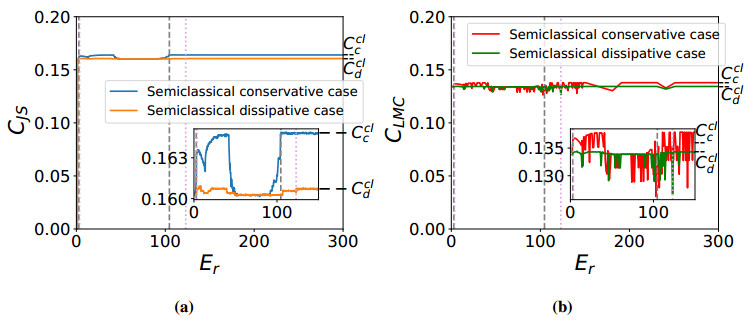
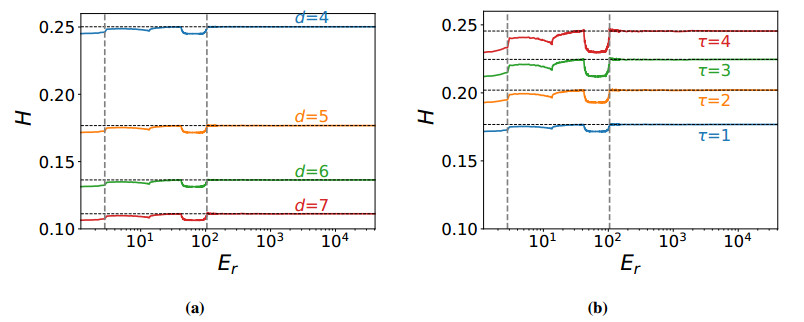
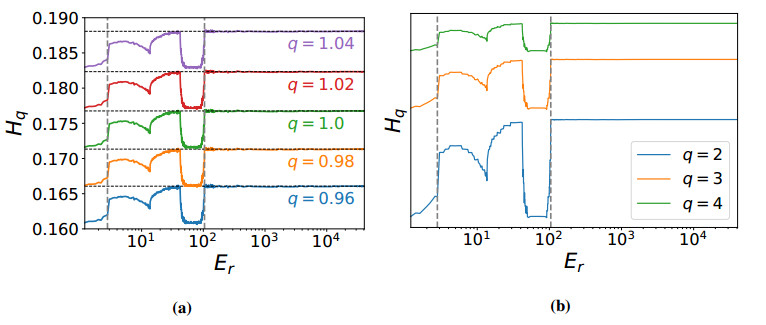
We investigated the dynamics of a regular nonlinear semiclassical system by employing Shannon entropy together with two associated formulations of statistical complexity: the López-Ruiz–Mancini–Calbet (LMC) and Jensen–Shannon approaches. Additionally, Tsallis entropy was used as an alternative quantifier. In this context, quantum variables interacted with a classical environment, and both conservative and dissipative regimes were considered. To compute information-theoretic quantifiers, probability distributions were extracted from the system's temporal evolution using the Bandt–Pompe permutation method. The classical limit was characterized by a motion invariant linked to the uncertainty principle. Our analysis revealed three distinct zones that characterized the structure of transitions across the classical–quantum boundary. These findings confirmed earlier results obtained in markedly different dynamical systems. This consistency supported the idea of a possible generalization, which, if established, would have significant implications for both semiclassical and quantum theories.
Citation: Gaspar Gonzalez Acosta, Andrés M. Kowalski. Statistical quantifiers and nonlinear conservative-dissipative classical transition[J]. AIMS Mathematics, 2025, 10(9): 20443-20465. doi: 10.3934/math.2025913
We investigated the dynamics of a regular nonlinear semiclassical system by employing Shannon entropy together with two associated formulations of statistical complexity: the López-Ruiz–Mancini–Calbet (LMC) and Jensen–Shannon approaches. Additionally, Tsallis entropy was used as an alternative quantifier. In this context, quantum variables interacted with a classical environment, and both conservative and dissipative regimes were considered. To compute information-theoretic quantifiers, probability distributions were extracted from the system's temporal evolution using the Bandt–Pompe permutation method. The classical limit was characterized by a motion invariant linked to the uncertainty principle. Our analysis revealed three distinct zones that characterized the structure of transitions across the classical–quantum boundary. These findings confirmed earlier results obtained in markedly different dynamical systems. This consistency supported the idea of a possible generalization, which, if established, would have significant implications for both semiclassical and quantum theories.

| [1] |
W. Struyve, Semi-classical approximations based on bohmian mechanics, Int. J. Mod. Phys. A, 35 (2020), 2050070. https://doi.org/10.1142/S0217751X20500700 doi: 10.1142/S0217751X20500700

|
| [2] |
V. Allori, N. Zanghì, On the classical limit of quantum mechanics, Found. Phys., 39 (2009), 20–32. https://doi.org/10.1007/s10701-008-9259-4 doi: 10.1007/s10701-008-9259-4
|
| [3] |
G. Hooft, Physics on the boundary between classical and quantum mechanics, J. Phys.: Conf. Ser., 504 (2014), 012003. https://doi.org/10.1088/1742-6596/504/1/012003 doi: 10.1088/1742-6596/504/1/012003
|
| [4] |
D. Dieks, A. Lubberdink, How classical particles emerge from the quantum world, Found. Phys., 41 (2011), 1051–1064. https://doi.org/10.1007/s10701-010-9515-2 doi: 10.1007/s10701-010-9515-2
|
| [5] |
M. Ludwig, B. Kubala, F. Marquardt, The optomechanical instability in the quantum regime, New J. Phys., 10 (2008), 095013. https://doi.org/10.1088/1367-2630/10/9/095013 doi: 10.1088/1367-2630/10/9/095013
|
| [6] |
J. Fink, L. Steffen, P. Studer, L. S. Bishop, M. Baur, R. Bianchetti, et al., Quantum-to-classical transition in cavity quantum electrodynamics, Phys. Rev. Lett., 105 (2010), 163601. https://doi.org/10.1103/physrevlett.105.163601 doi: 10.1103/physrevlett.105.163601
|
| [7] |
J. Raftery, D. Sadri, S. Schmidt, H. E. Türeci, A. A. Houck, Observation of a dissipation-induced classical to quantum transition, Phys. Rev. X, 4 (2014), 031043. https://doi.org/10.1103/physrevx.4.031043 doi: 10.1103/physrevx.4.031043
|
| [8] | E. Joos, H. D. Zeh, C. Kiefer, D. J. Giulini, J. Kupsch, I.-O. Stamatescu, Decoherence and the appearance of a classical world in quantum theory, Berlin, Heidelberg: Springer, 2003. https://doi.org/10.1007/978-3-662-05328-7 |
| [9] |
M. P. Das, Mesoscopic systems in the quantum realm: fundamental science and applications, Adv. Nat. Sci: Nanosci. Nanotechnol., 1 (2010), 043001. https://doi.org/10.1088/2043-6262/1/4/043001 doi: 10.1088/2043-6262/1/4/043001
|
| [10] |
T. Brandes, Coherent and collective quantum optical effects in mesoscopic systems, Phys. Rep., 408 (2005), 315–474. https://doi.org/10.1016/j.physrep.2004.12.002 doi: 10.1016/j.physrep.2004.12.002
|
| [11] |
F. Iachello, N. Zamfir, Quantum phase transitions in mesoscopic systems, Phys. Rev. Lett., 92 (2004), 212501. https://doi.org/10.1103/physrevlett.92.212501 doi: 10.1103/physrevlett.92.212501
|
| [12] |
F. Bloch, Nuclear induction, Phys. Rev., 70 (1946), 460. https://doi.org/10.1103/physrev.70.460 doi: 10.1103/physrev.70.460
|
| [13] | P. W. Milonni, M. Shih, J. R. Ackerhalt, Chaos in Laser-Matter Interactions, World Scientific Publishing Company, 1987. https://doi.org/10.1142/0323 |
| [14] |
A. A. Budini, Quantum–classical hybrid dynamics: Coupling mechanisms and diffusive approximation, Open Syst. Inf. Dyn., 31 (2024), 2450013. https://doi.org/10.1142/S1230161224500136 doi: 10.1142/S1230161224500136
|
| [15] |
A. D. Bermúdez Manjarres, M. Reginatto, S. Ulbricht, Three statistical descriptions of classical systems and their extensions to hybrid quantum–classical systems, Eur. Phys. J. Plus, 139 (2024), 780. https://doi.org/10.1140/epjp/s13360-024-05452-0 doi: 10.1140/epjp/s13360-024-05452-0
|
| [16] |
T. Micklitz, A. Altland, Semiclassical theory of chaotic quantum resonances, Phys. Rev. E, 87 (2013), 032918. https://doi.org/10.1103/PhysRevE.87.032918 doi: 10.1103/PhysRevE.87.032918
|
| [17] |
S. Prants, Quantum–classical correspondence in chaotic dynamics of laser-driven atoms, Phys. Scr., 92 (2017), 044002. https://doi.org/10.1088/1402-4896/aa5f8f doi: 10.1088/1402-4896/aa5f8f
|
| [18] |
R. F. Ribeiro, K. Burke, Deriving uniform semiclassical approximations for one-dimensional fermionic systems, J. Chem. Phys., 148 (2018), 194103. https://doi.org/10.1063/1.5025628 doi: 10.1063/1.5025628
|
| [19] |
F. Minganti, A. Miranowicz, R. W. Chhajlany, F. Nori, Quantum exceptional points of non-hermitian hamiltonians and liouvillians: The effects of quantum jumps, Phys. Rev. A, 100 (2019), 062131. https://doi.org/10.1103/PhysRevA.100.062131 doi: 10.1103/PhysRevA.100.062131
|
| [20] |
M. Bastarrachea-Magnani, S. Lerma-Hernández, J. Hirsch, Comparative quantum and semiclassical analysis of atom-field systems. ii. chaos and regularity, Phys. Rev. A, 89 (2014), 032102. https://doi.org/10.1103/PhysRevA.89.032102 doi: 10.1103/PhysRevA.89.032102
|
| [21] |
V. Allori, N. Zanghì, On the classical limit of quantum mechanics, Found. Phys., 39 (2009), 20–32. https://doi.org/10.1007/s10701-008-9259-4 doi: 10.1007/s10701-008-9259-4
|
| [22] |
J. Kurchan, Quantum bound to chaos and the semiclassical limit, J. Stat. Phys., 171 (2018), 965–979. https://doi.org/10.1007/s10955-018-2052-7 doi: 10.1007/s10955-018-2052-7
|
| [23] |
A. C. Oliveira, M. C. Nemes, K. F. Romero, Quantum time scales and the classical limit: Analytic results for some simple systems, Phys. Rev. E, 68 (2003), 036214. https://doi.org/10.1103/PhysRevE.68.036214 doi: 10.1103/PhysRevE.68.036214
|
| [24] |
A. Kowalski, A. Plastino, A. Proto, Semiclassical model for quantum dissipation, Phys. Rev. E, 52 (1995), 165. https://doi.org/10.1103/PhysRevE.52.165 doi: 10.1103/PhysRevE.52.165
|
| [25] |
A. M. Kowalski, A. Plastino, A. Proto, Classical limits, Phys. Lett. A, 297 (2002), 162–172. https://doi.org/10.1016/S0375-9601(02)00034-8 doi: 10.1016/S0375-9601(02)00034-8
|
| [26] |
G. Gonzalez Acosta, A. Plastino, A. Kowalski, Dynamical classic limit: Dissipative vs conservative systems, Chaos, 33 (2023), 013126. https://doi.org/10.1063/5.0126040 doi: 10.1063/5.0126040
|
| [27] |
A. Kowalski, M. Martín, A. Plastino, O. Rosso, Bandt–pompe approach to the classical-quantum transition, Phys. D, 233 (2007), 21–31. https://doi.org/10.1016/j.physd.2007.06.015 doi: 10.1016/j.physd.2007.06.015
|
| [28] |
R. Lopez-Ruiz, H. L. Mancini, X. Calbet, A statistical measure of complexity, Phys. Lett. A, 209 (1995), 321–326. https://doi.org/10.1016/0375-9601(95)00867-5 doi: 10.1016/0375-9601(95)00867-5
|
| [29] |
R. Lopez-Ruiz, Complexity in some physical systems, Int. J. Bifurcation Chaos, 11 (2001), 2669–2673. https://doi.org/10.1142/S0218127401003711 doi: 10.1142/S0218127401003711
|
| [30] |
X. Calbet, R. López-Ruiz, Tendency towards maximum complexity in a nonequilibrium isolated system, Phys. Rev. E, 63 (2001), 066116. https://doi.org/10.1103/PhysRevE.63.066116 doi: 10.1103/PhysRevE.63.066116
|
| [31] |
P. W. Lamberti, M. Martin, A. Plastino, O. Rosso, Intensive entropic non-triviality measure, Phys. A, 334 (2004), 119–131. https://doi.org/10.1016/j.physa.2003.11.005 doi: 10.1016/j.physa.2003.11.005
|
| [32] |
M. Martin, A. Plastino, O. A. Rosso, Generalized statistical complexity measures: Geometrical and analytical properties, Phys. A, 369 (2006), 439–462. https://doi.org/10.1016/j.physa.2005.11.053 doi: 10.1016/j.physa.2005.11.053
|
| [33] |
C. Tsallis, Entropic nonextensivity: A possible measure of complexity, Chaos, Solitons & Fractals, 13 (2002), 371–391. https://doi.org/10.1016/S0960-0779(01)00019-4 doi: 10.1016/S0960-0779(01)00019-4
|
| [34] |
C. Bandt, B. Pompe, Permutation entropy: A natural complexity measure for time series, Phys. Rev. Lett., 88 (2002), 174102. https://doi.org/10.1103/PhysRevLett.88.174102 doi: 10.1103/PhysRevLett.88.174102
|
| [35] |
K. Keller, M. Sinn, Ordinal analysis of time series, Phys. A, 356 (2005), 114–120. https://doi.org/10.1016/j.physa.2005.05.022 doi: 10.1016/j.physa.2005.05.022
|
| [36] |
P. M. Saco, L. C. Carpi, A. Figliola, E. Serrano, O. A. Rosso, Entropy analysis of the dynamics of el niño/southern oscillation during the holocene, Phys. A, 389 (2010), 5022–5027. https://doi.org/10.1016/j.physa.2010.07.006 doi: 10.1016/j.physa.2010.07.006
|
| [37] |
L. Zunino, M. C. Soriano, I. Fischer, O. A. Rosso, C. R. Mirasso, Permutation-information-theory approach to unveil delay dynamics from time-series analysis, Phys. Rev. E, 82 (2010), 046212. https://doi.org/10.1103/PhysRevE.82.046212 doi: 10.1103/PhysRevE.82.046212
|
| [38] | A. A. Pessa, H. V. Ribeiro, ordpy: A python package for data analysis with permutation entropy and ordinal network methods, Chaos, 31, https://doi.org/10.1063/5.0049901 |
| [39] |
J. R. C. Piqueira, S. H. V. de Mattos, Note on lmc complexity measure, Ecol. Modell., 222 (2011), 3603–3604. https://doi.org/10.1016/j.ecolmodel.2011.08.012 doi: 10.1016/j.ecolmodel.2011.08.012
|
| [40] |
J. R. C. Piqueira, S. H. V. L. d. Mattos, Lmc and sdl complexity measures: A tool to explore time series, Complexity, 2019 (2019), 2095063. https://doi.org/10.1155/2019/2095063 doi: 10.1155/2019/2095063
|
| [41] |
R. E. Monge, J. L. Crespo, Analysis of data complexity in human dna for gene-containing zone prediction, Entropy, 17 (2015), 1673–1689. https://doi.org/10.3390/e17041673 doi: 10.3390/e17041673
|
| [42] |
L. Zunino, D. Pérez, A. Kowalski, M. Martín, M. Garavaglia, A. Plastino, et al., Fractional brownian motion, fractional gaussian noise, and tsallis permutation entropy, Phys. A, 387 (2008), 6057–6068. https://doi.org/10.1016/j.physa.2008.07.004 doi: 10.1016/j.physa.2008.07.004
|
| [43] |
L. Zdeborová, F. Krzakala, Statistical physics of inference: Thresholds and algorithms, Adv. Phys., 65 (2016), 453–552. https://doi.org/10.1080/00018732.2016.1211393 doi: 10.1080/00018732.2016.1211393
|
| [44] |
A. Zvyagin, Dynamical quantum phase transitions, Low Temp. Phys., 42 (2016), 971–994. https://doi.org/10.1063/1.4969869 doi: 10.1063/1.4969869
|
| [45] |
F. Cooper, J. Dawson, S. Habib, R. D. Ryne, Chaos in time-dependent variational approximations to quantum dynamics, Phys. Rev. E, 57 (1998), 1489. https://doi.org/10.1103/PhysRevE.57.1489 doi: 10.1103/PhysRevE.57.1489
|
| [46] |
Y. Alhassid, R. Levine, Connection between the maximal entropy and the scattering theoretic analyses of collision processes, Phys. Rev. A, 18 (1978), 89. https://doi.org/10.1103/PhysRevA.18.89 doi: 10.1103/PhysRevA.18.89
|
| [47] |
R. Levine, D. Napoli, D. Otero, A. Plastino, A. Proto, Maximum entropy approach to nuclear fission processes, Nucl. Phys. A, 454 (1986), 338–358. https://doi.org/10.1016/0375-9474(86)90272-1 doi: 10.1016/0375-9474(86)90272-1
|
| [48] | V. I. Arnold, Mathematical Methods of Classical Mechanics, 2 Eds., New York: Springer, 2013. https://doi.org/10.1007/978-1-4757-2063-1 |
| [49] | S. Boyd, L. Vandenberghe, Convex Optimization, Cambridge: Cambridge University Press, 2004. https://doi.org/10.1017/CBO9780511804441 |
| [50] | W. Rudin, Functional Analysis, 2 Eds., McGraw-Hill, 1991. |
Figures(7)

Gaspar Gonzalez Acosta, Andrés M. Kowalski. Statistical quantifiers and nonlinear conservative-dissipative classical transition[J]. AIMS Mathematics, 2025, 10(9): 20443-20465. doi: 10.3934/math.2025913





 DownLoad: