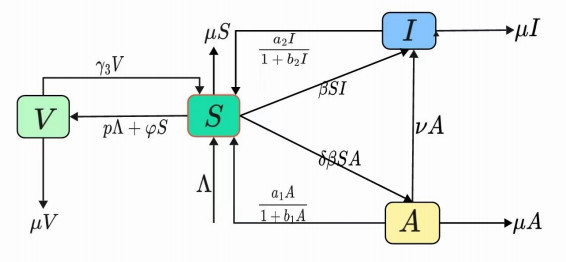
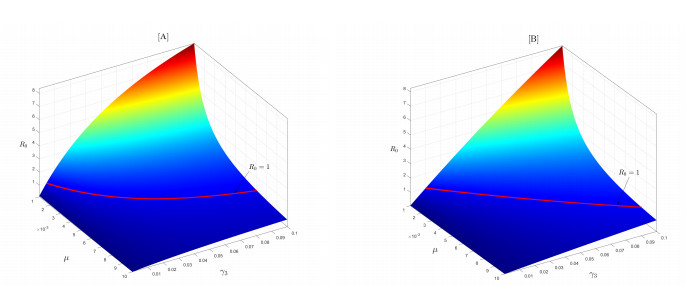
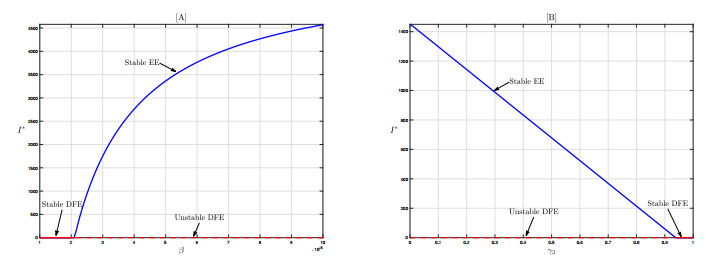
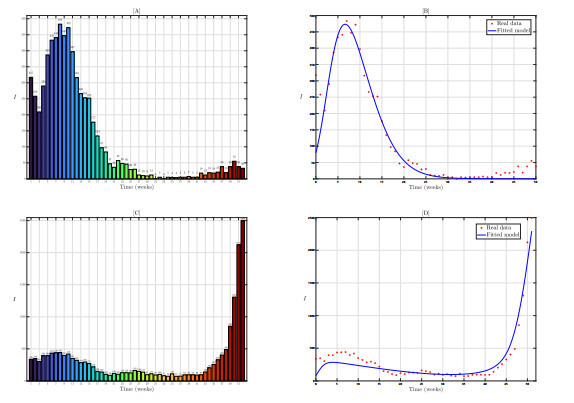
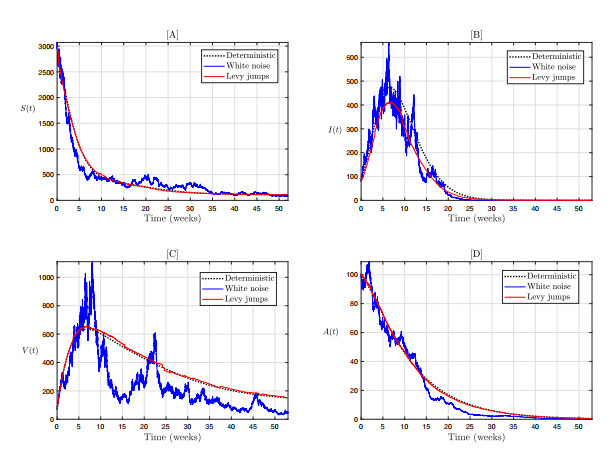
A profound understanding of influenza transmission mechanisms is crucial for developing effective control strategies. This study first establishes a deterministic SAIV influenza model incorporating vaccination and asymptomatic carriers. The basic reproduction number $ R_0 $ is derived using the next-generation matrix method, followed by an analysis of equilibrium existence and stability. The existence of a transcritical bifurcation in the deterministic model is rigorously demonstrated through bifurcation theory. Subsequently, a stochastic SAIV model incorporating both white noise and Lévy jumps is formulated based on the deterministic framework. By employing Lyapunov function theory, the existence, uniqueness, and non-negative boundedness of the global positive solution are proven, ensuring biological plausibility. Furthermore, threshold conditions for disease extinction and persistence are analytically derived, providing a theoretical delineation of influenza fade-out or endemic transmission. Finally, model parameters are estimated using empirical influenza data, validating the accuracy of the deterministic model and the reliability of stochastic dynamical predictions. The results indicate that limited medical resources facilitate sustained transmission and reduce eradication probability, while environmental stochasticity further emphasizes the critical role of optimized resource allocation in influenza containment.
Citation: Shunping Ouyang, Guoqin Chen, Yue Xia, Guoxing Shi, Yanbin Feng. Stochastic dynamics of influenza epidemic model with vaccination strategy[J]. AIMS Mathematics, 2025, 10(9): 20412-20442. doi: 10.3934/math.2025912
A profound understanding of influenza transmission mechanisms is crucial for developing effective control strategies. This study first establishes a deterministic SAIV influenza model incorporating vaccination and asymptomatic carriers. The basic reproduction number $ R_0 $ is derived using the next-generation matrix method, followed by an analysis of equilibrium existence and stability. The existence of a transcritical bifurcation in the deterministic model is rigorously demonstrated through bifurcation theory. Subsequently, a stochastic SAIV model incorporating both white noise and Lévy jumps is formulated based on the deterministic framework. By employing Lyapunov function theory, the existence, uniqueness, and non-negative boundedness of the global positive solution are proven, ensuring biological plausibility. Furthermore, threshold conditions for disease extinction and persistence are analytically derived, providing a theoretical delineation of influenza fade-out or endemic transmission. Finally, model parameters are estimated using empirical influenza data, validating the accuracy of the deterministic model and the reliability of stochastic dynamical predictions. The results indicate that limited medical resources facilitate sustained transmission and reduce eradication probability, while environmental stochasticity further emphasizes the critical role of optimized resource allocation in influenza containment.

| [1] |
M. Ali, F. Guma, A. Qazza, R. Saadeh, N. E. Alsubaie, M. Althubyani, et al., Stochastic modeling of influenza transmission: Insights into disease dynamics and epidemic management, PDE Appl. Math., 11 (2024), 100886. https://doi.org/10.1016/j.padiff.2024.100886 doi: 10.1016/j.padiff.2024.100886

|
| [2] |
X. Fu, Y. Zhou, J. Wu, X. Liu, C. Ding, C. Huang, et al., Clinical characteristics and outcomes during a severe influenza season in China during 2017–2018, BMC Infect. Dis., 19 (2019), 668. https://doi.org/10.1186/s12879-019-4181-2 doi: 10.1186/s12879-019-4181-2
|
| [3] |
S. Kim, J. Lee, E. Jung, Mathematical model of transmission dynamics and optimal control strategies for 2009 A/H1N1 influenza in the Republic of Korea, J. Theoret. Biol., 412 (2017), 74–85. https://doi.org/10.1016/j.jtbi.2016.09.025 doi: 10.1016/j.jtbi.2016.09.025
|
| [4] |
A. Finckh, B. Gilbert, B. Hodkinson, S. C. Bae, R. Thomas, K. D. Deane, et al., Global epidemiology of rheumatoid arthritis, Nat. Rev. Rheumatol., 18 (2022), 591–602. https://doi.org/10.1038/s41584-022-00827-y doi: 10.1038/s41584-022-00827-y
|
| [5] |
A. El-shenawy, M. El-Gamel, D. Reda, Troesch's problem: A numerical study with cubic trigonometric B-spline method, PDE Appl. Math., 10 (2024), 100694. https://doi.org/10.1016/j.padiff.2024.100694 doi: 10.1016/j.padiff.2024.100694
|
| [6] |
S. Lee, M. Golinski, G. Chowell, Modeling optimal age-specific vaccination strategies against pandemic influenza, Bull. Math. Biol., 74 (2012), 958–980. https://doi.org/10.1007/s11538-011-9704-y doi: 10.1007/s11538-011-9704-y
|
| [7] |
S. Bugalia, J. P. Tripathi, H. Wang, Mathematical modeling of intervention and low medical resource availability with delays: Applications to COVID-19 outbreaks in Spain and Italy, Math. Biosci. Eng., 18 (2021), 5865–5920. https://doi.org/10.3934/mbe.2021295 doi: 10.3934/mbe.2021295
|
| [8] |
W. Qin, S. Zhang, Y. Yang, J. Zhang, A discrete SIR epidemic model incorporating media impact, resource limitaions and threshold switching strategies, Infect. Dis. Model., 10 (2025), 1270–1290. https://doi.org/10.1016/j.idm.2025.07.006 doi: 10.1016/j.idm.2025.07.006
|
| [9] |
B. Zhou, N. Shi, Analysis of a stochastic SEIS epidemic model motivated by Black–Karasinski process: Probability density function, Chaos Solitons Fract., 189 (2024), 115713. https://doi.org/10.1016/j.chaos.2024.115713 doi: 10.1016/j.chaos.2024.115713
|
| [10] |
Z. Cao, W. Feng, X. Wen, L. Zu, M. Cheng, Dynamics of a stochastic SIQR epidemic model with standard incidence, Phys. A, 527 (2019), 121180. https://doi.org/10.1016/j.physa.2019.121180 doi: 10.1016/j.physa.2019.121180
|
| [11] |
Y. Cai, Y. Kang, W. Wang, A stochastic SIRS epidemic model with nonlinear incidence rate, Appl. Math. Comput., 305 (2017), 221–240. https://doi.org/10.1016/j.amc.2017.02.003 doi: 10.1016/j.amc.2017.02.003
|
| [12] |
X. B. Zhang, X. H. Zhang, The threshold of a deterministic and a stochastic SIQS epidemic model with varying total population size, Appl. Math. Model., 91 (2021), 749–767. https://doi.org/10.1016/j.apm.2020.09.050 doi: 10.1016/j.apm.2020.09.050
|
| [13] | D. Kiouach, Y. Sabbar, Developing new techniques for obtaining the threshold of a stochastic SIR epidemic model with 3-dimensional Lévy process, preprint paper, 2020. https://doi.org/10.48550/arXiv.2002.09022 |
| [14] |
S. Wang, G. Hu, T. Wei, L. Wang, Permanence of hybrid competitive Lotka-Volterra system with Lévy noise, Phys. A, 540 (2020), 123116. https://doi.org/10.1016/j.physa.2019.123116 doi: 10.1016/j.physa.2019.123116
|
| [15] |
J. Bao, C. Yuan, Stochastic population dynamics driven by Lévy noise, J. Math. Anal. Appl., 391 (2012), 363–375. https://doi.org/10.1016/j.jmaa.2012.02.043 doi: 10.1016/j.jmaa.2012.02.043
|
| [16] |
Q. Yang, X. Zhang, D. Jiang, Asymptotic behavior of a stochastic SIR model with general incidence rate and nonlinear Lévy jumps, Nonlinear Dyn., 107 (2022), 2975–2993. https://doi.org/10.1007/s11071-021-07095-7 doi: 10.1007/s11071-021-07095-7
|
| [17] |
Y. Sabbar, A. Din, D. Kiouach, Influence of fractal–fractional differentiation and independent quadratic Lévy jumps on the dynamics of a general epidemic model with vaccination strategy, Chaos Solitons Fract., 171 (2023), 113434. https://doi.org/10.1016/j.chaos.2023.113434 doi: 10.1016/j.chaos.2023.113434
|
| [18] |
D. Kiouach, S. E. Azami El‐idrissi, Y. Sabbar, The impact of Lévy noise on the threshold dynamics of a stochastic susceptible‐vaccinated‐infected‐recovered epidemic model with general incidence functions, Math. Meth. Appl. Sci., 47 (2024), 297–317. https://doi.org/10.1002/mma.9655 doi: 10.1002/mma.9655
|
| [19] |
J. Djordevic, K. R. Dahl, Stochastic optimal control of pre-exposure prophylaxis for HIV infection for a jump model, J. Math. Biol., 89 (2024), 55. https://doi.org/10.1007/s00285-024-02151-3 doi: 10.1007/s00285-024-02151-3
|
| [20] |
G. L. Anesi, Y. Lynch, L. Evans, A conceptual and adaptable approach to hospital preparedness for acute surge events due to emerging infectious diseases, Crit. Care Explor., 2 (2020), e0110. https://doi.org/10.1097/CCE.0000000000000110 doi: 10.1097/CCE.0000000000000110
|
| [21] |
J. Andrade, B. Beishuizen, M. Stein, M. Connolly, J. Duggan, Preparing for pandemic response in the context of limited resources, Syst. Dyn. Rev., 40 (2024), e1775. https://doi.org/10.1002/sdr.1775 doi: 10.1002/sdr.1775
|
| [22] |
W. Qin, X. Wu, Global analysis and optimal therapy in immunogenic tumors: A nonlinear state-dependent hybrid model with a dynamic threshold policy, Nonlinear Dyn, 113 (2025) 14013–14049. https://doi.org/10.1007/s11071-024-10847-w doi: 10.1007/s11071-024-10847-w
|
| [23] |
X. Guan, F. Yang, Y. Cai, W. Wang, Global stability of an influenza A model with vaccination, Appl. Math. Lett., 134 (2022), 108322. https://doi.org/10.1016/j.aml.2022.108322 doi: 10.1016/j.aml.2022.108322
|
| [24] |
J. Zhang, J. Jia, X. Song, Analysis of an SEIR epidemic model with saturated incidence and saturated treatment function, Sci. World J., 2014 (2014), 910421. https://doi.org/10.1155/2014/910421 doi: 10.1155/2014/910421
|
| [25] |
J. K. Ghosh, U. Ghosh, M. H. A. Biswas, S. Sarkar, Qualitative analysis and optimal control strategy of an SIR model with saturated incidence and treatment, Differ. Equ. Dyn. Sys., 31 (2023), 53–67. https://doi.org/10.1007/s12591-019-00486-8 doi: 10.1007/s12591-019-00486-8
|
| [26] | F. Brauer, C. Castillo-Chavez, Z. Feng, Mathematical models in epidemiology, New York: Springer, 2019. |
| [27] |
S. Boulaaras, Z. U. Rehman, F. A. Abdullah, R. Jan, M. Abdalla, A. Jan, Coronavirus dynamics, infections and preventive interventions using fractional-calculus analysis, AIMS Math, 8 (2023), 8680–8701. http://dx.doi.org/10.3934/math.2023436 doi: 10.3934/math.2023436
|
| [28] |
H. W. Hethcote, D. W. Tudor, Integral equation models for endemic infectious diseases, J. Math. Biol., 9 (1980), 37–47. https://doi.org/10.1007/BF00276034 doi: 10.1007/BF00276034
|
| [29] |
T. Vu, S. Farish, M. Jenkins, H. Kelly, A meta-analysis of effectiveness of influenza vaccine in persons aged 65 years and over living in the community, Vaccine, 20 (2002), 1831–1836. https://doi.org/10.1016/S0264-410X(02)00041-5 doi: 10.1016/S0264-410X(02)00041-5
|
| [30] |
A. Alkhazzan, J. Wang, Y. Nie, H. Khan, J. Alzabut, A novel SIRS epidemic model for two diseases incorporating treatment functions, media coverage, and three types of noise, Chaos Solitons Fract., 181 (2024), 114631. https://doi.org/10.1016/j.chaos.2024.114631 doi: 10.1016/j.chaos.2024.114631
|
| [31] | J. Guckenheimer, P. Holmes, Nonlinear oscillations, dynamical systems, and bifurcations of vector fields, Berlin: Springer, 2013. |
| [32] |
P. Sandhu, A. B. Shah, F. B. Ahmad, J. Kerr, H. B. Demeke, E. Graeden, et al., Emergency department and intensive care unit overcrowding and ventilator shortages in US hospitals during the COVID-19 pandemic, 2020-2021, Public Health Rep., 137 (2022), 796–802. https://doi.org/10.1177/00333549221091781 doi: 10.1177/00333549221091781
|
| [33] |
A. M. Salman, I. Ahmed, M. H. Mohd, M. S. Jamiluddin, Scenario analysis of COVID-19 transmission dynamics in Malaysia with the possibility of reinfection and limited medical resources scenarios, Comput. Biol. Med., 133 (2021), 104372. https://doi.org/10.1177/00333549221091781 doi: 10.1177/00333549221091781
|
| [34] |
J. Maurya, K. B. Blyuss, A. K. Misra, Modeling the impact of hospital beds and vaccination on the dynamics of an infectious disease, Math. Biosci., 368 (2024), 109133. https://doi.org/10.1016/j.mbs.2023.109133 doi: 10.1016/j.mbs.2023.109133
|
| [35] |
X. Zou, K Wang, Numerical simulations and modeling for stochastic biological systems with jumps, Commun. Nonlinear Sci. Numer. Simul., 19 (2014), 1557–1568. https://doi.org/10.1016/j.cnsns.2013.09.010 doi: 10.1016/j.cnsns.2013.09.010
|
| [36] | X. Mao, Stochastic differential equations and applications, Amsterdam: Elsevier, 2007. |
| [37] |
A. El Koufi, A. Bennar, N. Yousfi, Dynamics behaviors of a hybrid switching epidemic model with levy noise, Appl. Math., 15 (2021), 131–142. http://doi.org/10.18576/amis/150204 doi: 10.18576/amis/150204
|
| [38] |
M. El Fatini, R. Taki, A. Tridane, Threshold behaviour of a stochastic epidemic model with two-dimensional noises, Phys. A, 524 (2019), 776–786. https://doi.org/10.1016/j.physa.2019.04.224 doi: 10.1016/j.physa.2019.04.224
|
| [39] |
X. Jing, G. Liu, Z. Jin, Stochastic dynamics of an SEIR epidemic model on heterogeneous networks: A case of COVID-19, Int. J. Biomath., 8 (2025), 2550007. https://doi.org/10.1142/S179352452550007X doi: 10.1142/S179352452550007X
|
| [40] | A. Adiga, D. Dubhashi, B. Lewis, M. Marathe, S. Venkatramanan, A. Vullikanti, Mathematical models for covid-19 pandemic: A comparative analysis, J. Indian Inst. Sci., 100 (2020), 793–807. |
| [41] |
Y. Zhou, W. Zhang, Threshold of a stochastic SIR epidemic model with Lévy jumps, Phys. A, 446 (2016), 204–216. https://doi.org/10.1016/j.physa.2015.11.023 doi: 10.1016/j.physa.2015.11.023
|
| [42] |
Y. Sabbar, A. Khan, A. Din, D. Kiouach, S. P. Rajasekar, Determining the global threshold of an epidemic model with general interference function and high-order perturbation, AIMS Math., 7 (2022), 19865–19890. http://dx.doi.org/10.3934/math.20221088 doi: 10.3934/math.20221088
|
| [43] |
K. Fan, Y. Zhang, S. Gao, S. Chen, A delayed vaccinated epidemic model with nonlinear incidence rate and Lévy jumps, Phys. A, 544 (2020), 123379. https://doi.org/10.1016/j.physa.2019.123379 doi: 10.1016/j.physa.2019.123379
|
| [44] | Number of specimens testing positive for influenza in the United States in 2024, by week and subtype/lineage, Statista, 2025. Available online: https://www.statista.com/statistics/1122427/influenza-cases-number-us-by-subtype-week/. |
Figures(8) / Tables(3)

Shunping Ouyang, Guoqin Chen, Yue Xia, Guoxing Shi, Yanbin Feng. Stochastic dynamics of influenza epidemic model with vaccination strategy[J]. AIMS Mathematics, 2025, 10(9): 20412-20442. doi: 10.3934/math.2025912





 DownLoad: