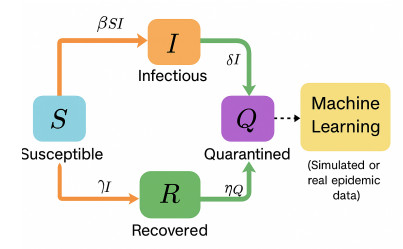
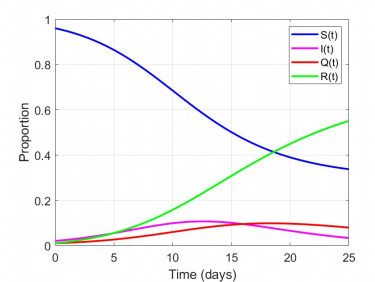
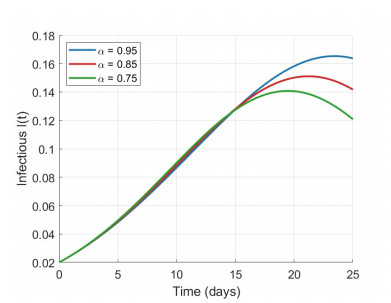
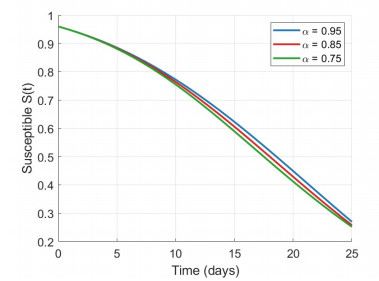
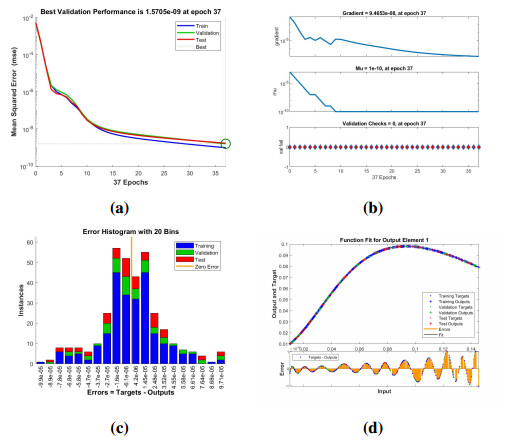
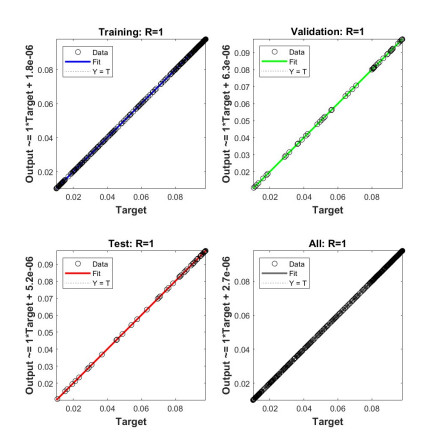
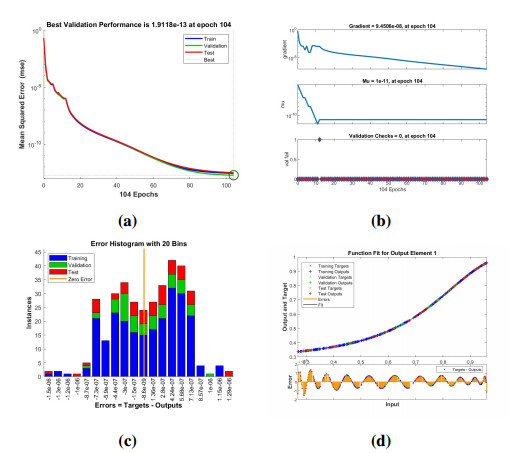
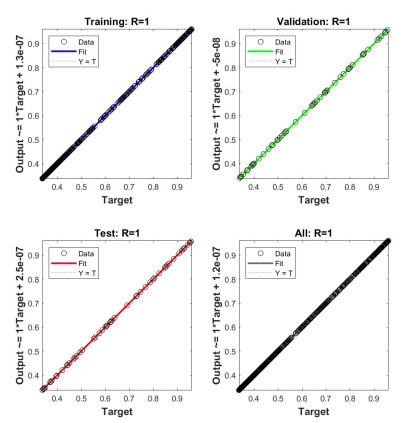
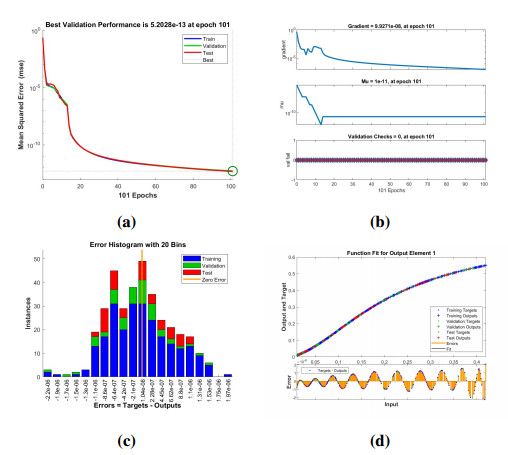
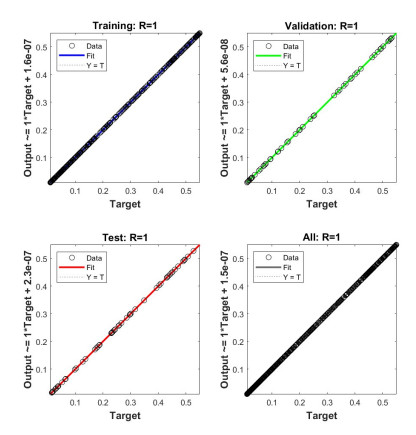
This paper introduces, analyzes, and numerically investigates a fractional-order SIQR epidemic model with the normalized Caputo–Fabrizio derivative. The model captures memory effects and the impact of quarantine or isolation interventions, offering a more realistic description of epidemic dynamics. We establish the existence, uniqueness, positivity, and population conservation properties, and then propose a robust numerical scheme. The influence of the memory parameter and kernel normalization is illustrated via simulations, with a discussion on their implications for epidemic forecasting and real-world control strategies. Furthermore, artificial neural networks are applied, with the dataset partitioned into training, validation, and testing subsets. A comprehensive assessment is carried out for each dataset partition.
Citation: Ramsha Shafqat, Ateq Alsaadi. Mathematical and numerical analysis of a fractional SIQR epidemic model with normalized Caputo–Fabrizio operator and machine learning approaches[J]. AIMS Mathematics, 2025, 10(9): 20235-20261. doi: 10.3934/math.2025904
This paper introduces, analyzes, and numerically investigates a fractional-order SIQR epidemic model with the normalized Caputo–Fabrizio derivative. The model captures memory effects and the impact of quarantine or isolation interventions, offering a more realistic description of epidemic dynamics. We establish the existence, uniqueness, positivity, and population conservation properties, and then propose a robust numerical scheme. The influence of the memory parameter and kernel normalization is illustrated via simulations, with a discussion on their implications for epidemic forecasting and real-world control strategies. Furthermore, artificial neural networks are applied, with the dataset partitioned into training, validation, and testing subsets. A comprehensive assessment is carried out for each dataset partition.

| [1] |
H. W. Hethcote, The mathematics of infectious diseases, SIAM Rev., 42 (2000), 599–653. https://doi.org/10.1137/S0036144500371907 doi: 10.1137/S0036144500371907

|
| [2] |
F. Brauer, Mathematical epidemiology: past, present, and future, Infectious Disease Modelling, 2 (2017), 113–127. https://doi.org/10.1016/j.idm.2017.02.001 doi: 10.1016/j.idm.2017.02.001
|
| [3] |
W. O. Kermack, A. G. McKendrick, A contribution to the mathematical theory of epidemics, Proc. R. Soc. Lond. A, 115 (1927), 700–721. https://doi.org/10.1098/rspa.1927.0118 doi: 10.1098/rspa.1927.0118
|
| [4] |
K. Diethelm, An investigation of some nonclassical methods for the numerical approximation of Caputo-type fractional derivatives, Numer. Algor., 47 (2008), 361–390. https://doi.org/10.1007/s11075-008-9193-8 doi: 10.1007/s11075-008-9193-8
|
| [5] |
R. Shafqat, A. Alsaadi, Artificial neural networks for stability analysis and simulation of delayed rabies spread models, AIMS Mathematics, 9 (2024), 33495–33531. https://doi.org/10.3934/math.20241599 doi: 10.3934/math.20241599
|
| [6] |
H. G. Sun, A. L. Chang, Y. Zhang, W. Chen, A review on variable-order fractional differential equations: mathematical foundations, physical models, numerical methods and applications, Fract. Calc. Appl. Anal., 22 (2019), 27–59. https://doi.org/10.1515/fca-2019-0003 doi: 10.1515/fca-2019-0003
|
| [7] |
A. Turab, R. Shafqat, S. Muhammad, M. Shuaib, M. F. Khan, M. Kamal, Predictive modeling of hepatitis B viral dynamics: A caputo derivative-based approach using artificial neural networks, Sci. Rep., 14 (2024), 21853. https://doi.org/10.1038/s41598-024-70788-7 doi: 10.1038/s41598-024-70788-7
|
| [8] |
R. Shafqat, A. Ateq, A. Alubaidi, A fractional-order alcoholism model incorporating hypothetical social influence: A theoretical and numerical study, J. Math., 2025 (2025), 6773909. https://doi.org/10.1155/jom/6773909 doi: 10.1155/jom/6773909
|
| [9] | A. Atangana, D. Baleanu, New fractional derivatives with nonlocal and non-singular kernel: theory and application to heat transfer model, (2016), arXiv: 1602.03408. https://doi.org/10.48550/arXiv.1602.03408 |
| [10] |
N. Sene, SIR epidemic model with Mittag–Leffler fractional derivative, Chaos Soliton. Fract., 137 (2020), 109833. https://doi.org/10.1016/j.chaos.2020.109833 doi: 10.1016/j.chaos.2020.109833
|
| [11] |
J. Kim, A normalized Caputo–Fabrizio fractional diffusion equation, AIMS Mathematics, 10 (2025), 6195–6208. https://doi.org/10.3934/math.2025282 doi: 10.3934/math.2025282
|
| [12] |
J. Zhang, D. S. Yang, H. G. Zhang, Y. C. Wang, B. W. Zhou, Dynamic event-based tracking control of boiler turbine systems with guaranteed performance, IEEE T. Autom. Sci. Eng., 21 (2024), 4272–4282. https://doi.org/10.1109/TASE.2023.3294187 doi: 10.1109/TASE.2023.3294187
|
| [13] |
J. L. You, Z. Q. Zhang, Finite-time synchronization of fractional order chaotic systems by applying the maximum-valued method of functions of five variables, AIMS Mathematics, 10 (2025), 7238–7255. https://doi.org/10.3934/math.2025331 doi: 10.3934/math.2025331
|
| [14] | Y. G. Kao, C. H. Wang, H. W. Xia, Y. Cao, Projective synchronization for uncertain fractional reaction-diffusion systems via adaptive sliding mode control based on finite-time scheme, In: Analysis and control for fractional-order systems, Singapore: Springer, 2024,141–163. https://doi.org/10.1007/978-981-99-6054-5_8 |
| [15] |
Y. G. Kao, Y. Li, J. H. Park, X. Y. Chen, Mittag–Leffler synchronization of delayed fractional memristor neural networks via adaptive control, IEEE T. Neur. Net. Lear., 32 (2021), 2279–2284. https://doi.org/10.1109/TNNLS.2020.2995718 doi: 10.1109/TNNLS.2020.2995718
|
| [16] |
Y. Cao, Y. G. Kao, J. H. Park, H. B. Bao, Global Mittag–Leffler stability of the delayed fractional-coupled reaction-diffusion system on networks without strong connectedness, IEEE T. Neur. Net. Lear., 33 (2022), 6473–6483. https://doi.org/10.1109/TNNLS.2021.3080830 doi: 10.1109/TNNLS.2021.3080830
|
| [17] |
Y. Cao, Y. G. Kao, Z. Wang, X. S. Yang, J. H. Park, W. Xie, Sliding mode control for uncertain fractional-order reaction-diffusion memristor neural networks with time delays, Neural Networks, 178 (2024), 106402. https://doi.org/10.1016/j.neunet.2024.106402 doi: 10.1016/j.neunet.2024.106402
|
| [18] |
Y. G. Kao, Y. Cao, X. Y. Chen, Global Mittag-Leffler synchronization of coupled delayed fractional reaction-diffusion Cohen–Grossberg neural networks via sliding mode control, Chaos, 32 (2022), 113123. https://doi.org/10.1063/5.0102787 doi: 10.1063/5.0102787
|
| [19] | I. Goodfellow, Y. Bengio, A. Courville, Deep learning, Cambridge: MIT Press, 2016. |
| [20] | S. Haykin, Neural networks: a comprehensive foundation, New Jersey: Prentice Hall PTR, 1994. |
| [21] |
Z. F. Yang, Z. Q. Zeng, K. Wang, S.-S. Wong, W. H. Liang, M. Zanin, et al, Modified SEIR and AI prediction of the epidemics trend of COVID-19 in China under public health interventions, J. Thorac. Dis., 12 (2020), 165–174. https://doi.org/10.21037/jtd.2020.02.64 doi: 10.21037/jtd.2020.02.64
|
| [22] | M. Caputo, M. Fabrizio, A new definition of fractional derivative without singular kernel, Progr. Fract. Differ. Appl., 1 (2015), 73–85. |
| [23] |
M. Jornet, Theory on new fractional operators using normalization and probability tools, Fractal Fract., 8 (2024), 665. https://doi.org/10.3390/fractalfract8110665 doi: 10.3390/fractalfract8110665
|
| [24] |
M. Caputo, Linear models of dissipation whose Q is almost frequency independent-Ⅱ, Geophysical Journal of the Royal Astronomical Society, 13 (1967), 529–539. https://doi.org/10.1111/j.1365-246X.1967.tb02303.x doi: 10.1111/j.1365-246X.1967.tb02303.x
|
Figures(22) / Tables(1)

Ramsha Shafqat, Ateq Alsaadi. Mathematical and numerical analysis of a fractional SIQR epidemic model with normalized Caputo–Fabrizio operator and machine learning approaches[J]. AIMS Mathematics, 2025, 10(9): 20235-20261. doi: 10.3934/math.2025904





 DownLoad: