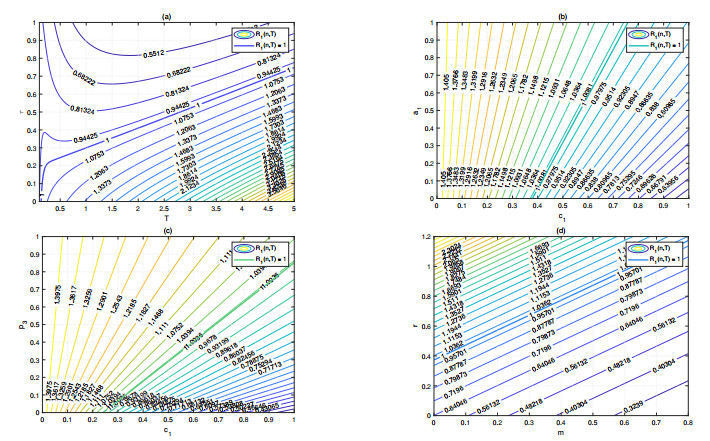
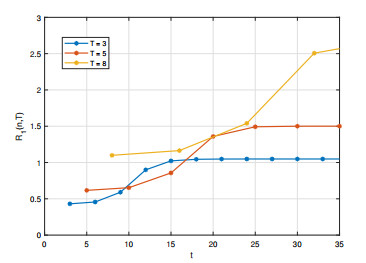
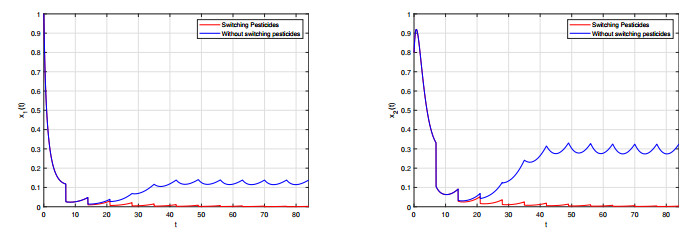
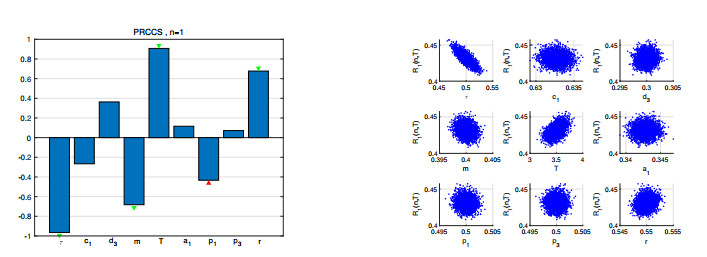
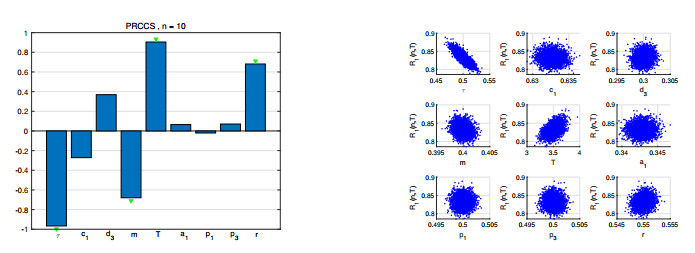
In this paper, according to the biological characteristics of B. gobica, it was divided into psyllid nymphs and adults, considering the chemical control of B. gobica combined with biological control, according to the resistance of psyllid nymphs and adults to pesticides as well as the predatory role of the dominant natural enemies on it, and we established a model of integrated control of B. gobica combined with the resistance to pesticides and the structure of stage. We investigated the dynamical properties of the model developed, theoretically proved the consistent boundedness of the system, and demonstrated sufficient conditions for the existence and global attractiveness of the periodic extinction solution of B. gobica. The effect of resistance development on B. gobica population density was discussed numerically, and the integrated B. gobica management strategy was compared with a single control strategy (chemical or biological), the effect of the number of pesticide sprays on the development of resistance to B. gobica was investigated, as well as the timing of pesticide switching according to the threshold theory, and, finally, the effect of the rest of the key parameters on the extinction threshold of B. gobica was illustrated by the contour plots as well as by sensitivity analyses. The results showed that shortening the release of natural enemies and the pulse period of spraying, controlling the intrinsic growth rate of nymphs, selecting pesticides with lower killing effect on natural enemies, controlling the killing rate of pesticides on natural enemies, and increasing the number of natural enemies released can be of great help to the management of B. gobica.
Citation: Mengge Zhao, Jinyan Wang. Study on integrated management model of Bactericera gobica Loginova combining resistance and stage structure[J]. AIMS Mathematics, 2025, 10(7): 15088-15107. doi: 10.3934/math.2025677
In this paper, according to the biological characteristics of B. gobica, it was divided into psyllid nymphs and adults, considering the chemical control of B. gobica combined with biological control, according to the resistance of psyllid nymphs and adults to pesticides as well as the predatory role of the dominant natural enemies on it, and we established a model of integrated control of B. gobica combined with the resistance to pesticides and the structure of stage. We investigated the dynamical properties of the model developed, theoretically proved the consistent boundedness of the system, and demonstrated sufficient conditions for the existence and global attractiveness of the periodic extinction solution of B. gobica. The effect of resistance development on B. gobica population density was discussed numerically, and the integrated B. gobica management strategy was compared with a single control strategy (chemical or biological), the effect of the number of pesticide sprays on the development of resistance to B. gobica was investigated, as well as the timing of pesticide switching according to the threshold theory, and, finally, the effect of the rest of the key parameters on the extinction threshold of B. gobica was illustrated by the contour plots as well as by sensitivity analyses. The results showed that shortening the release of natural enemies and the pulse period of spraying, controlling the intrinsic growth rate of nymphs, selecting pesticides with lower killing effect on natural enemies, controlling the killing rate of pesticides on natural enemies, and increasing the number of natural enemies released can be of great help to the management of B. gobica.

| [1] |
D. J. Ji, D. F. Zhang, Z. L. Wang, G. H. Fan, Q. Yu, Characterisics of nutrients in the fruits of Lycium barbarum under organic cultivatiion, in Chinese, J. Qinghai Univ., 40 (2022), 41–46. http://doi.org/10.13901/j.cnki.qhwxxbzk.2022.05.006 doi: 10.13901/j.cnki.qhwxxbzk.2022.05.006

|
| [2] | J. N. Zhang, J. Zhao, SWOT analysis and development strategy of Ningxia wolfberry industry, China-Arab States Sci. Technol. Forum, 4 (2018), 21–25. |
| [3] | C. Q. Xu, S. Liu, R. Xu, J. Chen, H. L. Qiao, H. Y. Jin, e al., Investigation of production status in major wolfberry producing areas of China and some suggestions, China J. Chin. Mater. Med., 39 (2014), 1979–1984. |
| [4] | Ningxia wolfberry: quality and safety escort polishing "gold signboard", in Chinese, Ningxia Daily, 2023. Available from: http://lcj.nx.gov.cn/xwzx/mtgz/202310/t20231010_4300934.html. |
| [5] | B. X. Ma, P. X. Wu, J. Xu, J. He, R. Zhang, R. Z. Zhang, Predatory function and field suppression to Poratrioza sinica Yang & Li (Lycium) by Harmonia axyridis Pallas, in Chinese, J. Environ. Entomol., 40 (2018), 70–81. |
| [6] | X. L. Liu, F. Li, H. H. Chen, Color tendency and daily active habit of Bactericera gobica Loginova, For. Sci. Technol., in Chinese, 09 (2023), 101–103. http://doi.org/10.13456/j.cnki.lykt.2022.11.02.0004 |
| [7] |
X. T. Fu, Y. Z. Cao, X. T. Dong, J. Chang, Z. J. Huo, R. X. Meng, Functional responses of two species of predatory mites (Acari: Phytoseiidae) to eggs and first-instar nymphs of Bactericera Gobica Logniova (Homoptera: Psyllidae), Exp. Appl. Acarol., 93 (2024), 197–210. http://doi.org/ 10.1007/S10493-024-00920-9 doi: 10.1007/S10493-024-00920-9
|
| [8] | S. Liu, C. Q. Xu, J. Chen, Wolfberry pest control technology, Beijing: China Agricultural Science and Technology Press, 2018. |
| [9] |
P. X. Wu, B. X. Ma, F. M. Wu, J. Xu, R. Z. Zhang, The endoparasitoid Psyllaephagus arenarius benefits from ectoparasitic venom via multiparasitism with the ectoparasitoid Tamarixia lycium, Insect Sci., 27 (2020), 815–825. http://doi.org/10.1111/1744-7917.12704 doi: 10.1111/1744-7917.12704
|
| [10] |
J. L. Li, S. Liu, M. Wei, L. Xu, L. F. Chi, C. Q. Xu, et al., Research on biological characteristics of Bactericera gobica adults and nymphs, Mod. Chin. Med., 23 (2021), 94–98. http://doi.org/10.13313/j.issn.1673-4890.20200305004 doi: 10.13313/j.issn.1673-4890.20200305004
|
| [11] | Y. P. Ren, Z. Q. Hu, The progress of research on chemical control for main diseases and insect pests of Chinese wolfberry in Ningxia, J. Ningxia Agric. Coll., 25 (2004), 88–91. |
| [12] | C. Q. Xu, S. Liu, H. L. Qiao, J. Chen, K. Guo, J. Yu, et al., Effects of bionic glue on experimental population dynamics of Poratrioza sinica and its natural enemies, China J. Chin. Mater. Med., 38 (2013), 666–669. |
| [13] |
F. Wang, C. Liu, J. He, Y. D. Tian, J. B. Chen, R. Zhang, Resistance of wolfberry aphid in Ningxia, in Chinese, J. Northwest A & F Univ. (Nat. Sci. Ed.), 45 (2017), 61–67. http://doi.org/10.13207/j.cnki.jnwafu.2017.12.009 doi: 10.13207/j.cnki.jnwafu.2017.12.009
|
| [14] |
K. P. Steinmann, M. H. Zhang, J. A. Grant, Does use of pesticides known to harm natural enemies of spider mites (acari: tetranychidae) result in increased number of miticide applications? An examination of california walnut orchards, J. Econ. Entomol., 104 (2011), 1496–1501. https://doi.org/10.1603/EC11168 doi: 10.1603/EC11168
|
| [15] |
Q. H. He, G. H. Li, Establishment and behavior analysis of the model considering wolfberry aphids and their dominant predators, in Chinese, J. Shihezi Univ. (Nat. Sci.), 41 (2023), 655–660. http://doi.org/10.13880/j.cnki.65-1174/n.2023.23.016 doi: 10.13880/j.cnki.65-1174/n.2023.23.016
|
| [16] | A. P. Liu, J. Q. Wang, L. B. Xu, S. J. Gao, Q. Tian, Studies on predation of Deraeocoris punctulatus on Paratrioza sinica, Plant Prot., 34 (2008), 85–89. |
| [17] | H. P. Li, L. Q. Duan, S. J. Feng, X. Jike, Investigation of predatory bug in wolfberry woods and the function response of the dominant species, J. Inner Mongolia Agric. Univ., 23 (2002), 69–71. |
| [18] |
H. Y. Ouyang, P. X. Wu, J. Xu, R. Zhang, J. He, R. Z. Zhang, Effectiveness of Harmonia axyridis as a natural enemy for controlling Poratrioza sinica Yang & Li in the field, in Chinese, Chin. J. Appl. Entomol., 54 (2017), 999–1007. http://doi.org/10.7679/j.issn.2095-1353.2017.119 doi: 10.7679/j.issn.2095-1353.2017.119
|
| [19] | L. Q. Duan, Study on bionomics and behavior of Paratrioza sinica Yang & Li and its natural enemies, in Chinese, PhD thesis, Northeast Forestry University, 2003. |
| [20] |
S. C. Holling, The functional response of predators to prey density and its role in mimicry and population regulation, Mem. Entomol. Soc. Canada, 97 (1965), 1–60. http://doi.org/10.4039/entm9745fv doi: 10.4039/entm9745fv
|
| [21] |
J. Yang, S. Y. Tang, Holling type Ⅱ predator-prey model with nonlinear pulse as state-dependent feedback control, J. Comput. Appl. Math., 291 (2016), 225–241. http://doi.org/10.1016/j.cam.2015.01.017 doi: 10.1016/j.cam.2015.01.017
|
| [22] |
J. H. Zhou, P. L. Li, N. Zunong, H. J. Zheng, J. Huang, Z. H. Wang, Functional response and predation preference of ladybeetle Propylea japonica to Asian citrus psyllid Diaphorina citri, in Chinese, J. Plant Prot., 47 (2020), 1062–1070. http://doi.org/10.13802/j.cnki.zwbhxb.2020.2019207 doi: 10.13802/j.cnki.zwbhxb.2020.2019207
|
| [23] |
Z. Dong, L. M. Bian, W. Zheng, L.Y. Zhang, F. S. Meng, Application of red-eye wasp technology to control corn borer in fresh corn fields in Yanshan hilly area, in Chinese, Bull. Agric. Sci. Technol., 10 (2021), 147–151. http://doi.org/10.3969/j.issn.1000-6400.2021.10.043 doi: 10.3969/j.issn.1000-6400.2021.10.043
|
| [24] | Z. C. Wang, Analysis and discussion on plant protection and integrated pest management related technologies, in Chinese, Agric. Dev. Equip., 09 (2021), 108–109. |
| [25] | Z. J. Gui, K. H. Wang, L. S. Chen, Mathematical theory and computation of pest control, Beijing: Science Press, 2014. |
| [26] | Y. N. Xiao, Y. C. Zhou, S. Y. Tang, Basic principles of mathematical modeling in biology, Xi'an: Xi'an Jiaotong University Press, 2012. |
| [27] |
B. Liu, Y. J. Zhang, L. S. Chen, The dynamical behaviors of a Lotka-Volterra predator-prey model concerning integrated pest management, Nonlinear Anal. Real World Appl., 6 (2005), 227–243. http://doi.org/10.1016/j.nonrwa.2004.08.001 doi: 10.1016/j.nonrwa.2004.08.001
|
| [28] |
S. Y. Tang, L. S. Chen, Modelling and analysis of integrated pest management strategy, Discrete Contin. Dyn. Syst.-B, 4 (2004), 759–768. http://doi.org/10.3934/dcdsb.2004.4.759 doi: 10.3934/dcdsb.2004.4.759
|
| [29] |
S. Y. Tang, G. Y. Tang, R. A. Cheke, Optimum timing for integrated pest management: Modelling rates of pesticide application and natural enemy releases, J. Theor. Biol., 2 (2010), 623–638. http://doi.org/10.1016/j.jtbi.2010.02.034 doi: 10.1016/j.jtbi.2010.02.034
|
| [30] |
J. H. Liang, S. Y. Tang, J. J. Nieto, R. A. Cheke, Analytical methods for detecting pesticide switches with evolution of pesticide resistance, Math. Biosci., 2 (2013), 249–257. http://doi.org/10.1016/j.mbs.2013.07.008 doi: 10.1016/j.mbs.2013.07.008
|
| [31] |
J. H. Liang, S. Y. Tang, R. A. Cheke, J. H. Wu, Adaptive release of natural enemies in a pest-natural enemy system with pesticide resistance, Bull. Math. Biol., 75 (2013), 2167–2195. http://doi.org/10.1007/s11538-013-9886-6 doi: 10.1007/s11538-013-9886-6
|
| [32] |
J. Yang, Y. S. Tan, Effects of pesticide dose on Holling Ⅱ predator-prey model with feedback control, J. Biol. Dyn., 12 (2018), 527–550. http://doi.org/10.1080/17513758.2018.1479457 doi: 10.1080/17513758.2018.1479457
|
| [33] |
B. Liu, G. Hu, B. L. Kang, X. Huang, Analysis of a hybrid pest management model incorporating pest resistance and different control strategies, Math. Biosci. Eng., 17 (2020), 4364–4383. http://doi.org/10.3934/mbe.2020241 doi: 10.3934/mbe.2020241
|
| [34] | B. Y. Liu, Sensitivity determination and control of Poratrioza sinica to common insecticides in Ningxia, Math. Biosci. Eng., 2022. |
| [35] |
X. N. Liu, L. S. Chen, Complex dynamics of Holling type Ⅱ Lotka-Volterra predator-prey system with impulsive perturbations on the predator, Chaos Solitons Fract., 26 (2003), 311–320. http://doi.org/10.1016/S0960-0779(02)00408-3 doi: 10.1016/S0960-0779(02)00408-3
|
| [36] |
B. Liu, B. L. Kang, F. M. Tao, G. Hu, Modelling the effects of pest control with development of pesticide resistance, Acta Math. Appl. Sin. Engl. Ser., 37 (2021), 109–125. http://doi.org/10.1007/S10255-021-0988-X doi: 10.1007/S10255-021-0988-X
|
| [37] |
J. Wang, Dynamics and bifurcation analysis of a state-dependent impulsive SIS model, Adv. Differ. Equ., 2021 (2021), 287. https://doi.org/10.1186/S13662-021-03436-3 doi: 10.1186/S13662-021-03436-3
|
| [38] |
M. Simeone, I. B. Hogue, C. J. Rozhnova, D. E. Kirschner, A methodology for performing global uncertainty and sensitivity analysis in systems biology, J. Theor. Biol., 254 (2008), 187–196. https://doi.org/10.1016/j.jtbi.2008.04.011 doi: 10.1016/j.jtbi.2008.04.011
|
| [39] |
F. Zhang, Z. Qiu, A. Huang, X. Zhao, Optimal control and cost-effectiveness analysis of a Huanglongbing model with comprehensive interventions, Appl. Math. Model., 90 (2021), 719–741. https://doi.org/10.1016/j.apm.2020.09.033 doi: 10.1016/j.apm.2020.09.033
|
| [40] |
S. Liu, J. L. Li, M. K. Yang, H. L. Qiao, K. Guo, R. Xu, et al., Influence of Bactericera gobica Loginova on Growth of Lycium barbarum L., in Chinese, Agric. Sci. Eng. China, 22 (2020), 715–728. http://doi.org/10.13313/j.issn.1673-4890.20200229002 doi: 10.13313/j.issn.1673-4890.20200229002
|
Figures(9)

Mengge Zhao, Jinyan Wang. Study on integrated management model of Bactericera gobica Loginova combining resistance and stage structure[J]. AIMS Mathematics, 2025, 10(7): 15088-15107. doi: 10.3934/math.2025677





 DownLoad: