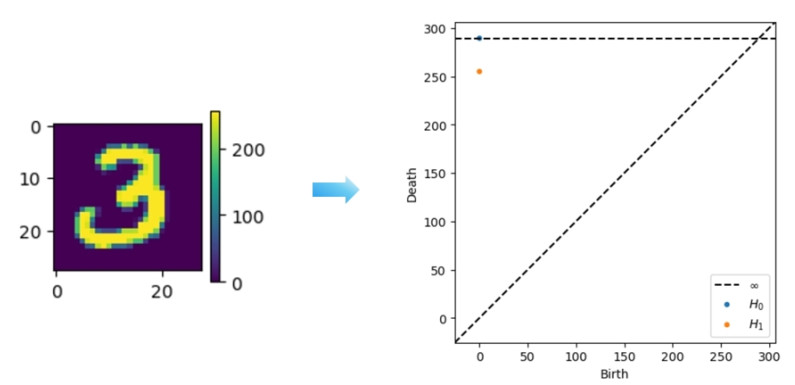
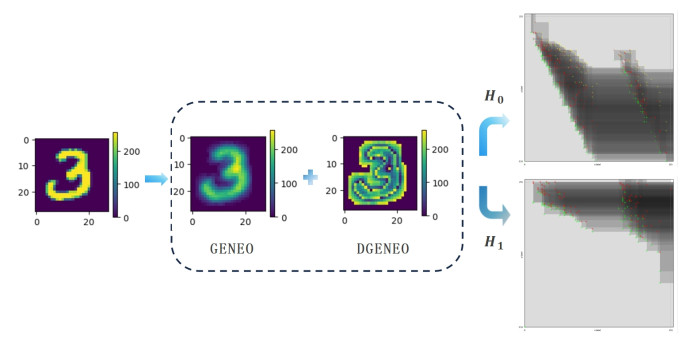
Two important tasks in the field of topological data analysis (TDA) are building practical filtrations on objects and using TDA to detect the geometry and primarily topological structures. Motivated by these tasks, we have defined the difference between the two group equivariant non-expansive operators (GENEOs) by DGENEO and built multiparameter filtrations by operators on images named the multi-GENEO, multi-DGENEO, and mix-GENEO, and we proved the stability of both the interleaving distance and multiparameter persistence landscape of the multi-GENEO with respect to the pseudometric on images, modeled as bounded functions. We also gave an upper bound for the multi-DGENEO and mix-GENEO. In practical applications, we regarded the space of images on a discrete domain, and then we built multifiltrations on the discrete function space. Finally, we conducted a comparable experiment on the MNIST dataset to demonstrate that our bifiltrations are superior to 1-parameter filtrations. The experiment results demonstrate that our bifiltrations have the ability to detect geometric and topological differences of digital images.
Citation: Jiaxing He, Bingzhe Hou, Tieru Wu, Yue Xin. Mix-GENEO: A flexible filtration for multiparameter persistent homology detects digital images[J]. AIMS Mathematics, 2025, 10(10): 24153-24178. doi: 10.3934/math.20251071
Two important tasks in the field of topological data analysis (TDA) are building practical filtrations on objects and using TDA to detect the geometry and primarily topological structures. Motivated by these tasks, we have defined the difference between the two group equivariant non-expansive operators (GENEOs) by DGENEO and built multiparameter filtrations by operators on images named the multi-GENEO, multi-DGENEO, and mix-GENEO, and we proved the stability of both the interleaving distance and multiparameter persistence landscape of the multi-GENEO with respect to the pseudometric on images, modeled as bounded functions. We also gave an upper bound for the multi-DGENEO and mix-GENEO. In practical applications, we regarded the space of images on a discrete domain, and then we built multifiltrations on the discrete function space. Finally, we conducted a comparable experiment on the MNIST dataset to demonstrate that our bifiltrations are superior to 1-parameter filtrations. The experiment results demonstrate that our bifiltrations have the ability to detect geometric and topological differences of digital images.

| [1] | H. Adams, M. Aminian, E. Farnell, M. Kirby, J. Mirth, R. Neville, et al., A fractal dimension for measures via persistent homology, In: Topological data analysis, Cham: Springer, 2020, 1–31. https://doi.org/10.1007/978-3-030-43408-3_1 |
| [2] | H. Adams, T. Emerson, M. Kirby, R. Neville, C. Peterson, P. Shipman, et al., Persistence images: A stable vector representation of persistent homology, J. Mach. Learn. Res., 18 (2017), 1–35. |
| [3] |
H. Adams, M. Moy, Topology applied to machine learning: From global to local, Front. Artif. Intell., 4 (2021), 668302. https://doi.org/10.3389/frai.2021.668302 doi: 10.3389/frai.2021.668302

|
| [4] | H. Anai, F. Chazal, M. Glisse, Y. Ike, H. Inakoshi, R. Tinarrage, et al., DTM-based filtrations, In: Topological data analysis, Cham: Springer, 2020, 33–66. https://doi.org/10.1007/978-3-030-43408-3_2 |
| [5] |
U. Bauer, M. B. Botnan, S. Oppermann, J. Steen, Cotorsion torsion triples and the representation theory of filtered hierarchical clustering, Adv. Math., 369 (2020), 107171. https://doi.org/10.1016/j.aim.2020.107171 doi: 10.1016/j.aim.2020.107171
|
| [6] |
M. G. Bergomi, P. Frosini, D. Giorgi, N. Quercioli, Towards a topological–geometrical theory of group equivariant non-expansive operators for data analysis and machine learning, Nat. Mach. Intell., 1 (2019), 423–433. https://doi.org/10.1038/s42256-019-0087-3 doi: 10.1038/s42256-019-0087-3
|
| [7] | B. Bleile, A. Garin, T. Heiss, K. Maggs, V. Robins, The persistent homology of dual digital image constructions, In: Research in computational topology 2, Cham: Springer, 2022, 1–26. https://doi.org/10.1007/978-3-030-95519-9_1 |
| [8] |
A. J. Blumberg, I. Gal, M. A. Mandell, M. Pancia, Robust statistics, hypothesis testing, and confidence intervals for persistent homology on metric measure spaces, Found. Comput. Math., 14 (2014), 745–789. https://doi.org/10.1007/s10208-014-9201-4 doi: 10.1007/s10208-014-9201-4
|
| [9] |
A. J. Blumberg, M. Lesnick, Universality of the homotopy interleaving distance, Trans. Amer. Math. Soc., 376 (2023), 8269–8307. https://doi.org/10.1090/tran/8738 doi: 10.1090/tran/8738
|
| [10] |
A. J. Blumberg, M. Lesnick, Stability of 2-parameter persistent homology, Found. Comput. Math., 24 (2024), 385–427. https://doi.org/10.1007/s10208-022-09576-6 doi: 10.1007/s10208-022-09576-6
|
| [11] |
O. Bobrowski, S. Mukherjee, J. E. Taylor, Topological consistency via kernel estimation, Bernoulli, 23 (2017), 288–328. https://doi.org/10.3150/15-BEJ744 doi: 10.3150/15-BEJ744
|
| [12] | M. B. Botnan, M. Lesnick, An introduction to multiparameter persistence, arXiv preprint arXiv:2203.14289, 2023. https://doi.org/10.48550/arXiv.2203.14289 |
| [13] | R. Brüel-Gabrielsson, B. J. Nelson, A. Dwaraknath, P. Skraba, L. J. Guibas, G. Carlsson, A topology layer for machine learning, arXiv:1905.12200, 2020. http://arXiv.org/abs/1905.12200 |
| [14] | P. Bubenik, Statistical topological data analysis using persistence landscapes, J. Mach. Learn. Res., 16 (2015), 77–102. |
| [15] |
P. Bubenik, M. Hull, D. Patel, B. Whittle, Persistent homology detects curvature, Inverse Probl., 36 (2020), 025008. https://doi.org/10.1088/1361-6420/ab4ac0 doi: 10.1088/1361-6420/ab4ac0
|
| [16] |
M. Buchet, F. Chazal, S. Y. Oudot, D. R. Sheehy, Efficient and robust persistent homology for measures, Comput. Geom., 58 (2016), 70–96. https://doi.org/10.1016/j.comgeo.2016.07.001 doi: 10.1016/j.comgeo.2016.07.001
|
| [17] |
G. Carlsson, T. Ishkhanov, V. de Silva, A. Zomorodian, On the local behavior of spaces of natural images, Int. J. Comput. Vis., 76 (2008), 1–12. https://doi.org/10.1007/s11263-007-0056-x doi: 10.1007/s11263-007-0056-x
|
| [18] | G. Carlsson, G. Singh, A. Zomorodian, Computing multidimensional persistence, In: Algorithms and computation, Berlin: Springer, 5878 (2009), 730–739. https://doi.org/10.1007/978-3-642-10631-6_74 |
| [19] |
G. Carlsson, A. Zomorodian, The theory of multidimensional persistence, Discrete Comput. Geom., 42 (2009), 71–93. https://doi.org/10.1007/s00454-009-9176-0 doi: 10.1007/s00454-009-9176-0
|
| [20] | M. Carrie$\rm \grave{r} $e, A. Blumberg, Multiparameter persistence image for topological machine learning, In: Advances in neural information processing systems, 2020. |
| [21] |
F. Chazal, L. J. Guibas, S. Y. Oudot, P. Skraba, Scalar field analysis over point cloud data, Discrete Comput. Geom., 46 (2011), 743–775. https://doi.org/10.1007/s00454-011-9360-x doi: 10.1007/s00454-011-9360-x
|
| [22] |
Y. M. Chung, S. Day, C. S. Hu, A multi-parameter persistence framework for mathematical morphology, Sci. Rep., 12 (2022), 6427. https://doi.org/10.1038/s41598-022-09464-7 doi: 10.1038/s41598-022-09464-7
|
| [23] | D. Cohen-Steiner, H. Edelsbrunner, D. Morozov, Vines and vineyards by updating persistence in linear time, In: Proceedings of the twenty-second annual symposium on Computational geometry, 2006,119–126. https://doi.org/10.1145/1137856.1137877 |
| [24] |
F. Conti, D. Moroni, M. A. Pascali, A topological machine learning pipeline for classification, Mathematics, 10 (2022), 3086. https://doi.org/10.3390/math10173086 doi: 10.3390/math10173086
|
| [25] |
R. Corbet, M. Kerber, M. Lesnick, G. Osang, Computing the multicover bifiltration, Discrete Comput. Geom., 70 (2023), 376–405. https://doi.org/10.1007/s00454-022-00476-8 doi: 10.1007/s00454-022-00476-8
|
| [26] |
W. Crawley-Boevey, Decomposition of pointwise finite-dimensional persistence modules, J. Algebra Appl., 14 (2015), 1550066. https://doi.org/10.1142/S0219498815500668 doi: 10.1142/S0219498815500668
|
| [27] | H. Edelsbrunner, J. Harer, Persistent homology–A survey, Contemp. Math., 453 (2008), 257–282. |
| [28] |
H. Edelsbrunner, G. Osang, The multi-cover persistence of Euclidean balls, Discrete Comput. Geom., 65 (2021), 1296–1313. https://doi.org/10.1007/s00454-021-00281-9 doi: 10.1007/s00454-021-00281-9
|
| [29] |
P. Frosini, $G$-invariant persistent homology, Math. Method. Appl. Sci., 38 (2015), 1190–1199. https://doi.org/10.1002/mma.3139 doi: 10.1002/mma.3139
|
| [30] |
P. Frosini, G. Jabłoński, Combining persistent homology and invariance groups for shape comparison, Discrete Comput. Geom., 55 (2016), 373–409. https://doi.org/10.1007/s00454-016-9761-y doi: 10.1007/s00454-016-9761-y
|
| [31] | A. Garin, G. Tauzin, A topological "reading" lesson: Classification of mnist using tda, In: 2019 18th IEEE international conference on machine learning and applications (ICMLA), USA: IEEE, 2019, 1551–1556. https://doi.org/10.1109/ICMLA.2019.00256 |
| [32] | L. Guibas, D. Morozov, Q. Mérigot, Witnessed $k$-distance, Discrete Comput. Geom., 49 (2013), 22–45. https://doi.org/10.1007/s00454-012-9465-x |
| [33] | O. Hacquard, K. Balasubramanian, G. Blanchard, C. Levrard, W. Polonik, Topologically penalized regression on manifolds, J. Mach. Learn. Res., 23 (2022), 1–39. |
| [34] | A. Hatcher, Algebraic topology, Cambridge: Cambridge University Press, 2001. |
| [35] | C. Hofer, R. Kwitt, M. Niethammer, M. Dixit, Connectivity-optimized representation learning via persistent homology, In: Proceedings of the 36th international conference on machine learnin, 2019. |
| [36] | C. Hofer, R. Kwitt, M. Niethammer, A. Uhl, Deep learning with topological signatures, In: Advances in neural information processing systems, 2017. |
| [37] |
M. Lesnick, The theory of the interleaving distance on multidimensional persistence modules, Found. Comput. Math., 15 (2015), 613–6505. https://doi.org/10.1007/s10208-015-9255-y doi: 10.1007/s10208-015-9255-y
|
| [38] | M. Lesnick, M. Wright, Interactive visualization of 2-d persistence modules, arXiv:1512.00180, 2015. https://doi.org/10.48550/arXiv.1512.00180 |
| [39] | D. Loiseaux, M. Carrière, A. Blumberg, A framework for fast and stable representations of multiparameter persistent homology decompositions, In: Advances in neural information processing systems, 36 (2023). |
| [40] | E. R. Love, B. Filippenko, V. Maroulas, G. Carlsson, Topological convolutional layers for deep learning, J. Mach. Learn. Res., 24 (2023), 1–35. |
| [41] | C. Maria, J. D. Boissonnat, M. Glisse, M. Yvinec, The gudhi library: Simplicial complexes and persistent homology, In: Mathematical software–ICMS 2014, Berlin: Springer, 8592 (2014). https://doi.org/10.1007/978-3-662-44199-2_28 |
| [42] | D. Morozov, Dionysus 2. Available from: https://mrzv.org/software/dionysus2/. |
| [43] | S. Y. Oudot, Persistence theory: From quiver representations to data analysis, In: Mathematical surveys and monographs, American Mathematical Society, 2017. |
| [44] | J. M. Phillips, B. Wang, Y. Zheng, Geometric inference on kernel density estimates, arXiv:1307.7760, 2013. https://doi.org/10.48550/arXiv.1307.7760 |
| [45] | L. Polterovich, D. Rosen, K. Samvelyan, J. Zhang, Topological persistence in geometry and analysis, In: University lecture series, American Mathematical Society, 74 (2020). |
| [46] | R. Rabadán, A. J. Blumberg, Topological data analysis for genomics and evolution: Topology in biology, Cambridge: Cambridge University Press, 2019. |
| [47] |
V. Robins, P. J. Wood, A. P. Sheppard, Theory and algorithms for constructing discrete morse complexes from grayscale digital images, IEEE Trans. Pattern Anal. Mach. Intell., 33 (2011), 1646–1658. https://doi.org/10.1109/TPAMI.2011.95 doi: 10.1109/TPAMI.2011.95
|
| [48] | N. Saul, C. Tralie, Scikit-TDA: Topological data analysis for python, 2019. http://doi.org/10.5281/zenodo.2533369 |
| [49] | B. Schweinhart, Fractal dimension and the persistent homology of random geometric complexes, Adv. Math., 372 (2020), 107291. |
| [50] |
B. Schweinhart, Persistent homology and the upper box dimension, Discrete Comput. Geom., 65 (2021), 331–364. https://doi.org/10.1007/s00454-019-00145-3 doi: 10.1007/s00454-019-00145-3
|
| [51] |
Y. E. Solomon, P. Bendich, Convolutional persistence transforms, J. Appl. Comput. Topology, 8 (2024), 1981–2013. https://doi.org/10.1007/s41468-024-00164-x doi: 10.1007/s41468-024-00164-x
|
| [52] | The RIVET Developers, Rivet, 2020. Available from: https://github.com/rivetTDA/rivet/. |
| [53] | O. Vipond, Multiparameter persistence landscapes, J. Mach. Learn. Res., 21 (2020), 1–38. |
| [54] |
O. Vipond, J. A. Bull, P. S. Macklin, U. Tillmann, C. W. Pugh, H. M. Byrne, et al., Multiparameter persistent homology landscapes identify immune cell spatial patterns in tumors, Proc. Natl. Acad. Sci. U.S.A., 118 (2021), e2102166118. https://doi.org/10.1073/pnas.2102166118 doi: 10.1073/pnas.2102166118
|
| [55] |
A. Zomorodian, G. Carlsson, Computing persistent homology, Discrete Comput. Geom., 33 (2005), 249–274. https://doi.org/10.1007/s00454-004-1146-y doi: 10.1007/s00454-004-1146-y
|
| [56] | A. J. Zomorodian, Topology for computing, In: Cambridge monographs on applied and computational mathematics, Cambridge: Cambridge University Press, 2009. https://doi.org/10.1017/CBO9780511546945 |

Figures(11) / Tables(2)

Jiaxing He, Bingzhe Hou, Tieru Wu, Yue Xin. Mix-GENEO: A flexible filtration for multiparameter persistent homology detects digital images[J]. AIMS Mathematics, 2025, 10(10): 24153-24178. doi: 10.3934/math.20251071





 DownLoad: