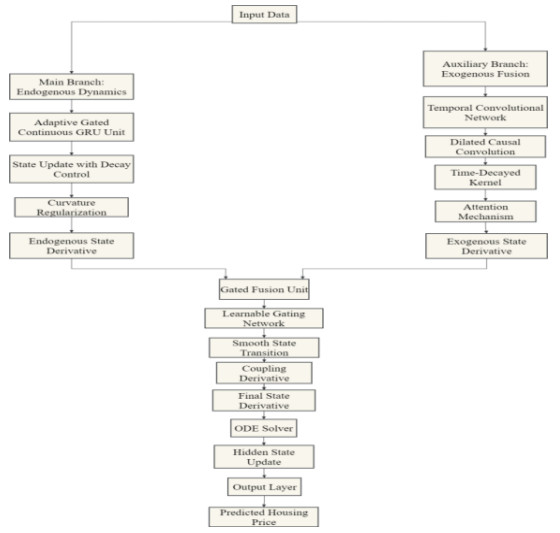
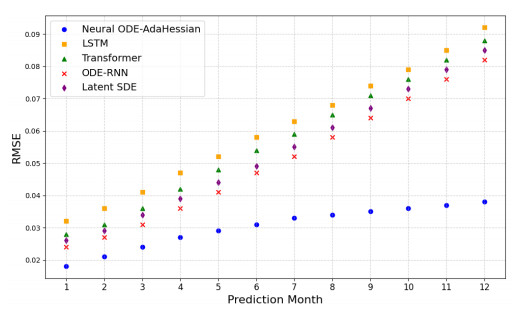
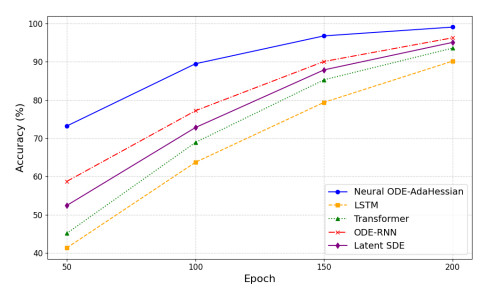
Traditional housing price prediction models often struggle to capture the complex dynamics of nonlinear and multi-scale time series. To address this challenge, this study proposes a machine learning–driven framework of neural ordinary differential equations (NODEs) designed to enhance both predictive accuracy and interpretability. The methodology integrates historical housing prices, macroeconomic indicators, and geospatial variables, with empirical mode decomposition (EMD) applied for multi-scale feature extraction. A dual-branch neural ODE architecture is developed: the main branch employs an adaptive gated GRU–ODE unit to model endogenous housing price dynamics, while the auxiliary branch fuses exogenous economic factors through time-varying convolution and attention mechanisms. At the theoretical level, a Lyapunov-based proof of convergence is derived, and an adaptive Hessian optimizer (AdaHessian) with Nesterov momentum is introduced to guarantee superlinear convergence. Experiments on the Zillow dataset (2004–2023) show that the proposed model achieves an RMSE of 0.03 for 12-month forecasts, converges within 200 epochs, and improves training stability with KL divergence reduced to 0.9. Beyond performance gains, the framework offers policy-relevant outputs, including long-horizon forecasts with uncertainty bounds, scenario analyses of macroeconomic shocks, and interpretable attribution of key drivers. These results confirm the framework's ability to capture the nonlinear continuous evolution of housing prices, while providing a scalable tool for spatiotemporal economic modeling with direct implications for policymakers, urban planners, and investors.
Citation: Zhikun Luo. Learning dynamics and convergence of machine learning driven neural ordinary differential equations model for housing price prediction[J]. AIMS Mathematics, 2025, 10(10): 23803-23820. doi: 10.3934/math.20251058
Traditional housing price prediction models often struggle to capture the complex dynamics of nonlinear and multi-scale time series. To address this challenge, this study proposes a machine learning–driven framework of neural ordinary differential equations (NODEs) designed to enhance both predictive accuracy and interpretability. The methodology integrates historical housing prices, macroeconomic indicators, and geospatial variables, with empirical mode decomposition (EMD) applied for multi-scale feature extraction. A dual-branch neural ODE architecture is developed: the main branch employs an adaptive gated GRU–ODE unit to model endogenous housing price dynamics, while the auxiliary branch fuses exogenous economic factors through time-varying convolution and attention mechanisms. At the theoretical level, a Lyapunov-based proof of convergence is derived, and an adaptive Hessian optimizer (AdaHessian) with Nesterov momentum is introduced to guarantee superlinear convergence. Experiments on the Zillow dataset (2004–2023) show that the proposed model achieves an RMSE of 0.03 for 12-month forecasts, converges within 200 epochs, and improves training stability with KL divergence reduced to 0.9. Beyond performance gains, the framework offers policy-relevant outputs, including long-horizon forecasts with uncertainty bounds, scenario analyses of macroeconomic shocks, and interpretable attribution of key drivers. These results confirm the framework's ability to capture the nonlinear continuous evolution of housing prices, while providing a scalable tool for spatiotemporal economic modeling with direct implications for policymakers, urban planners, and investors.

| [1] |
X. Qin, Z. Liang, J. Zhao, B. Li, Y. Duan, Y. Hu, et al., Parameter optimization method of hydrological model based on neural ordinary differential equations, (in chinese), J. Lake Sci., 37 (2025), 1000–1010. http://dx.doi.org/10.18307/2025.0342 doi: 10.18307/2025.0342

|
| [2] | C. Xu, J. Zhang, J. Yao, Delayed hybrid model construction based on expert system and neural ordinary differential equation, (in chinese), Metaverse Med., 1 (2024), 59–65. https://doi.org/10.61189/528667vzkwua |
| [3] | Y. Yao, S. Jin, Q. Wang, Subway short-term passenger flow prediction based on improved LSTM, In: 2023 IEEE 12th data driven control and learning systems conference (DDCLS), IEEE, 2023, 1280–1287. https://doi.org/10.1109/DDCLS58216.2023.10167265 |
| [4] |
Z. Yang, Z. Lin, Y. Yang, J. Li, Dual-path graph neural network with adaptive auxiliary module for link prediction, Big Data, 13 (2025), 333–343. https://doi.org/10.1089/big.2023.0130 doi: 10.1089/big.2023.0130
|
| [5] | F. Liang, R. Wang, Blockchain address risk behavior identification algorithm based on neural differential equations, (in chinese), J. Commun., 45 (2024), 105–113. https://dx.doi.org/10.11959/j.issn.1000-436x.2024211 |
| [6] |
G. Milunovich, Forecasting Australia's real house price index: A comparison of time series and machine learning methods, J. Forecasting, 39 (2020), 1098–1118. https://doi.org/10.1002/for.2678 doi: 10.1002/for.2678
|
| [7] |
B. Jin, X. Xu, Pre-owned housing price index forecasts using Gaussian process regressions, J. Model. Manag., 19 (2024), 1927–1958. https://doi.org/10.1108/jm2-12-2023-0315 doi: 10.1108/jm2-12-2023-0315
|
| [8] |
X. Xu, Y. Zhang, Second-hand house price index forecasting with neural networks, J. Prop. Res., 39 (2022), 215–236. https://doi.org/10.1080/09599916.2021.1996446 doi: 10.1080/09599916.2021.1996446
|
| [9] |
N. H. Zulkifley, S. A. Rahman, N. H. Ubaidullah, I. Ibrahim, House price prediction using a machine learning model: A survey of literature, Int. J. Mod. Educ. Comput. Sci., 12 (2020), 46–54. https://doi.org/10.5815/ijmecs.2020.06.04 doi: 10.5815/ijmecs.2020.06.04
|
| [10] |
S. J. Terregrossa, M. H. Ibadi, Combining housing price forecasts generated separately by hedonic and artificial neural network models, Asian J. Econ. Bus. Account., 21 (2021), 130–148. https://doi.org/10.9734/ajeba/2021/v21i130345 doi: 10.9734/ajeba/2021/v21i130345
|
| [11] |
X. Xu, Y. Zhang, Residential housing price index forecasting via neural networks, Neural Comput. Applic., 34 (2022), 14763–14776. https://doi.org/10.1007/s00521-022-07309-y doi: 10.1007/s00521-022-07309-y
|
| [12] |
A. De Stefani, House price history, biased expectations, and credit cycles: The role of housing investors, Real Estate Econ., 49 (2021), 1238–1266. https://doi.org/10.1111/1540-6229.12328 doi: 10.1111/1540-6229.12328
|
| [13] |
M. J. Chowhaan, D. Nitish, G. Akash, N. Sreevidya, S. Shaik, Machine learning approach for house price prediction, Asian J. Res. Comput. Sci., 16 (2023), 54–61. https://doi.org/10.9734/ajrcos/2023/v16i2339 doi: 10.9734/ajrcos/2023/v16i2339
|
| [14] |
G. Gao, Z. Bao, J. Cao, A. K. Qin, T. Sellis, Location-centered house price prediction: A multi-task learning approach, ACM Trans. Intell. Syst. Technol., 13 (2022), 1–25. https://doi.org/10.1145/3501806 doi: 10.1145/3501806
|
| [15] |
J. S. Chou, D. B. Fleshman, D. N. Truong, Comparison of machine learning models to provide preliminary forecasts of real estate prices, J. Hous Built Environ., 37 (2022), 2079–2114. https://doi.org/10.1007/s10901-022-09937-1 doi: 10.1007/s10901-022-09937-1
|
| [16] |
J. Hong, H. Choi, W. Kim, A house price valuation based on the random forest approach: The mass appraisal of residential property in South Korea, Int. J. Strateg. Prop. Manag., 24 (2020), 140–152. https://doi.org/10.3846/ijspm.2020.11544 doi: 10.3846/ijspm.2020.11544
|
| [17] |
S. Wang, Y. Zeng, J. Yao, H. Zhang, Economic policy uncertainty, monetary policy, and housing price in China, J. Appl. Econ., 23 (2020), 235–252. https://doi.org/10.1080/15140326.2020.1740874 doi: 10.1080/15140326.2020.1740874
|
| [18] |
M. Ma, V. W. Y. Tam, K. N. Le, R. Osei-Kyei, A systematic literature review on price forecasting models in construction industry, Int. J. Constr. Manag., 24 (2024), 1191–1200. https://doi.org/10.1080/15623599.2023.2241761 doi: 10.1080/15623599.2023.2241761
|
| [19] | J. Cox, S. C. Ludvigson, Drivers of the great housing boom-bust: Credit conditions, beliefs, or both?, Real Estate Econ., 49 (2021), 843–875. https://doi.org/10.1111/1540-6229.12303 |
| [20] |
M. Vatansever, İ. Demir, A. Hepşen, Cluster and forecasting analysis of the residential market in Turkey, Int. J. Hous. Mark. Anal., 13 (2020), 583–600. https://doi.org/10.1108/IJHMA-11-2019-0110 doi: 10.1108/IJHMA-11-2019-0110
|
| [21] |
M. Irandoust, The causality between house prices and stock prices: Evidence from seven European countries, Int. J. Hous. Mark. Anal., 14 (2021), 137–156. https://doi.org/10.1108/IJHMA-02-2020-0013 doi: 10.1108/IJHMA-02-2020-0013
|
| [22] |
L. Xu, Z. Li, A new appraisal model of second-hand housing prices in China's first-tier cities based on machine learning algorithms, Comput. Econ., 57 (2021), 617–637. https://doi.org/10.1007/s10614-020-09973-5 doi: 10.1007/s10614-020-09973-5
|
| [23] |
J. V. Duca, M. Hoesli, J. Montezuma, The resilience and realignment of house prices in the era of Covid-19, J. Eur. Real Estate Res., 14 (2021), 421–431. https://doi.org/10.1108/JERER-11-2020-0055 doi: 10.1108/JERER-11-2020-0055
|
| [24] |
W. K. O. Ho, B. S. Tang, S. W. Wong, Predicting property prices with machine learning algorithms, J. Prop. Res., 38 (2021), 48–70. https://doi.org/10.1080/09599916.2020.1832558 doi: 10.1080/09599916.2020.1832558
|
| [25] |
X. Xu, Y. Zhang, Cointegration between housing prices: Evidence from one hundred Chinese cities, J. Prop. Res., 40 (2023), 53–75. https://doi.org/10.1080/09599916.2022.2114926 doi: 10.1080/09599916.2022.2114926
|
| [26] |
R. Trojanek, Housing price cycles in Poland–the case of 18 provincial capital cities in 2000–2020, Int. J. Strateg. Prop. Manag., 25 (2021), 332–345. https://doi.org/10.3846/ijspm.2021.14920 doi: 10.3846/ijspm.2021.14920
|
| [27] |
A. Soltani, C. J. Pettit, M. Heydari, F. Aghaei, Housing price variations using spatio-temporal data mining techniques, J. Hous. Built Environ., 36 (2021), 1199–1227. https://doi.org/10.1007/s10901-020-09811-y doi: 10.1007/s10901-020-09811-y
|

Figures(5) / Tables(4)

Zhikun Luo. Learning dynamics and convergence of machine learning driven neural ordinary differential equations model for housing price prediction[J]. AIMS Mathematics, 2025, 10(10): 23803-23820. doi: 10.3934/math.20251058





 DownLoad: