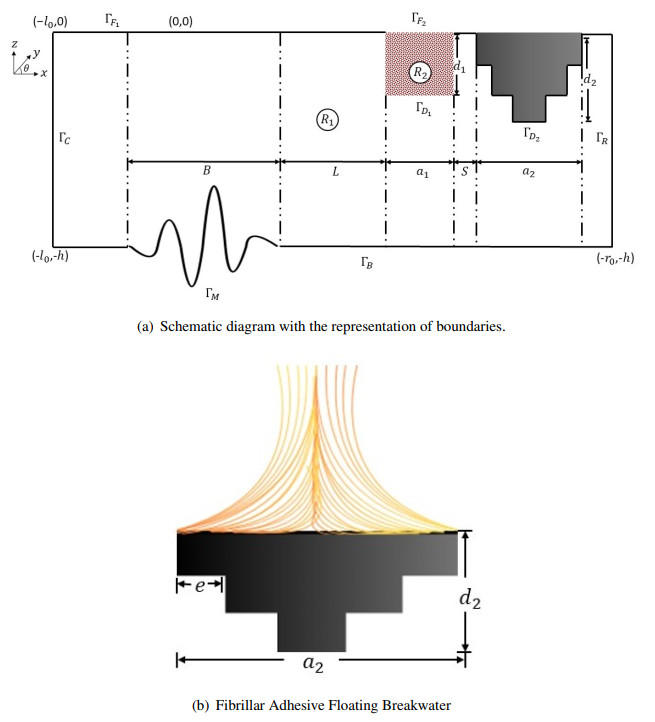
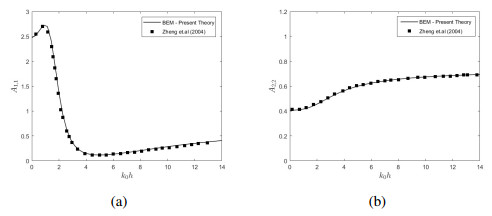
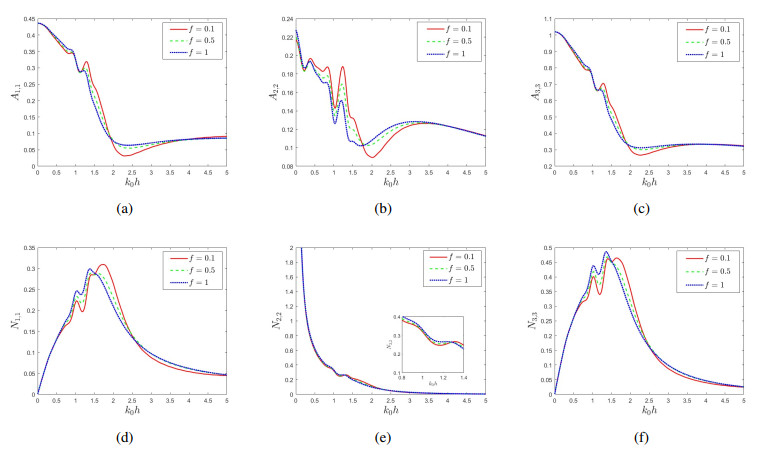
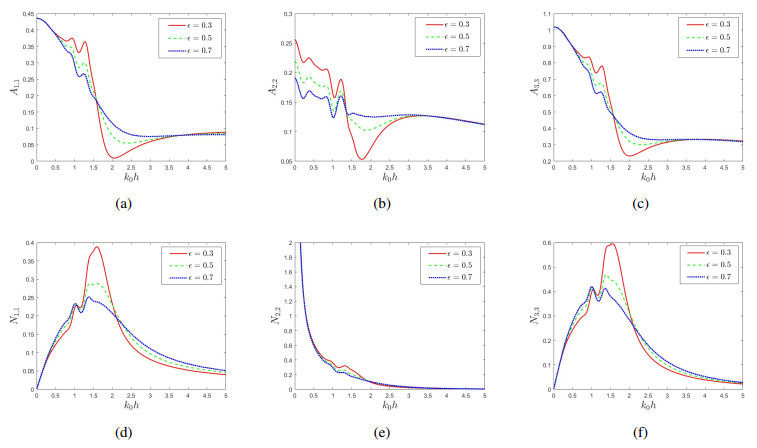
This study examines the dynamic response of a fibrillar adhesive floating breakwater positioned near a porous structure at a finite distance from Gaussian undulating seabed. The problem is addressed using linearized water wave theory, with numerical simulations based on the multi-domain boundary element method. The study primarily focuses on the analysis of crucial elements such as the added mass and damping coefficients associated with heave, surge, and pitch motions, considering the influence of both wave and structural parameters. Validation against existing literature confirms the accuracy and reliability of the proposed method. The study reveals that an increase in the number of seabed ripples leads to higher added mass and damping coefficients, particularly at larger wave incidence angles. Further, the frictional interaction between the water and the porous structure modifies the added mass coefficient, resulting in a shift in the resonance peak and significantly affecting the dynamic response of the breakwater. Moreover, surge and pitch motions are highly damped in intermediate waves as the porosity of the structure decreases.
Citation: S. Sujana Praisilin, Chandru Muthusamy, Higinio Ramos. Dynamic response of fibrillar adhesive floating breakwater near a porous structure and Gaussian oscillatory seabed with added mass and damping effects[J]. AIMS Mathematics, 2025, 10(10): 23715-23737. doi: 10.3934/math.20251054
This study examines the dynamic response of a fibrillar adhesive floating breakwater positioned near a porous structure at a finite distance from Gaussian undulating seabed. The problem is addressed using linearized water wave theory, with numerical simulations based on the multi-domain boundary element method. The study primarily focuses on the analysis of crucial elements such as the added mass and damping coefficients associated with heave, surge, and pitch motions, considering the influence of both wave and structural parameters. Validation against existing literature confirms the accuracy and reliability of the proposed method. The study reveals that an increase in the number of seabed ripples leads to higher added mass and damping coefficients, particularly at larger wave incidence angles. Further, the frictional interaction between the water and the porous structure modifies the added mass coefficient, resulting in a shift in the resonance peak and significantly affecting the dynamic response of the breakwater. Moreover, surge and pitch motions are highly damped in intermediate waves as the porosity of the structure decreases.

| [1] |
R. W. Yeung, The transient heaving motion of floating eylinders, J. Eng. Math., 16 (1982), 97–119. https://doi.org/10.1007/BF00042549 doi: 10.1007/BF00042549

|
| [2] |
Y. He, B. Han, X. Han, H. Xie, Wave blocking performance of the symmetrical double-wing floating breakwater, Ocean Eng., 303 (2024), 117852. https://doi.org/10.1016/j.oceaneng.2024.117852 doi: 10.1016/j.oceaneng.2024.117852
|
| [3] |
S. Sujana Praisilin, R. Gayathri, M. Chandru, Effect of Trench Configuration on the Scattering and Radiation of Surface Gravity Waves by Different Floating Breakwaters, Phys. Fluids, 37 (2025), 087225. https://doi.org/10.1063/5.0278889 doi: 10.1063/5.0278889
|
| [4] | H. Y. Wang, Z. C. Sun, Experimental study on the influence of geometrical configuration of porous floating breakwater on performance, J. Mar. Sci. Technol., 18 (2010), 13. |
| [5] | S. L. T. McGregor, Transdisciplinarity and biomimicry, Transdisciplinary J. Eng. Sci., 4 (2013). https://doi.org/10.22545/2013/00042 |
| [6] |
P. Rakshit, S. Banerjea, Effect of bottom undulation on the waves generated due to rolling of a plate, J. Mar. Sci. Appl., 10 (2011), 7–16. https://doi.org/10.1007/s11804-011-1035-8 doi: 10.1007/s11804-011-1035-8
|
| [7] |
C. C. Mei, J. L. Black, Scattering of surface waves by rectangular obstacles in waters of finite depth, J. Fluid Mech., 38 (1969), 499–511. https://doi.org/10.1017/S0022112069000309 doi: 10.1017/S0022112069000309
|
| [8] |
A. N. Williams, H. S. Lee, Z. Huang, Floating pontoon breakwaters, Ocean Eng., 27 (2000), 221–240. https://doi.org/10.1016/S0029-8018(98)00056-0 doi: 10.1016/S0029-8018(98)00056-0
|
| [9] |
S. Shafiuddin Amer, J. S. Mani, Performance of rigidly interconnected multiple floating pontoons, J. Nav. Archit. Mar. Eng., 1 (2004), 1–15. https://doi.org/10.1061/40775(182)27 doi: 10.1061/40775(182)27
|
| [10] |
M. R. Gesraha, An eigenfunction expansion solution for extremely flexible floating pontoons in oblique waves, App. Ocean Res., 26 (2004), 171–182. https://doi.org/10.1016/j.apor.2005.05.002 doi: 10.1016/j.apor.2005.05.002
|
| [11] | Diamantoulaki, Ioanna and Loukogeorgaki, Eva and Angelides, Demos C, 3D analysis of free and moored twin-pontoon floating breakwaters, ISOPE Int. Ocean Polar Eng. Conf., (2007), ISOPE-I-07-395. |
| [12] |
Y. Chen, Y. Liu, D. D. Meringolo, Comparison of hydrodynamic performances between single pontoon and double pontoon floating breakwaters through the SPH method, China Ocean Engineering, 36 (2022), 894–910. https://doi.org/10.1007/s13344-022-0078-8 doi: 10.1007/s13344-022-0078-8
|
| [13] |
S. C. Mohapatra, I. B. da Silva Bispo, Y. Guo, C. G. Soares, Analysis of wave-induced forces on a floating rectangular box with analytical and numerical approaches, J. Mar. Sci. Appl., 23 (2024), 113–126. https://doi.org/10.1007/s11804-024-00385-7 doi: 10.1007/s11804-024-00385-7
|
| [14] | S. C. Mohapatra, C. G. Soares, Wave energy system combined by a heaving box and a perforated flexible membrane wall, J. Mar. Sci. Appl., (2025), 1–12. https://doi.org/10.1007/s11804-025-00696-3 |
| [15] |
S. P. Samuel, R. Gayathri, S. Koley, C. Muthusamy, Motion responses with hydrodynamic factors in designing a floating breakwater and wave energy converter: A review, J. Ocean Eng. Mar. Energy, 11 (2025), 233–263. https://doi.org/10.1007/s40722-024-00372-8 doi: 10.1007/s40722-024-00372-8
|
| [16] |
C. Lee, J. Lee, Wave-induced surge motion of a tension leg structure, Ocean Eng., 20 (1993), 171–186. https://doi.org/10.1016/0029-8018(93)90033-E doi: 10.1016/0029-8018(93)90033-E
|
| [17] |
C. Lee, W. Ker, Coupling of linear waves and a hybrid porous TLP, Ocean Eng., 29 (2002), 1049–1066. https://doi.org/10.1016/S0029-8018(01)00065-8 doi: 10.1016/S0029-8018(01)00065-8
|
| [18] |
R. Gayathri, M. B. M. Khan, H. Behera, Attenuation of wave force on a floating dock by multiple porous breakwaters, Eng. Anal. Boundary Elem., 143 (2022), 170–189. https://doi.org/10.1016/j.enganabound.2022.06.002 doi: 10.1016/j.enganabound.2022.06.002
|
| [19] |
T. Sukcharoen, D. Kositgittiwong, C. Ekkawatpanit, T. N. H. Tran, W.Tangchirapat, Assessment of the solitary wave attenuation through pervious concrete breakwater, Constr. Build. Mater., 411 (2024), 134–457. https://doi.org/10.1016/j.conbuildmat.2023.134457 doi: 10.1016/j.conbuildmat.2023.134457
|
| [20] |
K.A. Belibassakis, A boundary element method for the hydrodynamic analysis of floating bodies in variable bathymetry regions, Eng. Anal. Boundary Elem., 32 (2008), 796–810. https://doi.org/10.1016/j.enganabound.2008.02.003 doi: 10.1016/j.enganabound.2008.02.003
|
| [21] |
K. Trivedi, S. Koley Effect of varying bottom topography on the radiation of water waves by a floating rectangular buoy, Fluids, 6 (2021), 59. https://doi.org/10.3390/fluids6020059 doi: 10.3390/fluids6020059
|
| [22] |
E. Arzt, S. Gorb, R. Spolenak, From micro to nano contacts in biological attachment devices, Proc. Natl. Acad. Sci., 100 (2003), 10603–10606. https://doi.org/10.1073/pnas.1534701100 doi: 10.1073/pnas.1534701100
|
| [23] |
K. Autumn, Y. A. Liang, S. T. Hsieh, W. Zesch, W. P. Chan, T. W. Kenny, et al., Adhesive force of a single gecko foot-hair, Nature, 405 (2000), 681–685. https://doi.org/10.1038/35015073 doi: 10.1038/35015073
|
| [24] |
M. P. Murphy, S. Kim, M. Sitti, Enhanced adhesion by gecko-inspired hierarchical fibrillar adhesives, ACS Appl. Mater. Interfaces, 1 (2009), 849–855. https://doi.org/10.1021/am8002439 doi: 10.1021/am8002439
|
| [25] |
R. Spolenak, S. Gorb, E. Arzt, Adhesion design maps for bio-inspired attachment systems, Acta biomater., 1 (2005), 5–13. https://doi.org/10.1016/j.actbio.2004.08.004 doi: 10.1016/j.actbio.2004.08.004
|
| [26] |
X. Li, D. Tao, H. Lu, P. Bai, Z. Liu, L. Ma, et al., Recent developments in gecko-inspired dry adhesive surfaces from fabrication to application, Surf. Topogr.: Metrol. Prop., 7 (2019), 023001. https://doi.org/10.1088/2051-672X/ab1447 doi: 10.1088/2051-672X/ab1447
|
| [27] |
J. Zhao, N. Xia, L. Zhang, A review of bioinspired dry adhesives: From achieving strong adhesion to realizing switchable adhesion, Bioinspir. Biomim., 19 (2024), 051003. https://doi.org/10.1088/1748-3190/ad62cf doi: 10.1088/1748-3190/ad62cf
|
| [28] |
M. Li, Y. Sun, B. Bi, T. Wang, L. Shi, X. Wang, Bio-and bioinspired textures for enhancing friction forces, Surf. Topogr.: Metrol. Prop., 13 (2025), 013003. https://doi.org/10.1088/2051-672X/adad8b doi: 10.1088/2051-672X/adad8b
|
| [29] |
T. W. Kim, B. Bhushan, The adhesion model considering capillarity for gecko attachment system, J. R. Soc. Interface, 5 (2008), 319–327. https://doi.org/10.1098/rsif.2007.1078 doi: 10.1098/rsif.2007.1078
|
| [30] |
X. Li, P. Bai, X. Li, L. Li, Y. Li, H. Lu, et al., Robust scalable reversible strong adhesion by gecko-inspired composite design, Friction, 10 (2022), 1192–1207. https://doi.org/10.1007/s40544-021-0522-4 doi: 10.1007/s40544-021-0522-4
|
| [31] |
S. Koley, H. Behera, T. Sahoo, Oblique wave trapping by porous structures near a wall, J. Eng. Mech., 141 (2015), 04014122. https://doi.org/10.1061/(ASCE)EM.1943-7889.0000843 doi: 10.1061/(ASCE)EM.1943-7889.0000843
|
| [32] |
H. Chen, C. Tsai, J. Chiu, Wave reflection from vertical breakwater with porous structure, Ocean Eng., 33 (2006), 1705–1717. https://doi.org/10.1016/j.oceaneng.2005.10.014 doi: 10.1016/j.oceaneng.2005.10.014
|
| [33] | M. R. A. V. Gent, Wave interaction with permeable coastal structures, PhD Thesis, Delft University of Technology, 1995. |
| [34] |
K. Panduranga, S. Koley, Water waves scattering by cylindrical dual porous floating breakwaters connected with a rectangular porous box and floating over an undulated seabed, Meccanica, 56 (2021), 3001–3024. https://doi.org/10.1007/s11012-021-01442-z doi: 10.1007/s11012-021-01442-z
|
| [35] |
K. G. Vijay, S. Koley, K. Trivedi, C. S. Nishad, Hydrodynamic coefficients of a floater near a partially reflecting seawall in the presence of an array of caisson blocks, J. Offshore Mech. Arct. Eng., 144 (2022), 021906. https://doi.org/10.1115/1.4052635 doi: 10.1115/1.4052635
|
| [36] |
S. Koley, K. Panduranga, N. Almashan, S. Neelamani, A. Al-Ragum, Numerical and experimental modeling of water wave interaction with rubble mound offshore porous breakwaters, Ocean Eng., 218 (2020), 108218. https://doi.org/10.1016/j.oceaneng.2020.108218 doi: 10.1016/j.oceaneng.2020.108218
|
| [37] | Katsikadelis, John T, The boundary element method for engineers and scientists: Theory and applications, Academic Press, 2016. |
| [38] |
D. Goyal, T. K. Hota, S. C. Martha, Propagation of nonlinear surface waves over non-periodic oscillatory bottom profiles, Eur. J. Mech.-B/Fluids, 104 (2024), 194–214. https://doi.org/10.1016/j.euromechflu.2023.12.003 doi: 10.1016/j.euromechflu.2023.12.003
|
| [39] |
Y. Zhao, Y. Liu, H. Li, A. Chang, Iterative dual BEM solution for water wave scattering by breakwaters having perforated thin plates, Eng. Anal. Boundary Elem., 120 (2020), 95–106. https://doi.org/10.1016/j.enganabound.2020.08.008 doi: 10.1016/j.enganabound.2020.08.008
|
| [40] |
Y. H. Zheng, Y. G. You, Y. M. Shen, On the radiation and diffraction of water waves by a rectangular buoy, Ocean Eng., 31 (2004), 1063–1082. https://doi.org/10.1016/j.oceaneng.2003.10.012 doi: 10.1016/j.oceaneng.2003.10.012
|
| [41] |
A. K. Mohapatra, K. G. Vijay, T. Sahoo, Bragg scattering of surface gravity waves by a submerged wavy porous plate, Ocean Eng., 219 (2021), 108273. https://doi.org/10.1016/j.oceaneng.2020.108273 doi: 10.1016/j.oceaneng.2020.108273
|
| [42] |
M. M. Jins, K. G. Vijay, V. Venkateswarlu, H. Behera, Oblique wave interaction with a floating dock in the presence of inverted trapezoidal pile-rock breakwaters, Eng. Anal. Boundary Elem., 172 (2025), 106111. https://doi.org/10.1016/j.enganabound.2024.106111 doi: 10.1016/j.enganabound.2024.106111
|
Figures(10) / Tables(1)

S. Sujana Praisilin, Chandru Muthusamy, Higinio Ramos. Dynamic response of fibrillar adhesive floating breakwater near a porous structure and Gaussian oscillatory seabed with added mass and damping effects[J]. AIMS Mathematics, 2025, 10(10): 23715-23737. doi: 10.3934/math.20251054





 DownLoad: