Rapid thermal cycling during laser welding strongly affects the microstructure of advanced high-strength steels, whereas repeated finite-element simulations across process conditions are computationally expensive. In this study, we developed a finite-element-informed convolutional neural network–long short-term memory (CNN–LSTM) and a two-dimensional cellular automaton (CA) framework for cooling-rate prediction and assessment of solidification-grain morphology in laser-welded QP1180 steel. A three-dimensional thermophysical finite element (FE) model was calibrated against a local thermocouple temperature history. At the calibration location, the selected peak-temperature and cooling-rate differences were below 5% and 10%, respectively. The calibrated model was then used to generate cooling-rate fields for 300 combinations of laser power, welding speed and defocusing distance obtained by Latin hypercube sampling. The CNN–LSTM surrogate mapped the three process parameters to a 200-dimensional cooling-rate field extracted from a 10 × 20 grid. On the fixed held-out test set, the model achieved a coefficient of determination (R2) of 0.88, a mean absolute error (MAE) of 0.25, and a root mean square error (RMSE) of 0.38. It yielded a higher R2 and lower MAE and RMSE than the standalone CNN and LSTM models. The predicted cooling-rate fields were converted into approximate local temperature histories over the solidification interval and coupled with the CA model. The simulated morphology reproduced the qualitative transition from columnar grains near the fusion boundary to a more equiaxed region toward the weld center. The framework was restricted to the investigated QP1180 lap-joint configuration and process window. The CA output represented solidification-grain morphology rather than the final multiphase microstructure; quantitative grain-scale validation and broader extrapolation require further experimental evidence.
Citation: Xiaojuan Li, Zhenfei Zhan, Liangjun Zhang, Silong Zhou, Zhong Liao, Huayang Xiang, Yuxiang Ji, Fuhao Fan. Finite-element-informed CNN–LSTM and cellular automata prediction of microstructure evolution in QP1180 steel laser welding[J]. AIMS Materials Science, 2026, 13(5): 996-1016. doi: 10.3934/matersci.2026047
Rapid thermal cycling during laser welding strongly affects the microstructure of advanced high-strength steels, whereas repeated finite-element simulations across process conditions are computationally expensive. In this study, we developed a finite-element-informed convolutional neural network–long short-term memory (CNN–LSTM) and a two-dimensional cellular automaton (CA) framework for cooling-rate prediction and assessment of solidification-grain morphology in laser-welded QP1180 steel. A three-dimensional thermophysical finite element (FE) model was calibrated against a local thermocouple temperature history. At the calibration location, the selected peak-temperature and cooling-rate differences were below 5% and 10%, respectively. The calibrated model was then used to generate cooling-rate fields for 300 combinations of laser power, welding speed and defocusing distance obtained by Latin hypercube sampling. The CNN–LSTM surrogate mapped the three process parameters to a 200-dimensional cooling-rate field extracted from a 10 × 20 grid. On the fixed held-out test set, the model achieved a coefficient of determination (R2) of 0.88, a mean absolute error (MAE) of 0.25, and a root mean square error (RMSE) of 0.38. It yielded a higher R2 and lower MAE and RMSE than the standalone CNN and LSTM models. The predicted cooling-rate fields were converted into approximate local temperature histories over the solidification interval and coupled with the CA model. The simulated morphology reproduced the qualitative transition from columnar grains near the fusion boundary to a more equiaxed region toward the weld center. The framework was restricted to the investigated QP1180 lap-joint configuration and process window. The CA output represented solidification-grain morphology rather than the final multiphase microstructure; quantitative grain-scale validation and broader extrapolation require further experimental evidence.

| [1] |
Guo W, Wan Z, Peng P, et al. (2018) Microstructure and mechanical properties of fiber laser welded QP980 steel. J Mater Process Technol 256: 229-238. https://doi.org/10.1016/j.jmatprotec.2018.02.015 doi: 10.1016/j.jmatprotec.2018.02.015
|
| [2] |
Xue J, Guo W, Zhang Y, et al. (2022) Local microstructure and mechanical characteristics of HAZ and tensile behavior of laser welded QP980 joints. Mater Sci Eng A 854: 143862. https://doi.org/10.1016/j.msea.2022.143862 doi: 10.1016/j.msea.2022.143862
|
| [3] |
Zhang W, Yang S, Lin Z, et al. (2020) Weld morphology and mechanical properties in laser spot welding of quenching and partitioning 980 steel. J Manuf Process 56: 1136-1145. https://doi.org/10.1016/j.jmapro.2020.05.057 doi: 10.1016/j.jmapro.2020.05.057
|
| [4] |
Zhang W, Tao W, Yang S (2021) Mechanical properties and fracture behaviors in remote laser spot welding of quenching and partitioning 980 steel. Opt Laser Technol 140: 107053. https://doi.org/10.1016/j.optlastec.2021.107053 doi: 10.1016/j.optlastec.2021.107053
|
| [5] |
Mohammadi Zahrani M, Ranjbarnodeh E, Ketabchi M, et al. (2024) Microstructure evolution and mechanical properties of laser-welded joints of 1.2 GPa-class quenching and partitioning steel. Opt Laser Technol 170: 110257. https://doi.org/10.1016/j.optlastec.2023.110257 doi: 10.1016/j.optlastec.2023.110257
|
| [6] |
Wei HL, Mukherjee T, Zhang W, et al. (2021) Mechanistic models for additive manufacturing of metallic components. Prog Mater Sci 116: 100703. https://doi.org/10.1016/j.pmatsci.2020.100703 doi: 10.1016/j.pmatsci.2020.100703
|
| [7] |
Herzog D, Seyda V, Wycisk E, et al. (2016) Additive manufacturing of metals. Acta Mater 117: 371-392. https://doi.org/10.1016/j.actamat.2016.07.019 doi: 10.1016/j.actamat.2016.07.019
|
| [8] |
Zhang J, Liou F, Seufzer W, et al. (2016) A coupled finite element cellular automaton model to predict thermal history and grain morphology of Ti-6Al-4V during direct metal deposition (DMD). Addit Manuf 11: 32-39. https://doi.org/10.1016/j.addma.2016.04.004 doi: 10.1016/j.addma.2016.04.004
|
| [9] |
Lian Y, Gan Z, Yu C, et al. (2019) A cellular automaton finite volume method for microstructure evolution during additive manufacturing. Mater Des 169: 107672. https://doi.org/10.1016/j.matdes.2019.107672 doi: 10.1016/j.matdes.2019.107672
|
| [10] |
Teferra K, Rowenhorst DJ (2021) Optimizing the cellular automata finite element model for additive manufacturing to simulate large microstructures. Acta Mater 213: 116930. https://doi.org/10.1016/j.actamat.2021.116930 doi: 10.1016/j.actamat.2021.116930
|
| [11] |
Liu S, Shin YC (2020) Integrated 2D cellular automata-phase field modeling of solidification and microstructure evolution during additive manufacturing of Ti6Al4V. Comput Mater Sci 183: 109889. https://doi.org/10.1016/j.commatsci.2020.109889 doi: 10.1016/j.commatsci.2020.109889
|
| [12] |
Rolchigo M, Stump B, Belak J, et al. (2020) Sparse thermal data for cellular automata modeling of grain structure in additive manufacturing. Modell Simul Mater Sci Eng 28: 065003. https://doi.org/10.1088/1361-651X/ab9734 doi: 10.1088/1361-651X/ab9734
|
| [13] |
Xiong F, Lian Y, Li MJ, et al. (2023) An extended cellular automaton finite volume method for grain nucleation-growth-coarsening during the wire-based additive manufacturing process. Addit Manuf 76: 103782. https://doi.org/10.1016/j.addma.2023.103782 doi: 10.1016/j.addma.2023.103782
|
| [14] |
Yuan L, Fattebert JL, Sun C, et al. (2024) Uncovering grain and subgrain microstructure at the scale of additive manufacturing melt tracks with a scalable cellular automaton solidification model. Addit Manuf 92: 104401. https://doi.org/10.1016/j.addma.2024.104401 doi: 10.1016/j.addma.2024.104401
|
| [15] |
Ren K, Chew Y, Zhang YF, et al. (2020) Thermal field prediction for laser scanning paths in laser aided additive manufacturing by physics-based machine learning. Comput Methods Appl Mech Eng 362: 112734. https://doi.org/10.1016/j.cma.2019.112734 doi: 10.1016/j.cma.2019.112734
|
| [16] |
Karniadakis GE, Kevrekidis IG, Lu L, et al. (2021) Physics-informed machine learning. Nat Rev Phys 3: 422-440. https://doi.org/10.1038/s42254-021-00314-5 doi: 10.1038/s42254-021-00314-5
|
| [17] |
Zhu Q, Liu Z, Yan J (2021) Machine learning for metal additive manufacturing: Predicting temperature and melt pool fluid dynamics using physics-informed neural networks. Comput Mech 67: 619-635. https://doi.org/10.1007/s00466-020-01952-9 doi: 10.1007/s00466-020-01952-9
|
| [18] |
Gunasegaram DR, Murphy AB, Barnard A, et al. (2021) Towards developing multiscale-multiphysics models and their surrogates for digital twins of metal additive manufacturing. Addit Manuf 46: 102089. https://doi.org/10.1016/j.addma.2021.102089 doi: 10.1016/j.addma.2021.102089
|
| [19] |
Ghungrad S, Faegh M, Gould B, et al. (2023) Architecture-driven physics-informed deep learning for temperature prediction in laser powder bed fusion additive manufacturing with limited data. J Manuf Sci Eng 145: 081007. https://doi.org/10.1115/1.4062237 doi: 10.1115/1.4062237
|
| [20] |
Chen J, Pierce J, Williams G, et al. (2024) Accelerating thermal simulations in additive manufacturing by training physics-informed neural networks with randomly synthesized data. J Comput Inf Sci Eng 24: 011004. https://doi.org/10.1115/1.4062852 doi: 10.1115/1.4062852
|
| [21] |
Tang J, Scheel P, Mohebbi MS, et al. (2024) On the calibration of thermo-microstructural simulation models for laser powder bed fusion process: integrating physics-informed neural networks with cellular automata. Addit Manuf 96: 104574. https://doi.org/10.1016/j.addma.2024.104574 doi: 10.1016/j.addma.2024.104574
|
| [22] |
Goldak J, Chakravarti A, Bibby M (1984) A new finite element model for welding heat sources. Metall Trans B 15: 299-305. https://doi.org/10.1007/BF02667333 doi: 10.1007/BF02667333
|
| [23] |
McKay MD, Beckman RJ, Conover WJ (1979) Comparison of three methods for selecting values of input variables in the analysis of output from a computer code. Technometrics 21: 239-245. https://doi.org/10.1080/00401706.1979.10489755 doi: 10.1080/00401706.1979.10489755
|
| [24] |
LeCun Y, Bengio Y, Hinton G (2015) Deep learning. Nature 521: 436-444. https://doi.org/10.1038/nature14539 doi: 10.1038/nature14539
|
| [25] |
Hochreiter S, Schmidhuber J (1997) Long short-term memory. Neural Comput 9: 1735-1780. https://doi.org/10.1162/neco.1997.9.8.1735 doi: 10.1162/neco.1997.9.8.1735
|
| [26] |
Thévoz P, Desbiolles JL, Rappaz M (1989) Modeling of equiaxed microstructure formation in casting. Metall Trans A 20: 311-322. https://doi.org/10.1007/BF02670257 doi: 10.1007/BF02670257
|
| [27] |
Guo J, Wang J, Cheng L, et al. (2024) Unravelling the mechanism of columnar-to-equiaxed transition and grain refinement in ultrasonic vibration assisted laser welding of Ti6Al4V titanium alloy. Ultrasonics 141: 107342. https://doi.org/10.1016/j.ultras.2024.107342 doi: 10.1016/j.ultras.2024.107342
|
| [28] |
Liu Y, Wang J, Yan T, et al. (2024) Effect of synchronous gas cooling method on microstructure and mechanical properties of laser welded joint for Ti6Al4V titanium alloy. Mater Today Commun 39: 108779. https://doi.org/10.1016/j.mtcomm.2024.108779 doi: 10.1016/j.mtcomm.2024.108779
|
| [29] |
Zhao Y, Hao L, Liu R, et al. (2024) Unravelling asymmetrical microstructure evolution and tensile fracture mechanism in laser welding of dissimilar 2219/2195 aluminum alloys. J Mater Res Technol 31: 4041-4058. https://doi.org/10.1016/j.jmrt.2024.07.087 doi: 10.1016/j.jmrt.2024.07.087
|





Figures(10) / Tables(6)

Xiaojuan Li, Zhenfei Zhan, Liangjun Zhang, Silong Zhou, Zhong Liao, Huayang Xiang, Yuxiang Ji, Fuhao Fan. Finite-element-informed CNN–LSTM and cellular automata prediction of microstructure evolution in QP1180 steel laser welding[J]. AIMS Materials Science, 2026, 13(5): 996-1016. doi: 10.3934/matersci.2026047

Geometry and dimensions of the laser-welded lap-joint specimen
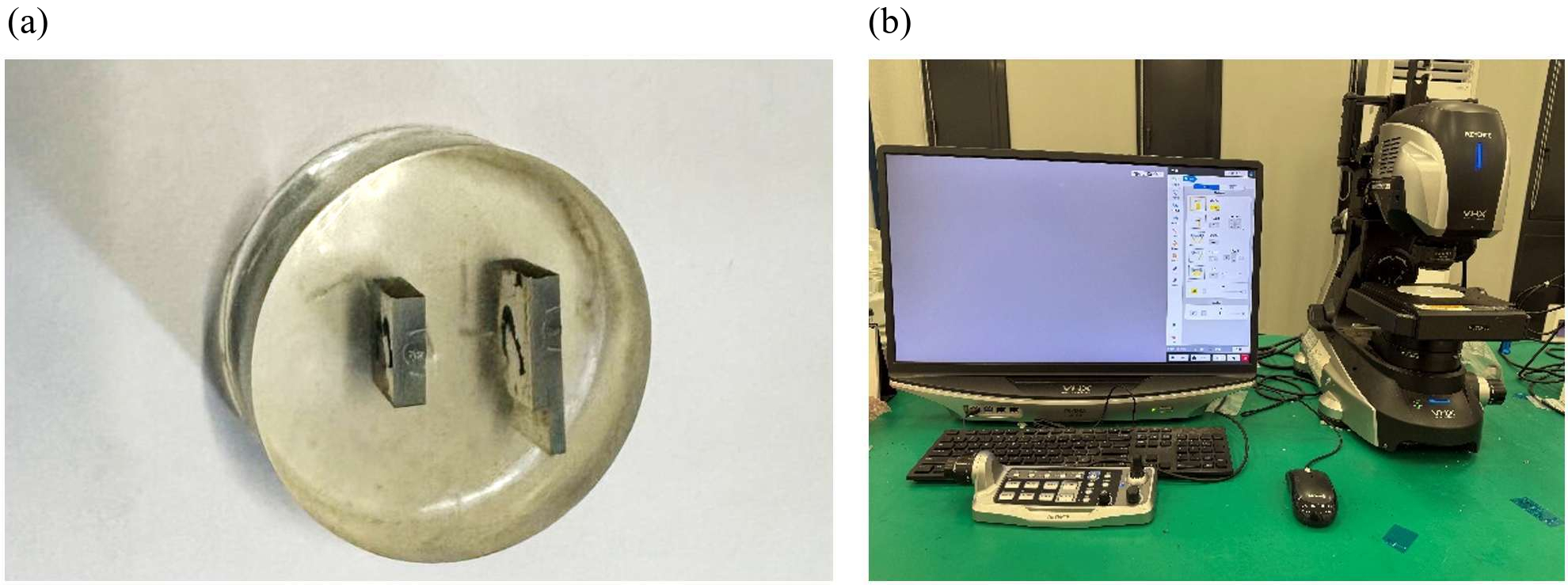
Metallographic characterization. (a) Mounted weld cross-sectional specimens; (b) KEYENCE VHX-7000 optical-microscopy system
FE model geometry and mesh layout. (a) Lap-joint geometry; (b) overall mesh layout
Schematic diagram of the double-ellipsoid heat source model
Architecture of the CNN-LSTM surrogate model for cooling-rate-field prediction
Schematic diagram of grain nucleation and growth in the cellular automata model
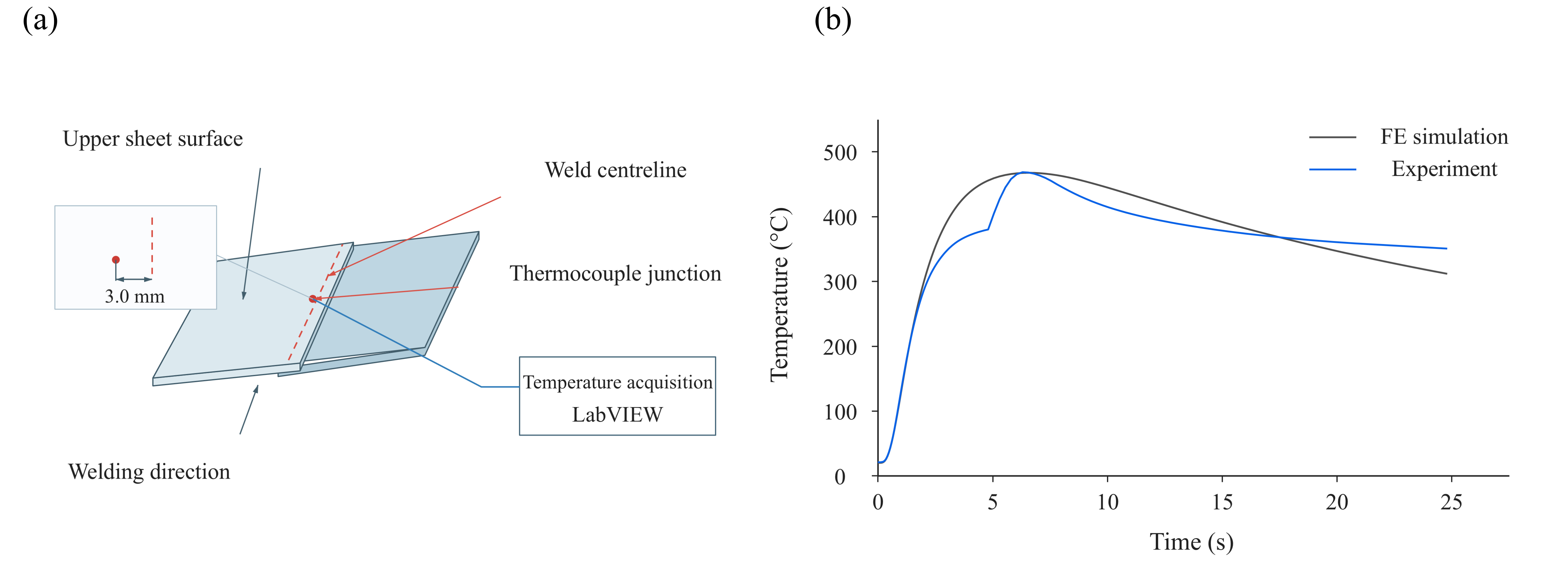
Local thermal-history calibration of the FE model. (a) Thermocouple placement; (b) comparison between the simulated and measured temperature histories
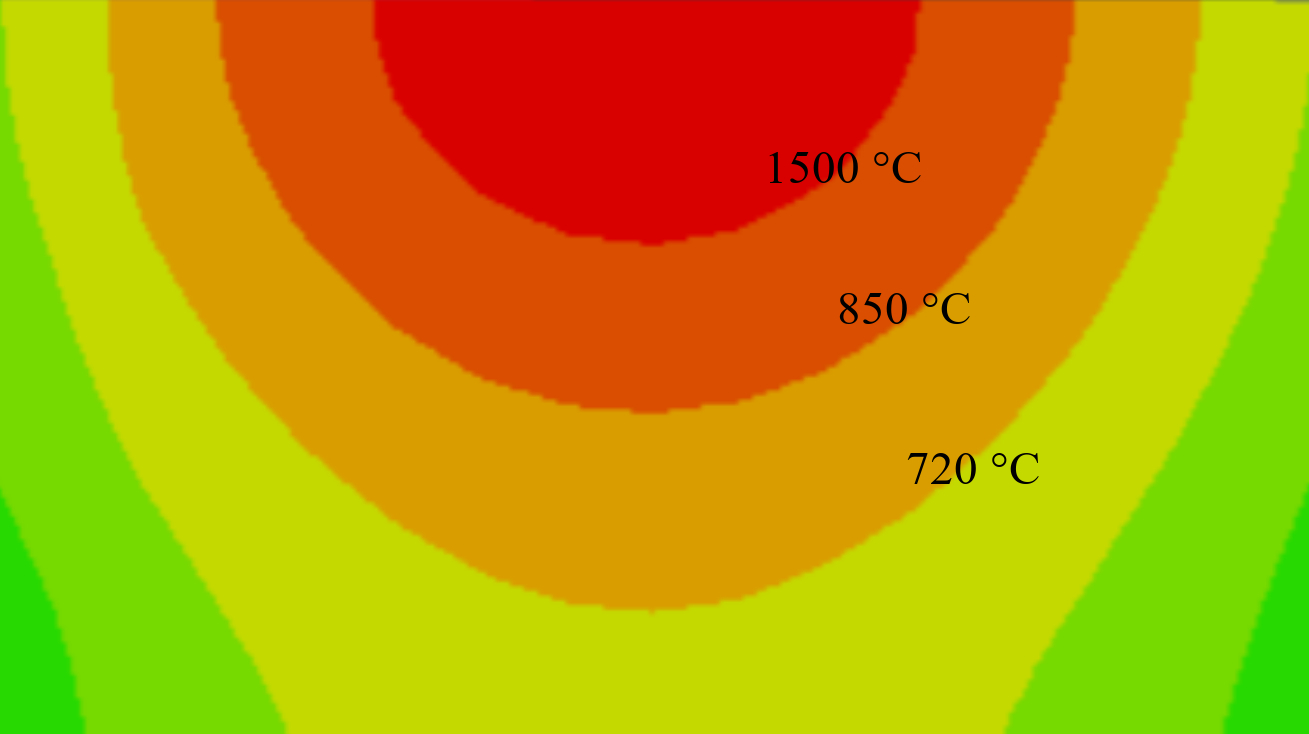
Calculated cross-sectional temperature field of the QP1180 steel laser-welded joint
Comparison between predicted and FE-derived cooling-rate values obtained by the CNN-LSTM model
Morphology-level comparison between (a) the experimentally observed post-welding microstructure and (b) the CA-predicted solidification-grain morphology at the weld cross-section




 DownLoad: