The development of sustainable structural concrete increasingly incorporates supplementary cementitious materials (SCMs) and nanoadditives to drastically reduce carbon footprints. However, microstructural densification using nanosilica (NS) and silica fume (SF) often enhances compressive strength at the expense of increased structural brittleness. Traditional engineering methods evaluate this brittleness through empirical static strength ratios (e.g., the brittleness index, BI), which inherently fail to reflect the post-cracking energy dissipation mechanisms and non-linear softening behavior. To overcome this limitation, we introduced a novel energy-based metric designated as the post-peak ductility index (PDI), which mathematically isolates the post-peak energy (Wpost) relative to the total work of fracture (Wt). An extensive experimental campaign was conducted on four distinct concrete formulations: a 100% ordinary Portland cement (OPC), reference concrete (REF), a ternary nano-composite (NSF, containing 5% NS and 10% SF), and two quaternary hybrid systems combining 5% NS, 10% SF, and varying contents of fly ash (FA) (5% and 15% FA) (quaternary hybrid concretes: H1 and H2). The holistic mechanical and fracture performance was characterized via three-point bending tests on notched beams, coupled with advanced multi-criteria radar chart mapping and Pearson correlation matrix analysis. The experimental results demonstrated a beneficial interaction in the quaternary formulation H1, which achieved a 48% increase in compressive strength alongside a 145% explosion in the Wt (Wt = 2.012 J) compared to the REF concrete. Furthermore, while the sole addition of NS increased matrix brittleness (reducing PDI to 85.01%), the inclusion of FA successfully restored ductility (PDI up to 89.71%). Statistical validation confirmed that the classical BI correlates negatively with actual fracture work, proving its inadequacy for high-performance formulations, whereas the proposed PDI accurately tracks true non-linear structural safety margins.
Citation: Grzegorz Ludwik Golewski. Beyond traditional brittleness: A novel post-peak ductility index (PDI) for assessing fracture energy in eco-friendly hybrid concretes[J]. AIMS Materials Science, 2026, 13(5): 976-995. doi: 10.3934/matersci.2026046
The development of sustainable structural concrete increasingly incorporates supplementary cementitious materials (SCMs) and nanoadditives to drastically reduce carbon footprints. However, microstructural densification using nanosilica (NS) and silica fume (SF) often enhances compressive strength at the expense of increased structural brittleness. Traditional engineering methods evaluate this brittleness through empirical static strength ratios (e.g., the brittleness index, BI), which inherently fail to reflect the post-cracking energy dissipation mechanisms and non-linear softening behavior. To overcome this limitation, we introduced a novel energy-based metric designated as the post-peak ductility index (PDI), which mathematically isolates the post-peak energy (Wpost) relative to the total work of fracture (Wt). An extensive experimental campaign was conducted on four distinct concrete formulations: a 100% ordinary Portland cement (OPC), reference concrete (REF), a ternary nano-composite (NSF, containing 5% NS and 10% SF), and two quaternary hybrid systems combining 5% NS, 10% SF, and varying contents of fly ash (FA) (5% and 15% FA) (quaternary hybrid concretes: H1 and H2). The holistic mechanical and fracture performance was characterized via three-point bending tests on notched beams, coupled with advanced multi-criteria radar chart mapping and Pearson correlation matrix analysis. The experimental results demonstrated a beneficial interaction in the quaternary formulation H1, which achieved a 48% increase in compressive strength alongside a 145% explosion in the Wt (Wt = 2.012 J) compared to the REF concrete. Furthermore, while the sole addition of NS increased matrix brittleness (reducing PDI to 85.01%), the inclusion of FA successfully restored ductility (PDI up to 89.71%). Statistical validation confirmed that the classical BI correlates negatively with actual fracture work, proving its inadequacy for high-performance formulations, whereas the proposed PDI accurately tracks true non-linear structural safety margins.

| [1] |
Amran M, Onaizi AM, Qader DN, et al. (2022) Innovative use of fly ash-finely powdered glass cullet as a nano additives for a sustainable concrete: Strength and microstructure and cost analysis. Case Stud Constr Mat 17: e01688. https://doi.org/10.1016/j.cscm.2022.e01688 doi: 10.1016/j.cscm.2022.e01688
|
| [2] |
Abood AM, Khazal H, Hassan AF (2022) On the determination of first-mode stress intensity factors and T-stress in a continuous functionally graded beam using digital image correlation method. AIMS Mater Sci 9: 56–70. https://doi.org/10.3934/matersci.2022004 doi: 10.3934/matersci.2022004
|
| [3] |
Golewski GL (2022) The specificity of shaping and execution of monolithic pocket foundations (PF) in hall buildings. Buildings 12: 192. https://doi.org/10.3390/buildings12020192 doi: 10.3390/buildings12020192
|
| [4] |
Benhelal E, Zahedi G, Shamsaei E, et al. (2013) Global strategies and potentials to curb CO2 emissions in cement industry. J Clean Prod 51: 142–161. https://doi.org/10.1016/j.jclepro.2012.10.049 doi: 10.1016/j.jclepro.2012.10.049
|
| [5] |
Voldsund M, Gardarsdottir SO, De Lena E, et al. (2019) Comparison of technologies for CO2 capture from cement production–Part 1: Technical evaluation. Energies 12: 559. https://doi.org/10.3390/en12030559 doi: 10.3390/en12030559
|
| [6] |
Riaz Ahmad M, Fernàndez-Jimenez A, Chen B, et al. (2024) Low-carbon cementitious materials: Scale-up potential, environmental impact and barriers. Constr Build Mater 445: 139087. https://doi.org/10.1016/j.conbuildmat.2024.139087 doi: 10.1016/j.conbuildmat.2024.139087
|
| [7] |
Marandi N, Shirzad S (2025) Sustainable cement and concrete technologies: a review of materials and processes for carbon reduction. Innov Infrastruct Solut 10: 408. https://doi.org/10.1007/s41062-025-02213-5 doi: 10.1007/s41062-025-02213-5
|
| [8] |
Bao S, Xie T, Chen H, et al. (2026) Synergistic effects of ultra-fine fly ash, silica fume and micro-nano bubble water on fracture properties of fly ash mortars. J Build Eng 123: 115944. https://doi.org/10.1016/j.jobe.2026.115944 doi: 10.1016/j.jobe.2026.115944
|
| [9] |
Aprianti SE (2017) A huge number of artificial waste material can be supplementary cementitious material (SCM) for concrete production—A review part Ⅱ. J Clean Prod 142: 4178–4194. https://doi.org/10.1016/j.jclepro.2015.12.115 doi: 10.1016/j.jclepro.2015.12.115
|
| [10] |
Xie T, Visitin P (2018) A unified approach for mix design of concrete containing supplementary cementitious materials based on reactivity moduli. J Clean Prod 203: 68–82. https://doi.org/10.1016/j.jclepro.2018.08.254 doi: 10.1016/j.jclepro.2018.08.254
|
| [11] |
Xie T, Yang G, Zhao X, et al. (2020) A unified model for predicting the compressive strength of recycled aggregate concrete containing supplementary cementitious materials. J Clean Prod 251: 119752. https://doi.org/10.1016/j.jclepro.2019.119752 doi: 10.1016/j.jclepro.2019.119752
|
| [12] |
Zhang J, Ke G, Liu Y (2021) Early hydration heat of calcium sulfomluminate cement with lnfluences of supplementary cementitious materials and water to binder ratio. Materials 14: 642. https://doi.org/10.3390/ma14030642 doi: 10.3390/ma14030642
|
| [13] |
Yaseen N, Alcivar-Bastidas S, Irfan-ul-Hassan M, et al. (2024) Concrete incorporating supplementary cementitious materials: Temporal evolution of compressive strength and environmental life cycle assessment. Heliyon 10: e25056. https://doi.org/10.1016/j.heliyon.2024.e25056 doi: 10.1016/j.heliyon.2024.e25056
|
| [14] |
Ahmed A (2024) Assessing the effects of supplementary cementitious materials on concrete properties: A review. Disc Civ Eng 1: 145. https://doi.org/10.1007/s44290-024-00154-z doi: 10.1007/s44290-024-00154-z
|
| [15] |
Torres-Acosta AA, Méndez-Páramo RA, Arista-Perrusquía C, et al. (2025) Portland cement paste performance when inert limestone filler is added as clinker replacement. AIMS Mater Sci 12: 224–244. https://doi.org/10.3934/matersci.2025012 doi: 10.3934/matersci.2025012
|
| [16] |
Piyarat N, Wangrakdiskul U, Maingam P (2021) Investigations of the influence of various industrial waste materials containing rice husk ash, waste glass, and sediment soil for eco-friendly production of non-fired tiles. AIMS Mater Sci 8: 469–485. https://doi.org/10.3934/matersci.2021029 doi: 10.3934/matersci.2021029
|
| [17] |
Abdulrahman H, Muhamad R, Visitin P, et al. (2022) Mechanical properties and bond stress-slip behaviour of fly ash geopolymer concrete. Constr Build Mater 327: 126909. https://doi.org/10.1016/j.conbuildmat.2022.126909 doi: 10.1016/j.conbuildmat.2022.126909
|
| [18] |
Azizi M, Samimi K (2025) Effect of silica fume on self-compacting earth concrete: Compressive strength, durability and microstructural studies. Constr Build Mater 472: 140815. https://doi.org/10.1016/j.conbuildmat.2025.140815 doi: 10.1016/j.conbuildmat.2025.140815
|
| [19] |
Lv X, Shi Y, Zhou S (2025) Effects of fly ash and silica fume on abrasion resistance of high-ferrite Portland cement: A comparative study. Constr Build Mater 489: 142198. https://doi.org/10.1016/j.conbuildmat.2025.142198 doi: 10.1016/j.conbuildmat.2025.142198
|
| [20] |
Hamada HM, Abed F, Binti Katman HY, et al. (2023) Effect of silica fume on the properties of sustainable cement concrete. J Mater Res Techn 24: 8887–8908. https://doi.org/10.1016/j.jmrt.2023.05.147 doi: 10.1016/j.jmrt.2023.05.147
|
| [21] |
Wang L, Zhang P, Guan J, et al. (2023) Editorial: Fabrication and properties of concrete containing industrial waste. Front Mater 10: 1169715. https://doi.org/10.3389/fmats.2023.1169715 doi: 10.3389/fmats.2023.1169715
|
| [22] |
Kim Y, Hanif A, Usman M, et al. (2018) Slag waste incorporation in high early strength concrete as cement replacement: Environmental impact and influence on hydration & durability attributes. J Clean Prod 172: 3056–3065. https://doi.org/10.1016/j.jclepro.2017.11.105 doi: 10.1016/j.jclepro.2017.11.105
|
| [23] |
Han F, Pu S, Zhou Y, et al. (2021) Effect of ultrafine mineral admixtures on the rheological properties of fresh cement paste: A review. J Build Eng 51: 104313. https://doi.org/10.1016/j.jobe.2022.104313 doi: 10.1016/j.jobe.2022.104313
|
| [24] |
Karlina AI, Karlina YI, Gladkich VA (2023) Analysis of experience in the use of micro- and nanoadditives from silicon production waste in concrete technologies. Minerals 13: 1525. https://doi.org/10.3390/min13121525 doi: 10.3390/min13121525
|
| [25] |
Abhilash PP, Kumar Nayak D, Sangoju B, et al. (2021) Effect of nano-silica in concrete: A review. Constr Build Mater 278: 122347. https://doi.org/10.1016/j.conbuildmat.2021.122347 doi: 10.1016/j.conbuildmat.2021.122347
|
| [26] |
Ahmadi SH, Mazloom M, Salehi H (2024) Total and initial fracture energies of self-compacting lightweight concrete containing silica fume and nano-silica. Eng Fract Mech 308: 110382. https://doi.org/10.1016/j.engfracmech.2024.110382 doi: 10.1016/j.engfracmech.2024.110382
|
| [27] |
Sanjuán MA, Argiz C, Galvez JC, et al. (2018) Combined effect of nano-SiO2 and nano-Fe2O3 on compressive strength, flexural strength, porosity and electrical resistivity in cement mortars. Mater De Constr 68: e150. https://doi.org/10.3989/mc.2018.10716 doi: 10.3989/mc.2018.10716
|
| [28] |
Golewski GL, Xi X, Zheng Y, et al. (2025) Experimental evaluation of Mode Ⅱ fracture and microstructure of matrix-aggregate bond of concrete with crushed limestone. C Stud Constr Mater 23: e05183. https://doi.org/10.1016/j.cscm.2025.e05183 doi: 10.1016/j.cscm.2025.e05183
|
| [29] |
Oltulu M, Sahin R (2023) Effect of nano-SiO2, nano-Al2O3 and nano-Fe2O3 powders on compressive strengths and capillary water absorption of cement mortar containing fly ash: A comparative study. Ener Build 58: 292–301. https://doi.org/10.1016/j.enbuild.2012.12.014 doi: 10.1016/j.enbuild.2012.12.014
|
| [30] |
Prokopski G, Halbiniak J (2000) Interfacial transition zone in cementitious materials. Cem Concr Res 30: 579–583. https://doi.org/10.1016/S0008-8846(00)00210-6 doi: 10.1016/S0008-8846(00)00210-6
|
| [31] |
Golewski GL (2025) The investigation of shear fracture toughness and structure of ITZ of limestone concrete with different aggregate grain size. Materials 18: 3954. https://doi.org/10.3390/ma18173954 doi: 10.3390/ma18173954
|
| [32] |
Joshaghani A, Balapour M, Moshhadian M, et al. (2020) Effects of nano-TiO2, nano-Al2O3, and nano-Fe2O3 on rheology, mechanical and durability properties of self-consolidating concrete (SCC): An experimental study. Constr Build Mater 245: 1118444. https://doi.org/10.1016/j.conbuildmat.2020.118444 doi: 10.1016/j.conbuildmat.2020.118444
|
| [33] |
Peng Y, Ma K, Long G, et al. (2019) Influence of nano-SiO2, nano-CaCO3 and nano-Al2O3 on rheological properties of cement-fly ash paste. Materials 12: 2598. https://doi.org/10.3390/ma12162598 doi: 10.3390/ma12162598
|
| [34] |
Siang Ng D, Paul SC, Anggraini V, et al. (2020) Influence of SiO2, TiO2 and Fe2O3 nanoparticles on the properties of fly ash blended cement mortars. Constr Build Mater 258: 119627. https://doi.org/10.1016/j.conbuildmat.2020.119627 doi: 10.1016/j.conbuildmat.2020.119627
|
| [35] |
Imam A, Sharma KK, Kumar V, et al. (2022) A review study on sustainable development of ultra high-performance concrete. AIMS Mater Sci 9: 9–35. https://doi.org/10.3934/matersci.2022002 doi: 10.3934/matersci.2022002
|
| [36] |
Singh RP, Vanapalli KR, Jadda K, et al. (2024) Durability assessment of fly ash, GGBS, and silica fume based geopolymer concrete with recycled aggregates against acid and sulfate attack. J Build Eng 82: 108354. https://doi.org/10.1016/j.jobe.2023.108354 doi: 10.1016/j.jobe.2023.108354
|
| [37] |
Alperen Bulut H, Sahin R (2022) Radiological characteristics of self-compacting concretes incorporating fly ash, silica fume, and slag. J Build Eng 58: 104987. https://doi.org/10.1016/j.jobe.2022.104987 doi: 10.1016/j.jobe.2022.104987
|
| [38] |
Mohseni E, Miyandehi BM, Yang J, et al. (2015) Single and combined effects of nano-SiO2, nano-Al2O3 and nano-TiO2 on the mechanical, rheological and durability properties of self-compacting mortar containing fly ash. Constr Build Mater 84: 331–340. https://doi.org/10.1016/j.conbuildmat.2015.03.006 doi: 10.1016/j.conbuildmat.2015.03.006
|
| [39] |
Xi X, Zheng Y, Zhuo J, et al. (2024) Influence of water glass modulus and alkali content on the properties of alkali-activated thermally activated recycled cement. Constr Build Mater 452: 138867. https://doi.org/10.1016/j.conbuildmat.2024.138867 doi: 10.1016/j.conbuildmat.2024.138867
|
| [40] |
Xi X, Zheng Y, Zhuo J, et al. (2024) Mechanical properties and hydration mechanism of nano-silica modified alkali-activated thermally activated recycled cement. J Build Eng 98: 110998. https://doi.org/10.1016/j.jobe.2024.110998 doi: 10.1016/j.jobe.2024.110998
|
| [41] |
Falikman V (2022) Defined-performance concretes using nanomaterials and nanotechnologies. Eng Proc 17: 12. https://doi.org/10.3390/engproc2022017012 doi: 10.3390/engproc2022017012
|
| [42] |
Zhang P, Han S, Wang X, et al. (2020) Nanoparticle-reinforced building materials with applications in civil engineering. Adv Mech Eng 12: 1–4. https://doi.org/10.1177/1687814020965438 doi: 10.1177/1687814020965438
|
| [43] |
Tasdemir C, Tasdemir MA, Lydon FD, et al. (1996) Effects of silica fume and aggregate size on the brittleness of concrete. Cem Concr Res 26: 63–68. https://doi.org/10.1016/0008-8846(95)00180-8 doi: 10.1016/0008-8846(95)00180-8
|
| [44] |
Ahmad J, Abid SR, Arbili MM, et al. (2022) A review on sustainable concrete with the partially substitutions of silica fume as a cementitious material. Sustainability 14: 12075. https://doi.org/10.3390/su141912075 doi: 10.3390/su141912075
|
| [45] |
Alex AG, Kemal Z, Gebrehiwet T, et al. (2022) Effect of α: Phase nano Al2O3 and rice husk ash in cement mortar. Adv Civ Eng 2022: 4335736. https://doi.org/10.1155/2022/4335736 doi: 10.1155/2022/4335736
|
| [46] |
Land G, Stephan D (2012) The influence of nano-silica on the hydration of ordinary Portland cement. J Mater Sci 47: 1011–1017. https://doi.org/10.1007/s10853-011-5881-1 doi: 10.1007/s10853-011-5881-1
|
| [47] |
Chen S, Wang H, Guan J, et al. (2022) Determination method and prediction model of fracture and strength of recycled aggregate concrete at different curing ages. Constr Build Mater 343: 128070. https://doi.org/10.1016/j.conbuildmat.2022.128070 doi: 10.1016/j.conbuildmat.2022.128070
|
| [48] |
Zhang S, Han B, Xie H, et al. (2021) Brittleness of concrete under different curing conditions. Materials 14: 7865. https://doi.org/10.3390/ma14247865 doi: 10.3390/ma14247865
|
| [49] |
Raphael JM (1984) Tensile strength of concrete. ACI Mater J 81: 158–165. https://doi.org/10.14359/10653 doi: 10.14359/10653
|
| [50] |
Oluokun FA (1991) Prediction of concrete tensile strength from compressive strength: evaluation of existing relations for normal weight concrete. ACI Mater J 88: 302–309. https://doi.org/10.14359/1942 doi: 10.14359/1942
|
| [51] |
Biricik H, Sarier N (2014) Comparative study of the characteristics of nanosilica–, silica fume– and fly ash–incorporated cement mortars. Mater Res 17: 570–582. https://doi.org/10.1590/S1516-14392014005000054 doi: 10.1590/S1516-14392014005000054
|
| [52] |
El-Fekyl MS, Youssef P, El-Tair AM, et al. (2019) Effect of nano silica addition on enhancing the performance of cement composites reinforced with nano cellulose fibers. AIMS Mater Sci 6: 864–883. https://doi.org/10.3934/matersci.2018.6.864 doi: 10.3934/matersci.2018.6.864
|
| [53] |
Han F, Pu S, Zhou Y, et al. (2022) Effect of ultrafine mineral admixtures on the rheological properties of fresh cement paste: A review. J Build Eng 51: 104313. https://doi.org/10.1016/j.jobe.2022.104313 doi: 10.1016/j.jobe.2022.104313
|
| [54] |
Golewski GL (2023) Mechanical properties and brittleness of concrete made by combined fly ash, silica fume and nanosilica with ordinary Portland cement. AIMS Mater Sci 10: 390–404. https://doi.org/10.3934/matersci.2023021 doi: 10.3934/matersci.2023021
|
| [55] |
Kaźmierowski M, Siemiginowski M, Kordasz M, et al. (2026) Compressive deformability and flexural fracture energy of high-strength concrete with bamboo fibers. Sci Rep 16: 18341. https://doi.org/10.1038/s41598-026-48624-x doi: 10.1038/s41598-026-48624-x
|
| [56] |
Craciun EM (2008) Energy criteria for crack propagation in prestresses elastic composites. Sol Mech Appl 154: 193–237. https://doi.org/10.1007/978-1-4020-8772-1_7 doi: 10.1007/978-1-4020-8772-1_7
|
| [57] |
Golewski GL (2024) Effect of coarse aggregate type on the fracture toughness of ordinary concrete. Infrastructures 11: 105509. https://doi.org/10.3390/infrastructures9100185 doi: 10.3390/infrastructures9100185
|
| [58] |
Guan J, Yin Y, Li Y, et al. (2022) A design method for determining fracture toughness and tensile strength pertinent to concrete sieving curve. Eng Fract Mech 271: 108596. https://doi.org/10.1016/j.engfracmech.2022.108596 doi: 10.1016/j.engfracmech.2022.108596
|
| [59] |
Wu J, Yang J, Zhang R, et al. (2022) Fatigue life estimating for chloride attacked RC beams using S-N curve combined with mesoscale simulation of chloride ingress. Int J Fat 158: 106751. https://doi.org/10.1016/j.ijfatigue.2022.106751 doi: 10.1016/j.ijfatigue.2022.106751
|
| [60] |
Guan J, Zhang Y, Meng J, et al. (2022) A simple method for determining independent fracture toughness and tensile strength of rock. Int J Min Sci Technol 32: 707–726. https://doi.org/10.1016/j.ijmst.2022.05.004 doi: 10.1016/j.ijmst.2022.05.004
|
| [61] |
Kim JK, Lee CS, Park CK, et al. (1997) The fracture characteristics of crushed limestone sand concrete. Cem Concr Res 27: 1719–1729. https://doi.org/10.1016/S0008-8846(97)00156-7 doi: 10.1016/S0008-8846(97)00156-7
|
| [62] |
Wan C, Hou P, Zhou L, et al. (2026) The fracture performance of modified recycled concrete: Influence of recycled aggregate and recycled powder. Eng Fract Mech 331: 111709. https://doi.org/10.1016/j.engfracmech.2025.111709 doi: 10.1016/j.engfracmech.2025.111709
|
| [63] |
Miannay DP (1998) Fracture Mechanics, New York: Springer-Verlag. |
| [64] |
Prokopski G, Langier B (2000) Effect of water/cement ratio and silica fume addition on the fracture toughness and morphology of fractured surfaces of gravel concretes. Cem Concr Res 30: 1427–1433. https://doi.org/10.1016/S0008-8846(00)00332-X doi: 10.1016/S0008-8846(00)00332-X
|
| [65] |
Kim JK, Lee CS, Ho SH (1997) The fracture characteristics of crushed limestone sand concrete. Cem Concr Res 27: 1719–1729. https://doi.org/10.1016/S0008-8846(97)00156-7 doi: 10.1016/S0008-8846(97)00156-7
|
| [66] |
Giaccio G, Rocco C, Zorbino R (1993) The fracture energy (GF) of high-strength concretes. Mater Struct 26: 381–386. https://doi.org/10.1007/BF02472938 doi: 10.1007/BF02472938
|
| [67] |
Fakoor M, Shahsavar S (2021) The effect of T-stress on mixed mode Ⅰ/Ⅱ fracture of composite materials: Reinforcement isotropic solid model in combination with maximum shear stress theory. Int J Sol Struct 229: 111145. https://doi.org/10.1016/j.ijsolstr.2021.111145 doi: 10.1016/j.ijsolstr.2021.111145
|
| [68] |
Zhang P, Gao JX, Dai XB, et al. (2016) Fracture behavior of fly ash concrete containing silica fume. Struct Eng Mech 59: 261–275. https://doi.org/10.12989/sem.2016.59.2.261 doi: 10.12989/sem.2016.59.2.261
|
| [69] |
Figueiredo F, da Silva P, Rotero ER, et al. (2022) Concrete with partial replacement of natural aggregate by PET aggregate—An exploratory study the influence in the compressive strength. AIMS Mater Sci 9: 172–183. https://doi.org/10.3934/matersci.2021022 doi: 10.3934/matersci.2021022
|
| [70] |
Golewski GL (2025) A new concrete composites based on quaternary binder systems reinforced nanosilica with enhanced fracture toughness and reduced interfacial microcracks. Adv Nano Res 19: 545–557. https://doi.org/10.12989/anr.2025.19.6.545 doi: 10.12989/anr.2025.19.6.545
|
| [71] |
Dave N, Misra AK, Srivastava A, et al. (2017) Study on quaternary micro-structure, strength, durability considering the influence of multi-factors. Constr Build Mater 139: 447–457. https://doi.org/10.1016/j.conbuildmat.2017.02.068 doi: 10.1016/j.conbuildmat.2017.02.068
|
| [72] |
Dave N, Misra AK, Srivastava A, et al. (2017) Setting time and standard consistency of quaternary binders: The influence of cementitious material addition and mixing. Int J Sustain Built Environ 6: 30–36. https://doi.org/10.1016/j.ijsbe.2016.10.004 doi: 10.1016/j.ijsbe.2016.10.004
|
| [73] |
Dave N, Misra AK, Srivastava A, et al. (2016) Experimental analysis of strength and durability properties of quaternary cement binder and mortar. Constr Build Mater 107: 117–124. https://doi.org/10.1016/j.conbuildmat.2015.12.195 doi: 10.1016/j.conbuildmat.2015.12.195
|
| [74] |
Li LG, Zheng JY, Ng PL, et al. (2021) Synergistic cementing efficiencies of nano-silica and micro-silica in carbonation resistance and sorptivity of concrete. J Build Eng 33: https://doi.org/101862.10.1016/j.jobe.2020.101862 doi: 10.1016/j.jobe.2020.101862
|
| [75] |
EN 197-1: 2011 (2011) Cement—Part 1: Composition, specifications and conformity criteria for common cements. NSAI Standard: Dublin, Ireland. |
| [76] |
ASTM C 618-03 (2008) Standard specification for coal fly ash and raw or calcined natural pozzolan for use in concrete. Annual book of ASTM standard: West Conshohocken, PA, USA. |
| [77] |
EN 1008: 2002 (2002) Mixing water for concrete—specification for sampling, testing and assessing the suitability of water, including water recovered from processes in the concrete industry, as mixing water for concrete. British Standards Institution (BSI): London, UK. |
| [78] |
Fraay ALA, Bijen JM, de Haan YM (1989) The reaction of fly ash in concrete. A critical examination. Cem Concr Res 19: 235–246. https://doi.org/10.1016/0008-8846(89)90088-4 doi: 10.1016/0008-8846(89)90088-4
|
| [79] |
Odler I (1991) Strength of cement (final report). Mater Struct 24: 143–157. https://doi.org/10.1007/BF02472476 doi: 10.1007/BF02472476
|
| [80] |
Ho DWS, Lewis RK (1985) Effectiveness of fly ash for strength and durability of concrete. Cem Concr Res 15: 793–800. https://doi.org/10.1016/0008-8846(85)90145-0 doi: 10.1016/0008-8846(85)90145-0
|
| [81] |
Zhang MH (1995) Microstructure, crack propagation, and mechanical properties of cement pastes containing high volumes of fly ashes. Cem Concr Res 25: 1165–1178. https://doi.org/10.1016/0008-8846(95)00109-P doi: 10.1016/0008-8846(95)00109-P
|
| [82] |
DIN 4226-1: 2001-07 (2001) Aggregates for concrete and mortar—Part 1: Normal and heavy-weight aggregates. German Standards Institution: Essen, Germany. |
| [83] |
EN 13791: 2019-12 (2019) Assessment of in-situ compressive strength in structures and precast concrete components. British Standards Institution (BSI): London, UK. |
| [84] |
EN 12390-2: 2019 (2019) Testing hardened concrete—Part 2: Making and curing specimens for strength tests. British Standards Institution (BSI): London, UK. |
| [85] |
EN 12390-3: 2011+AC (2012) Testing hardened concrete—Part 3: Compressive strength of test specimens. British Standards Institution (BSI): London, UK. |
| [86] |
EN 12390-6: 2009 (2009) Testing hardened concrete—Part 6: Tensile Splitting strenght of test specimens. British Standards Institution (BSI): London, UK. |
| [87] |
Golewski GL (2024) Comparison of fracture behavior of set concretes based on natural and crushed aggregates. Mater Res Express 11: 105509. https://doi.org/10.1088/2053-1591/ad87b4 doi: 10.1088/2053-1591/ad87b4
|
| [88] |
Shah SP (1990) Determination of fracture parameters ($ {\mathrm{K}}_{\mathrm{I}\mathrm{c}}^{\mathrm{S}} $ and CTODc) of plain concrete using three-point bend tests. Mater Struct 23: 457–460. https://doi.org/10.1007/BF02472029 doi: 10.1007/BF02472029
|
| [89] |
RILEM TC 50-FMC (1985) Determination of the fracture energy of mortar and concrete by means of three-point bend tests on notched beams. Mater Struct 18: 285–290. https://doi.org/10.1007/BF02472918 doi: 10.1007/BF02472918
|
| [90] |
Hillerborg A, Modéer M, Petersoon PE (1976) Analysis of crack formation and crack growth in concrete by means of fracture mechanics and finite elements. Cem Concr Res 6: 773–782. https://doi.org/10.1016/0008-8846(76)90007-7 doi: 10.1016/0008-8846(76)90007-7
|
| [91] |
Zhou R, Lu Y, Wang LG, et al. (2021) Mesoscale modelling of size effect on the evolution of fracture process zone in concrete. Eng Fract Mech 252: 107559. https://doi.org/10.1016/j.engfracmech.2021.107559 doi: 10.1016/j.engfracmech.2021.107559
|
| [92] |
Zhou R, Chen HM (2019) Mesoscopic investigation of size effect in notched concrete beams: The role of fracture process zone. Eng Fract Mech 213: 103–118. https://doi.org/10.1016/j.engfracmech.2019.03.028 doi: 10.1016/j.engfracmech.2019.03.028
|
| [93] |
Behfarnia M, Salemi O (2017) Combined effects of micro-silica and nano-silica on durability of mortar. Constr Build Mater 157: 337–347. https://doi.org/10.1016/j.conbuildmat.2017.09.105 doi: 10.1016/j.conbuildmat.2017.09.105
|
| [94] |
Wang Y, Xu Z, Wang J, et al. (2020) Synergistic effect of nano-silica and silica fume on hydration properties of cement-based materials. J Ther Anal Calorim 140: 2225–2235. https://doi.org/10.1007/s10973-019-08929-8 doi: 10.1007/s10973-019-08929-8
|
| [95] |
Liu M, Tan H, He X (2014) Effect of nano-silica on early strength and microstructure of fly ash concrete. Constr Build Mater 52: 300–306. https://doi.org/10.1016/j.conbuildmat.2018.10.214 doi: 10.1016/j.conbuildmat.2018.10.214
|
| [96] |
Li G (2004) Properties of high-volume fly ash concrete incorporating nano-SiO2. Cem Concr Res 34: 1043–1049. https://doi.org/10.1016/j.cemconres.2003.11.013 doi: 10.1016/j.cemconres.2003.11.013
|
| [97] |
Zhang P, Li Q (2013) Effect of polypropylene fiber on durability of concrete composite containing fly ash and silica fume. Compos Part B Eng 45: 1587–1594. https://doi.org/10.1016/j.compositesb.2012.10.006 doi: 10.1016/j.compositesb.2012.10.006
|
| [98] |
Hou PK, Kawashima S, Wang KJ, et al. (2013) Effects of colloidal nanosilica on rheological and mechanical properties of fly ash-cement mortar. Cem Concr Compos 35: 12–22. https://doi.org/10.1016/j.cemconcomp.2012.08.027 doi: 10.1016/j.cemconcomp.2012.08.027
|
| [99] |
Mehrab AH, Yaqubi E, Amirfakhrian S, et al. (2025) Multidimensional fracture assessment of SCM-modified high-performance hybrid fiber-reinforced concrete: Comparative insights from WFM, SEM, and BEM approaches. Res Eng 28: 107800. https://doi.org/10.1016/j.rineng.2025.107800 doi: 10.1016/j.rineng.2025.107800
|
| [100] |
Kaur Sood S, Vesmawala GR (2024) An overview of recent advances in fracture performance of nano engineered cement composites. Constr Build Mater 431: 136489. https://doi.org/10.1016/j.conbuildmat.2024.136489 doi: 10.1016/j.conbuildmat.2024.136489
|
Figures(5) / Tables(6)

Grzegorz Ludwik Golewski. Beyond traditional brittleness: A novel post-peak ductility index (PDI) for assessing fracture energy in eco-friendly hybrid concretes[J]. AIMS Materials Science, 2026, 13(5): 976-995. doi: 10.3934/matersci.2026046

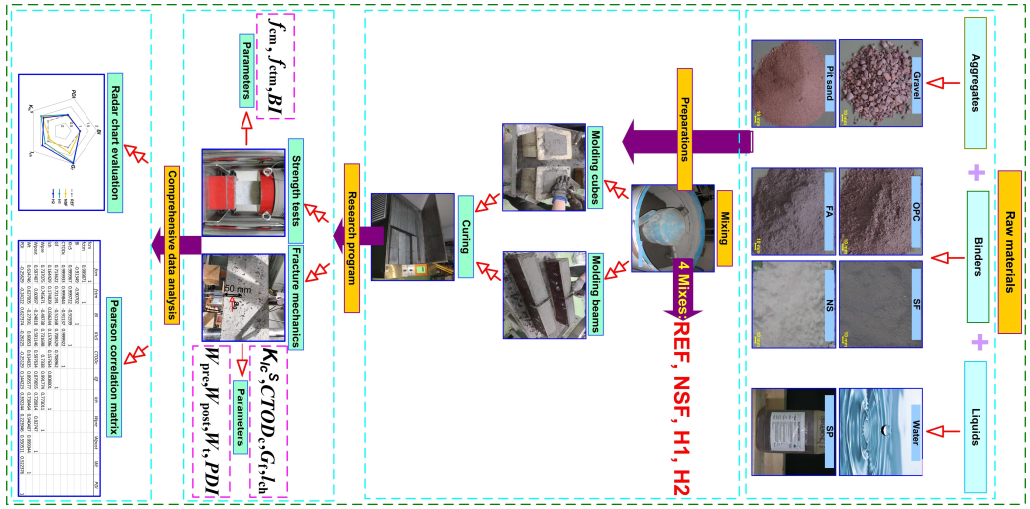
Flowchart of the experimental program: from raw materials selection (with incorporated scale bars for size reference) and specimen preparation to mechanical testing and comprehensive data analysis
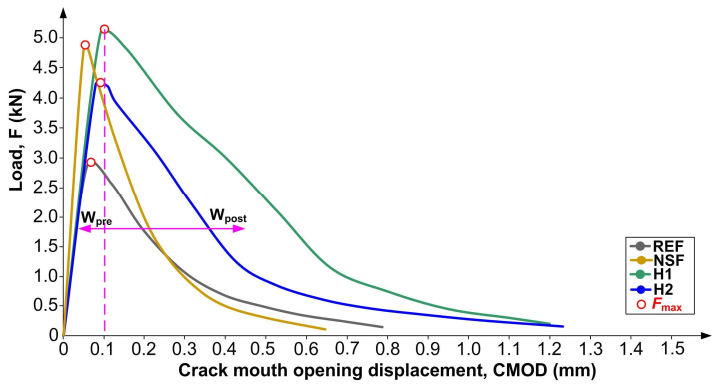
Experimental F–CMOD envelope curves illustrating the full fracture process for all concrete mixes
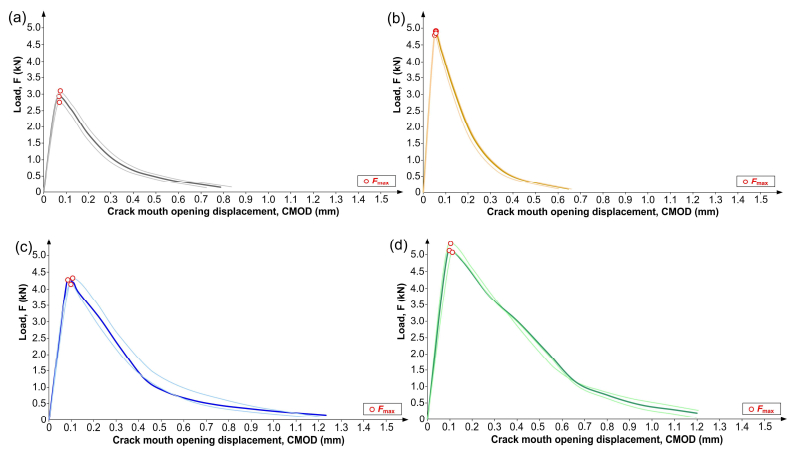
Detailed graphical representation of the Wpre and Wpost fracture work decomposition and the resulting PDI trend for the analyzed concrete mixes: (a) REF; (b) NSF; (c) H1; (d) H2
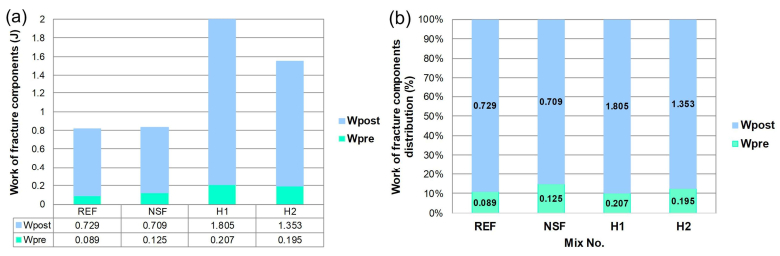
Analysis of the fracture work components for the tested concrete mixes: (a) absolute values of Wpre and Wpost fracture energy; (b) percentage distribution of the fracture work components
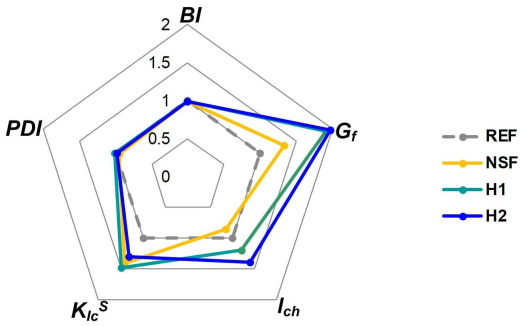
Radar chart presenting a multi-criteria evaluation of the mechanical and fracture mechanics parameters of the analyzed concrete mixes, normalized to the REF




 DownLoad: